Scotch Thistle Onopordum acanthium
Also called Cotton Thistle, Scotch Cottonthistle, Heraldic Thistle
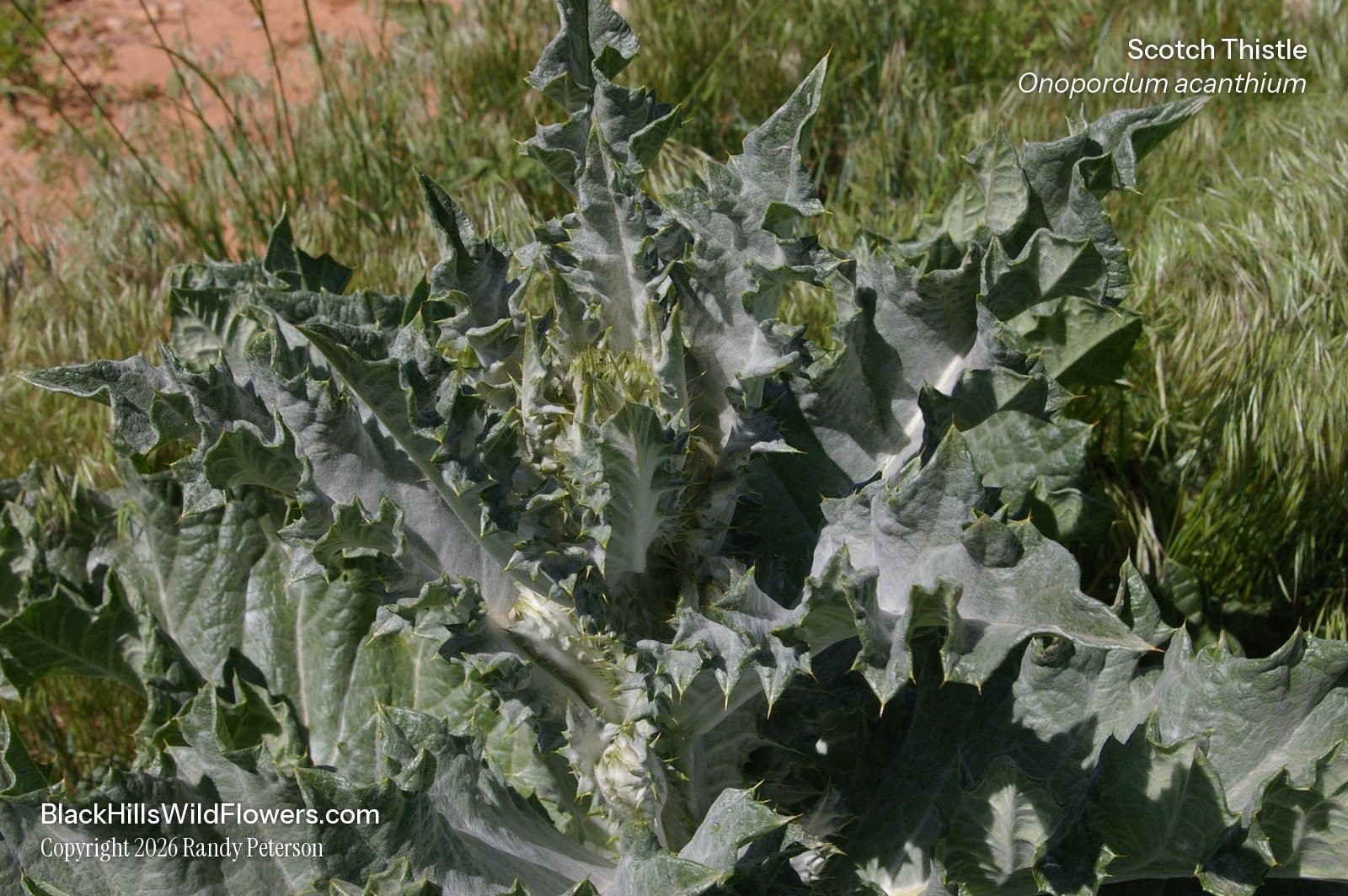
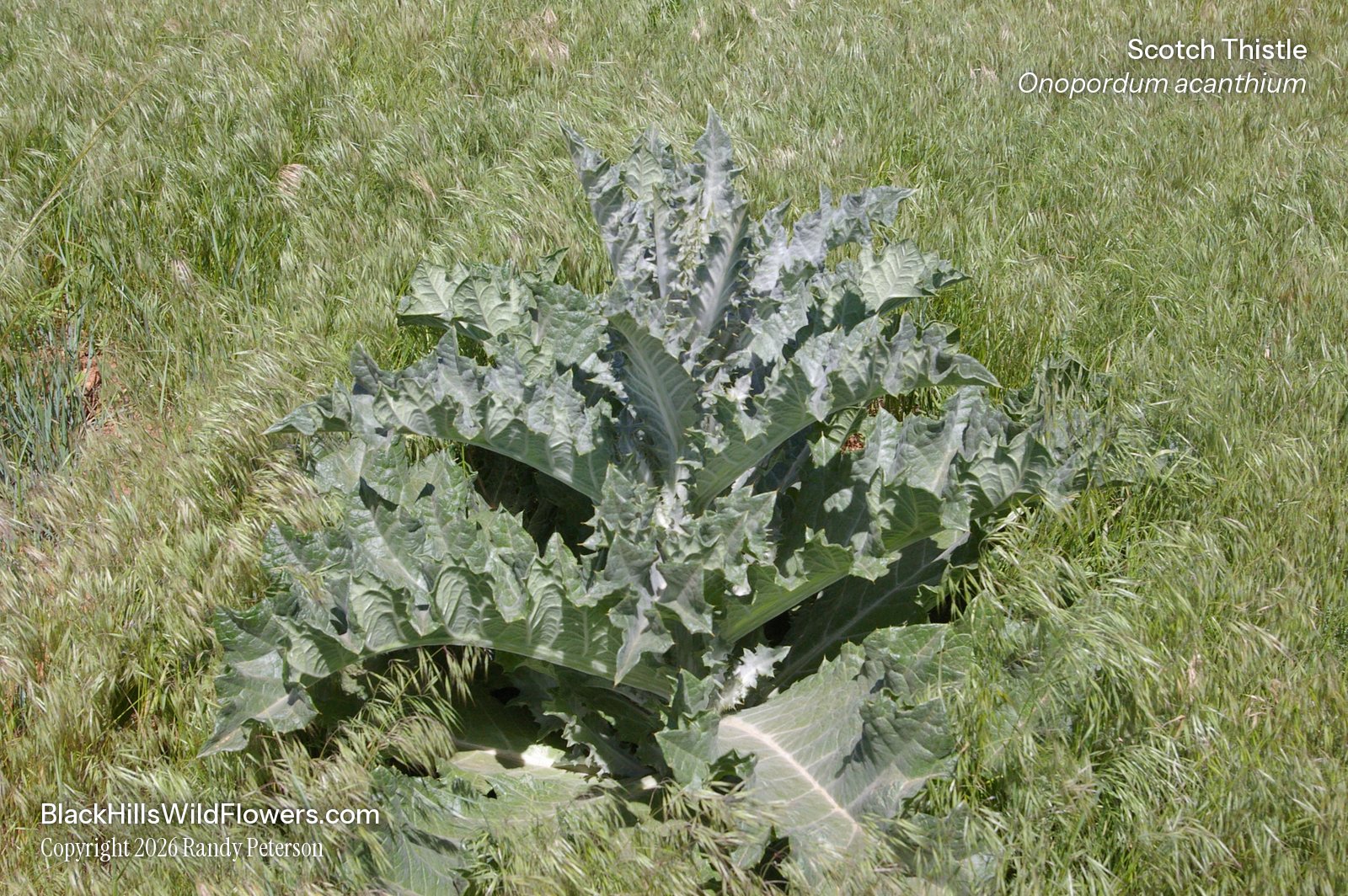
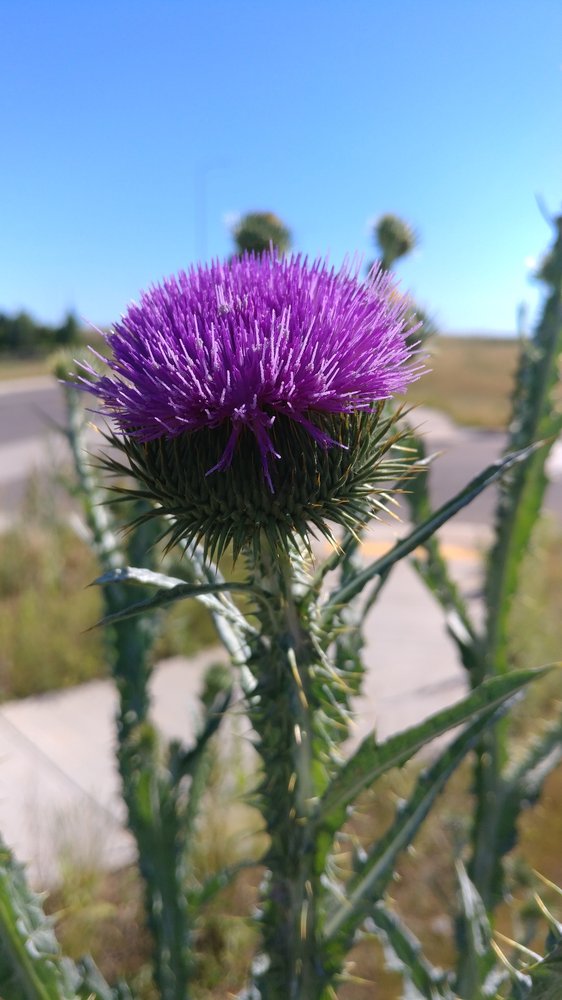
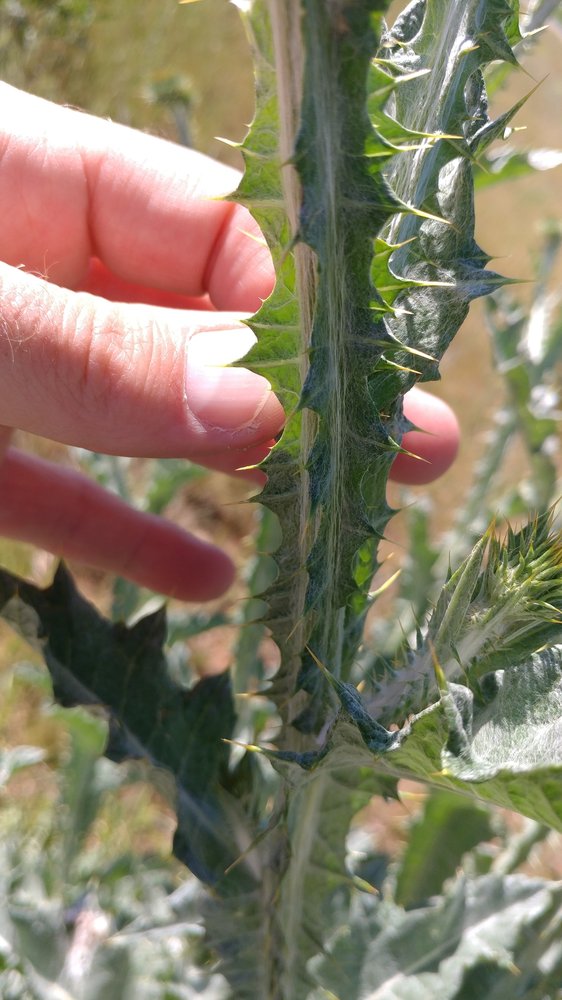
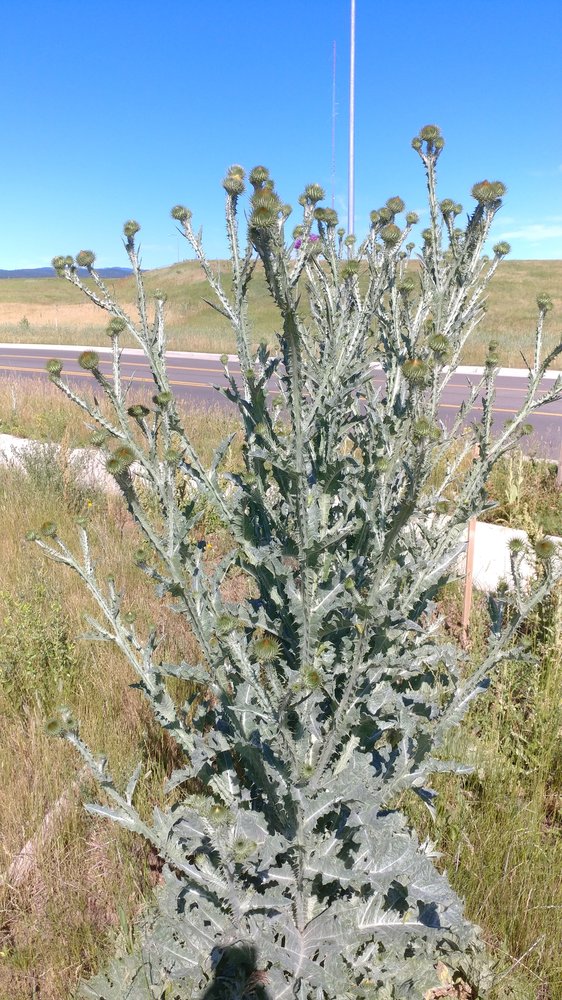
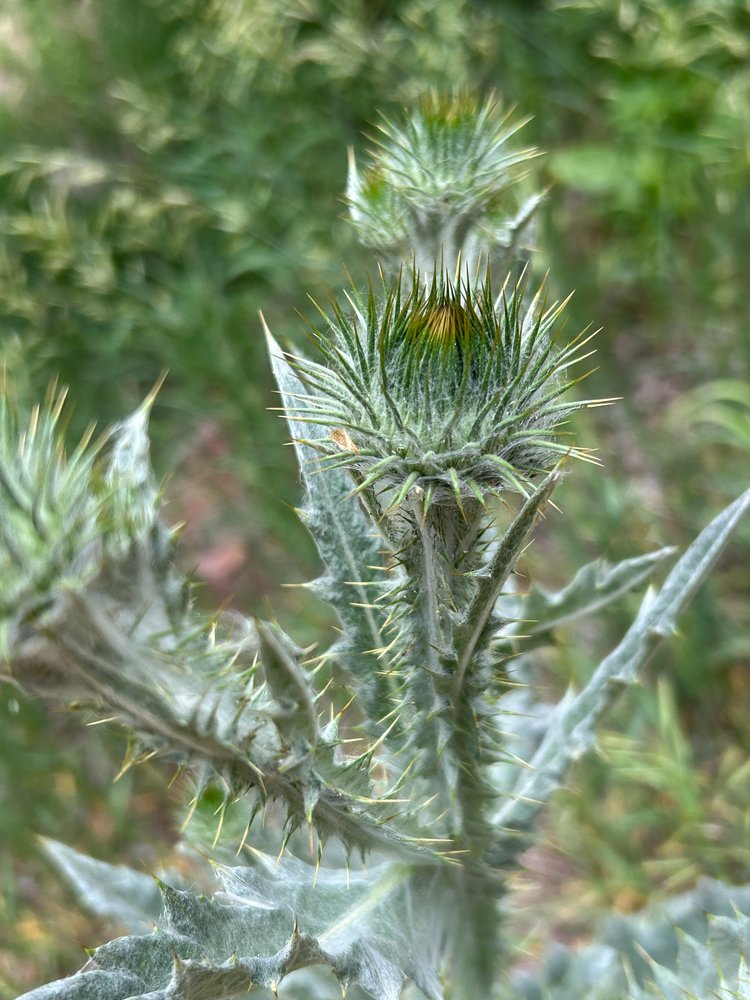
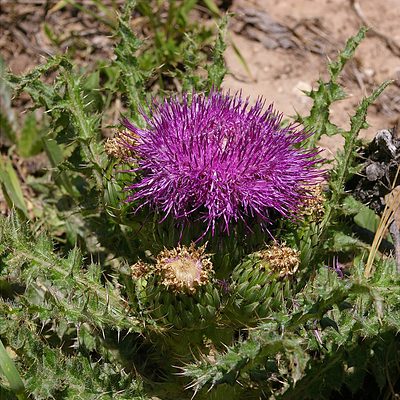
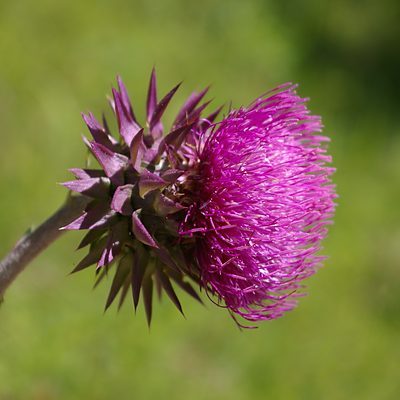
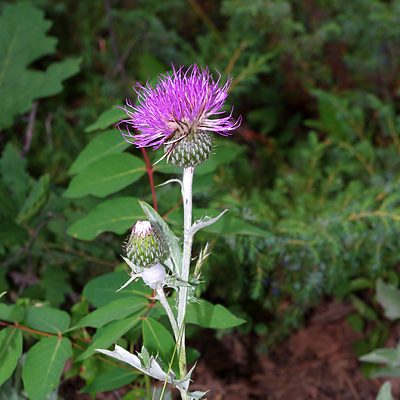
Scotch Thistle (Onopordum acanthium) is a very large thistle from Europe and Asia whose broad, spiny leaves are coated in gray-white wool, with spiny wings running up the stems and round purple heads in midsummer. It spends its first year as a big woolly rosette and bolts to as much as 4 m (13 ft) in its second. Around the Black Hills it grows in pastures, along roads and in creek bottoms, and Lawrence, Butte and Fall River counties list it as a locally noxious weed. Photographed in the Black Hills.
Free photos from other sources
| Family | Asteraceae · Aster |
|---|---|
| Status | Introduced biennial |
| Blooms | July in the Black Hills-area specimens found in flower; June to September across its range (FNA) |
| Height | 0.5–4 m (1½–13 ft) |
| Where | Pastures, rangeland, roadsides, disturbed ground and creek bottoms |
| Also called | Cotton Thistle, Scotch Cottonthistle, Heraldic Thistle |
| Listed | Locally noxious in Lawrence (2024–2028), Butte (2026–2030) and Fall River (2026–2030) counties, South Dakota, and in Harding, Hutchinson and Lake counties; not on South Dakota's state noxious weed list. A state designated noxious weed in Wyoming, and on Wyoming's prohibited noxious weed seed list (Wyo. Code R. 010-63-3). |
| Note | The Black Hills National Forest lists Scotch Thistle among invasive plants already established in the region, to be contained. |
Roots, seeds & germination
Root: A heavy taproot that can reach 30 cm (1 ft) or more deep in the first year, under the rosette.
Seed: One plant can make 8,400 to 40,000 seeds. Each is a brown to black achene 4–5 mm long, wrinkled crosswise, with a ring of pink to reddish bristles 7–9 mm long. Wind spreads them a short way, and water, livestock, wildlife and people carry them farther. Nebraska Extension says the seeds can stay alive in the soil for up to 20 years.
Germination: Most seed doesn't sprout right away. Nebraska Extension says more than 80% of it has a water-soluble coating that holds it back until moisture breaks the dormancy, and that seed sprouts best covered by soil, because light can hold it back; a Washington weed board review instead found that most seed sprouts under alternating light and dark. Seeds usually sprout in late fall. Seedlings from late fall grow as true biennials, and those from late summer or early fall can behave as annuals.
How do you identify Scotch Thistle?
In its first year look for a rosette of very broad, blue-gray, woolly leaves whose edges are cut into short, broad, triangular, spine-tipped lobes; a big rosette can reach 1.5 m (5 ft) across. In the second year a stout stem bolts, with spiny, ribbon-like wings up to 15 mm wide that run all the way up to the flower heads. The leaves reach 60 cm (2 ft) long and are thickly woolly, especially underneath. The round heads, 2–5 cm (1–2 in) across, sit 2 or 3 together at the branch tips, with purple or white florets above narrow, spine-tipped bracts. Utah State University Extension notes that its leaves are wider, with shorter lobes and a lighter color, than those of Bull Thistle and Musk Thistle; its heads stay upright, where Musk Thistle's often nod; and its spiny bracts stay green, while Musk Thistle's take on the color of the flower.
When does it bloom?
July in the Black Hills-area specimens found in flower; June to September across its range (FNA).
Where does it grow?
Pastures, rangeland, roadsides, ditches and other disturbed ground, and creek bottoms; it moves in fastest on disturbed ground dominated by annual plants such as cheatgrass. SDSU lists it on pasture, range and disturbed sites in the southwest part of South Dakota. The National Park Service lists it at Wind Cave and Devils Tower, and herbarium specimens from Crook County, Wyoming, describe dry grassland hills near Devils Tower, where it was a common roadside weed in 1960, and a cottonwood and boxelder terrace along a creek; a 2013 Butte County specimen came from a river floodplain terrace.
Other thistles in this guide
Aster family (Asteraceae): 62 other plants in this guide
- Aromatic Aster
- Arrowleaf Balsamroot
- Arrowleaf Sweet Coltsfoot
- Bachelor's Button
- Balsam Ragwort
- Black-eyed Susan
- Blanket Flower
- Blue Lettuce
- Broom Snakeweed
- Bull Thistle
- Canada Hawkweed
- Canada Lettuce
- Canada Thistle
- Chicory
- Common Burdock
- Common Dandelion
- Common Sunflower
- Common Tansy
- Common Yarrow
- Curlycup Gumweed
- Cutleaf Coneflower
- Dotted Gayfeather
- Drummond's Thistle
- Easter Daisy
- False Boneset
- Fetid Marigold
- Field Pussytoes
- Fringed Sagewort
- Hairy Golden Aster
- Heart-leaved Arnica
- Hooker's Townsend Daisy
- Horseweed
- Jerusalem Artichoke
- Lambstongue Groundsel
- Maximilian Sunflower
- Missouri Goldenrod
- Mountain Dandelion
- Musk Thistle
- Oxeye Daisy
- Pearly Everlasting
- Pineapple Weed
- Prairie Coneflower
- Prairie False Dandelion
- Purple Coneflower
- Rocky Mountain Blazing Star
- Rosy Pussytoes
- Rubber Rabbitbrush
- Rush Skeletonplant
- Silver Sagebrush
- Smooth Blue Aster
- Spotted Joe-Pye Weed
- Stemless Four-nerve Daisy
- Stiff Goldenrod
- Stiff Sunflower
- Threenerve Fleabane
- Wavyleaf Thistle
- Western Ragweed
- White Hawkweed
- White Prairie Aster
- White Sagebrush
- Woolly Groundsel
- Yellow Salsify
Sources: Flora of North America Vol. 19-21: Onopordum acanthium subsp. acanthium, eFloras; Flora of North America Vol. 19-21: genus Onopordum (Cotton thistle), eFloras; Utah State University Extension: Identification and Management of Scotch Thistle in Pastures, Rangelands, and Non-Crop Settings; Nebraska Extension CropWatch (2019): Invasive Scotch Thistle Weed has Staying Power; SDSU Extension, Noxious Weeds of South Dakota, Extension Special Series 34 (revised 2010); Washington State Noxious Weed Control Board: Written findings, Onopordum acanthium; USDA PLANTS Database: Onopordum acanthium, Scotch cottonthistle (ONAC); South Dakota DANR: Locally Noxious Weed Pest List (county designations and expiry years); South Dakota DANR: State Noxious Weeds; Wyoming Weed and Pest Council: State Designated Weed List; Wyoming Department of Agriculture rules, Chapter 63: Prohibited Noxious Weeds, 010-63 Wyo. Code R. § 63-3 (Cornell LII); Black Hills National Forest: Invasive plants species accounts; NPSpecies checklist, Wind Cave National Park vascular plants; NPSpecies checklist, Devils Tower National Monument vascular plants; GBIF occurrence search: Onopordum acanthium herbarium specimens, South Dakota and Wyoming; GBIF specimen 4073703870: Crook County, WY, 1960, dry grassland hills, common roadside weed; GBIF specimen 4929632453: Crook County, WY, 1992, cottonwood and boxelder alluvial terrace; GBIF specimen 1927942778: Butte County, SD, 2013, river floodplain terrace.