Common Burdock Arctium minus
Also called Lesser Burdock, Wild Rhubarb, waȟpé tȟáŋka (Lakota)
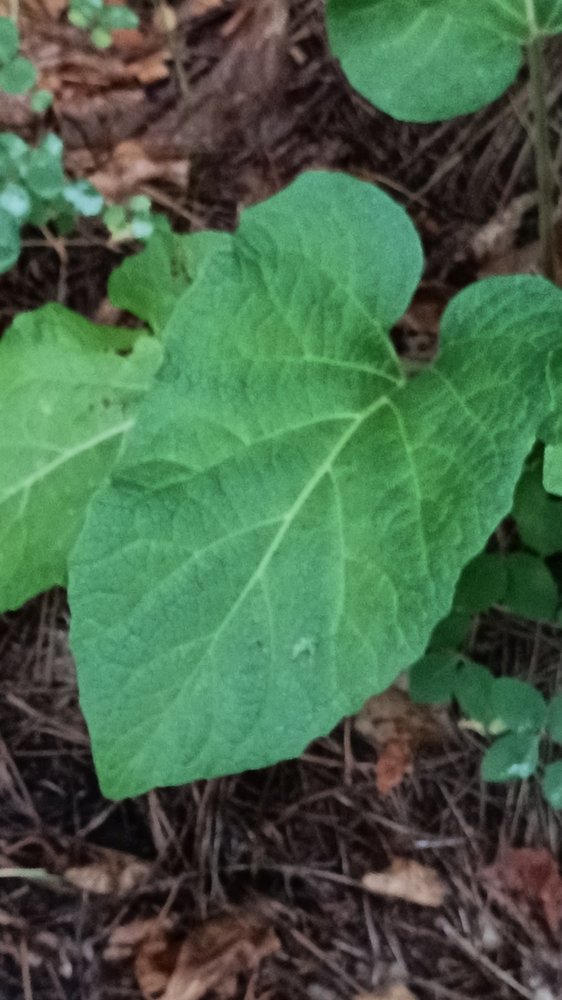
Common Burdock (Arctium minus) is an introduced biennial of the aster family with very large, wavy, heart-shaped leaves and round, bur-like heads of pink-purple flowers from July into September. It grows on roadsides, creek banks and disturbed ground, and in the Black Hills its herbarium specimens come mostly from Lawrence County.
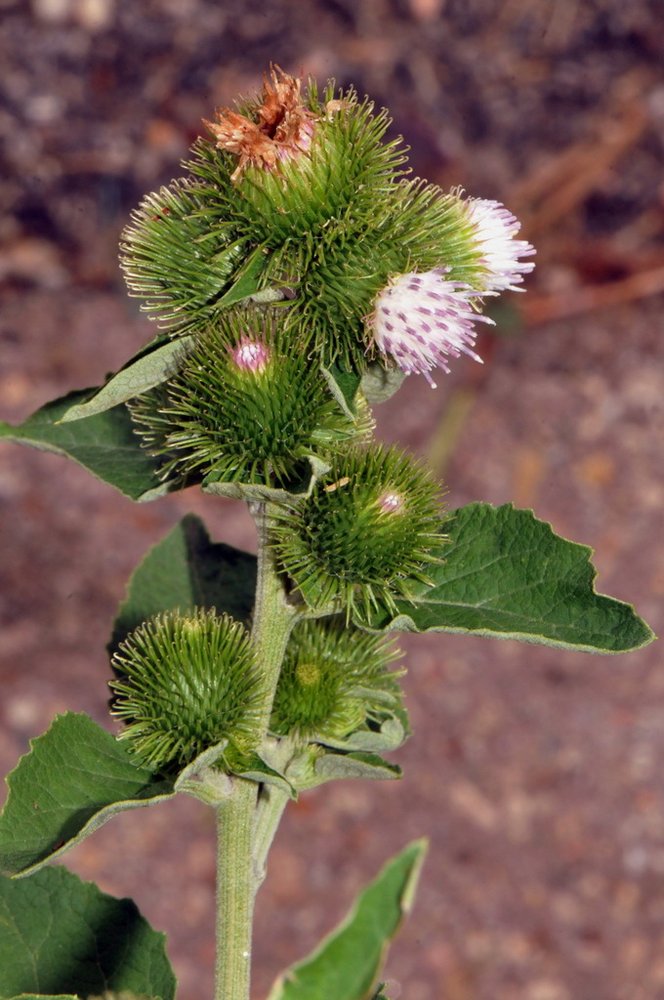
Free photos from other sources
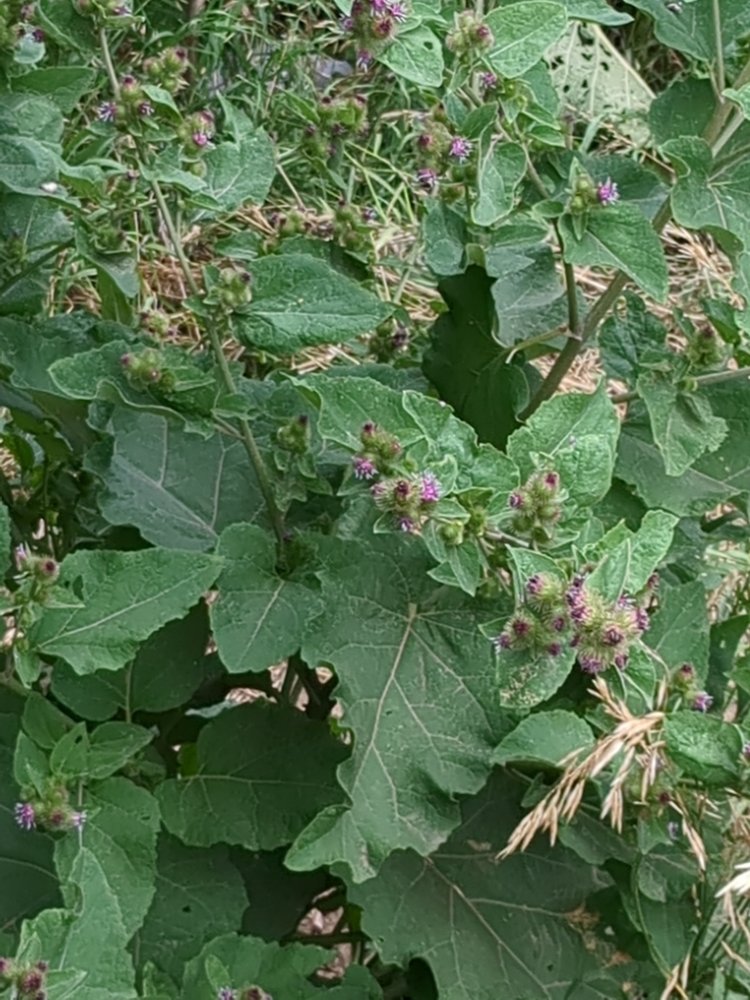
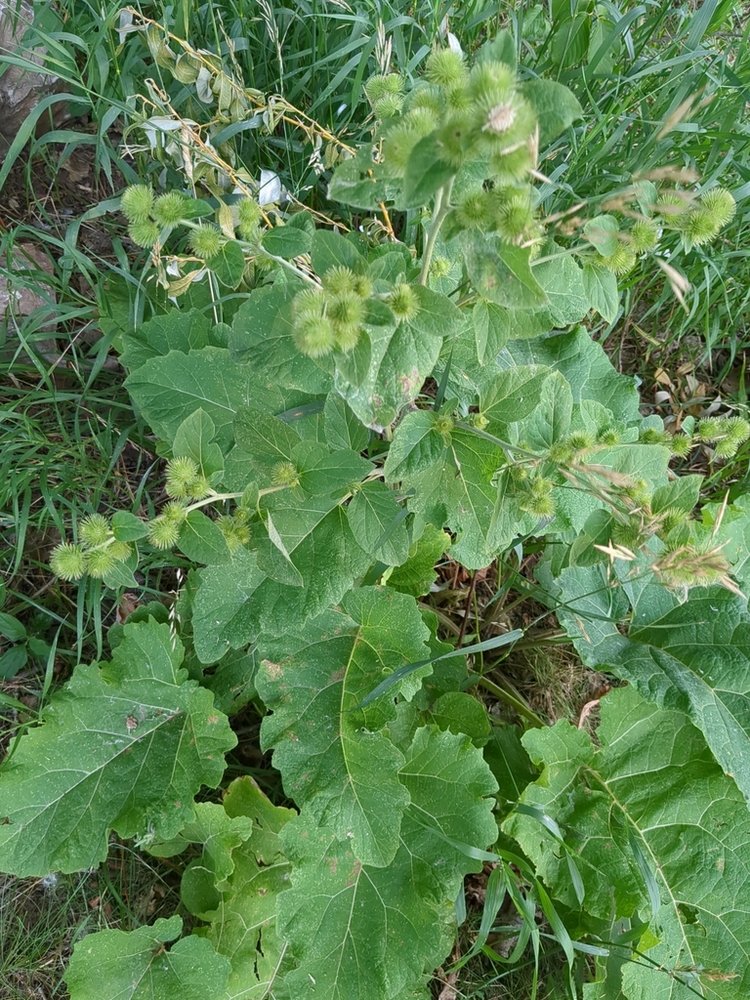
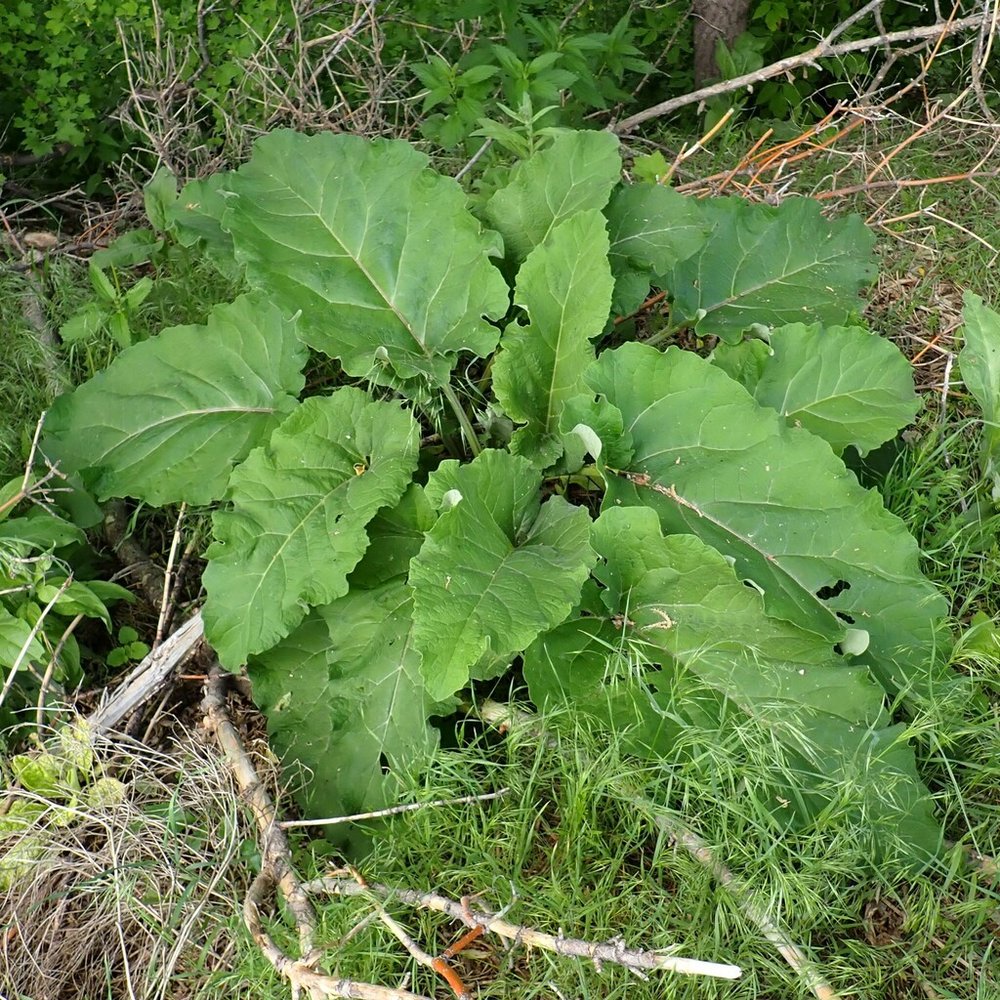
| Family | Asteraceae · Aster |
|---|---|
| Status | Introduced biennial |
| Blooms | July into September |
| Height | 50–300 cm (20–120 in) |
| Where | Roadsides, creek banks, waste ground, fields and forest clearings |
| Also called | Lesser Burdock, Wild Rhubarb, waȟpé tȟáŋka (Lakota) |
| Synonym | Lappa minor |
| Listed | State designated noxious weed in Wyoming (Wyoming Weed & Pest Council list). Not on South Dakota's state noxious weed list; locally noxious in Butte and Harding counties, SD, and several other counties, none of them Lawrence, Pennington, Custer, Meade or Fall River. |
| Toxicity | NC State Extension says the burs and bristles may cause severe eye, skin or respiratory problems in people, dogs, horses and other livestock. |
| Food use | Utah State University Extension says the root is edible raw or cooked, with the best roots from young plants, and that young leaves and leaf stems are edible and have been used as a potherb. NC State Extension says the plant is grown in Asia for its edible roots and stems. |
| Traditional use | Black Elk and Flying By's 1998 list of culturally important plants gives the Lakota name waȟpé tȟáŋka for burdock and records the young shoots and tender roots as eaten raw or cooked and a decoction of the roots as used as a blood tonic. Gilmore's 1919 account records that White Horse of the Omaha, passing on what he had learned from the Oto, described a decoction of the root as a remedy for pleurisy. Moerman's database records that the Potawatomi took an infusion of the root as a blood purifier and general tonic (Smith 1933) and that the Mohegan used a poultice of the leaves for rheumatic pains (Tantaquidgeon 1972). |
Traditional use: first drafted by Google AI, then checked against the sources on this page.
Roots, seeds & germination
Root: A large, fleshy taproot, which Minnesota Wildflowers says does not respond well to herbicide.
Seed: The seeds are dark brown to blackish with darker spots, 5–8 mm (about ¼ in) long, with a tuft of short bristles that falls off as the seed dries. At maturity the bracts of the head dry stiff and brown, and their hooks cling to clothing and fur, spreading the seed. Minnesota Wildflowers says the plant keeps a persistent seed bank.
How do you identify Common Burdock?
Look for a tall, much-branched biennial, 50–300 cm (20–120 in), with huge basal leaves 30–60 cm (1–2 ft) long that are heart-shaped at the base, wavy-edged and borne on hollow stalks; the leaves shrink and lose their stalks higher up the stem. The first-year plant is just a rosette of these leaves. Flower heads sit in loose sprays at the branch tips and leaf axils, short-stalked to nearly stalkless, each with 20–40 pink-purple florets inside a ball of narrow green bracts that end in tiny hooks and dry into the burs. Minnesota Wildflowers notes the leaves are similar in size and shape to rhubarb leaves. Flora of North America tells it from Woolly Burdock (Arctium tomentosum), which it reports from South Dakota, by the heads: Woolly Burdock usually has long-stalked heads in a flat-topped cluster, very densely cobwebby bracts and florets with minute glandular hairs.
When does it bloom?
July into September.
Where does it grow?
Waste places, roadsides, fields and forest clearings up to 2,200 m (7,200 ft), says Flora of North America. Black Hills herbarium specimens, 29 from Lawrence County, 3 from Pennington County and 3 from Crook County, Wyoming, were collected from 1933 to 2009, July to October, along creek banks, at picnic areas and roadsides, and in yards, alleys and parks. The 2009 Crook County specimen came from a disturbed opening under ponderosa pine and paper birch.
Aster family (Asteraceae): 62 other plants in this guide
- Aromatic Aster
- Arrowleaf Balsamroot
- Arrowleaf Sweet Coltsfoot
- Bachelor's Button
- Balsam Ragwort
- Black-eyed Susan
- Blanket Flower
- Blue Lettuce
- Broom Snakeweed
- Bull Thistle
- Canada Hawkweed
- Canada Lettuce
- Canada Thistle
- Chicory
- Common Dandelion
- Common Sunflower
- Common Tansy
- Common Yarrow
- Curlycup Gumweed
- Cutleaf Coneflower
- Dotted Gayfeather
- Drummond's Thistle
- Easter Daisy
- False Boneset
- Fetid Marigold
- Field Pussytoes
- Fringed Sagewort
- Hairy Golden Aster
- Heart-leaved Arnica
- Hooker's Townsend Daisy
- Horseweed
- Jerusalem Artichoke
- Lambstongue Groundsel
- Maximilian Sunflower
- Missouri Goldenrod
- Mountain Dandelion
- Musk Thistle
- Oxeye Daisy
- Pearly Everlasting
- Pineapple Weed
- Prairie Coneflower
- Prairie False Dandelion
- Purple Coneflower
- Rocky Mountain Blazing Star
- Rosy Pussytoes
- Rubber Rabbitbrush
- Rush Skeletonplant
- Scotch Thistle
- Silver Sagebrush
- Smooth Blue Aster
- Spotted Joe-Pye Weed
- Stemless Four-nerve Daisy
- Stiff Goldenrod
- Stiff Sunflower
- Threenerve Fleabane
- Wavyleaf Thistle
- Western Ragweed
- White Hawkweed
- White Prairie Aster
- White Sagebrush
- Woolly Groundsel
- Yellow Salsify
Sources: Minnesota Wildflowers: Arctium minus (Common Burdock); Flora of North America Vol. 19: Arctium minus (D. J. Keil), eFloras; Flora of North America Vol. 19: genus Arctium, eFloras; Flora of North America Vol. 19: Arctium tomentosum, eFloras; USDA PLANTS Database: Arctium minus (ARMI2); Wyoming Weed and Pest Council: State Designated Weed List; South Dakota Department of Agriculture and Natural Resources: State Noxious Weed and Pest List; South Dakota Locally Noxious Weed and Pest List (updated 2024); Utah State University Extension: Range Plants of Utah, Burdock; NC State Extension Plant Toolbox: Arctium minus; Native American Ethnobotany Database (BRIT): Arctium minus; Culturally Important Plants of the Lakota (Black Elk and Flying By, 1998), entry 25; Gilmore 1919, Uses of Plants by the Indians of the Missouri River Region, p. 135; GBIF specimen 2512329857 (Lawrence County, SD, 2009; creek riparian zone); GBIF specimen 2512331601 (Crook County, WY, 2009; disturbed opening under pine and birch); GBIF occurrence search: Arctium minus, preserved specimens, South Dakota and Wyoming.