Musk Thistle Carduus nutans
Also called Nodding Thistle, Nodding Plumeless Thistle
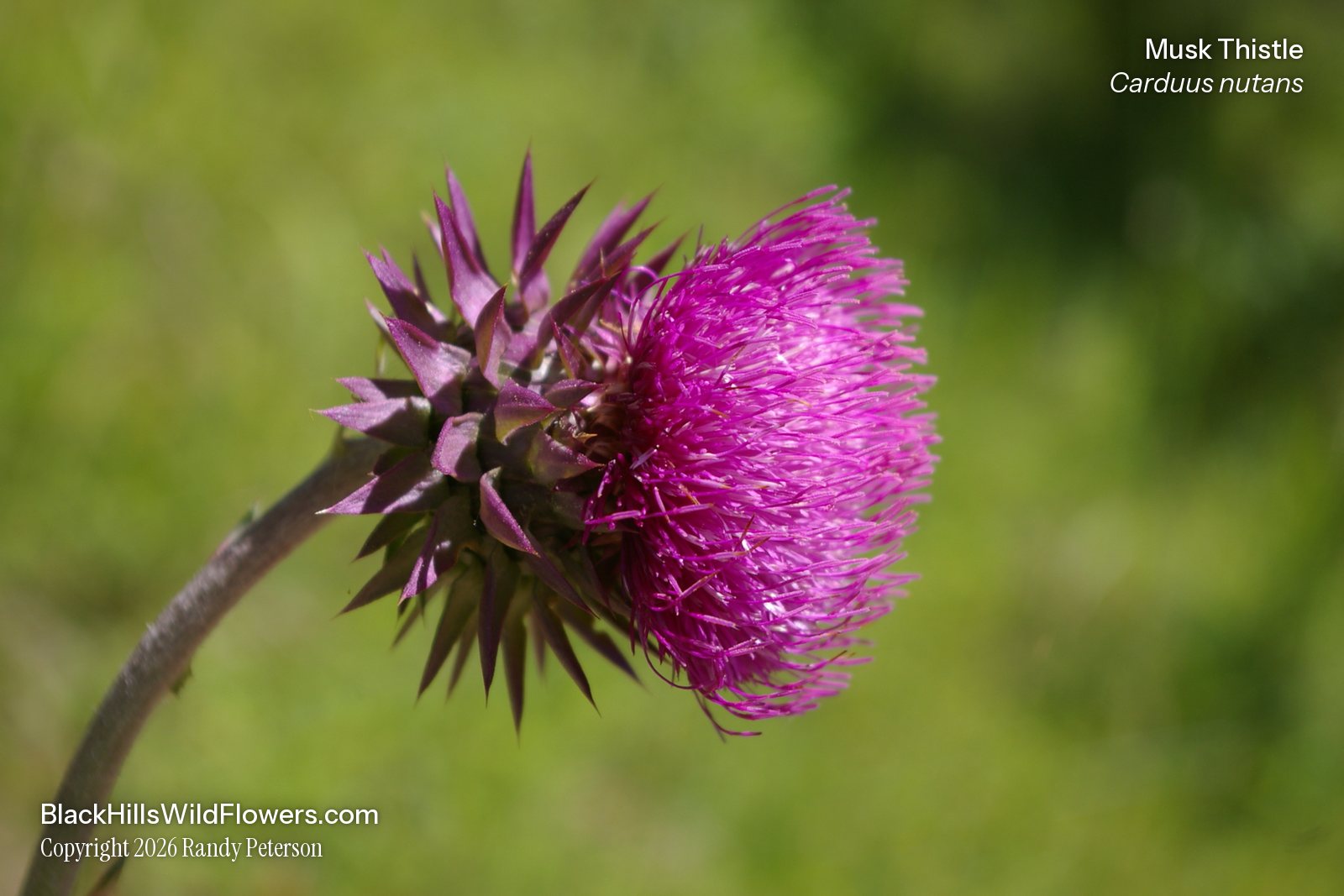
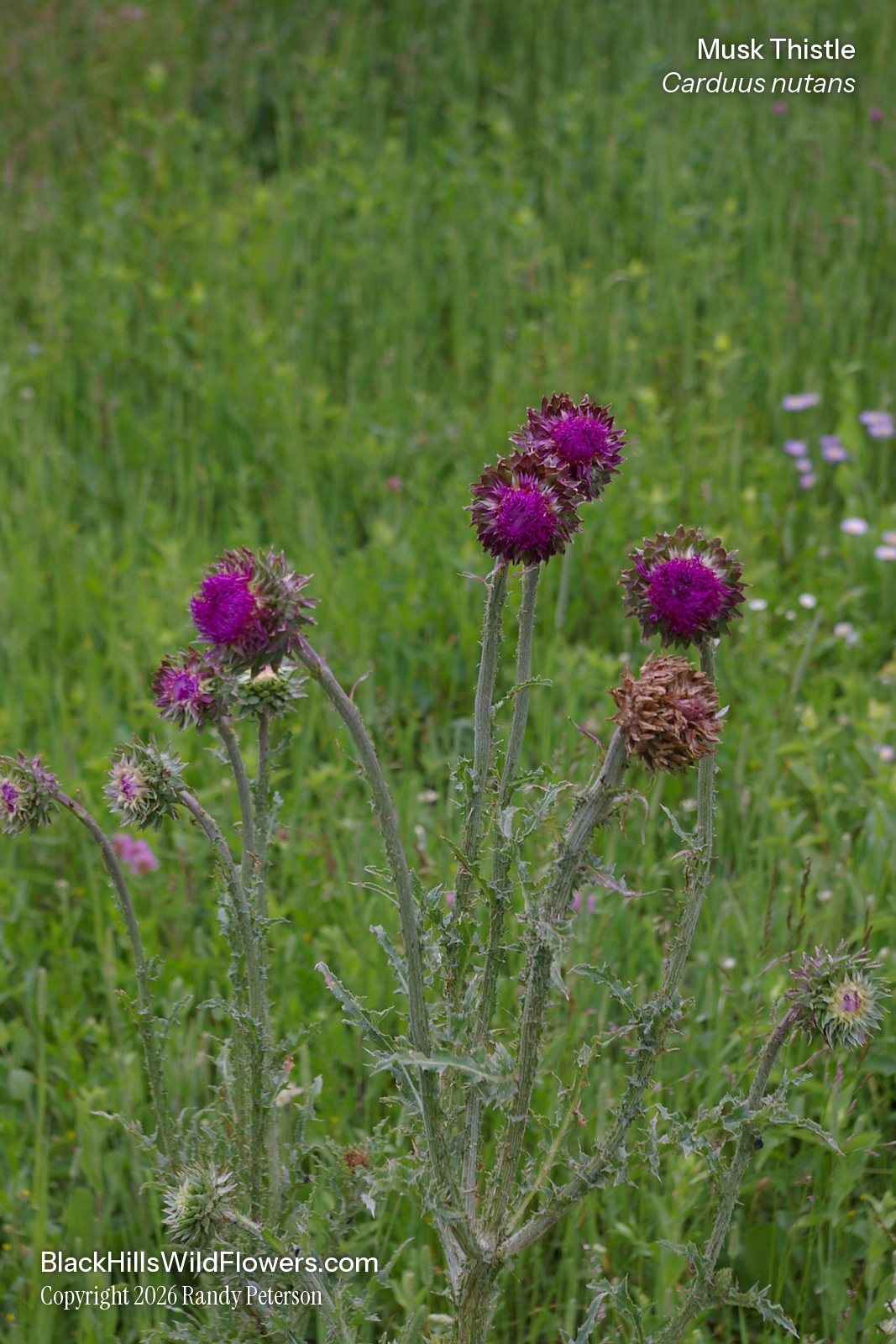
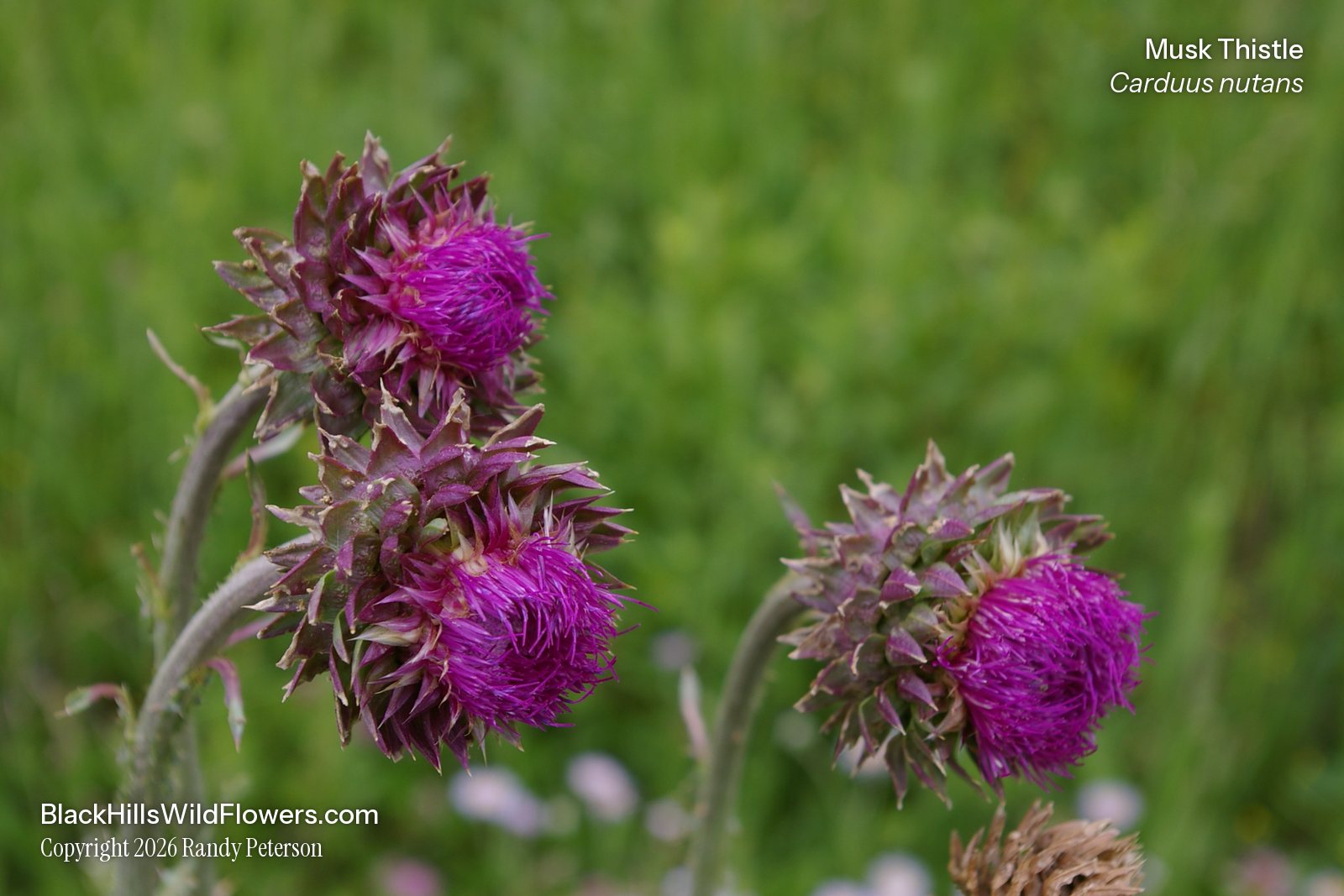
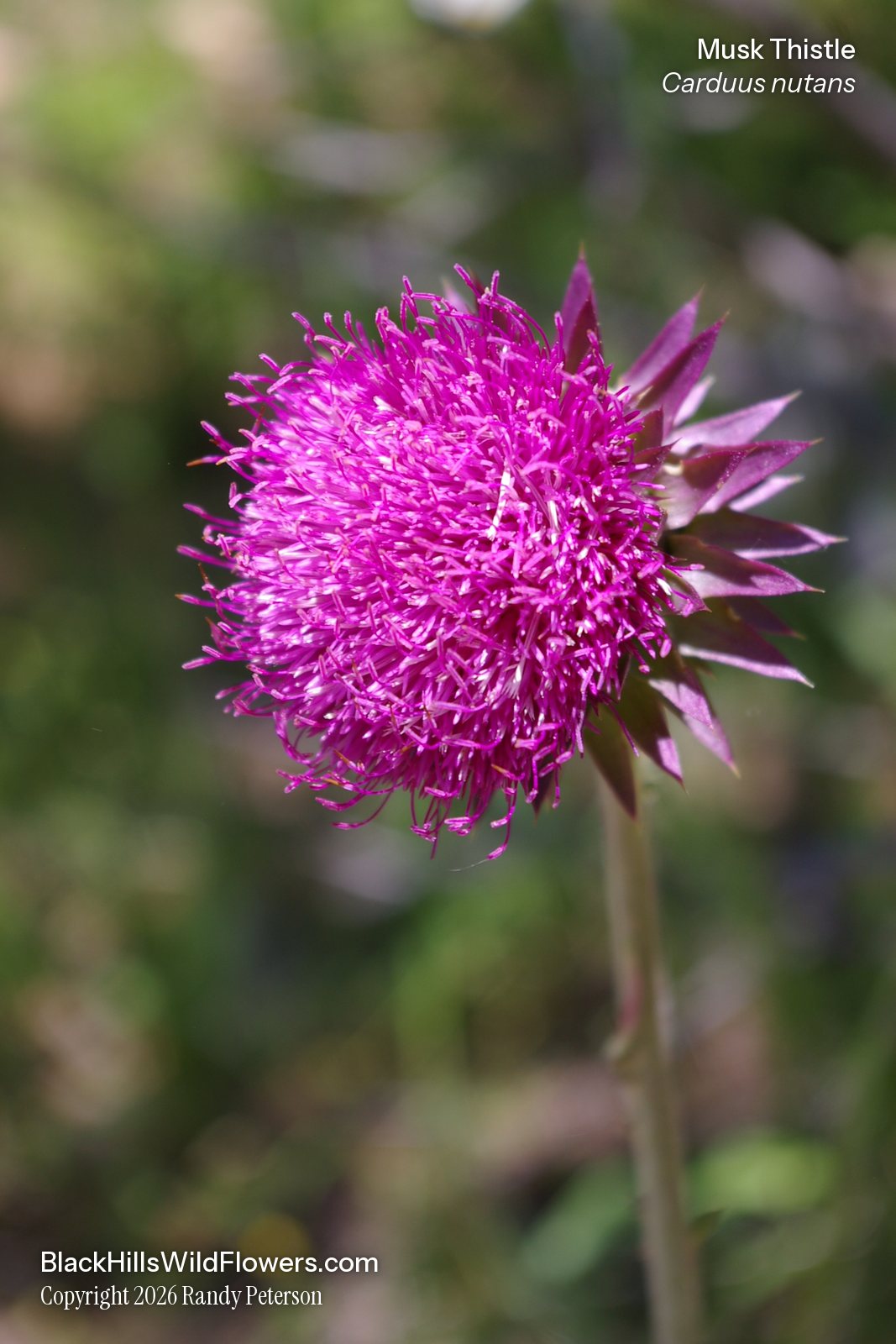
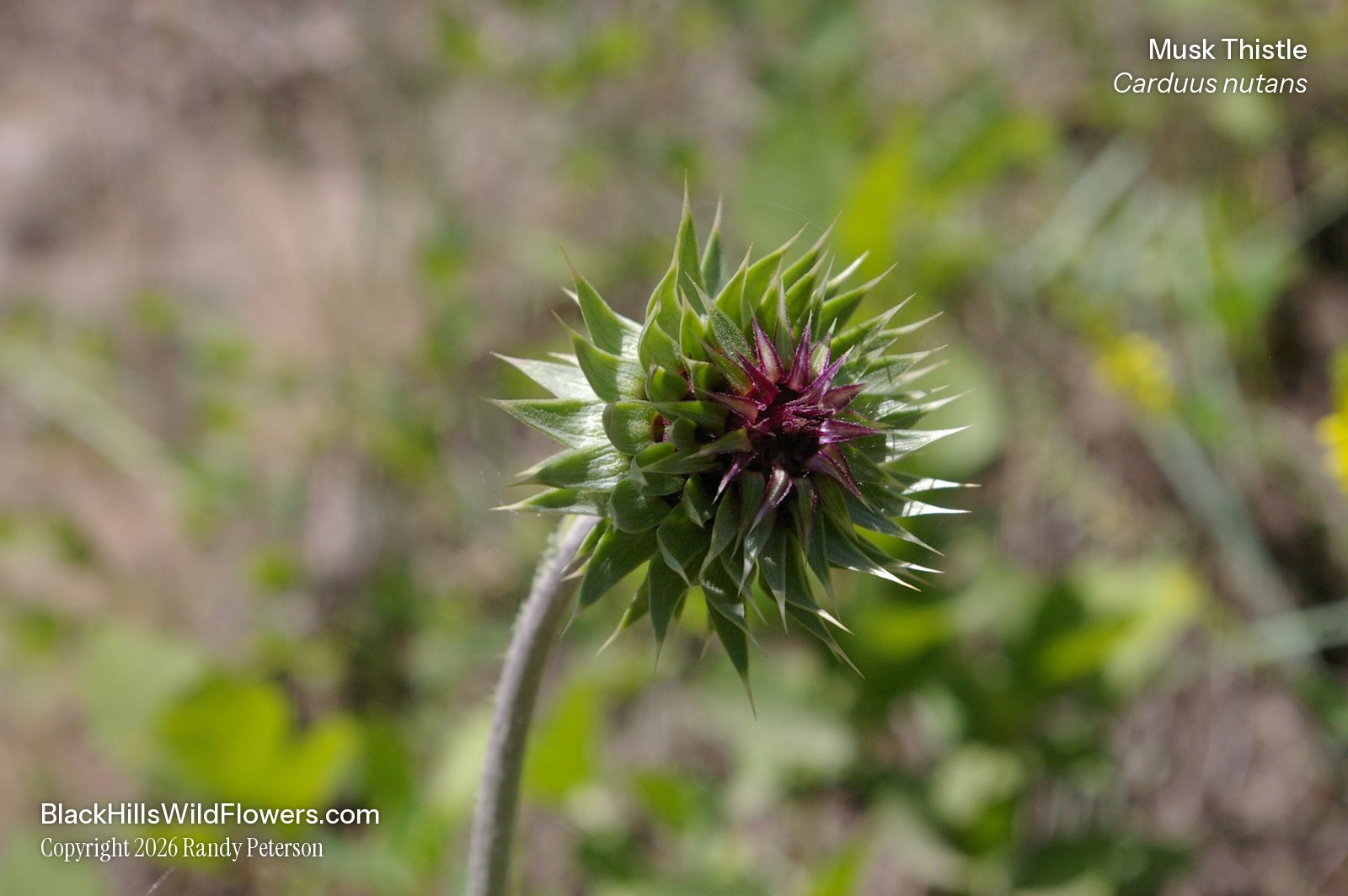
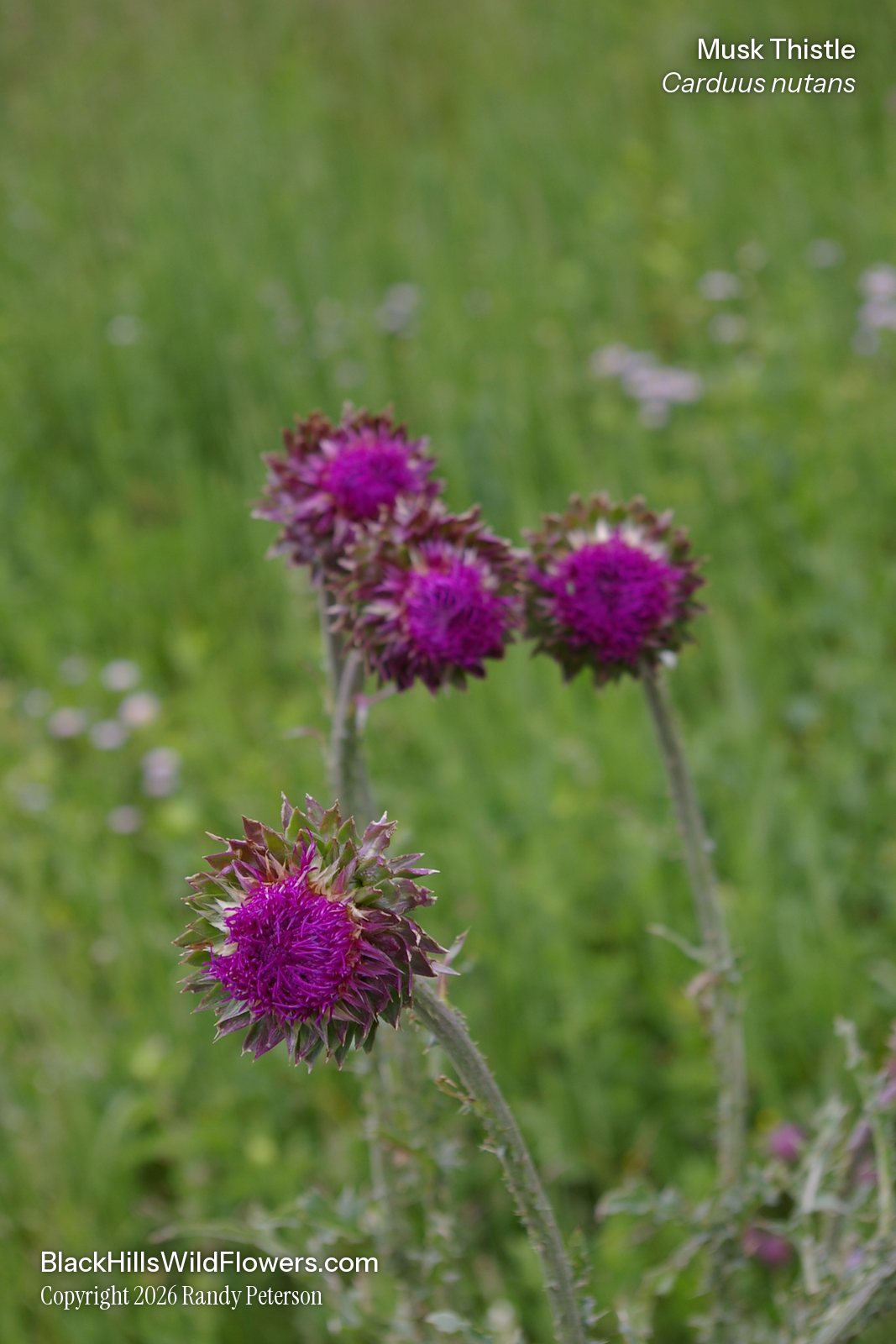
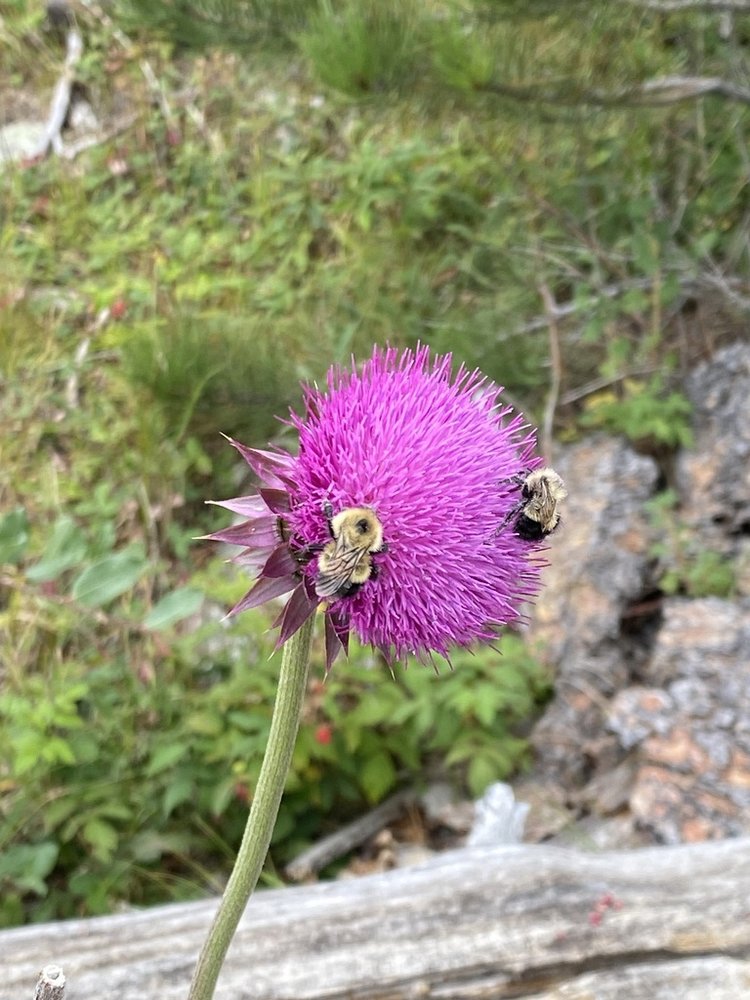
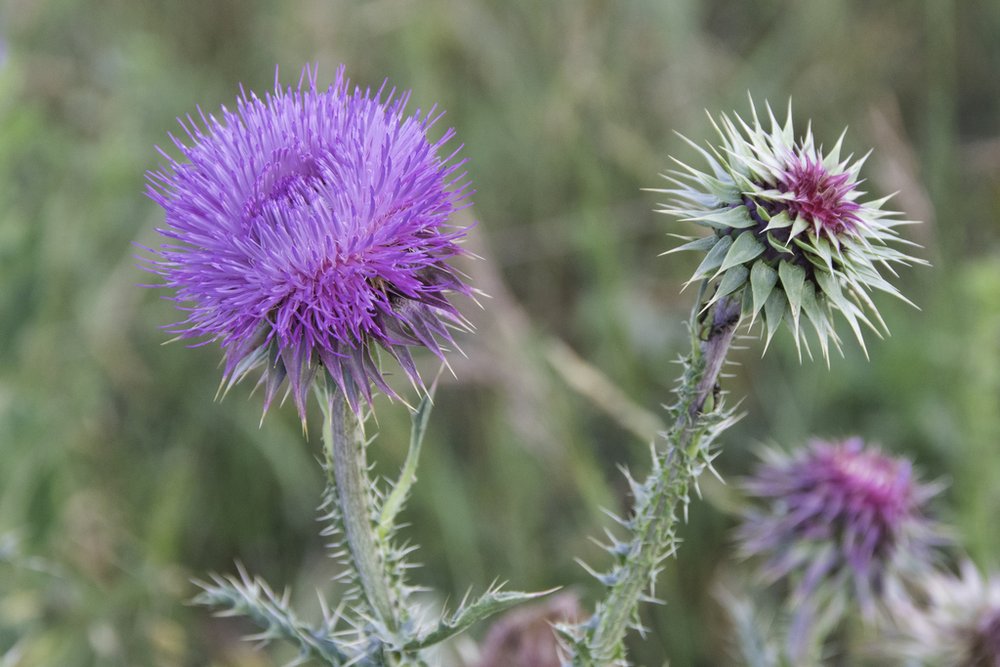
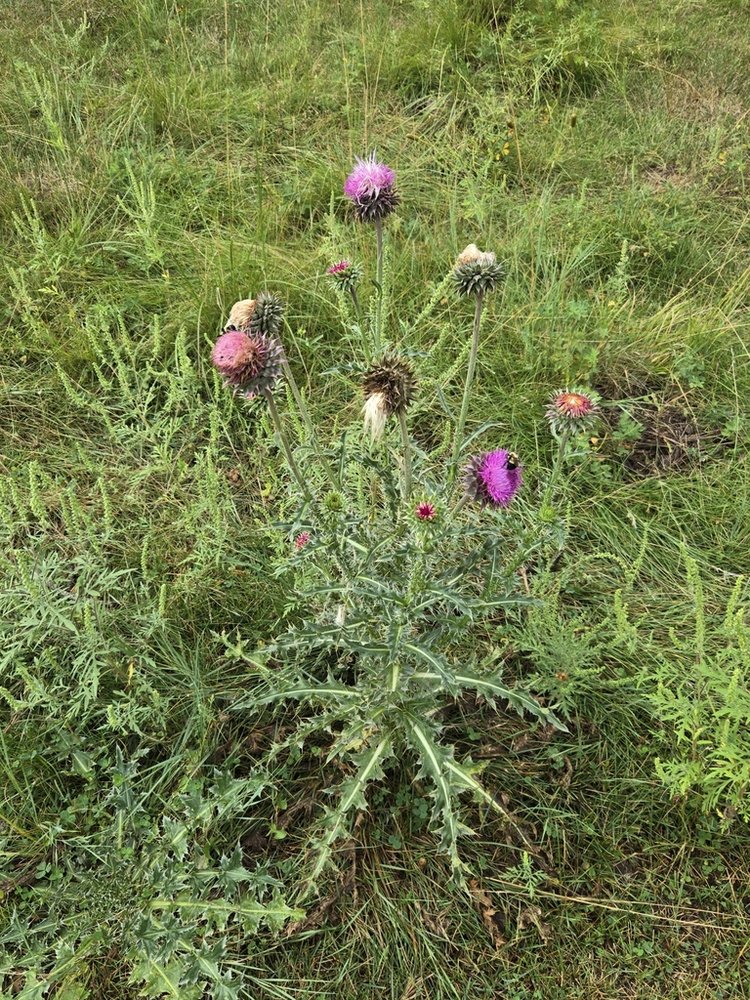
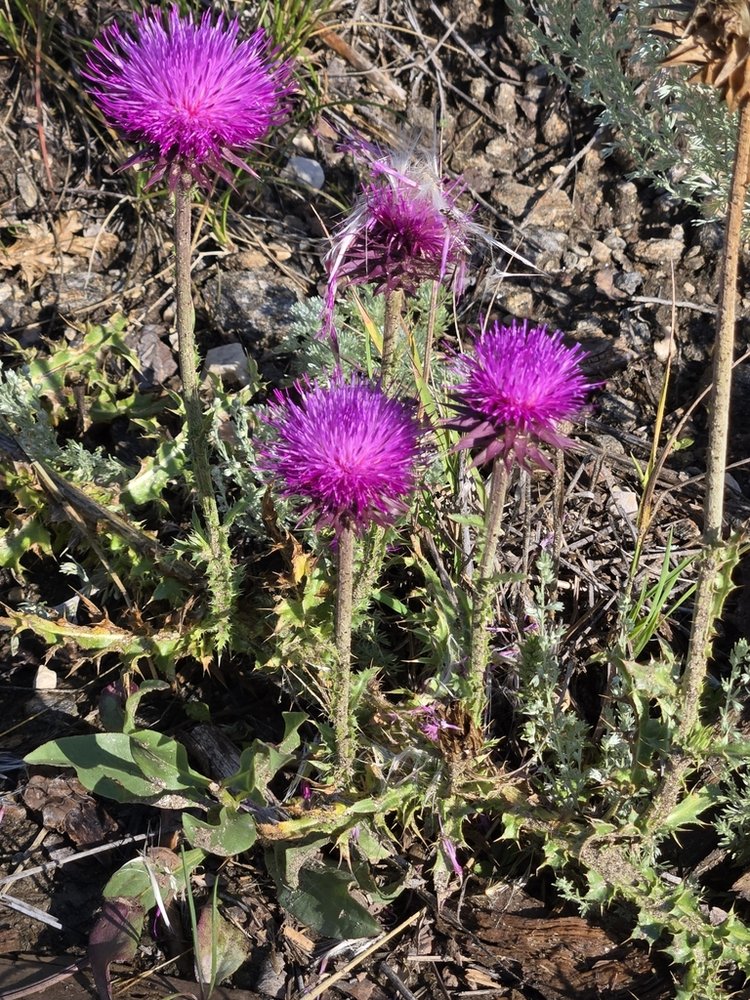
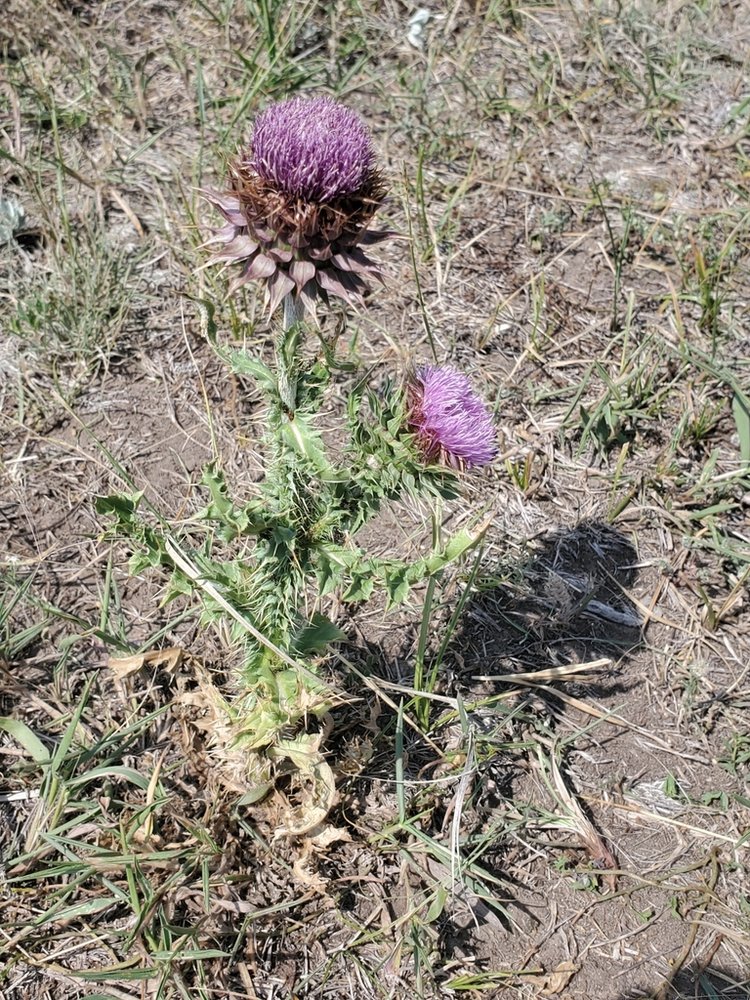
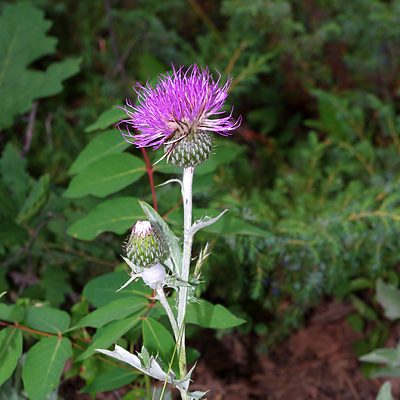
Musk Thistle (Carduus nutans), also called Nodding Thistle, is an introduced biennial weed with big rose-purple heads, 4–8 cm (1½–3 in) across, that often nod on a long, curved stalk above a ring of broad, spine-tipped bracts. It blooms from June into September in pastures, rangeland, roadsides and disturbed ground. The Black Hills National Forest calls it widespread on the Forest, and it is a listed noxious weed in some Black Hills counties and in Wyoming. Photographed in the Black Hills.
Free photos from other sources
| Family | Asteraceae · Aster |
|---|---|
| Status | Introduced biennial, sometimes annual |
| Blooms | June into September |
| Height | 40–200 cm (16–79 in) |
| Where | Pastures, rangeland, roadsides, fields and disturbed ground, along creeks and stock ponds |
| Also called | Nodding Thistle, Nodding Plumeless Thistle |
| Synonym | Carduus thoermeri, Carduus macrocephalus, Carduus nutans subsp. leiophyllus, Carduus nutans subsp. macrocephalus |
| Listed | Locally noxious in Custer (2024–2028), Fall River (2024–2028) and Butte (2026–2030) counties, South Dakota, listed as Musk & Plumeless Thistles; not on South Dakota's state noxious weed list. A state designated noxious weed in Wyoming, and on Wyoming's prohibited noxious weed seed list (Wyo. Code R. 010-63-3). |
| Note | Native to Europe and Asia. The Black Hills National Forest ranks it Class C: established and widespread. |
Roots, seeds & germination
Root: A rosette has many small roots in the fall and grows a large, fleshy taproot in spring that is hollow near the soil surface. Buds on the root crown and upper root can sprout if the plant is damaged.
Seed: The first heads to open are the top ones, and they are the largest; lower branches add more heads later. The florets in each head open from the edge inward. Each fruit is 4–5 mm long, golden to brown, with a tuft of bristles 13–25 mm (½–1 in) long. In one study, large top heads averaged 535 seeds and smaller heads midway up the stem 298, and a single uncrowded plant carried 643 heads; the Black Hills National Forest says one plant can make over 100,000 seeds in a season. Fewer than 5 percent of seeds stay attached to the bristle tuft when it blows off, so most seed lands near the parent, and wet seed coats turn sticky, which lets seeds stick to moving objects. Seeds may stay viable in the soil 10 to 15 years or more.
Germination: Seeds sprout in spring and fall, usually within 14 to 21 days of shedding, though other studies find a period of dormancy. Most seedlings come up in fall, and seed collected in September averaged 81 percent germination in moist sand in a greenhouse. The plant spends about 90 percent of its life as a rosette before it bolts, flowers, seeds and dies.
How do you identify Musk Thistle?
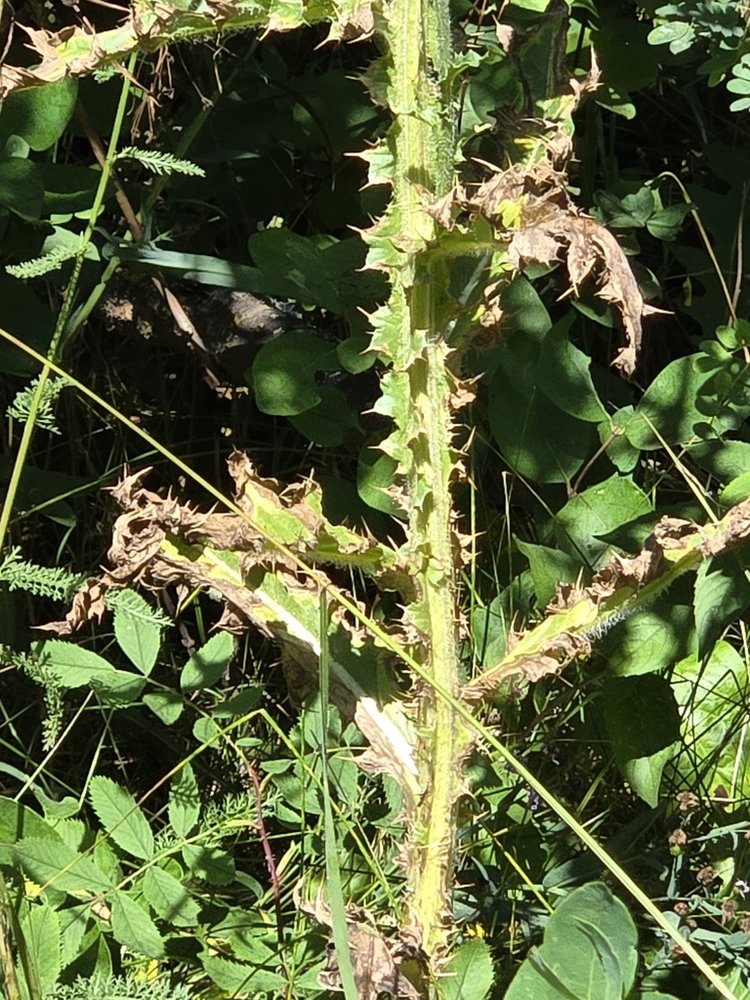
Look for a single big head at the end of each branch, often nodding, on a stalk 2–30 cm (1–12 in) long that has no spiny wings near the top. The head is 4–8 cm (1½–3 in) across, rose-purple, and sits on a ring of broad, triangular bracts, green or tinged purple, that spread or bend back and end in spines 1–4 mm long. Below the heads the stem carries spiny wings with spines 2–10 mm long. The leaves are coarsely lobed and toothed, dark green with a white midrib, spine-tipped, and mostly hairless except along the main veins underneath; basal leaves reach 10–40 cm (4–16 in). Plants stand 40–200 cm (16–79 in) tall. Plumeless Thistle, listed with it on the county weed lists, is its close relative; Minnesota Wildflowers says its heads are rather smaller, with narrow bracts, and SDSU gives them as 1.3–2 cm (½–¾ in) across, in clusters. Bull Thistle has bristle-like spines on the upper face of its leaves, a mark no other North American thistle has, and heads 2.5–5 cm (1–2 in) wrapped in narrow spine-tipped bracts. Canada Thistle is a creeping perennial with many small heads about 2 cm (¾ in) across. The native Wavyleaf Thistle has densely gray-felted stems and leaf undersides, and native Drummond's Thistle carries its heads on stalks usually no more than 5 cm (2 in) long, crowded and overtopped by the upper leaves, with bracts pressed flat.
When does it bloom?
June into September.
Where does it grow?
Pastures, rangeland, roadsides, fields and disturbed ground, along creeks and stock ponds; it does best on disturbed ground but can move into undisturbed sites. The Black Hills National Forest's invasive plant accounts call it widespread on the Forest and rank it Class C, established in the region. The National Park Service lists it at Wind Cave National Park, Mount Rushmore National Memorial and Devils Tower National Monument, where it is one of three thistles controlled with herbicides. Herbarium specimens from 1946 to 2011 come from Lawrence, Pennington and Custer counties in South Dakota and Crook County in Wyoming; the oldest, from Lawrence County, grew on a stony roadside in deciduous and pine woods, and later labels name a hay field, ponderosa pine parkland, a riparian meadow and a disturbed stream corridor. iNaturalist has 82 research-grade records within 100 km of the central Hills.
Other thistles in this guide
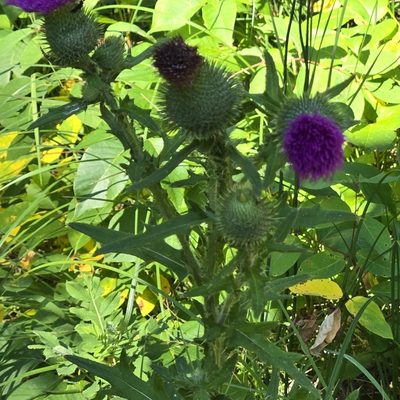
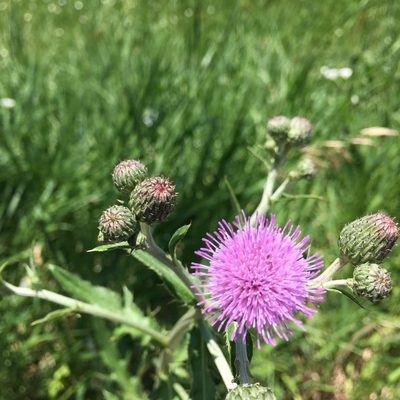
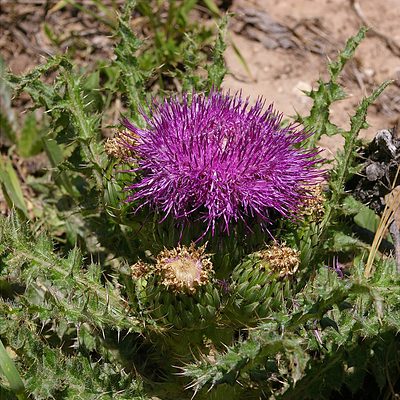
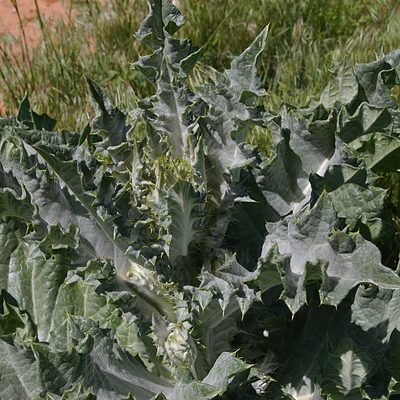
Aster family (Asteraceae): 62 other plants in this guide
- Aromatic Aster
- Arrowleaf Balsamroot
- Arrowleaf Sweet Coltsfoot
- Bachelor's Button
- Balsam Ragwort
- Black-eyed Susan
- Blanket Flower
- Blue Lettuce
- Broom Snakeweed
- Bull Thistle
- Canada Hawkweed
- Canada Lettuce
- Canada Thistle
- Chicory
- Common Burdock
- Common Dandelion
- Common Sunflower
- Common Tansy
- Common Yarrow
- Curlycup Gumweed
- Cutleaf Coneflower
- Dotted Gayfeather
- Drummond's Thistle
- Easter Daisy
- False Boneset
- Fetid Marigold
- Field Pussytoes
- Fringed Sagewort
- Hairy Golden Aster
- Heart-leaved Arnica
- Hooker's Townsend Daisy
- Horseweed
- Jerusalem Artichoke
- Lambstongue Groundsel
- Maximilian Sunflower
- Missouri Goldenrod
- Mountain Dandelion
- Oxeye Daisy
- Pearly Everlasting
- Pineapple Weed
- Prairie Coneflower
- Prairie False Dandelion
- Purple Coneflower
- Rocky Mountain Blazing Star
- Rosy Pussytoes
- Rubber Rabbitbrush
- Rush Skeletonplant
- Scotch Thistle
- Silver Sagebrush
- Smooth Blue Aster
- Spotted Joe-Pye Weed
- Stemless Four-nerve Daisy
- Stiff Goldenrod
- Stiff Sunflower
- Threenerve Fleabane
- Wavyleaf Thistle
- Western Ragweed
- White Hawkweed
- White Prairie Aster
- White Sagebrush
- Woolly Groundsel
- Yellow Salsify
Sources: Flora of North America Vol. 19: Carduus nutans (D. J. Keil), eFloras; Flora of North America Vol. 19: Cirsium vulgare, eFloras; Flora of North America Vol. 19: Cirsium arvense, eFloras; Flora of North America Vol. 19: Cirsium undulatum, eFloras; Flora of North America Vol. 19: Cirsium drummondii, eFloras; USDA Forest Service Fire Effects Information System: Carduus nutans (Zouhar 2002); USDA PLANTS Database: Carduus nutans (CANU4); SDSU Extension, Noxious Weeds of South Dakota, Extension Special Series 34 (revised 2010); SDSU Extension, 2026 Weed Control: Noxious Weeds (P-00144-2026); South Dakota DANR: Locally Noxious Weed Pest List (updated 2024); Wyoming Weed and Pest Council: State Designated Weed List; Wyoming Department of Agriculture rules, Chapter 63: Prohibited Noxious Weeds, 010-63 Wyo. Code R. § 63-3 (Cornell LII); Black Hills National Forest: Invasive plant species accounts and BHIPP priority list; NPS Devils Tower National Monument: Nonnative Species; Minnesota Wildflowers: Carduus nutans (Nodding Thistle); Kansas Wildflowers and Grasses: Carduus nutans; NPSpecies checklist, Wind Cave National Park vascular plants; NPSpecies checklist, Mount Rushmore National Memorial vascular plants; NPSpecies checklist, Devils Tower National Monument vascular plants; GBIF occurrence search: Carduus nutans herbarium specimens, South Dakota and Wyoming; GBIF specimen 2890632419: Lawrence County, 1946, stony roadside in deciduous and pine woods, in fruit; GBIF specimen 5159162641: Crook County, Wyoming, 1976, hay field, in flower and fruit; GBIF specimen 2270228140: Black Hills National Forest, Pennington County, 1983, ponderosa pine parkland; GBIF specimen 176900556: Custer County, 1981; GBIF specimen 2890632399: Lawrence County, 1993, full sun, flowering June 20; GBIF specimen 2512331996: Black Hills National Forest, Pennington County, 2010, riparian meadow, flowering; GBIF specimen 2512330715: Black Hills National Forest, Crook County, Wyoming, 2010, disturbed riparian corridor and roadside; GBIF specimen 1257775825: Black Hills National Forest, Pennington County, 2011, 1,721 m; iNaturalist: research-grade Carduus nutans observations within 100 km of the Black Hills.