Western Ragweed Ambrosia psilostachya
Also called Cuman Ragweed, Perennial Ragweed
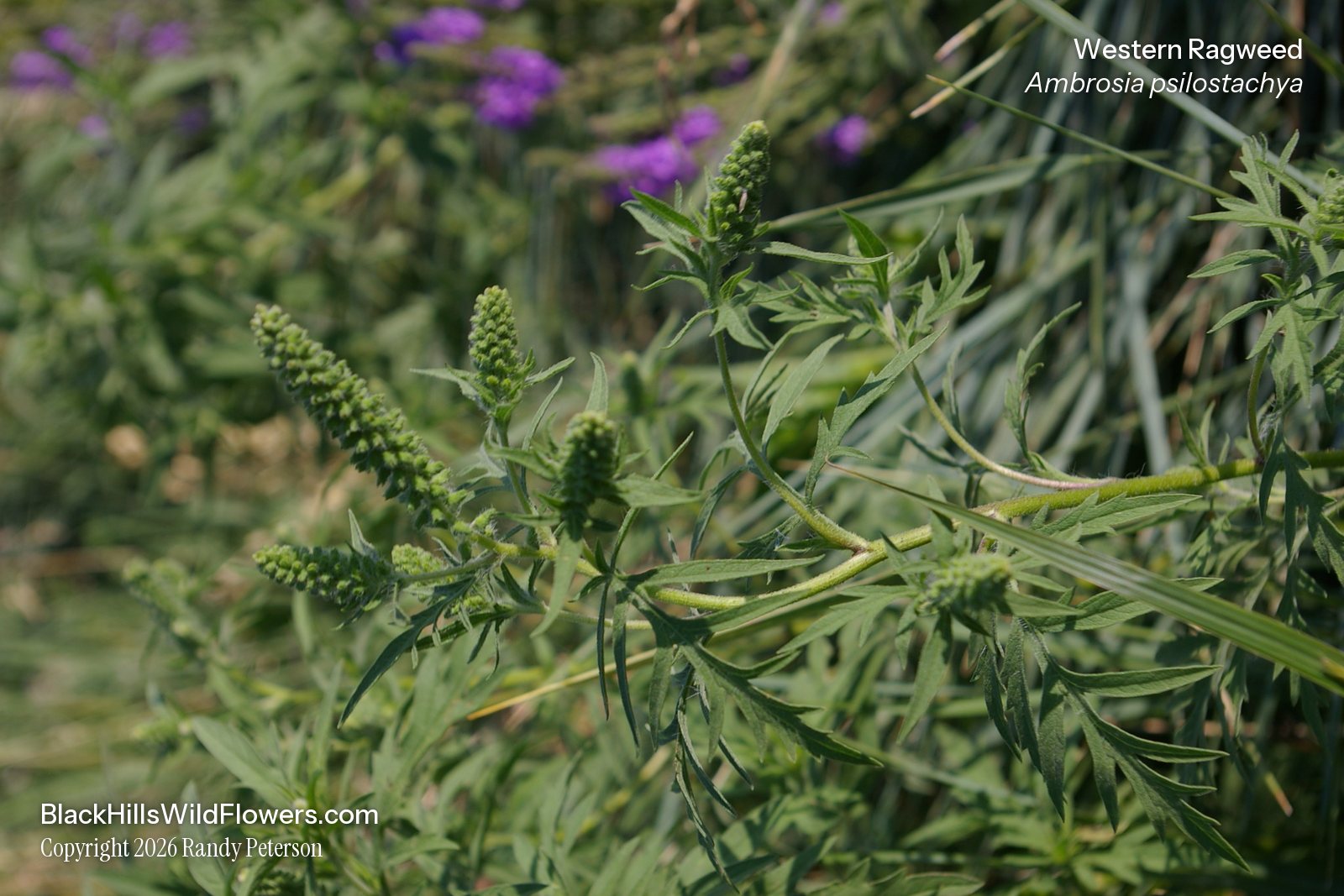
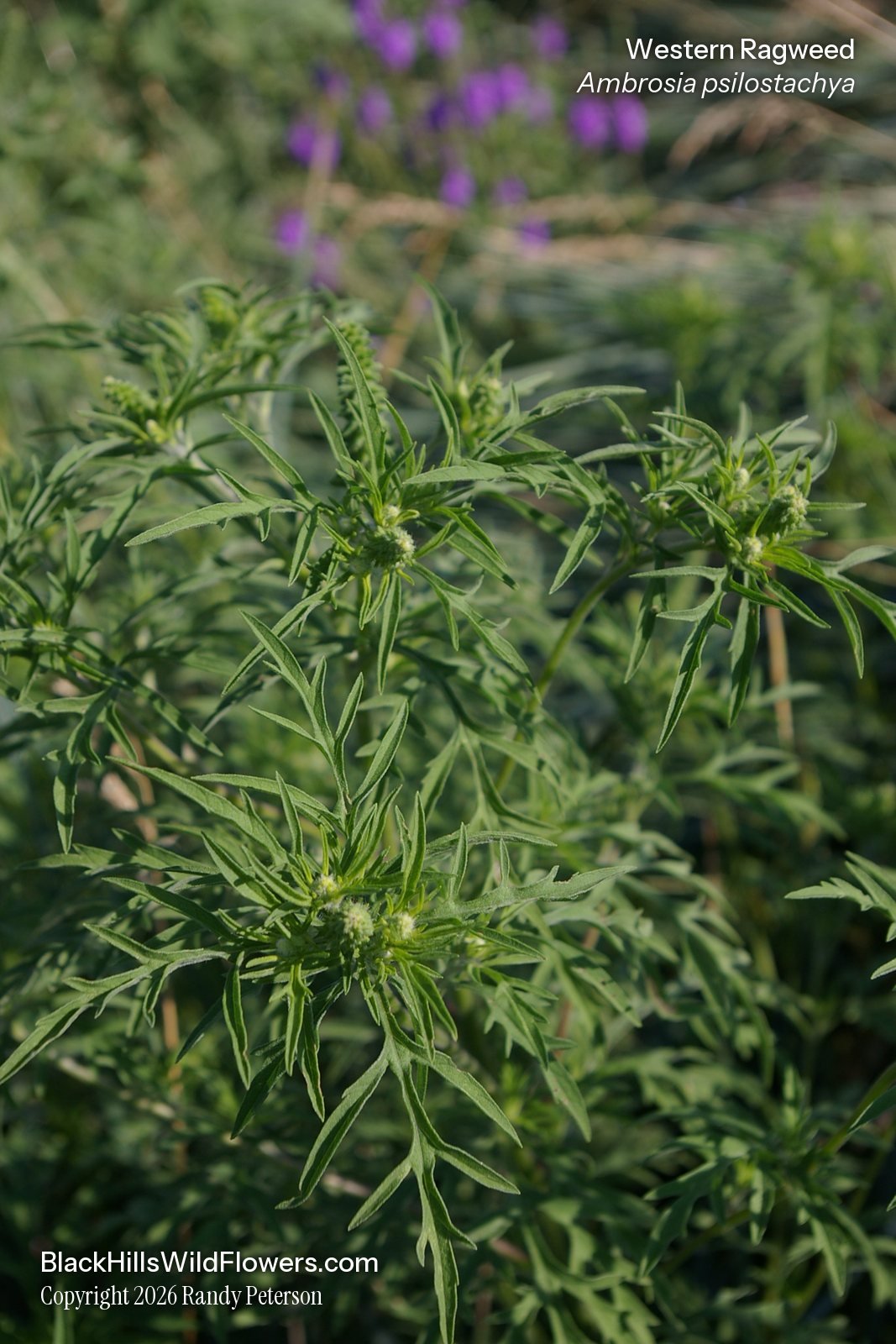
Western Ragweed (Ambrosia psilostachya) is a native perennial with gray-green, rough-hairy leaves cut into narrow lobes and slender spikes of tiny green, button-like flower heads from July into September. It spreads by creeping rhizomes (underground stems) into patches on dry prairie, meadows, roadsides and other open, disturbed ground, and the National Park Service lists it at Wind Cave, Jewel Cave, Mount Rushmore and Devils Tower. Photographed in the Black Hills.
Free photos from other sources
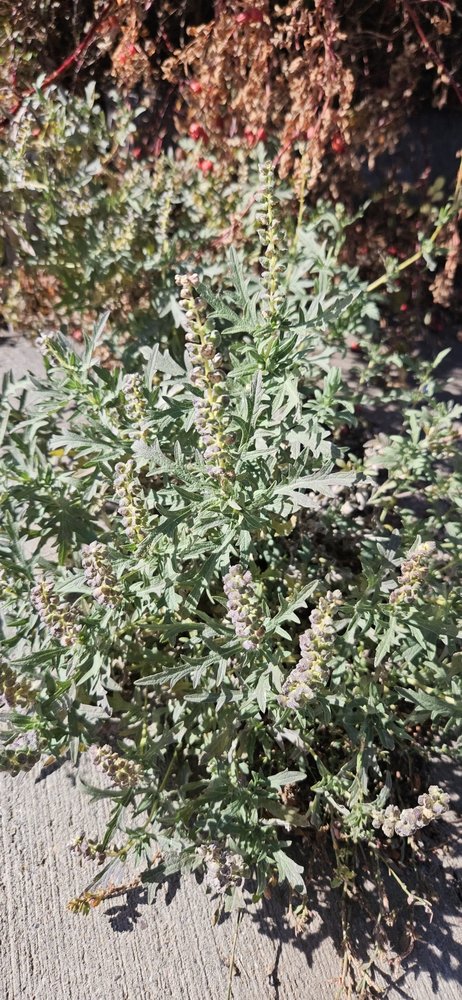
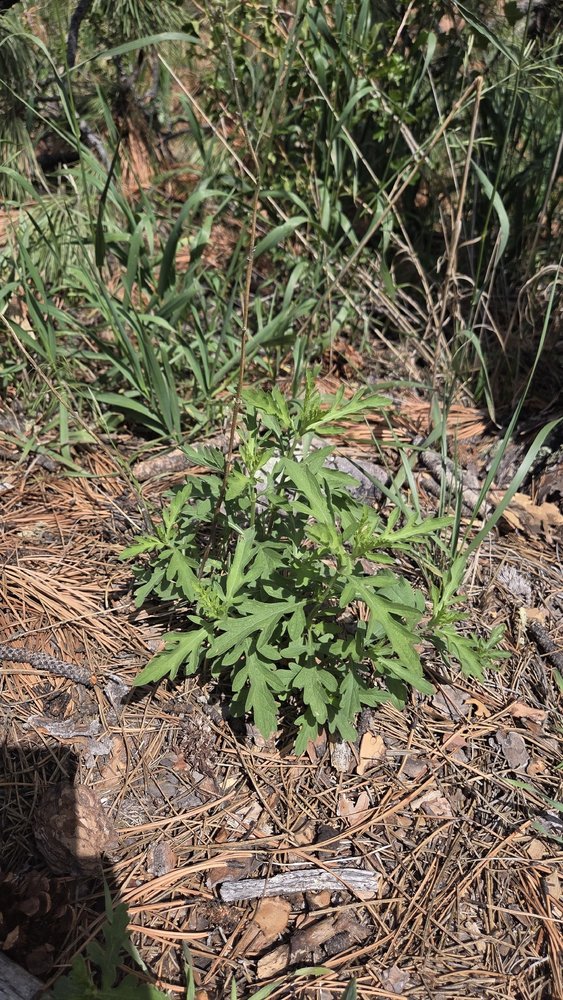
| Family | Asteraceae · Aster |
|---|---|
| Status | Native perennial |
| Blooms | July into September |
| Height | 10–100 cm (4–40 in) |
| Where | Dry prairie, meadows, roadsides and open, disturbed ground |
| Also called | Cuman Ragweed, Perennial Ragweed |
| Synonym | Ambrosia coronopifolia, Ambrosia psilostachya var. coronopifolia |
| Toxicity | Its pollen is a major cause of hay fever and other allergy symptoms in late summer and early fall. |
| Traditional use | Kansas Wildflowers records that the Cheyenne drank a tea of the ground leaves and stems for colds and bowel troubles, and that the Kiowa washed sores on people and horses with a decoction of the plant. |
Roots, seeds & germination
Root: It grows from fibrous, creeping rhizomes that branch and can reach 1–2 m (3–6 ft) deep, which lets it spread into patches even where seedlings can't get started.
Seed: Each female head holds a single flower and ripens into a small, hairy bur 2–3 mm long, top-shaped to round, with no spines or 1 to 6 short ones near the top; the seed stays inside the bur.
How do you identify Western Ragweed?
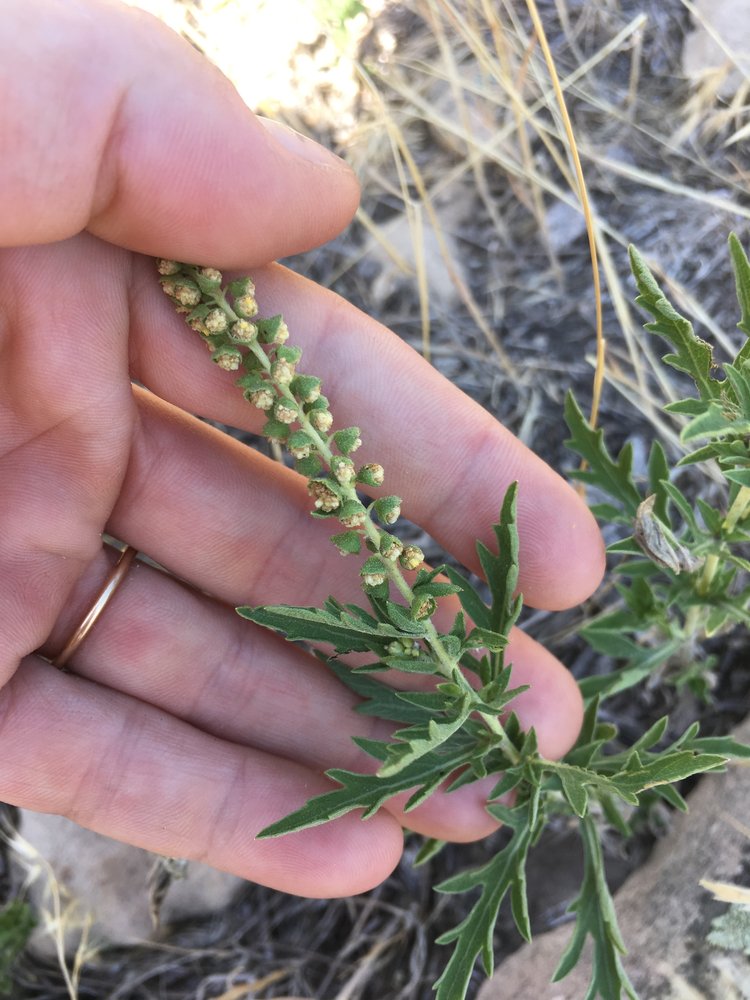
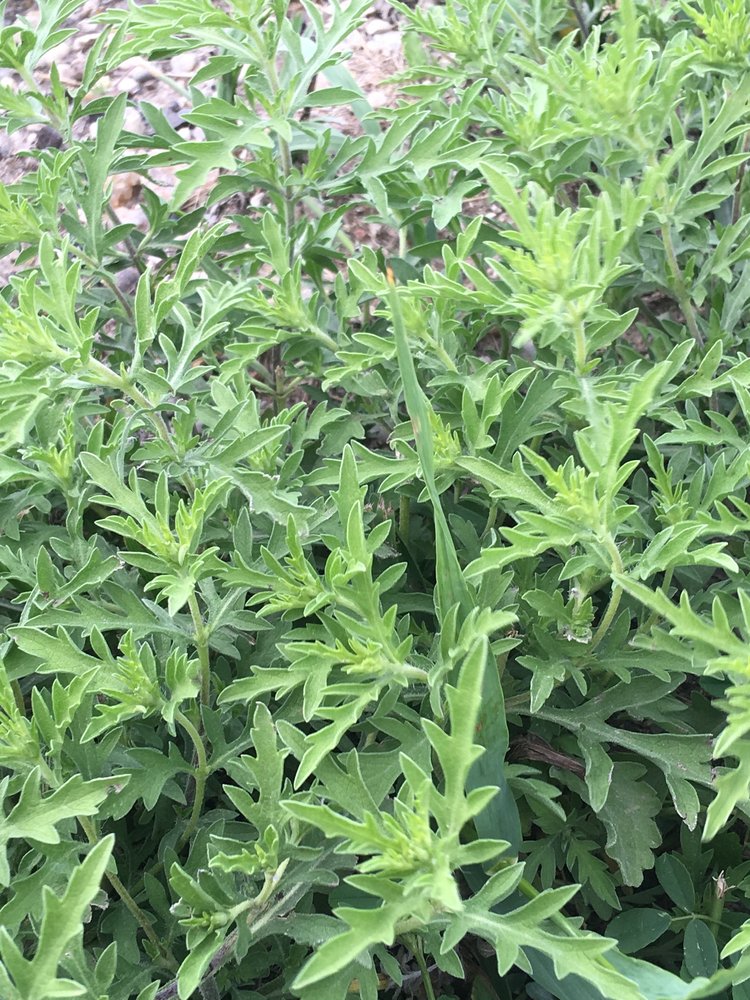
Look for a stiff, gray-green plant whose leaves are cut once into narrow lobes, the lobes sometimes toothed; the leaves are rough with short hairs, opposite low on the stem and alternate higher up, on short stalks that are often winged, or none. In late summer slender spikes 2.5–15 cm (1–6 in) long stand at the branch tips, packed with tiny green to yellowish, bead-like male heads; the few female heads sit lower, in the leaf angles, and ripen into small, hairy burs 2–3 mm long. It spreads by creeping rhizomes, so it often grows in patches. Minnesota Wildflowers notes that Common Ragweed (Ambrosia artemisiifolia), an annual, is much more branched and less hairy, with thinner, more finely divided, fern-like leaves and a taproot instead of creeping rhizomes.
When does it bloom?
July into September.
Where does it grow?
Dry prairie, meadows, roadsides and other open, disturbed ground, often on sandy, rocky or clay soil. Black Hills herbarium labels describe a roadside in rocky limey soil, dry red clay in an open meadow, a meadow above a canyon in the Bear Lodge Mountains, grassland beside a highway, and red sandstone under ponderosa pine and bur oak at Devils Tower. The 1986 Jewel Cave survey lists it, the National Park Service lists it at Wind Cave, Jewel Cave, Mount Rushmore and Devils Tower, and Black Hills specimens come from Lawrence, Custer and Fall River counties in South Dakota and Crook and Weston counties in Wyoming.
Aster family (Asteraceae): 62 other plants in this guide
- Aromatic Aster
- Arrowleaf Balsamroot
- Arrowleaf Sweet Coltsfoot
- Bachelor's Button
- Balsam Ragwort
- Black-eyed Susan
- Blanket Flower
- Blue Lettuce
- Broom Snakeweed
- Bull Thistle
- Canada Hawkweed
- Canada Lettuce
- Canada Thistle
- Chicory
- Common Burdock
- Common Dandelion
- Common Sunflower
- Common Tansy
- Common Yarrow
- Curlycup Gumweed
- Cutleaf Coneflower
- Dotted Gayfeather
- Drummond's Thistle
- Easter Daisy
- False Boneset
- Fetid Marigold
- Field Pussytoes
- Fringed Sagewort
- Hairy Golden Aster
- Heart-leaved Arnica
- Hooker's Townsend Daisy
- Horseweed
- Jerusalem Artichoke
- Lambstongue Groundsel
- Maximilian Sunflower
- Missouri Goldenrod
- Mountain Dandelion
- Musk Thistle
- Oxeye Daisy
- Pearly Everlasting
- Pineapple Weed
- Prairie Coneflower
- Prairie False Dandelion
- Purple Coneflower
- Rocky Mountain Blazing Star
- Rosy Pussytoes
- Rubber Rabbitbrush
- Rush Skeletonplant
- Scotch Thistle
- Silver Sagebrush
- Smooth Blue Aster
- Spotted Joe-Pye Weed
- Stemless Four-nerve Daisy
- Stiff Goldenrod
- Stiff Sunflower
- Threenerve Fleabane
- Wavyleaf Thistle
- White Hawkweed
- White Prairie Aster
- White Sagebrush
- Woolly Groundsel
- Yellow Salsify
Sources: Minnesota Wildflowers: Ambrosia psilostachya (Western Ragweed); Flora of North America Vol. 21: Ambrosia psilostachya, eFloras; Flora of North America Vol. 21: genus Ambrosia and key, eFloras; Kansas Wildflowers & Grasses: Ambrosia psilostachya (Western ragweed); Utah State University Extension, Range Plants of Utah: Western Ragweed; USDA PLANTS Database: Ambrosia psilostachya, Cuman ragweed (AMPS); Marriott and Hartman 1986, A Survey of the Vegetation of Jewel Cave National Monument; NPSpecies checklist, Wind Cave National Park vascular plants; NPSpecies checklist, Jewel Cave National Monument vascular plants; NPSpecies checklist, Mount Rushmore National Memorial vascular plants; NPSpecies checklist, Devils Tower National Monument vascular plants; GBIF occurrence search: Ambrosia psilostachya herbarium specimens, South Dakota and Wyoming; GBIF specimen 3091263986: Lawrence County, SD, 1972, roadside, rocky limey soil; GBIF specimen 3034737778: Crook County, WY, 1979, dry red clay of open meadow; GBIF specimen 2573350140: Crook County, WY, 1984, meadow above a canyon, Bear Lodge Mountains; GBIF specimen 4912202479: Weston County, WY, 1984, grassland near the road; GBIF specimen 4912202478: Crook County, WY, 1996, red sandstone, ponderosa pine and bur oak.