Jerusalem Artichoke Helianthus tuberosus
Also called Jerusalem Sunflower, Girasole, Topinambour, pȟaŋǧí zí (Lakota)
Jerusalem Artichoke (Helianthus tuberosus) is a tall, rough-stemmed perennial sunflower with yellow flower heads that open from August into October. South Dakota's Open PRAIRIE guide says it grows on open or shaded moist sites throughout the state, and herbarium specimens from the Black Hills come from streambanks, open woods and roadsides.
Free photos from other sources
| Family | Asteraceae · Aster |
|---|---|
| Status | Native perennial |
| Blooms | August into October |
| Height | 1–3 m (3–10 ft) |
| Where | Moist open or shaded ground: streambanks, floodplain woods, thickets, woodland edges and roadsides |
| Also called | Jerusalem Sunflower, Girasole, Topinambour, pȟaŋǧí zí (Lakota) |
| Synonym | Helianthus tomentosus |
| Food use | The tubers are edible (Kansas Wildflowers). SDSU's Open PRAIRIE guide and Minnesota Wildflowers both say food naturalists still grow the plant, and Open PRAIRIE adds that it was once grown commercially in South Dakota but never found a significant market. |
| Traditional use | Gilmore (1919) lists the Omaha, Ponca, Winnebago and Pawnee as eating the tubers: the Pawnee only raw, the others raw, boiled or roasted. He adds that the people of all the Nebraska tribes said they had never grown the plant. Moerman's database records that the Dakota boiled the tubers and sometimes fried them after boiling (Gilmore 1913), and that the Lakota used the stalks and tubers for food (Rogers 1980, Sicangu), ate the tubers fresh, and dried them to eat in famines (Kraft 1990, Standing Rock). The Lakota plant guide by Black Elk and Flying By (1998) lists the tubers as boiled or roasted, sometimes fried after boiling, and says overuse of them is said to cause gas. |
| Note | Flora of North America says this sunflower is so widely spread as a weed that its original range is hard to tell, while USDA PLANTS lists it as native to the lower 48 states. |
Traditional use: first drafted by Google AI, then checked against the sources on this page.
Roots, seeds & germination
Root: A slender, long-creeping rhizome, an underground stem, with branches that carry small tubers at the tips; plants often grow in colonies. The tubers form late in the season.
Seed: Each seed is a dry, brown, slightly flattened fruit 5–7 mm (about ¼ in) long, with no tuft of hairs but 2 bristly scales at the tip.
Germination: SDSU's Open PRAIRIE guide says seed needs no treatment before sowing and that tubers can be separated in the fall for transplanting.
How do you identify Jerusalem Artichoke?
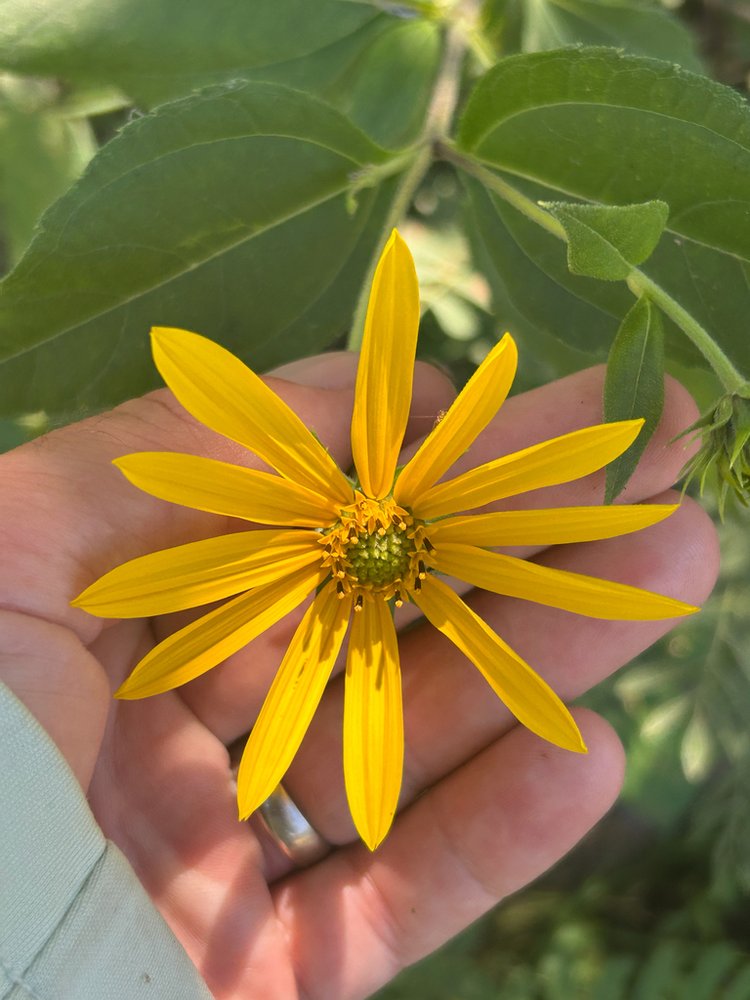
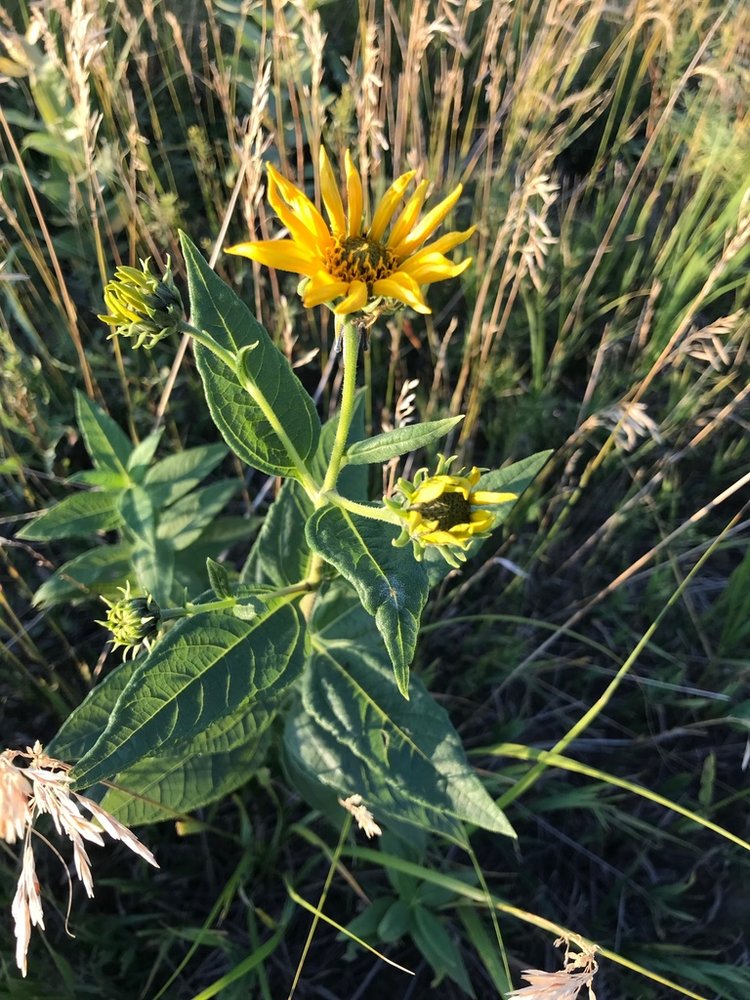
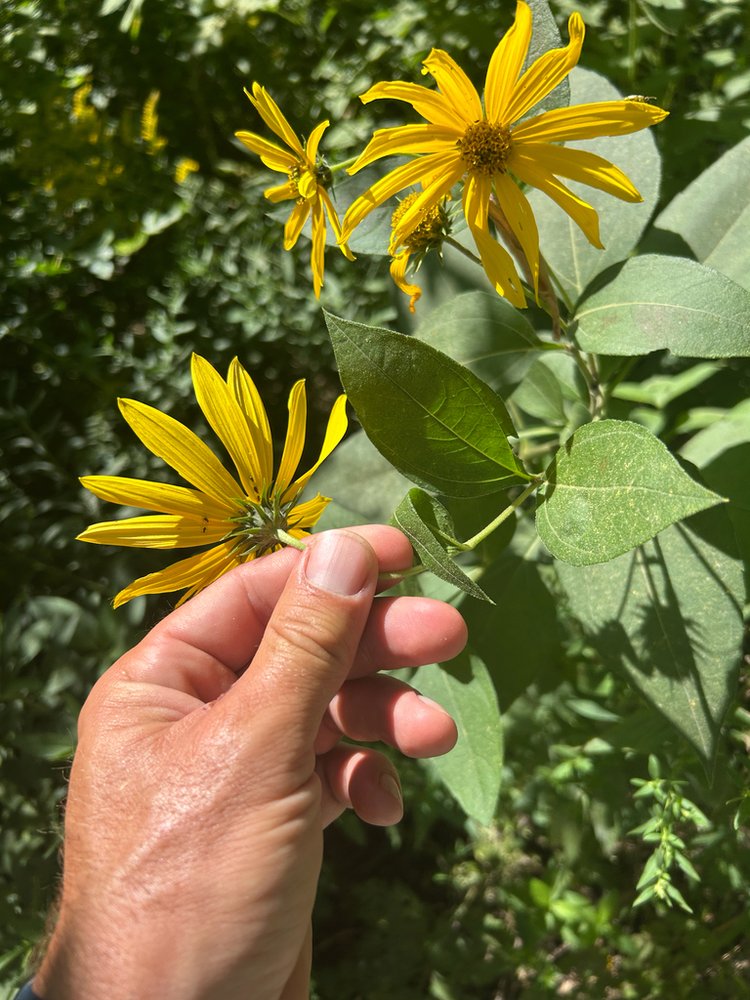
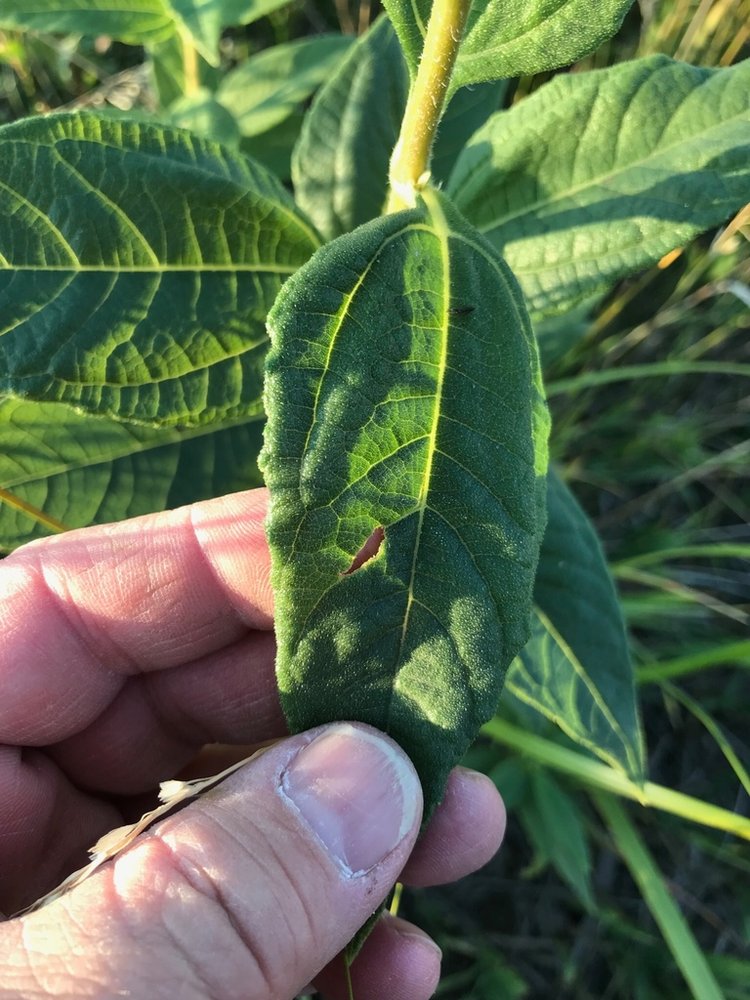
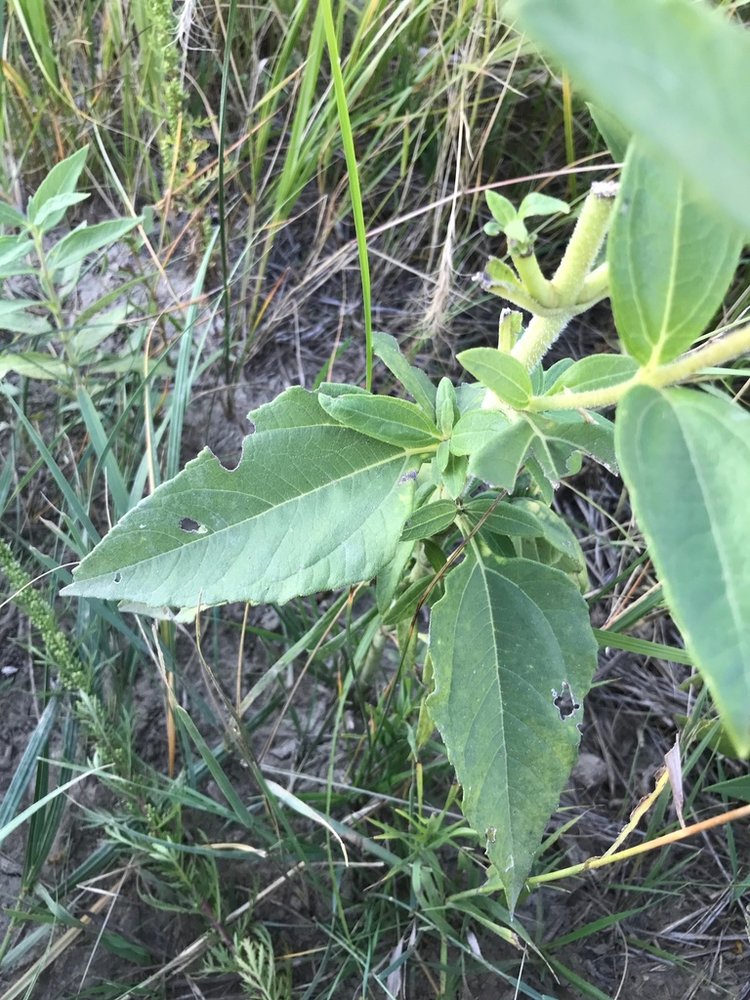
Look for a tall plant, 1–3 m (3–10 ft), with a stout stem covered in stiff whitish hairs and large, rough, toothed leaves that are opposite on the lower stem and alternate higher up. The leaf blades are ovate to lanceolate, 10–25 cm (4–10 in) long, hairy underneath and tapered at the base into a winged stalk. Each head has 10 to 20 yellow rays around a yellow-orange disk, and the bracts beneath it are pointed and spread at the tips. Minnesota Wildflowers says this species has the largest and proportionately broadest leaves of the tall sunflowers it covers. Small tubers form on underground stems late in the season.
When does it bloom?
August into October.
Where does it grow?
Moist open or shaded ground along streams and in floodplain woods, thickets, woodland edges and roadsides. Herbarium sheets from the Black Hills, collected between 1887 and 2010, record it on a floodplain in open deciduous woods, on a stony roadside among shrubs, along a stream, on creek alluvium and on roadsides in Lawrence and Pennington counties, and in a road corridor beside ponderosa pine and bur oak forest in Crook County, Wyoming. The National Park Service lists it at Mount Rushmore. The USDA calls it native to the lower 48 states, but Flora of North America says it is so widely spread as a weed that its original range is hard to tell.
Other sunflowers in this guide
Aster family (Asteraceae): 62 other plants in this guide
- Aromatic Aster
- Arrowleaf Balsamroot
- Arrowleaf Sweet Coltsfoot
- Bachelor's Button
- Balsam Ragwort
- Black-eyed Susan
- Blanket Flower
- Blue Lettuce
- Broom Snakeweed
- Bull Thistle
- Canada Hawkweed
- Canada Lettuce
- Canada Thistle
- Chicory
- Common Burdock
- Common Dandelion
- Common Sunflower
- Common Tansy
- Common Yarrow
- Curlycup Gumweed
- Cutleaf Coneflower
- Dotted Gayfeather
- Drummond's Thistle
- Easter Daisy
- False Boneset
- Fetid Marigold
- Field Pussytoes
- Fringed Sagewort
- Hairy Golden Aster
- Heart-leaved Arnica
- Hooker's Townsend Daisy
- Horseweed
- Lambstongue Groundsel
- Maximilian Sunflower
- Missouri Goldenrod
- Mountain Dandelion
- Musk Thistle
- Oxeye Daisy
- Pearly Everlasting
- Pineapple Weed
- Prairie Coneflower
- Prairie False Dandelion
- Purple Coneflower
- Rocky Mountain Blazing Star
- Rosy Pussytoes
- Rubber Rabbitbrush
- Rush Skeletonplant
- Scotch Thistle
- Silver Sagebrush
- Smooth Blue Aster
- Spotted Joe-Pye Weed
- Stemless Four-nerve Daisy
- Stiff Goldenrod
- Stiff Sunflower
- Threenerve Fleabane
- Wavyleaf Thistle
- Western Ragweed
- White Hawkweed
- White Prairie Aster
- White Sagebrush
- Woolly Groundsel
- Yellow Salsify
Sources: SDSU Open PRAIRIE, South Dakota Native Plant Research: Asteraceae, Helianthus tuberosus (R. Neil Reese); Flora of North America Vol. 21: Helianthus tuberosus (eFloras); Minnesota Wildflowers: Helianthus tuberosus (Jerusalem Artichoke); Kansas Wildflowers and Grasses: Helianthus tuberosus (Jerusalem artichoke); Missouri Plants: Helianthus tuberosus (Jerusalem Artichoke); USDA PLANTS Database: Helianthus tuberosus (HETU); NPSpecies checklist, Mount Rushmore National Memorial vascular plants; GBIF specimen 3038911732: Bennett 1939, Lawrence County, open deciduous woods on a floodplain (BHSC); GBIF specimen 3034737838: Bennett 1946, Lawrence County, stony roadside among deciduous shrubs (BHSC); GBIF specimen 2512284212: McIntosh 1924, Pennington County, along a stream, frequent in the open (BHSC); GBIF specimen 2512284203: Van Bruggen 1970, Pennington County, alluvium along a creek (BHSC); GBIF specimen 3034737936: Peterson 1986, Lawrence County, roadside (BHSC); GBIF specimen 2512288136: Elliott 2010, Black Hills National Forest, Wyoming side, disturbed road corridor and ponderosa pine and bur oak forest (USFS/BHSC); GBIF specimen 1456015045: Forwood 1887, South Dakota, Black Hills (US); GBIF occurrence search: Helianthus tuberosus, South Dakota and Wyoming herbarium specimens (taxon key 3119175); Native American Ethnobotany Database (BRIT): Helianthus tuberosus (Dakota, Lakota and other nations); Culturally Important Plants of the Lakota (Black Elk and Flying By, 1998), entry 143, filed with the South Dakota PUC; Gilmore 1919, Uses of Plants by the Indians of the Missouri River Region, p. 131.