Stiff Goldenrod
Solidago rigida
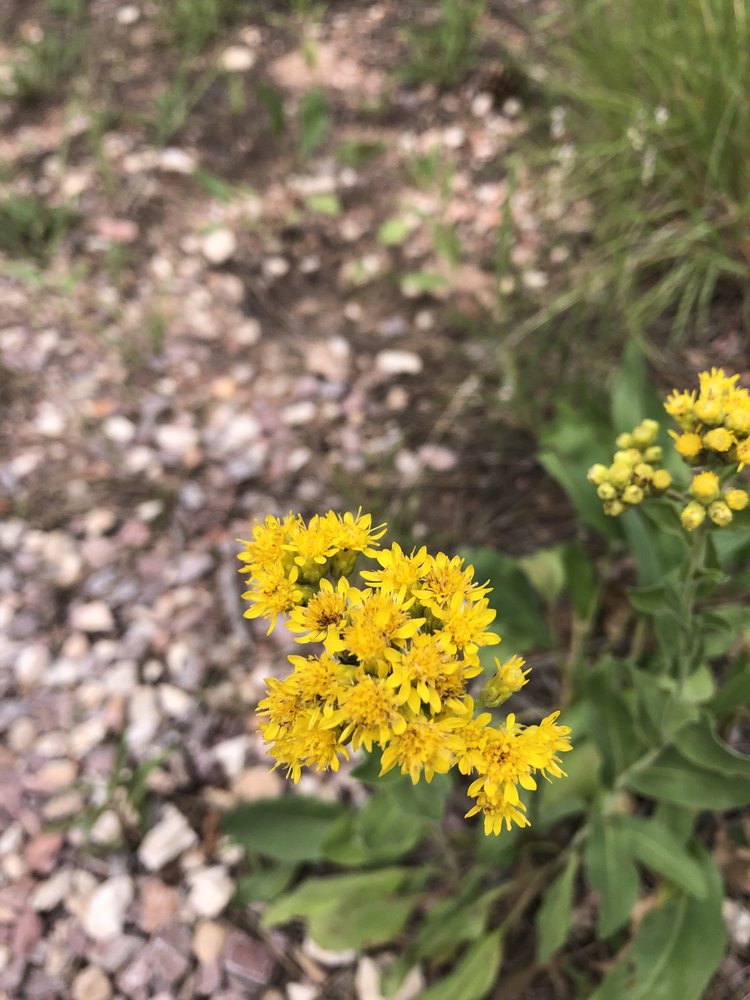
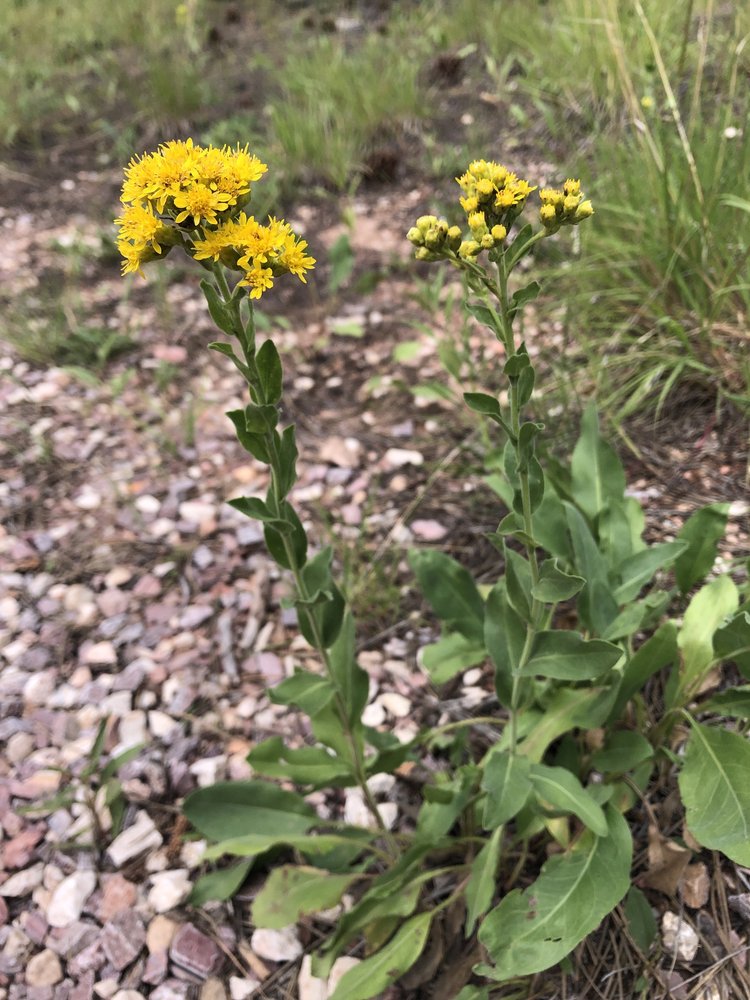
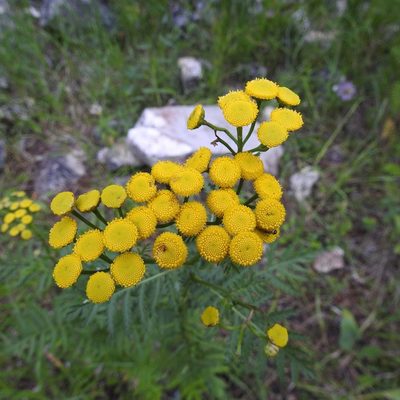
Stiff Goldenrod (Solidago rigida) is a native perennial with flat-topped clusters of bright yellow flower heads and thick, rough, grayish leaves. It blooms from late July into October, mostly in August and September, on dry prairie, meadows and open pine woods in the Black Hills, where four other common goldenrods, Missouri, Canada, Giant and Gray, bloom alongside it.
Free photos from other sources
| Family | Asteraceae · Aster |
|---|---|
| Status | Native perennial |
| Blooms | Late July into October, mostly August and September |
| Height | 30–90 cm (12–35 in) |
| Where | Dry open prairie, meadows, open pine woods, rocky and sandy hillsides, roadsides |
| Also called | Stiff-leaved Goldenrod, Rigid Goldenrod, Hard-leaved Goldenrod, tȟal'ágnake (Lakota), čhaŋȟlóǧaŋ makȟá ayúblaya (Lakota), miméla waȟčázi (Lakota) |
| Synonym | Oligoneuron rigidum, Aster rigidus, Solidago rigida var. humilis, Oligoneuron rigidum var. humile, Oligoneuron canescens, Solidago canescens, Solidago parvirigida |
| Traditional use | Sitting Bull College's 1998 Culturally Important Plants of the Lakota says Stiff Goldenrod leaves were laid on the ground as a plate to keep meat clean, and that a tea of Missouri Goldenrod was taken for stomachache, influenza and sore throat. |
| Note | This page also covers Missouri Goldenrod (Solidago missouriensis), Canada Goldenrod (Solidago canadensis in the broad sense), Giant Goldenrod (Solidago gigantea) and Gray Goldenrod (Solidago nemoralis). |
Roots, seeds & germination
Root: A thick, woody, branching crown with short rhizomes, so it grows in loose clumps rather than spreading colonies. On North Dakota prairie the main roots run sideways 30–46 cm (12–18 in) and then down to 1.5–1.8 m (5–6 ft). Fire kills the tops, but it sprouts again from the crown.
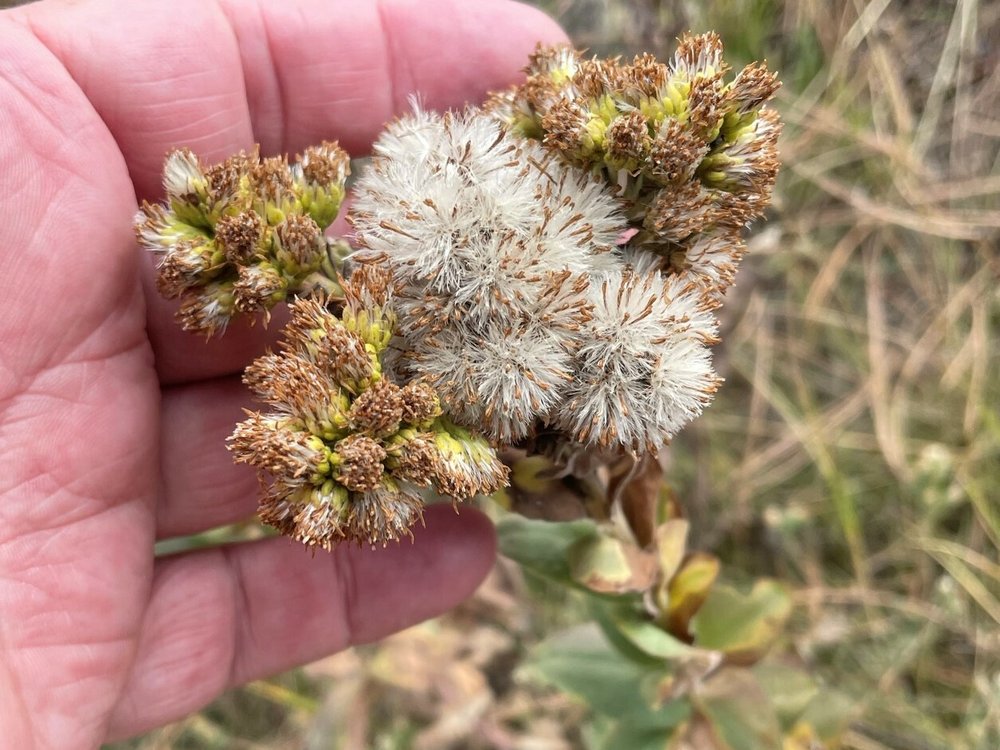
Seed: A small, ribbed achene (a dry, one-seeded fruit) about 1–2.5 mm long, with a tuft of white to light brown bristles that carries it on the wind. Seed ripens in September and October, and the fluffy heads hang on into early winter.
Germination: Seed needs about 60 days of cold, moist stratification, then sprouts in one to two weeks. SDSU notes it also needs light, so it is sown on or barely under the surface, and sowing in late fall lets winter do the stratifying. Plants can also be divided in spring or fall.
How do you identify Stiff Goldenrod?
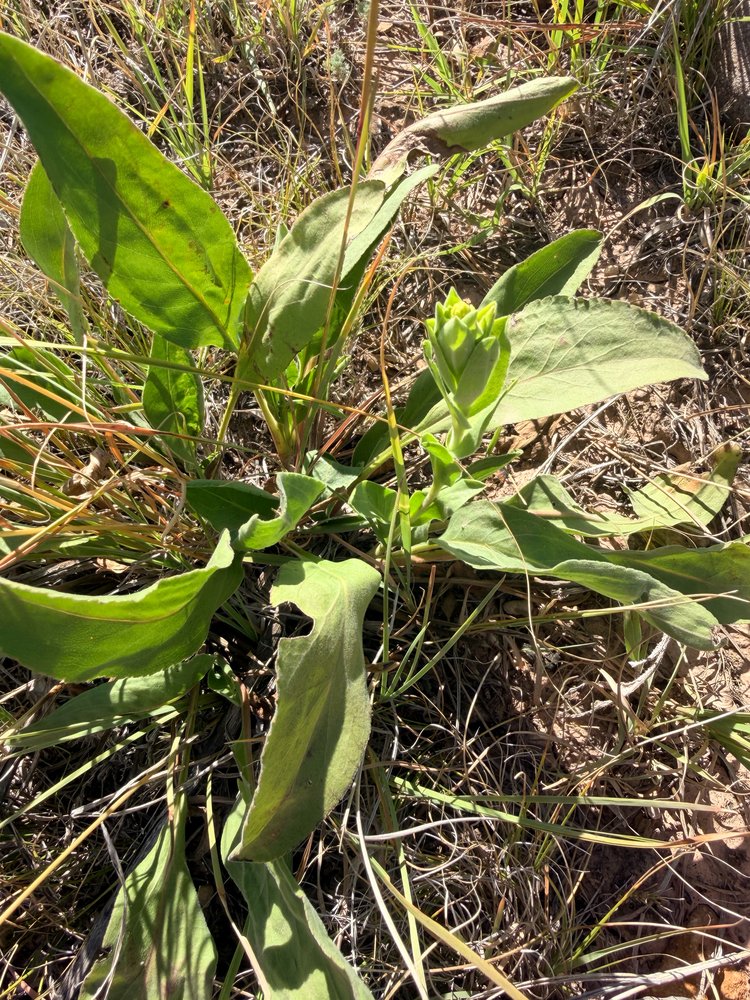
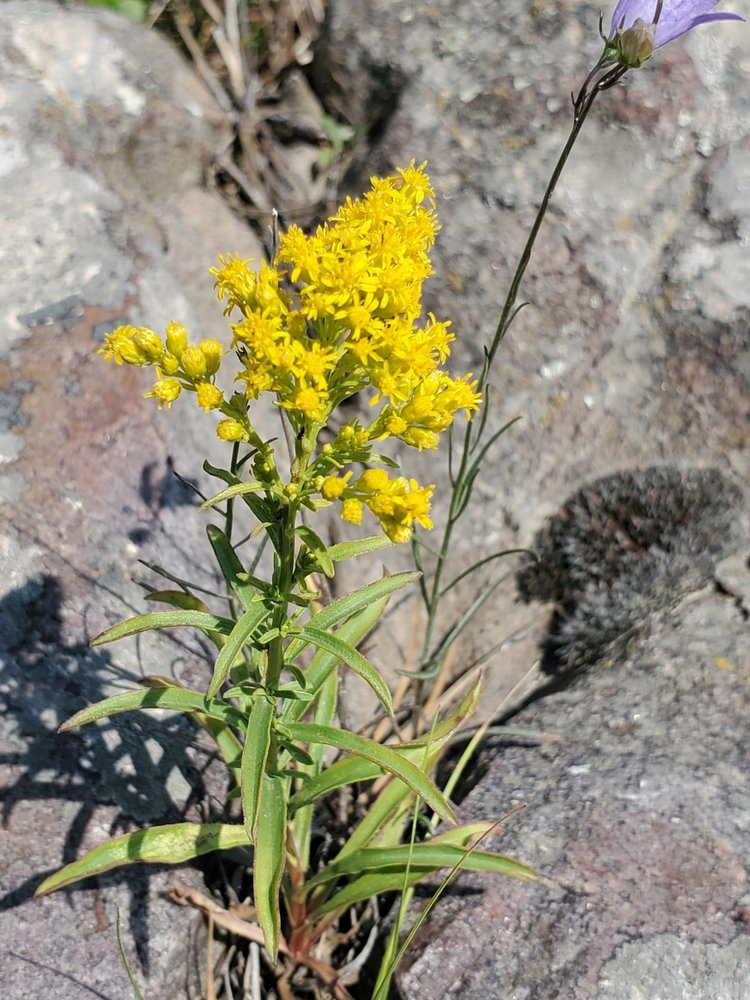
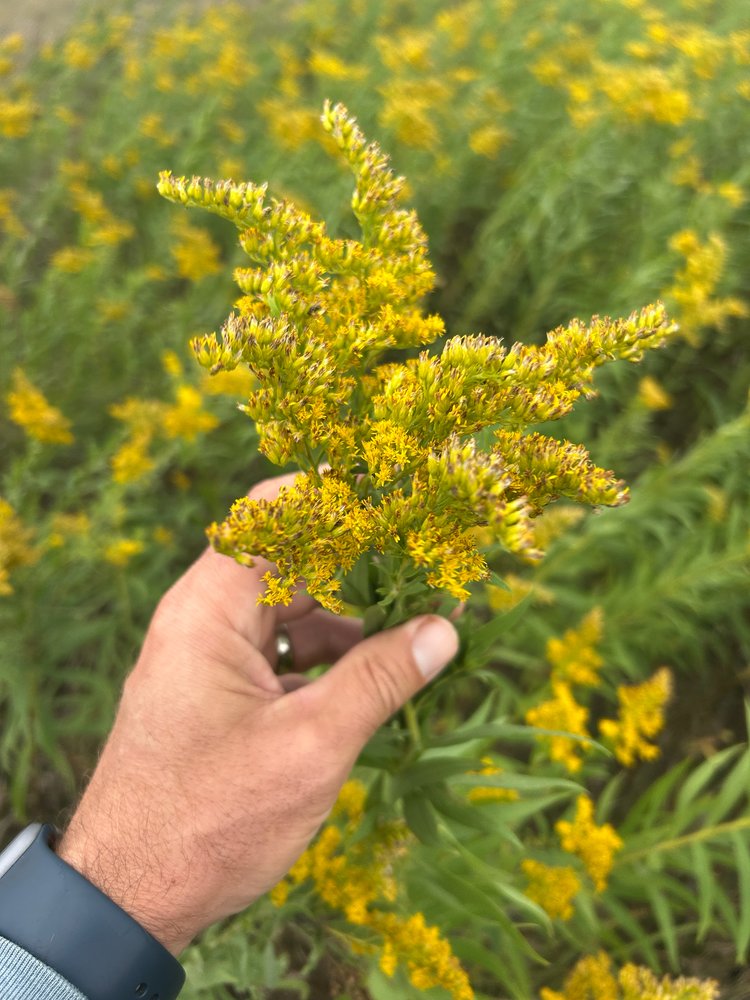
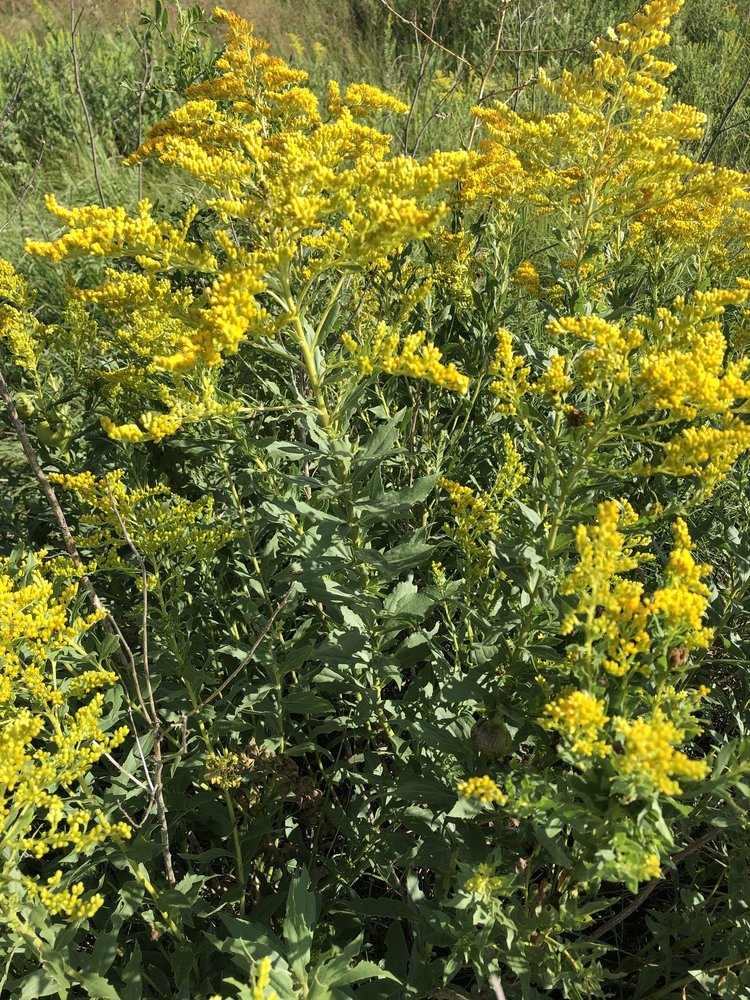
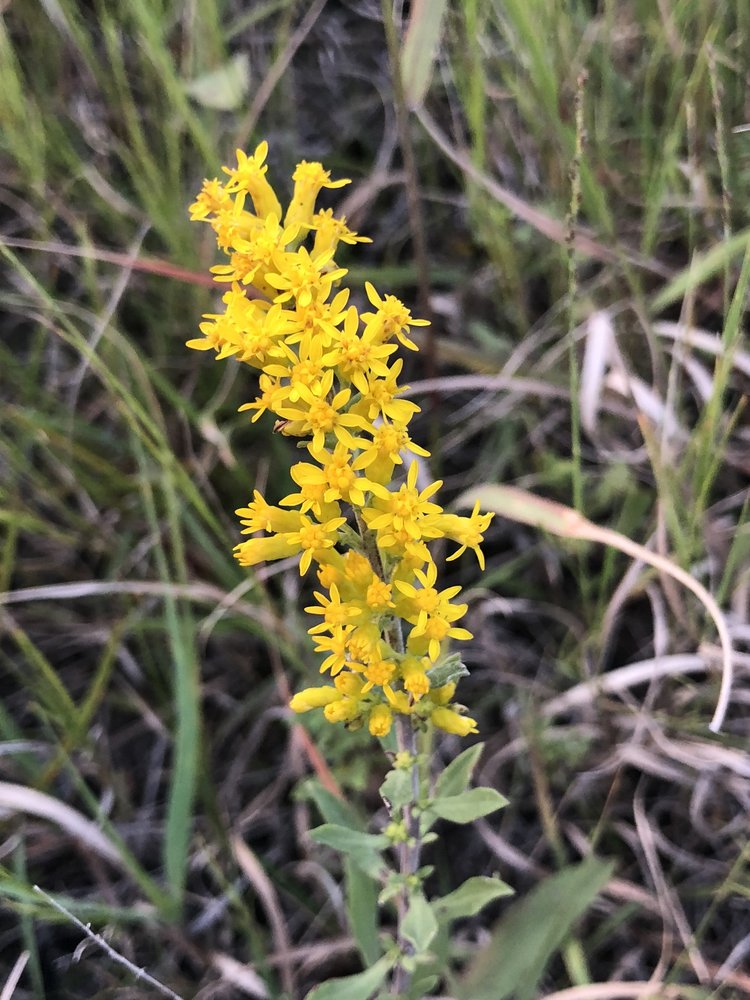
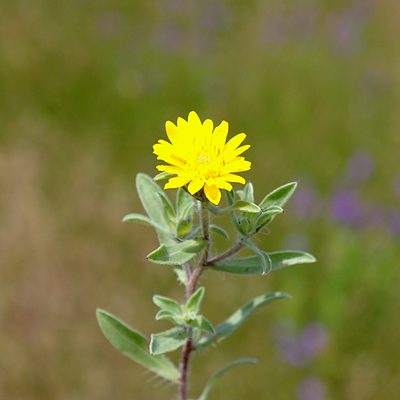
Stiff Goldenrod is the only yellow goldenrod in the Hills with a flat-topped cluster: heads packed into a flat or slightly domed top 3–13 cm (1–5 in) across, each head about 1 cm (⅜ in) across with 6–13 short rays. Its leaves are thick, firm and grayish, rough with short stiff hairs and not sharply toothed, and large oval basal leaves on long stalks are still there at flowering. The other goldenrods on this page carry small heads in plumes or wands. Missouri Goldenrod has a smooth stem and narrow, smooth leaves and blooms first, from July. Canada and Giant Goldenrod are tall colony-formers with sharply toothed, three-veined leaves, Canada with a hairy stem and Giant with a smooth, often waxy one. Gray Goldenrod is short and gray-hairy, with a narrow, one-sided wand.
When does it bloom?
Late July into October, mostly August and September.
Where does it grow?
Full sun on dry to medium, often sandy, gravelly or eroded soil: open prairie, mountain meadows, grassy clearings in ponderosa pine, rocky hillsides and roadsides. The 1986 plant survey of Jewel Cave National Monument lists it as Solidago rigida var. humilis, NPSpecies lists it at Wind Cave, Mount Rushmore and Devils Tower, and herbarium specimens from 1875 on come from Lawrence, Pennington, Custer, Meade and Fall River counties and Crook County, Wyoming. Of the others, Missouri Goldenrod is the most widespread, Canada Goldenrod favors moister meadows and draws, Giant Goldenrod grows along streams, and Gray Goldenrod grows on dry, sandy or gravelly ground.
Other flowers to compare
Sources: Flora of North America Vol. 20: Solidago rigida (Semple & Cook 2006); Flora of North America: Solidago rigida subsp. humilis; Flora of North America: Solidago missouriensis; Flora of North America: Solidago canadensis; Flora of North America: Solidago altissima; Flora of North America: Solidago altissima subsp. gilvocanescens; Flora of North America: Solidago lepida; Flora of North America: Solidago gigantea; Flora of North America: Solidago nemoralis; Flora of North America: Solidago nemoralis subsp. decemflora; Semple, Astereae Lab, University of Waterloo: Solidago rigida; Semple, Astereae Lab, University of Waterloo: Solidago rigida ssp. humilis; ITIS: Solidago rigida (TSN 36297; Oligoneuron rigidum TSN 508151 not accepted); USDA NRCS PLANTS Database: Oligoneuron rigidum (OLRI); USDA NRCS Plant Fact Sheet: Stiff Goldenrod, Oligoneuron rigidum (Elsberry PMC; archived); Reese, R.N. 2025. Asteraceae: Solidago rigida. South Dakota Native Plant Research, SDSU Open PRAIRIE; Manske, L.L. Autecology of Stiff Goldenrod on the Northern Mixed Grass Prairie. NDSU Dickinson Research Extension Center, DREC 17-1152; Minnesota Wildflowers: Solidago rigida (Stiff Goldenrod); Kansas Wildflowers and Grasses: Solidago rigida; Minnesota Board of Water and Soil Resources: Featured Plant, Stiff Goldenrod (2014); Prairie Moon Nursery: Oligoneuron rigidum, Stiff Goldenrod; Marriott, H. & Hartman, R. 1986. A Survey of the Vegetation of Jewel Cave National Monument; NPSpecies checklist, Jewel Cave NM (JECA) vascular plants; NPSpecies checklist, Wind Cave NP (WICA) vascular plants; NPSpecies checklist, Mount Rushmore NMem (MORU) vascular plants; NPSpecies checklist, Devils Tower NM (DETO) vascular plants; GBIF occurrence search: Solidago rigida in the Black Hills area; GBIF occurrence search: Solidago missouriensis in the Black Hills area; GBIF occurrence search: Solidago gigantea in the Black Hills area; GBIF occurrence search: Solidago nemoralis in the Black Hills area; GBIF occurrence search: Solidago canadensis in the Black Hills area; Black Elk, L.S. & Flying By, W.D. 1998. Culturally Important Plants of the Lakota (Sitting Bull College), entries 205, 288, 289; Gilmore, M.R. 1919. Uses of Plants by the Indians of the Missouri River Region (BAE 33rd Annual Report), p. 133; Wikipedia: Solidago rigida (for Densmore 1928 and Smith 1928 ethnobotany citations); Swihart, E. 2022. Autumn allergies: Don't blame goldenrod. University of Illinois Extension; Thompson, C.M. 2006. Autumn Gold. OutdoorIllinois, Illinois DNR, August 2006; Asthma and Allergy Foundation of America: How to win against ragweed pollen allergy; iNaturalist: Stiff Goldenrod observations in the Black Hills.