Pineapple Weed Matricaria discoidea
Also called Disc Mayweed, Pineappleweed, Rayless Mayweed, Wild Chamomile, skuyómna (Lakota)
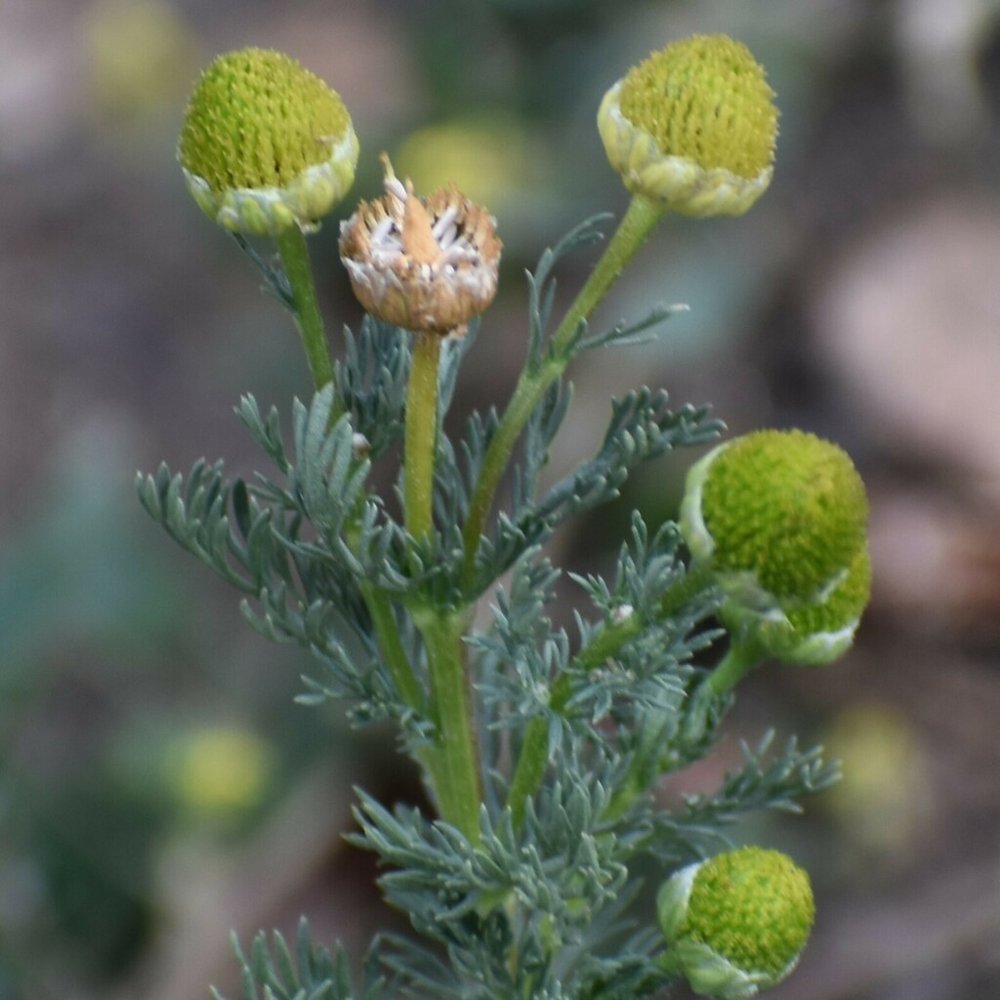
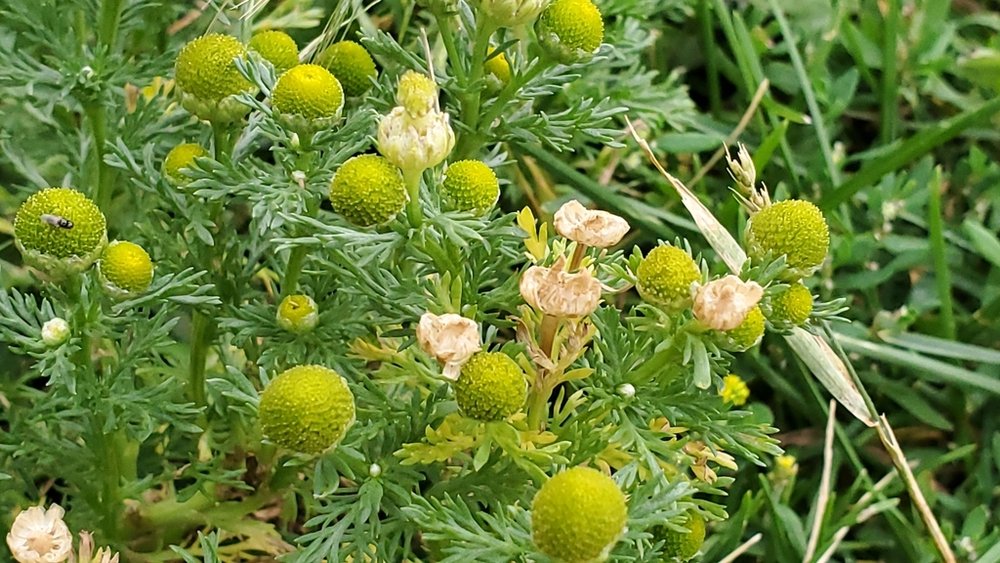
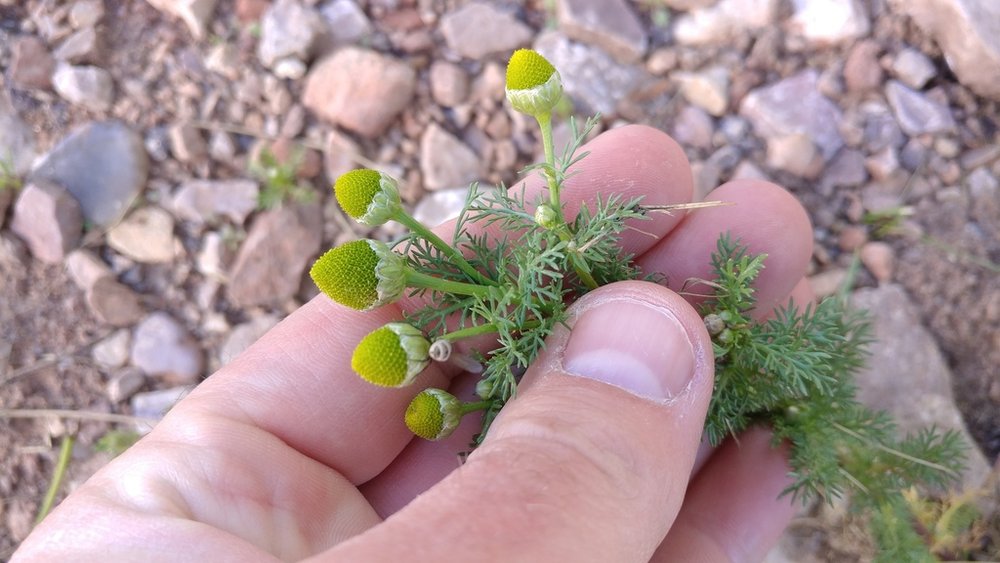
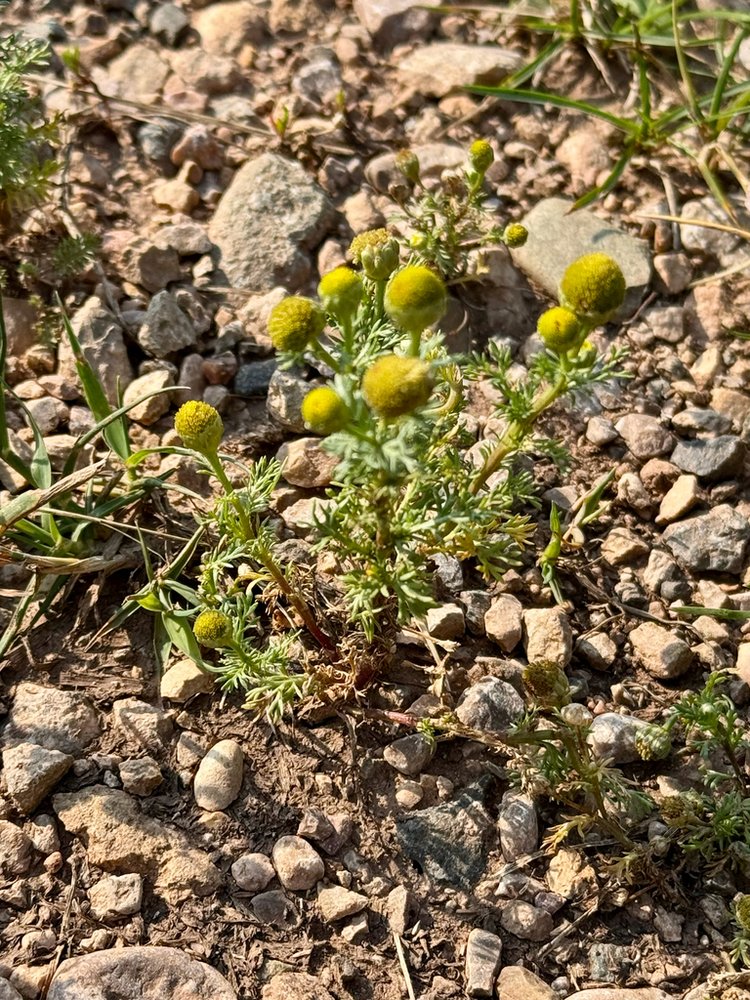
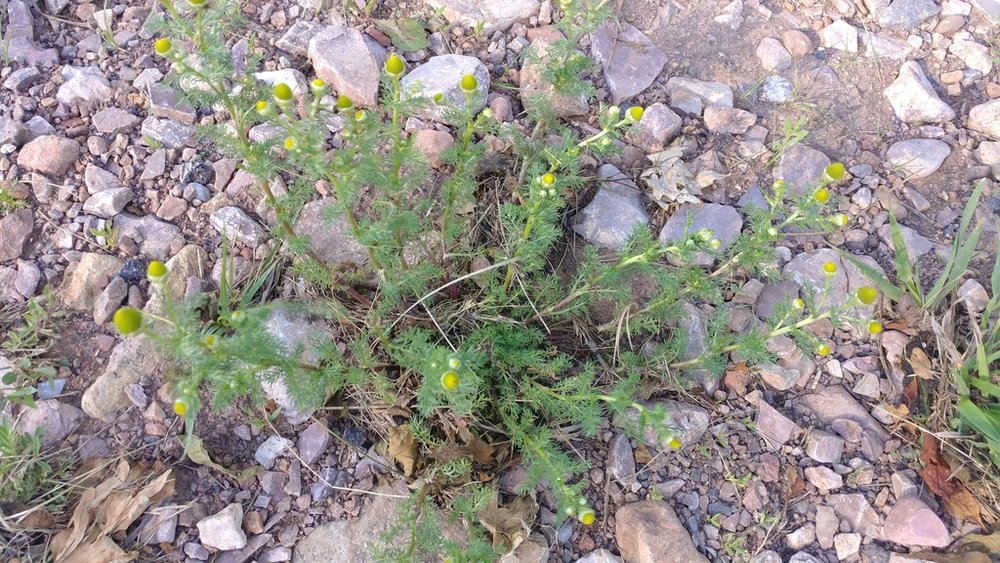
Pineapple Weed (Matricaria discoidea), also called Disc Mayweed, is a low annual with feathery leaves and round, greenish-yellow flower heads that have no petal-like rays and smell of pineapple when crushed. It blooms from May into September on roadsides, gravel and other disturbed ground, and herbarium specimens from Lawrence, Pennington and Custer counties in South Dakota and Crook County in Wyoming are on record.
Free photos from other sources
| Family | Asteraceae · Aster |
|---|---|
| Status | Introduced annual |
| Blooms | May into September |
| Height | 7–30 cm (3–12 in) |
| Where | Roadsides, gravel, barnyards and other disturbed ground, in sun or part shade |
| Also called | Disc Mayweed, Pineappleweed, Rayless Mayweed, Wild Chamomile, skuyómna (Lakota) |
| Synonym | Chamomilla suaveolens, Lepidotheca suaveolens, Tanacetum suaveolens |
| Traditional use | Moerman's ethnobotany database (BRIT) records that the Crow dried and crushed the plant to line baby cradles (Hart 1992), that the Blackfoot used the dried blossoms as an insect repellent (Johnston 1987) and as perfume (McClintock 1909), and that the Cheyenne used the dried, pulverized flowers and leaves, with sweet grass, horse mint and sweet pine, as a perfume (Grinnell 1972). Black Elk and Flying By 1998 (entry 185) say the flowers made a pineapple-scented tea. |
| Note | Sources disagree on where it is native. Washington State University Extension calls it native to North America and Missouri Plants native to the western U.S.; Illinois Wildflowers says it came to Illinois from the Pacific Northwest, and Minnesota Wildflowers says it may have come from there or from Asia. USDA PLANTS lists it as introduced in the lower 48 states, and the 1986 survey of Jewel Cave's vegetation and Black Elk and Flying By (1998) both mark it as introduced, so this guide calls it introduced. |
Roots, seeds & germination
Root: A branching taproot (Illinois Wildflowers); Missouri Plants also calls it a taprooted annual.
Seed: Each disk flower is replaced by an oblong seed (achene) 0.9–1.2 mm (about 1/25 in) long, with no tuft of hairs and 3 to 5 small ribs (Illinois Wildflowers; Missouri Plants). The plant spreads by reseeding itself (Illinois Wildflowers) and tends to form colonies (Minnesota Wildflowers).
How do you identify Pineapple Weed?
Look for a low, branching annual 7–30 cm (3–12 in) tall with feathery, fern-like leaves cut into narrow segments, up to 5 cm (2 in) long, and small dome-shaped or cone-shaped greenish-yellow flower heads 6–8 mm (¼–⅓ in) across at the ends of the branches. The heads have no ray flowers (the petal-like flowers around the edge of a daisy). They are made only of tiny disk flowers, each with 4 small lobes, and the bracts around the base of the head have papery, whitish edges (Minnesota Wildflowers; Illinois Wildflowers). The leaves are alternate, and the stems and leaves are mostly hairless (Minnesota Wildflowers; Illinois Wildflowers). Crushed leaves and heads smell like pineapple (Illinois Wildflowers; Washington State University Extension). Mayweed Chamomile (Anthemis cotula) looks similar but has white ray flowers and a repulsive odor (Washington State University Extension), and Illinois Wildflowers says Pineapple Weed lacks the white rays of the mayweeds and chamomiles that share its finely cut leaves. The seeds are small and have no tuft of hairs (Minnesota Wildflowers).
When does it bloom?
May into September.
Where does it grow?
Roadsides and waste areas, in dry soil and in sun or part shade (Minnesota Wildflowers); Illinois Wildflowers adds gravelly or compacted ground, stony pasture slopes, barnyards, the edges of driveways, and gravelly ground along railroads and roads, and says disturbed ground is strongly preferred. GBIF holds 54 preserved specimens from the Black Hills counties: Lawrence 28, Pennington 15, Custer 5 and Butte 1 in South Dakota, and Crook 5 in Wyoming; the oldest, from Custer County, was collected in 1914 in a barnyard, and other labels give roadsides, wasteland and weeds about houses. The plant lists of Jewel Cave National Monument, Mount Rushmore National Memorial and Devils Tower National Monument record it as present, and the 1986 survey of Jewel Cave's vegetation lists it under the older name Matricaria matricarioides and marks it as introduced. iNaturalist has 69 research-grade records from the Black Hills and its foothills, dated May to October. It isn't on South Dakota's state noxious weed list or its locally noxious (county) list, or on Wyoming's state designated weed list or weed-seed lists.
Aster family (Asteraceae): 62 other plants in this guide
- Aromatic Aster
- Arrowleaf Balsamroot
- Arrowleaf Sweet Coltsfoot
- Bachelor's Button
- Balsam Ragwort
- Black-eyed Susan
- Blanket Flower
- Blue Lettuce
- Broom Snakeweed
- Bull Thistle
- Canada Hawkweed
- Canada Lettuce
- Canada Thistle
- Chicory
- Common Burdock
- Common Dandelion
- Common Sunflower
- Common Tansy
- Common Yarrow
- Curlycup Gumweed
- Cutleaf Coneflower
- Dotted Gayfeather
- Drummond's Thistle
- Easter Daisy
- False Boneset
- Fetid Marigold
- Field Pussytoes
- Fringed Sagewort
- Hairy Golden Aster
- Heart-leaved Arnica
- Hooker's Townsend Daisy
- Horseweed
- Jerusalem Artichoke
- Lambstongue Groundsel
- Maximilian Sunflower
- Missouri Goldenrod
- Mountain Dandelion
- Musk Thistle
- Oxeye Daisy
- Pearly Everlasting
- Prairie Coneflower
- Prairie False Dandelion
- Purple Coneflower
- Rocky Mountain Blazing Star
- Rosy Pussytoes
- Rubber Rabbitbrush
- Rush Skeletonplant
- Scotch Thistle
- Silver Sagebrush
- Smooth Blue Aster
- Spotted Joe-Pye Weed
- Stemless Four-nerve Daisy
- Stiff Goldenrod
- Stiff Sunflower
- Threenerve Fleabane
- Wavyleaf Thistle
- Western Ragweed
- White Hawkweed
- White Prairie Aster
- White Sagebrush
- Woolly Groundsel
- Yellow Salsify
Sources: Minnesota Wildflowers: Matricaria discoidea (Pineapple-weed); Illinois Wildflowers: Pineapple Weed (Matricaria discoidea); Missouri Plants: Matricaria discoidea (Pineapple Weed); Washington State University Extension, HortSense: Weeds, Pineappleweed (Matricaria discoidea); USDA PLANTS Database: Matricaria discoidea (MADI6), introduced in the lower 48 states; USDA PLANTS Database: synonyms of Matricaria discoidea (MADI6); Native American Ethnobotany Database (BRIT): Matricaria discoidea; Culturally Important Plants of the Lakota (Black Elk and Flying By, Sitting Bull College, 1998), entry 185; NPSpecies checklist, Jewel Cave National Monument (vascular plants); NPSpecies checklist, Mount Rushmore National Memorial (vascular plants); NPSpecies checklist, Devils Tower National Monument (vascular plants); A Survey of the Vegetation of Jewel Cave National Monument (Marriott and Hartman, University of Wyoming, 1986); GBIF occurrence search: Matricaria discoidea, preserved specimens, South Dakota (51) and Wyoming (28); iNaturalist: Matricaria discoidea research-grade observations in the Black Hills; South Dakota DANR: State Noxious Weed and Pest List; South Dakota DANR: Locally Noxious Weed and Pest List (county designations, PDF); Wyoming Weed and Pest Council: Identify Weeds (state designated weeds); Wyoming rule 010-63 Wyo. Code R. 63-3: Prohibited Noxious Weeds (weed-seed list); Wyoming rule 010-63 Wyo. Code R. 63-4: Restricted Noxious Weeds (weed-seed list).