White Prairie Aster Symphyotrichum falcatum
Also called Western Heath Aster, White Aster, čhaŋȟlóǧaŋ pȟépȟela (Lakota)
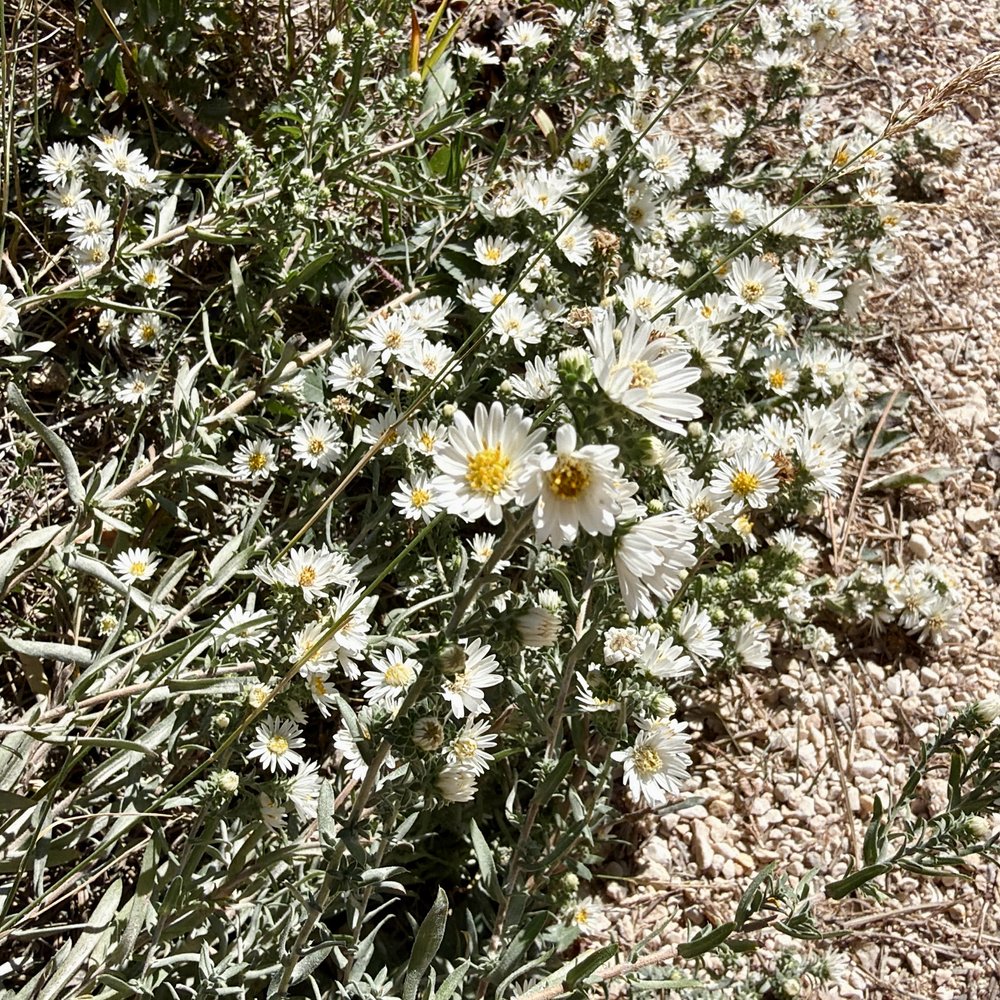
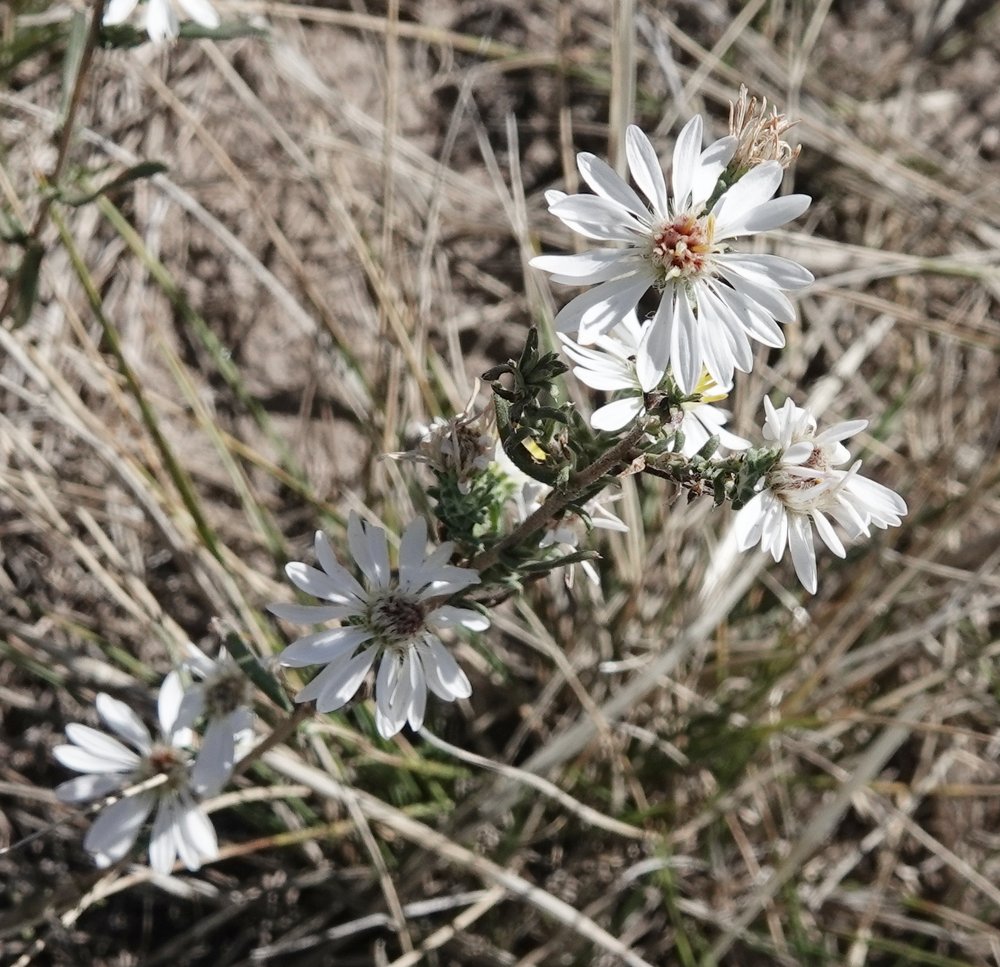
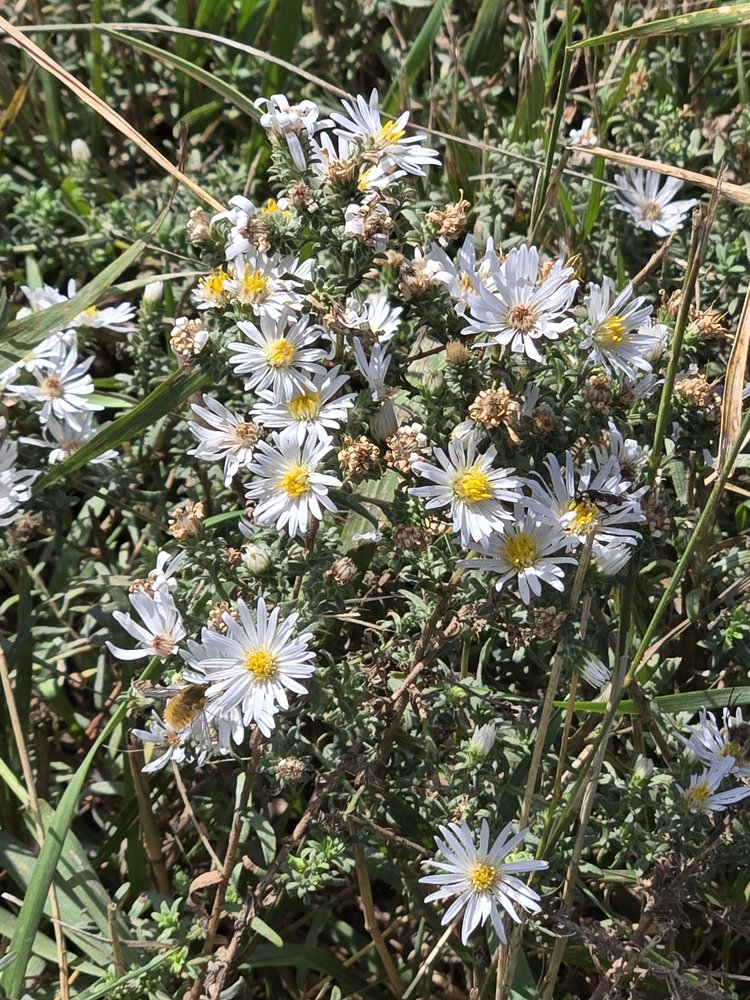
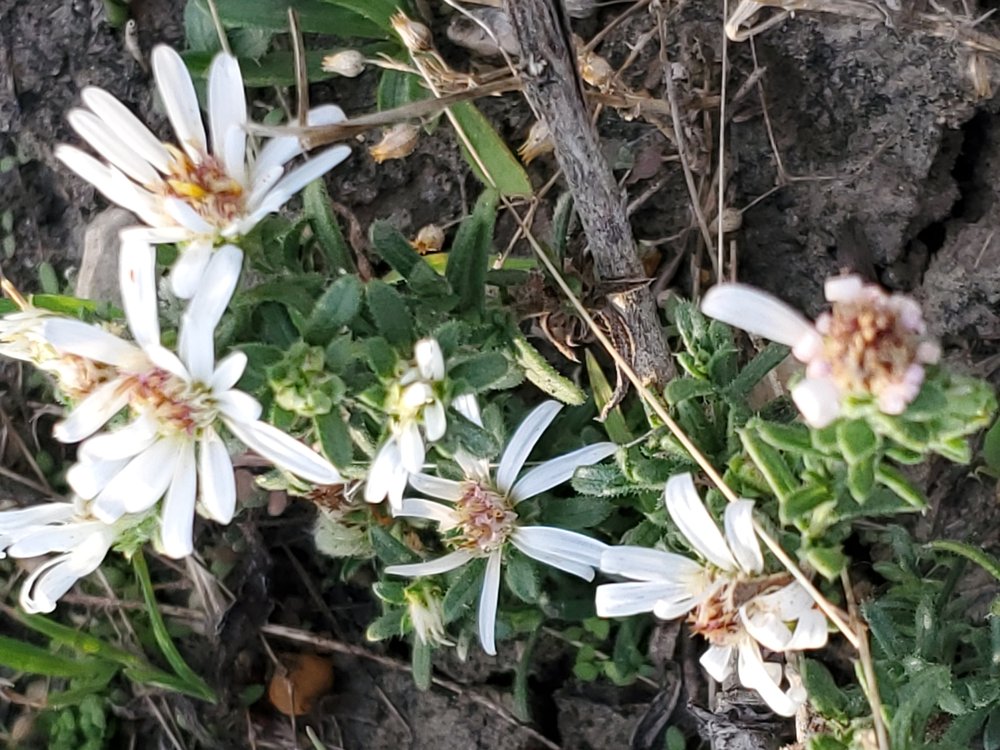
White Prairie Aster (Symphyotrichum falcatum) is a native perennial of the aster family, 10–80 cm (4–31 in) tall, with hairy stems, narrow gray-green leaves and many small white heads whose yellow centers turn brown with age. It blooms in August and September on dry prairie, roadsides and open pine woods, and in the Black Hills the National Park Service lists it at Wind Cave, Jewel Cave, Mount Rushmore and Devils Tower.
Free photos from other sources
| Family | Asteraceae · Aster |
|---|---|
| Status | Native perennial |
| Blooms | August and September |
| Height | 10–80 cm (4–31 in) |
| Where | Dry prairie, grassland and meadows, roadsides, stream banks and open ponderosa pine woods |
| Also called | Western Heath Aster, White Aster, čhaŋȟlóǧaŋ pȟépȟela (Lakota) |
| Synonym | Aster falcatus, Aster commutatus, Virgulus falcatus |
| Note | Black Elk and Flying By (1998) list it with Heath Aster under one Lakota name, čhaŋȟlóǧaŋ pȟépȟela, and note that deer and pronghorn graze both. |
Roots, seeds & germination
Root: Two varieties grow from different roots. Var. commutatum, the form on the Jewel Cave and Devils Tower lists, spreads by tangled rhizomes (underground stems) and sends up new shoots at the ends of long rhizomes, so it forms colonies, usually with one stem per shoot. Var. falcatum grows in tufts of 1 to 5 stems from a corm-like, branched woody crown.
Seed: Each head makes dark brown, egg-shaped, faintly ribbed seeds 2–2.5 mm long, densely covered in short stiff hairs, each topped by a whitish pappus (a tuft of bristles) 4.5–6 mm long.
How do you identify White Prairie Aster?
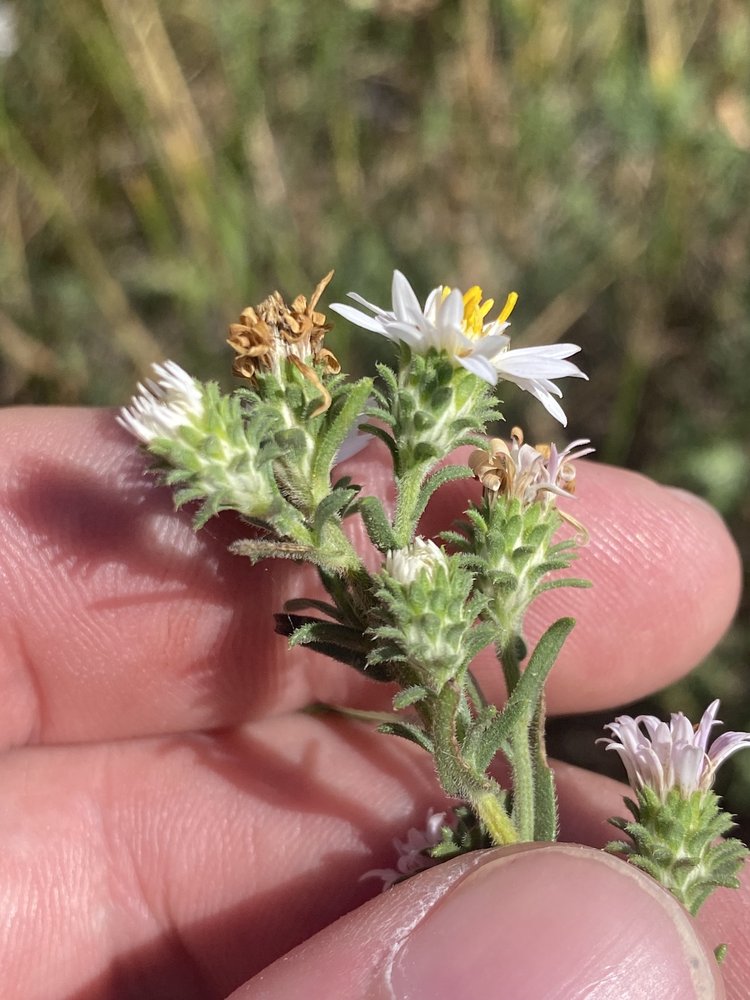
Look for a hairy, grayish plant with many small heads in an open, leafy, branching cluster. Each head has 15 to 35 narrow white rays and 8 to 30 yellow disc florets that turn brown with age, and the cup of bracts under it is 4.5–8 mm (about ¼ in) tall, with spine-tipped bracts in 3 or 4 unequal rows, green above and white below, the outer ones spreading or curved back. The leaves are narrow, stalkless, untoothed and firm, light gray-green and 2–5 cm (1–2 in) long, and the stems and leaves are covered in short curly hairs. Heath Aster (Symphyotrichum ericoides) is the one plant Flora of North America says it closely resembles: Heath Aster has smaller heads with fewer florets in denser clusters, and on the Great Plains the two can be hard to tell apart. Smooth Blue Aster, also on this site, has light purple heads and bluish-green leaves that clasp the stem.
When does it bloom?
August and September.
Where does it grow?
Dry, open ground from the plains into the mountains: prairie and grassland, dry meadows, roadsides, stream banks and open ponderosa pine woods. The National Park Service lists it as present at Wind Cave, Jewel Cave, Mount Rushmore and Devils Tower, the 1986 plant survey of Jewel Cave lists it, and the Devils Tower native plants page lists it among the wildflowers seen along its trails. Herbarium specimens from 1892 to 2013 come from Lawrence, Pennington, Custer, Meade and Fall River counties and from Crook and Weston counties in Wyoming, with labels naming prairie, open roadsides, trail margins through conifer forest, creek sides and open ponderosa pine woods in the Bear Lodge Mountains at 1,716 m (5,630 ft).
Other asters in this guide
Aster family (Asteraceae): 62 other plants in this guide
- Aromatic Aster
- Arrowleaf Balsamroot
- Arrowleaf Sweet Coltsfoot
- Bachelor's Button
- Balsam Ragwort
- Black-eyed Susan
- Blanket Flower
- Blue Lettuce
- Broom Snakeweed
- Bull Thistle
- Canada Hawkweed
- Canada Lettuce
- Canada Thistle
- Chicory
- Common Burdock
- Common Dandelion
- Common Sunflower
- Common Tansy
- Common Yarrow
- Curlycup Gumweed
- Cutleaf Coneflower
- Dotted Gayfeather
- Drummond's Thistle
- Easter Daisy
- False Boneset
- Fetid Marigold
- Field Pussytoes
- Fringed Sagewort
- Hairy Golden Aster
- Heart-leaved Arnica
- Hooker's Townsend Daisy
- Horseweed
- Jerusalem Artichoke
- Lambstongue Groundsel
- Maximilian Sunflower
- Missouri Goldenrod
- Mountain Dandelion
- Musk Thistle
- Oxeye Daisy
- Pearly Everlasting
- Pineapple Weed
- Prairie Coneflower
- Prairie False Dandelion
- Purple Coneflower
- Rocky Mountain Blazing Star
- Rosy Pussytoes
- Rubber Rabbitbrush
- Rush Skeletonplant
- Scotch Thistle
- Silver Sagebrush
- Smooth Blue Aster
- Spotted Joe-Pye Weed
- Stemless Four-nerve Daisy
- Stiff Goldenrod
- Stiff Sunflower
- Threenerve Fleabane
- Wavyleaf Thistle
- Western Ragweed
- White Hawkweed
- White Sagebrush
- Woolly Groundsel
- Yellow Salsify
Sources: USDA PLANTS Database: Symphyotrichum falcatum (SYFA); GBIF species page: Symphyotrichum falcatum (Lindl.) G.L.Nesom; NPSpecies checklist, Wind Cave National Park vascular plants; NPSpecies checklist, Jewel Cave National Monument vascular plants; NPSpecies checklist, Mount Rushmore National Memorial vascular plants; NPSpecies checklist, Devils Tower National Monument vascular plants; Marriott and Hartman 1986, A Survey of the Vegetation of Jewel Cave National Monument; National Park Service, Devils Tower National Monument: Native Plants; Flora of North America Vol. 20: Symphyotrichum falcatum, eFloras; University of Waterloo Astereae Lab (J. C. Semple): Symphyotrichum falcatum; Montana Field Guide: White Prairie Aster, Symphyotrichum falcatum; Black Hills National Forest: Black Hills native plants (Smooth Blue Aster entry); GBIF occurrence search: Symphyotrichum falcatum herbarium specimens, South Dakota and Wyoming; Culturally Important Plants of the Lakota (Black Elk and Flying By, 1998), filed with the South Dakota PUC.