Asters of the Black Hills
All 4 asters in this guide, side by side, A to Z. Compare the photos, bloom time, height and where each grows, then open the one that fits for more photos and the full ID notes. Each plant's page lists its sources.
| Plant | Color | Blooms | Height | Where | How to tell it apart |
|---|---|---|---|---|---|
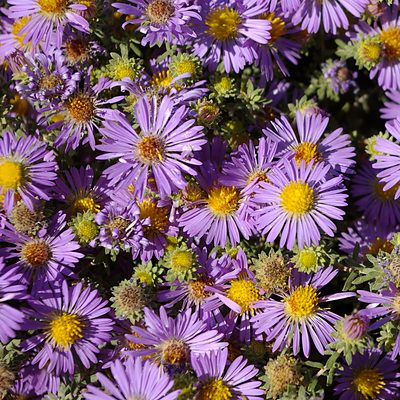 Aromatic AsterSymphyotrichum oblongifolium | Purple | August and September | 10–80 cm (4–31 in) | Dry, open, rocky or sandy ground | Crush a leaf: the flowers have no scent, but the leaves give off a pleasant smell. Leaves are narrow, stalkless and rough, and the bracts under each head (the small scales that cup it) have gland-tipped hairs and loose, spreading green tips. Each head has about 20 to 35 rays. Threenerve Fleabane has far more, 100 to 150. |
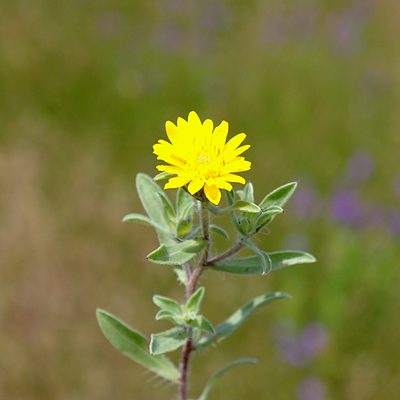 Hairy Golden AsterHeterotheca villosa | Yellow | July into September | 10–50 cm (4–20 in) | Dry grasslands, meadows and open forest; sandy or gravelly soil | Look for low, sprawling to upright stems with small stalkless leaves about 2.5 cm (1 in) long, gray-green from their hairs and often twisted or wavy. The heads have 10 to 35 yellow rays around a small yellow center, with green bracts in 4 to 6 overlapping layers below. |
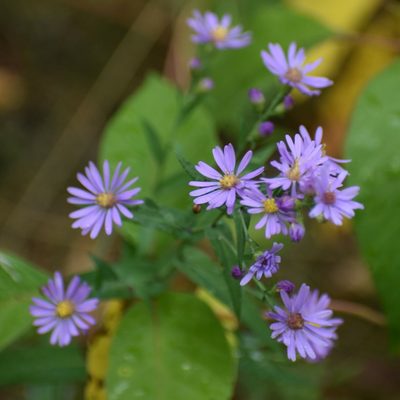 Smooth Blue AsterSymphyotrichum laeve | Purple, Blue | Late July into October, mostly August and September | 30–100 cm (12–40 in) | Open pine woods, meadows, rocky hillsides, roadsides and prairies | Check the leaves first: they are hairless, thick, slightly waxy and blue-green, often without teeth, and the upper ones have no stalk and wrap around the stem at the base. The stem is smooth too, often with a bluish or reddish cast. Heads are up to about 2.5 cm (1 in) across, with 15–25 light blue to lavender rays around a yellow center that turns reddish with age, in an open, branching cluster. |
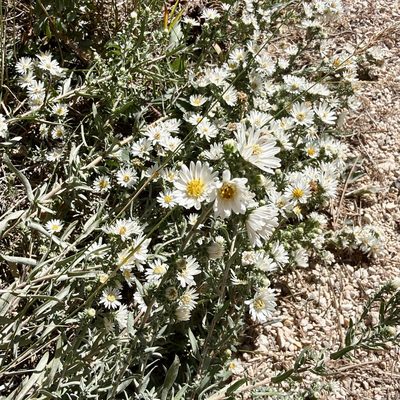 White Prairie AsterSymphyotrichum falcatum | White | August and September | 10–80 cm (4–31 in) | Dry prairie, grassland and meadows, roadsides, stream banks and open ponderosa pine woods | Look for a hairy, grayish plant with many small heads in an open, leafy, branching cluster. Each head has 15 to 35 narrow white rays and 8 to 30 yellow disc florets that turn brown with age, and the cup of bracts under it is 4.5–8 mm (about ¼ in) tall, with spine-tipped bracts in 3 or 4 unequal rows, green above and white below, the outer ones spreading or curved back. The leaves are narrow, stalkless, untoothed and firm, light gray-green and 2–5 cm (1–2 in) long, and the stems and leaves are covered in short curly hairs. Heath Aster (Symphyotrichum ericoides) is the one plant Flora of North America says it closely resembles: Heath Aster has smaller heads with fewer florets in denser clusters, and on the Great Plains the two can be hard to tell apart. Smooth Blue Aster, also on this site, has light purple heads and bluish-green leaves that clasp the stem. |
Other look-alike groups: 38 groups
- Anemones (4)
- Beardtongues (5)
- Buttercups (3)
- Cacti (4)
- Cinquefoils (7)
- Clovers (6)
- Coneflowers (4)
- Currants and gooseberries (5)
- Daisies (5)
- Dandelions (3)
- Docks and buckwheats (4)
- Evening primroses (4)
- Ferns (4)
- Gentians (4)
- Grasses (11)
- Groundsels and ragworts (3)
- Lilies (5)
- Mayflowers and false Solomon's seals (3)
- Milkvetches and locoweeds (12)
- Milkweeds (6)
- Mints (8)
- Mustards (11)
- Orchids (8)
- Paintbrushes (3)
- Pines (3)
- Raspberries and thimbleberries (3)
- Sagebrushes and sageworts (3)
- Sedges (3)
- Speedwells and kittentails (3)
- Sunflowers (4)
- Thistles (6)
- Vervains (3)
- Vetches (4)
- Violets (7)
- Wild lettuces (3)
- Wild onions (3)
- Wild plums and cherries (3)
- Willows (3)