Mayflowers and false Solomon's seals of the Black Hills
All 3 mayflowers and false Solomon's seals in this guide, side by side, A to Z. Compare the photos, bloom time, height and where each grows, then open the one that fits for more photos and the full ID notes. Each plant's page lists its sources.
| Plant | Color | Blooms | Height | Where | How to tell it apart |
|---|---|---|---|---|---|
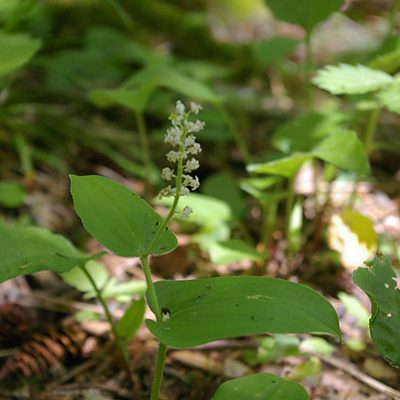 Canada MayflowerMaianthemum canadense | White | Late May and June | 8–20 cm (3–8 in) | Moist, shady floors of spruce, aspen, birch and pine forest, creek bottoms and north slopes | Look for patches of single heart-based leaves rising from the ground, with a few stems 8–20 cm (3–8 in) tall that zigzag between two, rarely three, alternate leaves of unequal size, each oval with a heart-shaped base, a pointed tip and parallel veins, toothless, up to 7.5 cm (3 in) long, hairless on top and sometimes finely hairy underneath. One dense spike-like cluster 2.5–6 cm (1–2½ in) long tops each flowering stem; each tiny flower, about 6–9 mm (¼–⅜ in) across, has 4 white tepals that curve back and 4 stamens that stick out like the points of a star, and the tepals drop soon after blooming. The berries are green speckled with red and ripen dark red in late summer. Canada Mayflower looks like a dwarf Starry False Solomon's Seal, but unlike that plant its flowering stalk usually has only two leaves, and its flowers have just 4 tepals and 4 stamens, where most plants of the old lily family have 6 of each. |
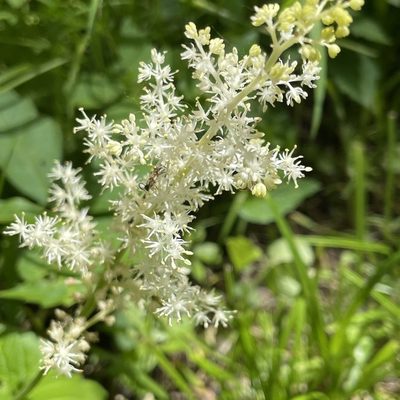 Feathery False Solomon's SealMaianthemum racemosum | White | May into July | 35–80 cm (14–31 in) | Moist woods and thickets, in part shade or shade, including creek canyons, ravines and floodplain woods | Look for a perennial from a whitish rhizome (an underground stem) with a simple, unbranched stem, erect to arching and finely hairy, that zig-zags between the alternate leaves. The leaves are lance-shaped to elliptical, 6–15 cm (2½–6 in) long and 2–7 cm (¾–2¾ in) wide, in two rows, stalkless or on a very short stalk, with a rounded base, a pointed tip, edges that are slightly wavy but without teeth, hairs on the underside and heavy parallel veins. At the stem tip is a plume-like cluster (a panicle) 8–13 cm (3–5 in) long and about 5 cm (2 in) across, with up to 80 star-shaped flowers, each about 3 mm (⅛ in) across, with 3 white petals and 3 petal-like sepals that look like 6 petals, and cream to pale yellow stamen tips. The fruit is a cluster of waxy berries 4–6 mm (⅛–¼ in) across that go from green to red, or on to purple (South Dakota State University), and Minnesota Wildflowers says they are bright red when ripe. Minnesota Wildflowers compares it with two plants in this guide. Starry False Solomon's Seal prefers sunnier places, has fewer, larger flowers, a stem that is often more upright, and leaves that are narrower and stiffer. Smooth Solomon's Seal carries its flowers on the underside of the arching stem instead of in a plume at the end. |
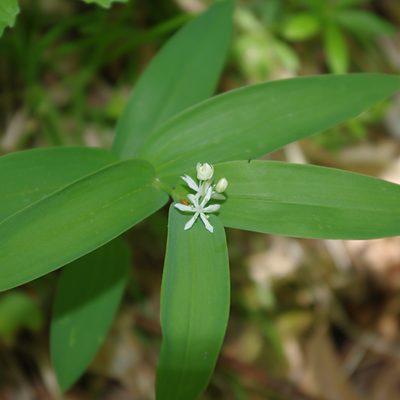 Starry False Solomon's SealMaianthemum stellatum | White | May through June, a few into July | 15–65 cm (6–26 in) | Pine, spruce and aspen woods, wooded stream banks and forest edges | Look for an unbranched stem 15–65 cm (6–26 in) tall that leans a little and bends slightly at each leaf, with about 7–9 narrow, lance-shaped, stalkless leaves in two flat rows, parallel-veined and often folded along the midrib. At the tip is one short spike of about 5–20 white, six-pointed star flowers about 1 cm (⅜ in) across. The round berries are green with dark stripes at first and ripen to reddish purple or red. Feathery False Solomon's Seal has more, smaller flowers and wider leaves that do not clasp the stem, and Smooth Solomon's Seal carries its flowers along the underside of the arching stem instead of in a cluster at the tip. |
Other look-alike groups: 38 groups
- Anemones (4)
- Asters (4)
- Beardtongues (5)
- Buttercups (3)
- Cacti (4)
- Cinquefoils (7)
- Clovers (6)
- Coneflowers (4)
- Currants and gooseberries (5)
- Daisies (5)
- Dandelions (3)
- Docks and buckwheats (4)
- Evening primroses (4)
- Ferns (4)
- Gentians (4)
- Grasses (11)
- Groundsels and ragworts (3)
- Lilies (5)
- Milkvetches and locoweeds (12)
- Milkweeds (6)
- Mints (8)
- Mustards (11)
- Orchids (8)
- Paintbrushes (3)
- Pines (3)
- Raspberries and thimbleberries (3)
- Sagebrushes and sageworts (3)
- Sedges (3)
- Speedwells and kittentails (3)
- Sunflowers (4)
- Thistles (6)
- Vervains (3)
- Vetches (4)
- Violets (7)
- Wild lettuces (3)
- Wild onions (3)
- Wild plums and cherries (3)
- Willows (3)