Sedges of the Black Hills
All 3 sedges in this guide, side by side, A to Z. Compare the photos, bloom time, height and where each grows, then open the one that fits for more photos and the full ID notes. Each plant's page lists its sources.
| Plant | Blooms | Height | Where | How to tell it apart |
|---|---|---|---|---|
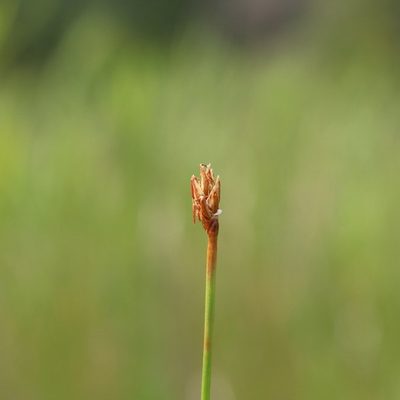 Beaked SpikerushEleocharis rostellata | July and August in the Rocky Mountain region (no Black Hills flowering dates found) | 20–100 cm (8–40 in) | Warm, mineral-rich seeps with saturated to flooded ground | Look for dense tufts of wiry, slightly flattened stems with no leaf blades, only sheaths at the base, each fertile stem ending in a single egg-shaped spikelet 5–17 mm long with 20 to 40 straw-colored to brown scales. Its best mark, according to the Forest Service, is the way some stems arch over or lie down and root from a bud at the tip, starting new plants. The uppermost leaf sheath is dark red to brown at the base, and the seed is 1.5–2.5 mm long with a short beak. |
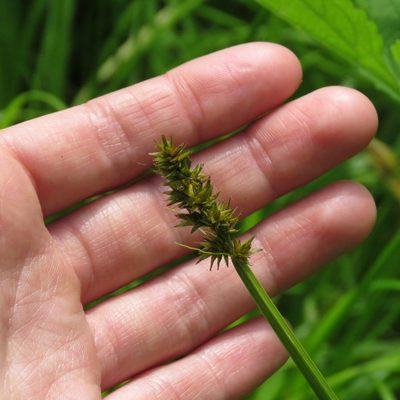 Foxtail SedgeCarex alopecoidea | Fruits in June and July | 40–80 cm (15–32 in) | Wet meadows, stream banks and the moist edges of wetlands, especially on lime-rich ground | Look for a dense, cylindrical cluster 2–4 cm (¾–1½ in) long of 8 to 12 stalkless spikes crowded into one bristly head, each spike with male flowers at its tip and female flowers below; the bract under the lowest spike ends in a bristle that often reaches past that spike. The stem is up to 80 cm (32 in) tall, strongly three-sided with narrow wings on the angles, and stout but spongy, so it squeezes easily. The front of each leaf sheath is smooth, thin and fragile, whitish with red to purple dots. The fruit sacs are 3–4 mm long, tan to coppery, widest at the rounded base, with a toothed beak nearly as long as the body. Flora of North America says it is most like Carex conjuncta, a sedge of the eastern and central states not recorded in South Dakota, which has wrinkled sheath fronts and 3 to 5 strong veins on the back of each fruit sac. |
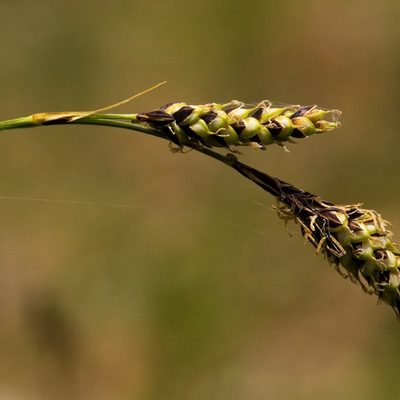 Southwestern Showy SedgeCarex bella | July and August | 45–90 cm (18–36 in) | Cool, moist, shaded spruce and birch forest among granite outcrops and boulders at the heads of small streams | Look for three or four spikes, each 12–25 mm (½–1 in) long, set apart from one another on long thin stalks and hanging or nodding, each with female flowers above and male flowers at the base. The scales are light to dark brown with thin, clear edges and a lighter, often raised midvein, and are about as broad as the fruit sacs; the fruit sacs are pale green or pale yellow, veinless, 3–4 mm long, with a very short beak. The stems grow in clumps and are rough toward the base, with leaves 3–6 mm wide; the bract below the lowest spike can be shorter or longer than the whole head. |
Other look-alike groups: 38 groups
- Anemones (4)
- Asters (4)
- Beardtongues (5)
- Buttercups (3)
- Cacti (4)
- Cinquefoils (7)
- Clovers (6)
- Coneflowers (4)
- Currants and gooseberries (5)
- Daisies (5)
- Dandelions (3)
- Docks and buckwheats (4)
- Evening primroses (4)
- Ferns (4)
- Gentians (4)
- Grasses (11)
- Groundsels and ragworts (3)
- Lilies (5)
- Mayflowers and false Solomon's seals (3)
- Milkvetches and locoweeds (12)
- Milkweeds (6)
- Mints (8)
- Mustards (11)
- Orchids (8)
- Paintbrushes (3)
- Pines (3)
- Raspberries and thimbleberries (3)
- Sagebrushes and sageworts (3)
- Speedwells and kittentails (3)
- Sunflowers (4)
- Thistles (6)
- Vervains (3)
- Vetches (4)
- Violets (7)
- Wild lettuces (3)
- Wild onions (3)
- Wild plums and cherries (3)
- Willows (3)