Milkvetches and locoweeds of the Black Hills
All 12 milkvetches and locoweeds in this guide, side by side, A to Z. Compare the photos, bloom time, height and where each grows, then open the one that fits for more photos and the full ID notes. Each plant's page lists its sources.
| Plant | Color | Blooms | Height | Where | How to tell it apart |
|---|---|---|---|---|---|
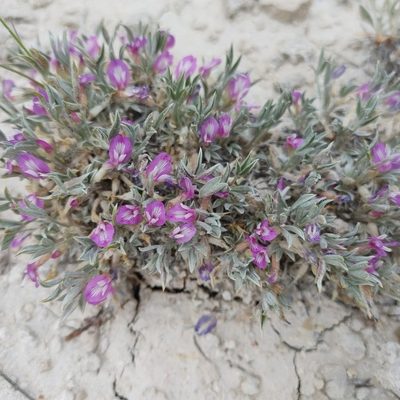 Barr's MilkvetchAstragalus barrii | Purple | May into June | Low mat; leaves 1–4 cm (½–1½ in) long | Barren clay, siltstone and sandstone buttes, gullied knolls and badland slopes, in limy soil | Look for a low, dense mat or cushion of silvery leaves (Center for Plant Conservation). Each leaf is 1–4 cm (½–1½ in) long with 3 narrow, lance-shaped leaflets, densely covered with short white hairs, and has thin, papery stipules (small leaf-like flaps) at its base (USDA Forest Service; Montana Field Guide). The pea-shaped flowers are purple or pinkish purple, with petals 7–17 mm (¼–⅔ in) long, in a narrow, open cluster of a few flowers; the calyx (the cup behind the petals) is 3–5 mm (⅛–¼ in) long and thick with long white hairs. The pod is narrowly oval, 4–8 mm (⅙–⅓ in) long and only 1–2 mm wide, with a few white hairs (USDA Forest Service; Montana Field Guide). The Montana Field Guide calls the flowers small, iridescent and bluish purple to bluish pink, fading as they dry, sometimes to yellowish white, and says that on steep slopes the cushions often sit on small pedestals of soil they have kept from eroding. It says flowers are needed to tell it from four other mat-forming, three-leaflet milkvetches: two have flowers about half the size and denser mats, and two have larger, cream to whitish flowers and calyx tubes 6–16 mm long. None of those four is in this guide. |
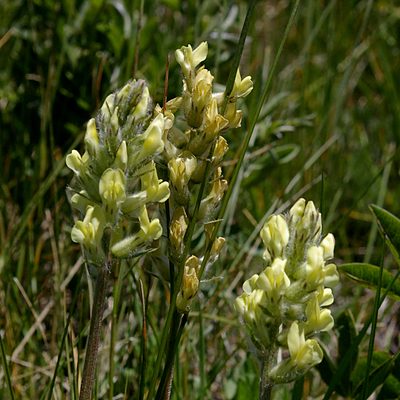 Canada MilkvetchAstragalus canadensis | White | May into August | 30–120 cm (12–47 in) | Moist prairies, riverbanks and open wooded hillsides | Dense, spike-like clusters of 30 to 100 narrow, creamy pea flowers stand on stalks from the leaf axils, above compound leaves with 11 to 35 blunt-tipped leaflets. The pods are the best mark: they stand upright and are smooth, oval and two-chambered, 9–15 mm long. American Milkvetch has loose clusters of 10 to 30 nodding flowers and hanging, bladdery pods. Stems can turn red in strong sun. |
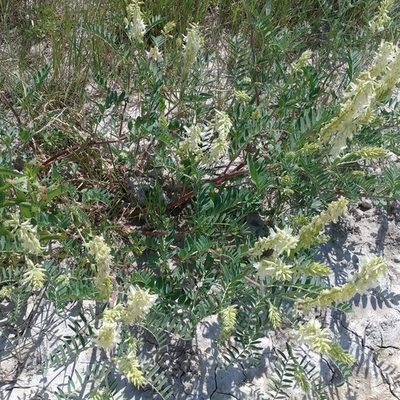 Cream MilkvetchAstragalus racemosus | White | May into July | 15–70 cm (6–28 in) | Clay and alkaline soils on prairie, hillsides, roadsides, stream valleys and open woods | Look for clumps of upright to sprawling, branched stems, often red near the base, with feathery compound leaves of 11 to 31 narrow leaflets. Loose, drooping spikes of 15 to 70 pea flowers rise from the leaf joints on stalks longer than the leaves. Each flower is 12–19 mm (½–¾ in) long, white to cream, sometimes with purplish tips or streaks, with a bell-shaped calyx (the green cup under the flower) covered in white hairs. The pods are smooth, flattened and drooping, with a pointed tail. Minnesota Wildflowers separates it from Canada Milkvetch (Astragalus canadensis), which has stalkless, tightly packed flowers, an erect two-chambered pod and spreads by rhizomes, where Cream Milkvetch has loose, drooping flowers and a taproot. Black Elk and Flying By (1998) warn not to confuse it with other milkvetches, because this one is poisonous. |
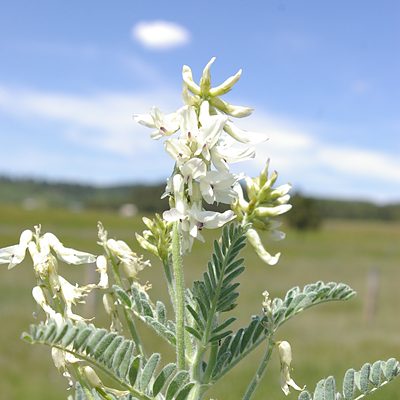 Drummond's MilkvetchAstragalus drummondii | White | May into July, from herbarium labels in Wyoming and Montana (no South Dakota bloom dates found) | 25–60 cm (10–24 in) | Dry grassland, open hills and clay hilltops, and grassy openings in open ponderosa pine woodland | Look for clumps of stout, upright, hollow stems 25–60 cm (10–24 in) tall, covered like the leaves with long, spreading, often wavy hairs. The leaves are 4–10 cm (1½–4 in) long, with 13 to 33 narrow, round-tipped leaflets. Long-stalked spikes of 14 to 50 nodding flowers stand above the leaves; each flower is whitish to pale cream, 1.5–2.5 cm (⅝–1 in) long, with a tubular calyx (the cup of sepals) clothed in black, white or mixed hairs and a keel tipped with dull lilac. The pods hang down on slender stalks 6–11 mm long; they are hairless, 1.5–3.2 cm (⅝–1¼ in) long and grooved underneath, glossy green at first and papery straw-colored when ripe. Barneby's treatment of the genus calls it the only tall, upright milkvetch with shaggy-haired foliage in its range, which makes it easy to recognize. |
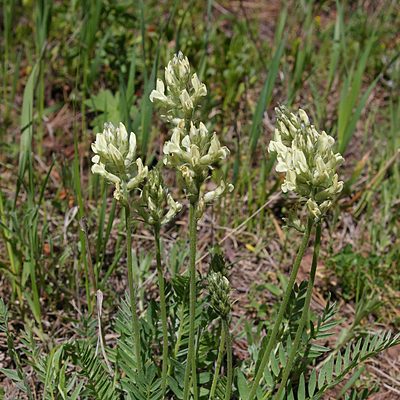 Field LocoweedOxytropis campestris | White, Yellow | April into July | 5–30 cm (2–12 in) | Limestone plateaus, high ridges, gravelly slopes, meadows and open ponderosa pine | Look for a tuft with no leafy stem: every leaf and flower stalk rises from the crown. The leaves are pinnate, 3–20 cm (1–8 in) long, with 11 to 35 leaflets 5–25 mm (¼–1 in) long that are silky with silvery hairs on both sides, and a papery, finely hairy stipule sits at the base of each leaf. The flowers crowd into a dense spike of 8 to 30 at the top of a hairy, leafless stalk 5–25 cm (2–10 in) tall; each is a pea flower 10–20 mm (⅜–¾ in) long, creamy white to pale yellow, now and then tinged purple, with a calyx covered in mixed white and black hairs. The mark that puts it in the locoweeds rather than the milkvetches is the keel, the lowest pair of petals, which ends in a sharp, abrupt point; on a milkvetch (Astragalus) the keel is rounded or pointed but usually not beaked, and the leaves are arranged along the stems. The pods are 10–20 mm (⅜–¾ in) long with a short hooked beak, and their walls stay thin and papery when dry. White Locoweed, listed at Wind Cave, Jewel Cave and Devils Tower, is the closest look-alike: the Montana Field Guide says the two are most alike, with whitish flowers, but that White Locoweed's pods become bony rather than papery and its flowers run somewhat larger, averaging 15 mm; its banner petal is 16–25 mm (⅝–1 in) and its pod walls thick and rigid. Lambert's Crazyweed has magenta flowers that dry purple and a leathery or woody pod. |
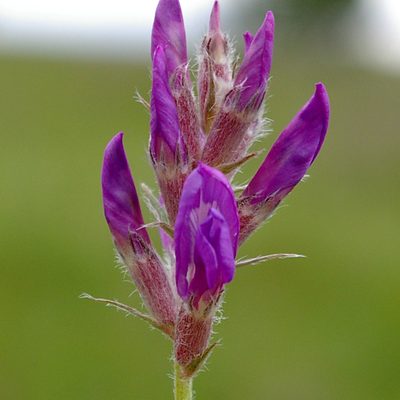 Field MilkvetchAstragalus agrestis | Purple | June and July | 10–30 cm (4–12 in) | Prairies, moist meadows and stream banks | Look for a round to egg-shaped head of light purple flowers, each 1/2 to 3/4 inch long, with long gray to black hairs on the calyx (the cup behind the petals). Leaves have 13 to 21 leaflets, and the stems come up scattered rather than in a dense clump. Prairie Milkvetch has very similar flowers but a far denser cluster of stems. Pods stand erect and are densely white-hairy. |
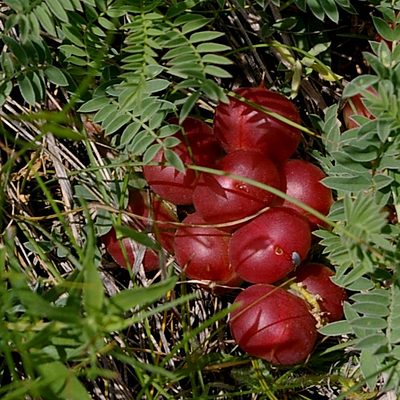 Groundplum MilkvetchAstragalus crassicarpus | Purple | April and May | 11–60 cm (4–24 in) | Prairie hillsides, stream banks and open woods | Look for hairy stems that sprawl on the ground and rise at the tips, leaves split into 13 to 27 small leaflets, and smooth, round pods 15–25 mm long that ripen red to purple. The pods turn woody as they age. |
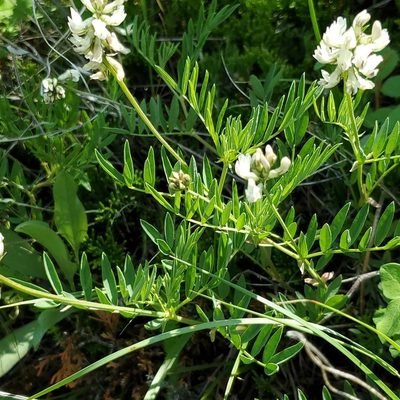 Indian MilkvetchAstragalus australis | White | May into July | 6–40 cm (2–16 in) | Open ponderosa pine woods, grassy slopes and stony ground | Look for a low perennial with long, soft hairs, its stems 6–40 cm (2–16 in) long, spreading or rising from a branched woody base. Each leaf has 7 to 15 narrow leaflets 5–25 mm (¼–1 in) long, and the stipules (small leafy flaps where the leaf joins the stem) of the lower leaves are joined (Montana Field Guide; E-Flora BC). Clusters of 5 to 25 white flowers spread or droop on stalks from the leaf joints. Each flower has a calyx (the cup of sepals behind it) covered in short black hairs, an upturned banner (the upper petal) 7–10 mm (about ⅜ in) long, and a keel 5–8 mm (about ¼ in) long with a purple tip (Montana Field Guide; E-Flora BC also gives the black-haired calyx, the purple tips and flower clusters from the leaf joints). The pod is crescent-shaped, flattened from side to side, 1–2 cm (⅜–¾ in) long, hairless, and hangs on a stalk 2–8 mm (about ⅛–⅓ in) long (Montana Field Guide). The Lady Bird Johnson Wildflower Center gives the height as up to about 50 cm (20 in). Montana Field Guide says the Montana plants are variety glabriusculus, the variety the Jewel Cave and Mount Rushmore plant lists name. |
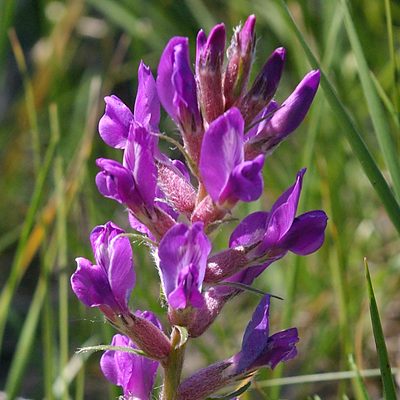 Lambert's CrazyweedOxytropis lambertii | Purple | May into early July | 10–30 cm (4–12 in) | Prairies, plains, river bluffs and hillsides | Leaves and flower stalks all rise from the crown, with no leafy stem, and each silvery leaf has 7 to 19 leaflets. Look at the keel, the lowest petals of the pea flower: on a crazyweed it comes to a point, while on a milkvetch or other Astragalus it is blunt. Woolly locoweed carries its leaves and flowers on stems. |
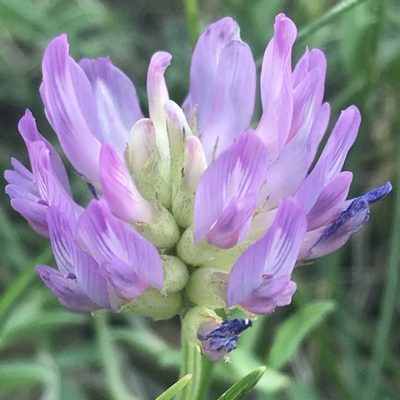 Laxmann's MilkvetchAstragalus laxmannii var. robustior | Purple | Late May into August, mostly June and July | 10–40 cm (4–16 in) | Dry, open grassland, mountain meadows, rocky and limestone slopes, roadsides and open pine | Look for a dense clump of leafy stems from one crown, with 15–50 small pea flowers crowded into an upright, round to cylinder-shaped spike, all pointing upward, on a stout, ribbed stalk that rises from a leaf joint and is usually as long as the leaf or longer. The flowers are lavender to blue, sometimes pink or nearly white, and the cup behind each one has a salt-and-pepper mix of short black and white hairs. Field Milkvetch has similar flowers but grows as scattered stems from underground runners in moister ground, and its pods are shorter and broader, with long white hairs. Lambert's Crazyweed has leaves only at the base, a leafless flower stalk and a keel that ends in a sharp point. |
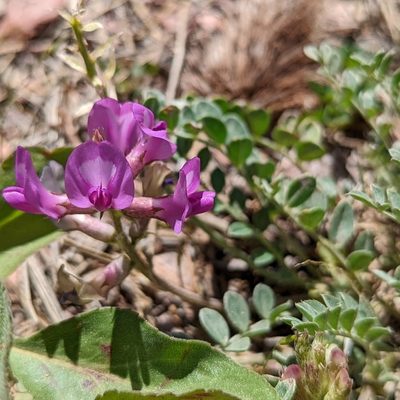 Missouri MilkvetchAstragalus missouriensis | Purple | May into July | 2.5–15 cm (1–6 in) | Dry prairie, hillsides, bluffs and gravelly or clay slopes with sparse cover, and openings in ponderosa pine forest | Look for a low plant whose few short stems lie flat, the whole thing silvery-white to gray-green from straight, shiny hairs pressed against the leaves. Each leaf is divided into 5 to 21 (usually 11 to 17) oval leaflets 3.5–13 mm long, hairy on both sides. Stout flower stalks 3.5–11 cm long rise in flower and lie down in fruit, each with a short loose cluster of 3 to 15 pink-purple flowers; the banner is 9.5–22 mm long with a pale patch in its fold, and the calyx (the cup behind the petals) has mixed black and white hairs. The pod is the other mark: plump, oblong and beaked, 1.4–2.7 cm (½–1 in) long, hairy, turning leathery and black with a wrinkled surface and often staying on the plant into the next year. Barneby's Atlas says that over most of its range the only other low, tufted milkvetch with divided leaves and the same pick-shaped hairs (each hair attached near its middle) is Lotus Milkvetch, and Minnesota Wildflowers separates it from other milkvetches by its gray-green leaves, large upper petal and mostly prostrate growth. Tufted Milkvetch has single-blade leaves, a banner 6.5–9.5 mm long and flattened pods 4–13 mm long. Groundplum Milkvetch has sprawling stems 10–60 cm (4–24 in) long, 15 to 27 leaflets that are sparsely hairy or hairless above, and smooth, fleshy, round to egg-shaped pods. Lambert's Crazyweed has no stems, flower stalks 5–30 cm (2–12 in) tall with 6 to 25 flowers, and cylinder-shaped, silky pods. |
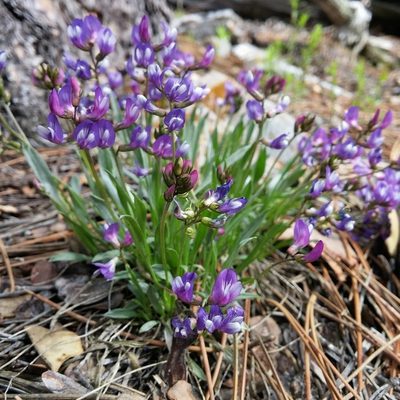 Tufted MilkvetchAstragalus spatulatus | Purple | April into June | Flower stalks 0.4–7 cm (up to 3 in); mats up to 30 cm (12 in) across | Dry hilltops, ridges, rocky slopes and bare outcrops in grassland and open pine forest, on limestone, shale, sandstone and clay | Look for a dense, low tuft or cushion of silvery-gray foliage, the hairs pressed flat along the leaves. The leaves are the mark: most are single narrow blades 1–3 cm (up to 6 cm) long with no leaflets, though a few later leaves may carry one or two pairs of side leaflets of the same shape, and papery stipules fused into a sheath thatch the crown. Flower stalks 0.4–7 cm long rise from the tuft, each with 2 to 9 small pea flowers, the banner 6–9.5 mm long, bright pink-purple with white wing tips, over a calyx (the cup behind the petals) thick with white or black hairs. The pod is erect, flattened, sharp-pointed, 4–15 mm long and hairy. Missouri Milkvetch has divided leaves with 7 to 21 silvery leaflets lying mostly flat on the ground, a banner 1.3–2.5 cm (½–1 in) long, and oblong, beaked, hairy pods 1.3–2.5 cm (½–1 in) long. Lambert's Crazyweed has divided basal leaves with 7 to 19 leaflets, and flower stalks 5–30 cm (2–12 in) tall carrying 6 to 25 flowers. |
Other look-alike groups: 38 groups
- Anemones (4)
- Asters (4)
- Beardtongues (5)
- Buttercups (3)
- Cacti (4)
- Cinquefoils (7)
- Clovers (6)
- Coneflowers (4)
- Currants and gooseberries (5)
- Daisies (5)
- Dandelions (3)
- Docks and buckwheats (4)
- Evening primroses (4)
- Ferns (4)
- Gentians (4)
- Grasses (11)
- Groundsels and ragworts (3)
- Lilies (5)
- Mayflowers and false Solomon's seals (3)
- Milkweeds (6)
- Mints (8)
- Mustards (11)
- Orchids (8)
- Paintbrushes (3)
- Pines (3)
- Raspberries and thimbleberries (3)
- Sagebrushes and sageworts (3)
- Sedges (3)
- Speedwells and kittentails (3)
- Sunflowers (4)
- Thistles (6)
- Vervains (3)
- Vetches (4)
- Violets (7)
- Wild lettuces (3)
- Wild onions (3)
- Wild plums and cherries (3)
- Willows (3)