Mints of the Black Hills
All 8 mints in this guide, side by side, A to Z. Compare the photos, bloom time, height and where each grows, then open the one that fits for more photos and the full ID notes. Each plant's page lists its sources.
| Plant | Color | Blooms | Height | Where | How to tell it apart |
|---|---|---|---|---|---|
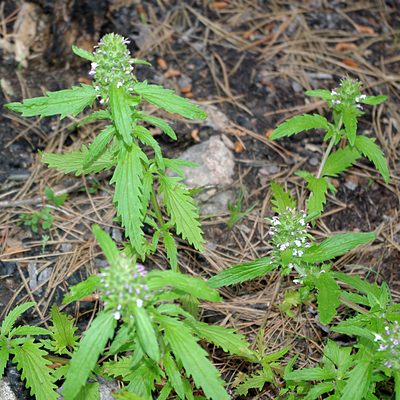 American DragonheadDracocephalum parviflorum | Purple, Green & Brown | Mid-June to mid-July in dated Black Hills specimens; June into September across the Great Plains (FEIS) | 15–80 cm (6–32 in) | Roadsides, gravel, burns, open pine woods, rocky hillsides and stream floodplains | Look for a square stem with opposite, lance-shaped leaves up to about 8 cm (3 in) long that have large, coarse, sharp teeth and a slender stalk. The flowers crowd into a thick spike 2.5–10 cm (1–4 in) long at the stem tip and at the ends of side stems from the upper leaf joints. Each flower is only about 6 mm (¼ in) long, pale blue-violet, with a notched upper lip and a 3-lobed lower lip, and it reaches about as far as its calyx (the green cup around it) or a little past it. Long, hairy bracts (leafy scales) under the flowers have sharp teeth that each end in a spine, which gives the head a spiny look, and the whole head turns brown after bloom. |
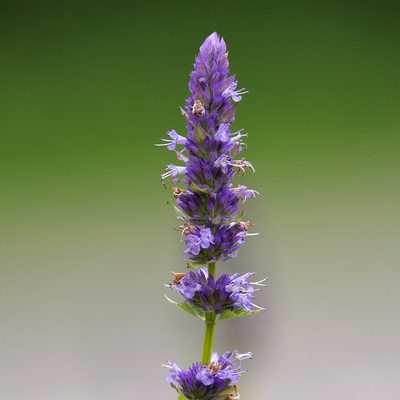 Anise HyssopAgastache foeniculum | Purple, Blue | July and August, with a few in June and September | 60–100 cm (2–3 ft) | Moist gulches, stream banks, canyon bottoms, aspen and birch woods, and openings in pine forest | Look for a square stem with opposite, coarsely toothed, egg-shaped leaves that are whitish underneath and smell strongly of licorice or anise when crushed. The small blue-violet to lavender flowers crowd into a dense, cylinder-shaped spike 4–12 cm (1½–5 in) long at the stem tip, with four stamens poking out of each flower, and the base of the spike is often broken into separate whorls. Wild Bergamot has its flowers in one round head at each stem tip, not a spike. Catnip has softly hairy leaves and whitish to pale lavender flowers with purple or pink dots. |
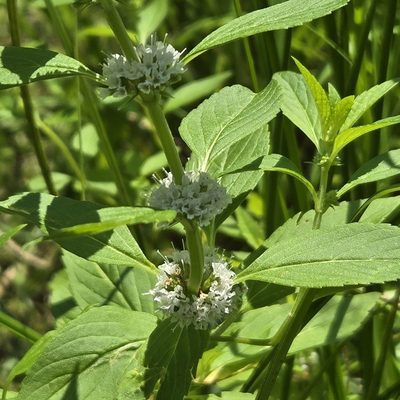 Canada MintMentha arvensis | Purple | July into September | 15–75 cm (6–30 in) | Stream banks, creek bottoms, lake and pond shores, wet meadows, springs and ditches | Crush a leaf: the smell is mint. The stem is square, upright or leaning, green or red, with hairs at least along the angles. The leaves are opposite, each pair set at right angles to the next, 2–6.5 cm (¾–2½ in) long, narrowly egg-shaped to elliptic with a pointed tip and toothed edges, on short stalks. The flowers are the mark: dense whorls of about 20 tiny tubular flowers, 3–7 mm long, ring the stem at the leaf joints along much of its length and open from the bottom up, while the stem tip stays leafy with no flower head on it. Each flower is pale lavender, pink or white with darker spots inside, the upper lip notched and the lower lip three-lobed, and four long stamens poke out of the tube; the hairy calyx (the cup behind the petals) has short triangular teeth. Bugleweeds grow in the same wet places with the same leaf arrangement and small whorls, but their flowers are white with only two stamens and their leaves have no mint smell. |
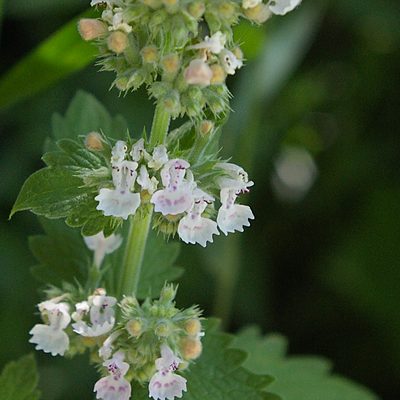 CatnipNepeta cataria | White | June into September | 40–100 cm (16–39 in) | Disturbed sites, roadsides, open fields and woodland edges | Square, finely hairy stems carry opposite, heart-shaped leaves with rounded teeth. Crushed leaves smell strongly of mint from nepetalactone, and cats are strongly drawn to the plant. Thick, tightly packed flower clusters at the stem tips hold two-lipped flowers, about ⅓ to ½ inch long, white to pale lavender with darker dots on the lower lip. |
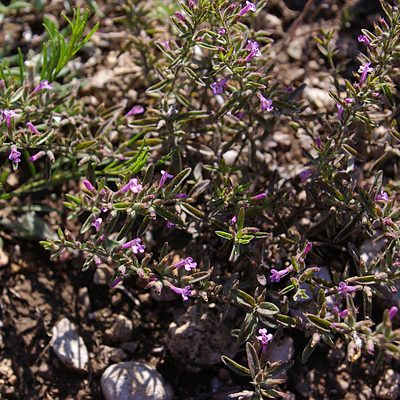 Drummond's False PennyroyalHedeoma drummondii | Purple, Pink | June into September | 10–40 cm (4–16 in) | Limestone outcrops and ledges, rocky slopes and road banks, and dry prairie | Look for a clump of square, finely hairy stems with opposite, narrow leaves about 8–18 mm (⅓–¾ in) long and 1–4 mm wide, smooth-edged and blunt, on short stalks. The flowers sit in small clusters in the leaf joints. Each is a narrow tube 8–15 mm (⅓–⅗ in) long with a 3-lobed lower lip, coming out of a hairy, ribbed calyx (the cup around the flower) 5–8 mm (⅕–⅓ in) long that has 5 slender, bristle-tipped teeth and a ring of hairs in its throat. A New Mexico guide says its minty smell and calyx teeth that come together and nearly close the mouth in fruit set it apart from other false pennyroyals. Rough False Pennyroyal (Hedeoma hispida) also grows in the Black Hills; Kansas Wildflowers describes it as an annual with stiff, stalkless leaves under 2.5 mm (1/10 in) wide, usually fringed with hairs, and blue or whitish flowers only about 6 mm (¼ in) long. |
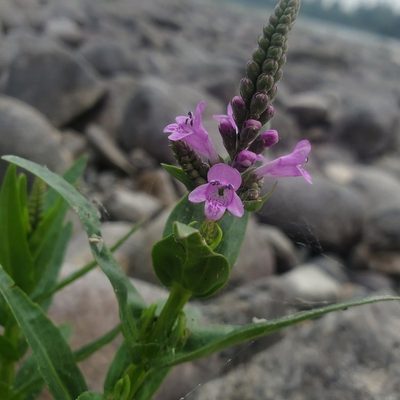 False DragonheadPhysostegia parviflora | Purple, Pink | July into September | up to 100 cm (40 in) | Wet low places such as river and lake shores | Look for an upright plant up to about 1 m (3 ft) tall with unstalked leaves that are narrow to elliptic, toothed or smooth-edged, and broadest near the base, where they somewhat clasp the stem; the leaves just under the flowers are more lance-shaped. The flowers sit in a tight spike up to 10 cm (4 in) long, each flower 12–16 mm (½ in) long, usually with sticky glandular hairs, on a finely glandular-hairy calyx. Gleason and Cronquist give the flowers of the similar Obedient Plant (Physostegia virginiana) as longer, (14–)16–35 mm, without glands, on leaves that generally do not clasp. A 1990 herbarium sheet from Lawrence County is named Obedient Plant, so which of the two grows in the Hills is not settled. |
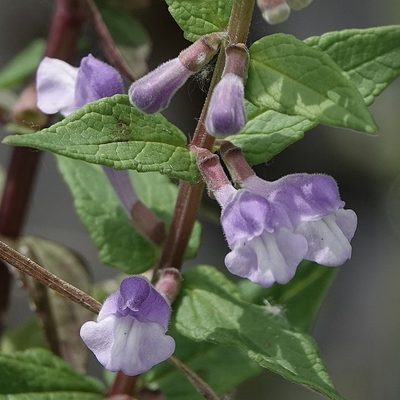 Marsh SkullcapScutellaria galericulata | Blue | June into August | 30–75 cm (12–30 in) | Wet meadows, stream banks, shores, swamps and creek-bottom wetlands | Look for a square, branching stem 30–75 cm (12–30 in) tall with fine rough hairs on its angles, and opposite leaves 2–6 cm (¾–2¼ in) long, lance-shaped to oblong, with rounded or blunt teeth and little or no leaf stalk. The flowers are tubular and irregular, 1–2 cm (½–¾ in) long, blue to violet and hairy, borne in pairs from opposite leaf joints just below the stem tip. The upper lip forms a rounded hood over the mouth, and the broad, wavy lower lip is blue-dotted against a white throat. The fruit is a round cluster of 4 brown nutlets inside the persistent calyx (the green cup under the flower). Minnesota Wildflowers separates it from Mad-dog Skullcap (Scutellaria lateriflora), which grows in the same wet places there, by flowers about half the size in racemes without the blue-spotted lower lip and by broader leaves. GBIF holds only three specimens of Mad-dog Skullcap from the Hills counties, collected in 1914, 1925 and 1965. |
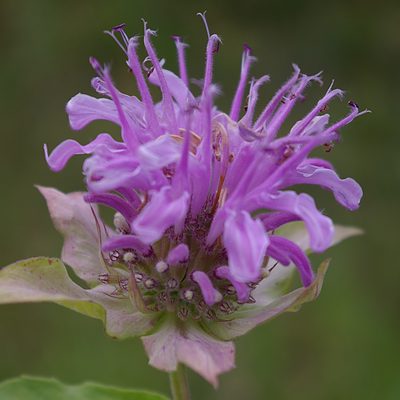 Wild BergamotMonarda fistulosa | Purple | July and August, with a few in June and September | 30–120 cm (1–4 ft) | Open ponderosa pine forest, meadows, prairie edges, roadsides and trailsides | Look for one round, pom-pom-like head 2.5–5 cm (1–2 in) across at the tip of each stem, made of many narrow, two-lipped, lavender-pink to light purple tubes. The stem is square, and the opposite, toothed, lance-shaped leaves smell strongly of oregano or thyme when crushed; in Black Hills plants the leaf stalks are very short. Anise Hyssop has its small blue-violet flowers in a cylinder-shaped spike, leaves white underneath and an anise smell. After bloom the flowers drop, and the head of empty calyx tubes turns dark brown. |
Other look-alike groups: 38 groups
- Anemones (4)
- Asters (4)
- Beardtongues (5)
- Buttercups (3)
- Cacti (4)
- Cinquefoils (7)
- Clovers (6)
- Coneflowers (4)
- Currants and gooseberries (5)
- Daisies (5)
- Dandelions (3)
- Docks and buckwheats (4)
- Evening primroses (4)
- Ferns (4)
- Gentians (4)
- Grasses (11)
- Groundsels and ragworts (3)
- Lilies (5)
- Mayflowers and false Solomon's seals (3)
- Milkvetches and locoweeds (12)
- Milkweeds (6)
- Mustards (11)
- Orchids (8)
- Paintbrushes (3)
- Pines (3)
- Raspberries and thimbleberries (3)
- Sagebrushes and sageworts (3)
- Sedges (3)
- Speedwells and kittentails (3)
- Sunflowers (4)
- Thistles (6)
- Vervains (3)
- Vetches (4)
- Violets (7)
- Wild lettuces (3)
- Wild onions (3)
- Wild plums and cherries (3)
- Willows (3)