Docks and buckwheats of the Black Hills
All 4 docks and buckwheats in this guide, side by side, A to Z. Compare the photos, bloom time, height and where each grows, then open the one that fits for more photos and the full ID notes. Each plant's page lists its sources.
| Plant | Color | Blooms | Height | Where | How to tell it apart |
|---|---|---|---|---|---|
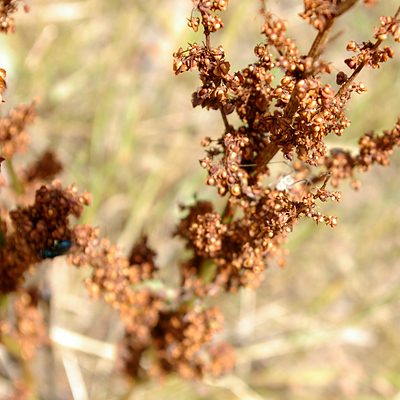 Curly DockRumex crispus | Green & Brown | June into July | 30–150 cm (12–60 in) | Roadsides, fields, waste ground, stream and pond borders | Look for hairless leaves up to 12 inches long with strongly crinkled, wavy edges, and a stout, ribbed stem ending in branching clusters of whorled flowers. In seed the clusters dry rusty brown, and each seed sits inside three papery wings that have flat to slightly jagged edges and usually a small grain (tubercle) on each. Many other docks have toothed wings, broader flat leaves, or fewer grains. |
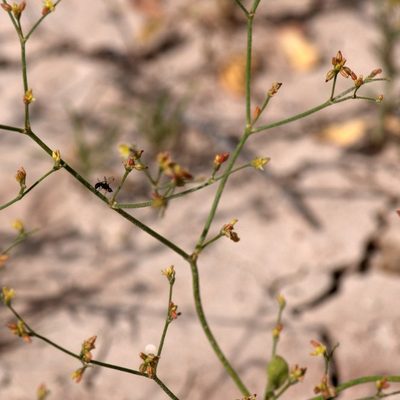 Dakota BuckwheatEriogonum visheri | Yellow | Late June into September | Flowering stem 2.5–15 cm (1–6 in) above the basal leaves, then branching | Barren clay and shale outcrops and bare outwash in badlands; small eroded patches in mixed-grass prairie | Look for a skeleton-like annual: one slender stem rises 2.5–15 cm (1–6 in) above the basal leaves, then divides into 2 or 3 branches that keep forking into an open, airy head tipped with very small clusters of yellowish flowers (USDA Forest Service). The Montana Field Guide adds that the basal leaves form a rosette (a ring of leaves at ground level), that the smaller, oblong stem leaves sit low on the stem, and that the flowers are tiny and pale yellow. Each flower makes one dark-brown seed. The plant often grows on ground that is more than 90 percent bare, and it keeps flowering after its leaves and stems have turned reddish brown (USDA Forest Service). Its yellow flowers separate it from Eriogonum gordonii, which has white flowers (USDA Forest Service). The Montana Field Guide separates it from the other annual buckwheats there: Eriogonum cernuum and E. annuum have densely hairy leaves, and E. salsuginosum has a deeply lobed, cup-shaped involucre (the little cup that holds each flower cluster), where Dakota Buckwheat's is shallowly lobed and top-shaped. None of those three is in this guide. |
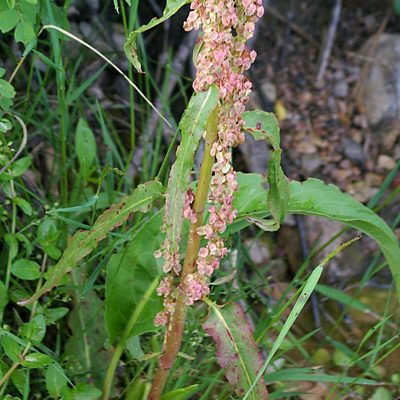 DockRumex sp. | Green & Brown | June into August for most South Dakota docks | 15–150 cm (6–60 in), depending on species | Moist open ground and disturbed sites; sandy dunes and riverbanks for some | Look for alternate leaves, small greenish to reddish-brown flowers in a large, loose cluster, and three-sided fruits wrapped in three enlarged inner tepals, or wings. To name the species, check the wings: toothed or smooth, how large, and whether they carry grains (tubercles). Then check whether the leaves are wavy or flat, and dull or shiny. |
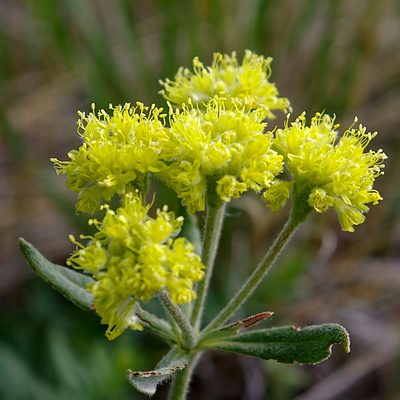 Yellow BuckwheatEriogonum flavum | Yellow | May into August, mostly June and July | 4–25 cm (1½–10 in) | Dry plains, ridges, hilltops and rocky slopes, from the prairie into open pine woods; sometimes on limestone | Look for a low mat of crowded, stalked leaves 1–7 cm (½–3 in) long, narrow to elliptic with smooth edges, green on top and densely white or gray woolly underneath, growing from a thick woody base that keeps its old dead leaf bases. The flower stalks are leafless and hairy, 4–25 cm (1½–10 in) tall, with a ring of 4 to 6 leaf-like bracts where they branch into an umbel of ball-shaped flower clusters. Each cluster sits in a bell-shaped woolly cup 3–9 mm long with 5 to 8 short teeth and holds many flowers 3–7 mm long that are bright yellow, sometimes tinged pink, hairy on the outside, with 9 stamens and 3 styles sticking out of the flower. Fruit starts in late July, and by September the flowers have dried papery around small tan seeds. |
Other look-alike groups: 38 groups
- Anemones (4)
- Asters (4)
- Beardtongues (5)
- Buttercups (3)
- Cacti (4)
- Cinquefoils (7)
- Clovers (6)
- Coneflowers (4)
- Currants and gooseberries (5)
- Daisies (5)
- Dandelions (3)
- Evening primroses (4)
- Ferns (4)
- Gentians (4)
- Grasses (11)
- Groundsels and ragworts (3)
- Lilies (5)
- Mayflowers and false Solomon's seals (3)
- Milkvetches and locoweeds (12)
- Milkweeds (6)
- Mints (8)
- Mustards (11)
- Orchids (8)
- Paintbrushes (3)
- Pines (3)
- Raspberries and thimbleberries (3)
- Sagebrushes and sageworts (3)
- Sedges (3)
- Speedwells and kittentails (3)
- Sunflowers (4)
- Thistles (6)
- Vervains (3)
- Vetches (4)
- Violets (7)
- Wild lettuces (3)
- Wild onions (3)
- Wild plums and cherries (3)
- Willows (3)