Dakota Buckwheat Eriogonum visheri
Also called Visher's Buckwheat, Dakota Wild Buckwheat
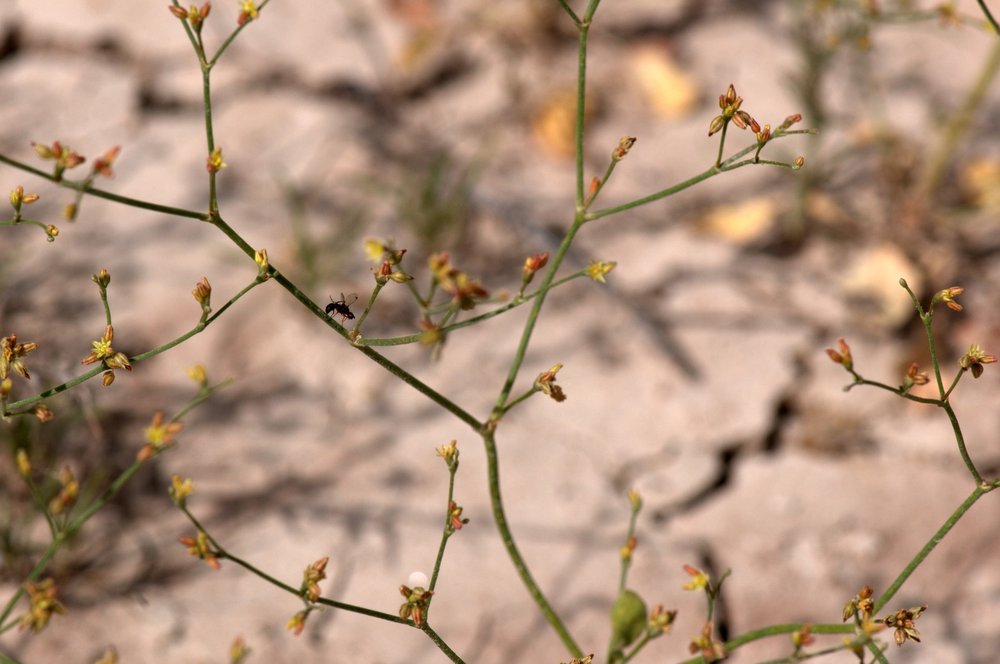
Dakota Buckwheat (Eriogonum visheri) is a small annual with thin, repeatedly forking stems that carry tiny pale yellow flowers from late June into September. It grows on barren clay and shale in the badlands and on the plains of western South Dakota, well east and northeast of the Black Hills, and no source or herbarium label opened for this guide puts it inside the Hills.
Free photos from other sources
| Family | Polygonaceae · Buckwheat |
|---|---|
| Status | Native annual |
| Blooms | Late June into September |
| Height | Flowering stem 2.5–15 cm (1–6 in) above the basal leaves, then branching |
| Where | Barren clay and shale outcrops and bare outwash in badlands; small eroded patches in mixed-grass prairie |
| Also called | Visher's Buckwheat, Dakota Wild Buckwheat |
| Note | South Dakota's Natural Heritage Program lists Dakota Buckwheat on its rare plant table, ranked S3, vulnerable in the state. This page gives no locations. |
Roots, seeds & germination
Root: A slender taproot (Montana Field Guide).
Seed: Each flower produces a single dark-brown seed. The seeds have no wings or plumes, and wind and water may carry them (USDA Forest Service).
Germination: A spring annual that sprouts in May; each year's plants come from seeds already in the soil and need bare ground to sprout in, and seeds ripen and fall through the whole flowering season (USDA Forest Service). The same document says the seeds may need both scarification (nicking the seed coat) and stratification (a cold, moist period) before they sprout, and the Center for Plant Conservation reports that an arboretum grew it from seed after scarifying the seed.
How do you identify Dakota Buckwheat?
Look for a skeleton-like annual: one slender stem rises 2.5–15 cm (1–6 in) above the basal leaves, then divides into 2 or 3 branches that keep forking into an open, airy head tipped with very small clusters of yellowish flowers (USDA Forest Service). The Montana Field Guide adds that the basal leaves form a rosette (a ring of leaves at ground level), that the smaller, oblong stem leaves sit low on the stem, and that the flowers are tiny and pale yellow. Each flower makes one dark-brown seed. The plant often grows on ground that is more than 90 percent bare, and it keeps flowering after its leaves and stems have turned reddish brown (USDA Forest Service). Its yellow flowers separate it from Eriogonum gordonii, which has white flowers (USDA Forest Service). The Montana Field Guide separates it from the other annual buckwheats there: Eriogonum cernuum and E. annuum have densely hairy leaves, and E. salsuginosum has a deeply lobed, cup-shaped involucre (the little cup that holds each flower cluster), where Dakota Buckwheat's is shallowly lobed and top-shaped. None of those three is in this guide.
When does it bloom?
Late June into September.
Where does it grow?
Dakota Buckwheat grows on barren, eroding outcrops of clay, siltstone and shale in the badlands, on the bare clay outwash at the foot of slopes, on the eroding edges of buttes, tables and benches, and on small eroded patches in mixed-grass prairie (USDA Forest Service; Center for Plant Conservation; Montana Field Guide). The soil is low in nutrients and often salty and limy, and the sites sit at about 580–910 m (1,900–3,000 ft) (USDA Forest Service). It is a regional endemic known only from western South Dakota, western North Dakota and southeastern Montana (USDA Forest Service; Montana Field Guide). South Dakota's rare plant table ranks it G3 (vulnerable across its whole range) and S3 in the state and describes it as a plant of badland outcrops. GBIF holds 90 preserved specimens from South Dakota, collected from 1912 to 2003. The 23 from the western South Dakota areas that take in part of the Black Hills all come from the plains and badlands well east and northeast of the Hills: the 20 with a locality say base of an eroded butte, barren shale and clay slopes and outwash, badland slopes, alkali flats, eroded pasture, flat prairie or a dry stream bed in badland soil, and none says Black Hills or pine forest. The plant lists of the four Black Hills park units and the Forest Service's 2023 draft assessment of at-risk species for the Black Hills forest plan don't include it.
Other docks and buckwheats in this guide
Buckwheat family (Polygonaceae): 4 other plants in this guide
Sources: South Dakota Game, Fish and Parks: Rare Plants of South Dakota (South Dakota Natural Heritage Program, 2018); USDA Forest Service: biological evaluation of sensitive plants, Appendix F (Dakota buckwheat and Barr's milkvetch); Center for Plant Conservation: Dakota Buckwheat (Eriogonum visheri); Montana Field Guide: Visher's Buckwheat (Eriogonum visheri); USDA PLANTS Database: Eriogonum visheri, Visher's buckwheat (ERVI14); GBIF occurrence search: Eriogonum visheri, South Dakota (90 preserved specimens); USDA Forest Service Rocky Mountain Region, Revised Forest Assessment: At-Risk Species, draft, October 2023 (searched; Eriogonum visheri not listed); National Park Service NPSpecies: vascular plant checklist for a Black Hills park unit, 1 of 4 (searched; not listed); National Park Service NPSpecies: vascular plant checklist for a Black Hills park unit, 2 of 4 (searched; not listed); National Park Service NPSpecies: vascular plant checklist for a Black Hills park unit, 3 of 4 (searched; not listed); National Park Service NPSpecies: vascular plant checklist for a Black Hills park unit, 4 of 4 (searched; not listed); Native American Ethnobotany Database (BRIT): search for Eriogonum visheri (no uses listed); ITIS: Eriogonum visheri A. Nelson (TSN 21275, accepted).