Swamp Smartweed Persicaria amphibia
Also called Water Smartweed, Longroot Smartweed, Water Knotweed, Marsh Smartweed, táku šašála (Lakota), pšitȟóla hú iyéčheča (Lakota)
Swamp Smartweed (Persicaria amphibia) is a native perennial of the buckwheat family that grows in shallow water and on wet ground, and is known by dense spikes of bright pink flowers that open from June into September. In the Black Hills, herbarium specimens come from creeks, ponds, lake shores and wet meadows in Pennington, Custer, Lawrence, Meade and Fall River counties and Crook County, Wyoming.
Free photos from other sources
| Family | Polygonaceae · Buckwheat |
|---|---|
| Status | Native perennial |
| Blooms | June into September |
| Height | 30–90 cm (12–36 in) |
| Where | Shallow water, shores, ditches, creek margins and other wet ground |
| Also called | Water Smartweed, Longroot Smartweed, Water Knotweed, Marsh Smartweed, táku šašála (Lakota), pšitȟóla hú iyéčheča (Lakota) |
| Synonym | Polygonum amphibium |
| Traditional use | Black Elk and Flying By's 1998 list of culturally important plants gives the Lakota names táku šašála and pšitȟóla hú iyéčheča for it and records the young shoots as eaten raw or cooked and the root as also eaten, said to have a pleasant, nutty flavor. Moerman's database has no uses under Persicaria amphibia; under its variety Polygonum amphibium var. emersum it records that Rogers (1980) listed it as a Lakota food, that the Meskwaki used the root for mouth sores (Smith 1928) and that the Ojibwa took an infusion of the plant for stomach pain (Smith 1932). |
Traditional use: first drafted by Google AI, then checked against the sources on this page.
Roots, seeds & germination
Root: A perennial that usually has rhizomes (underground stems) or stolons (runners), according to Missouri Plants; Minnesota Wildflowers says the stem may root at the lower nodes and form dense colonies.
Seed: The fruit is a dark brown seed-like achene, 2–3 mm long, shiny or dull and mostly smooth (Minnesota Wildflowers; Missouri Plants).
How do you identify Swamp Smartweed?
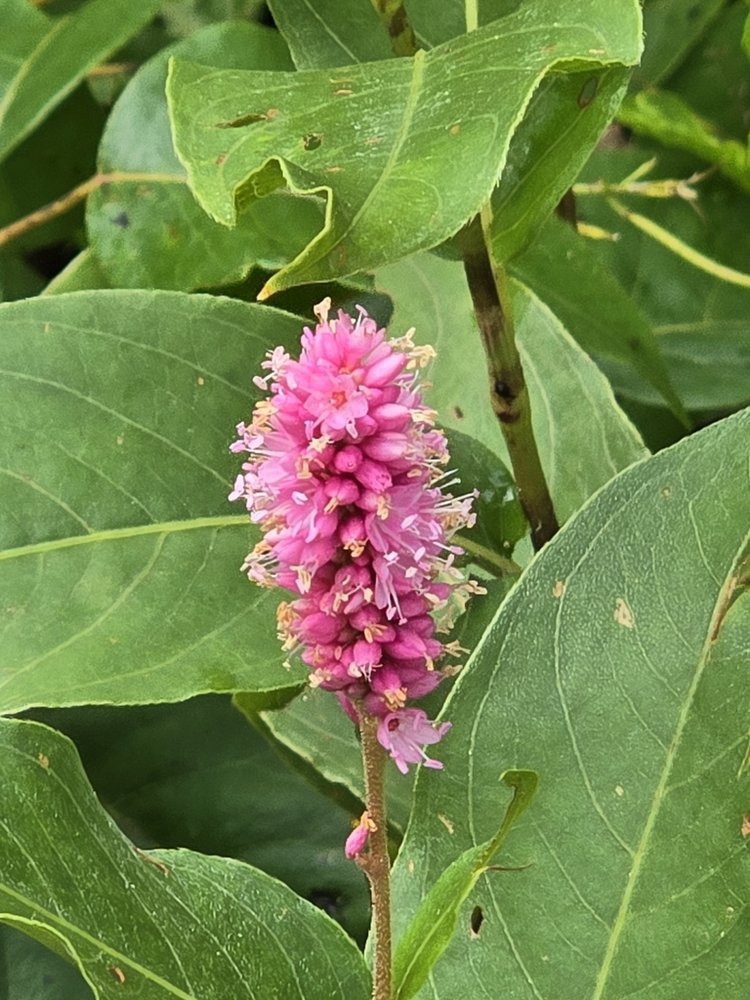
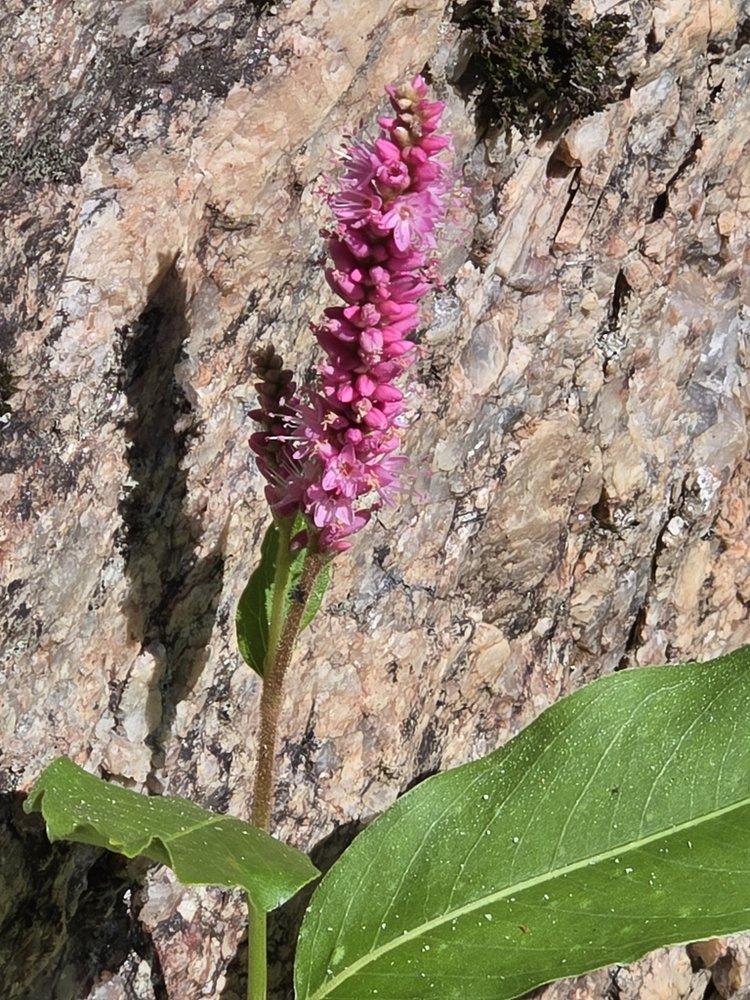
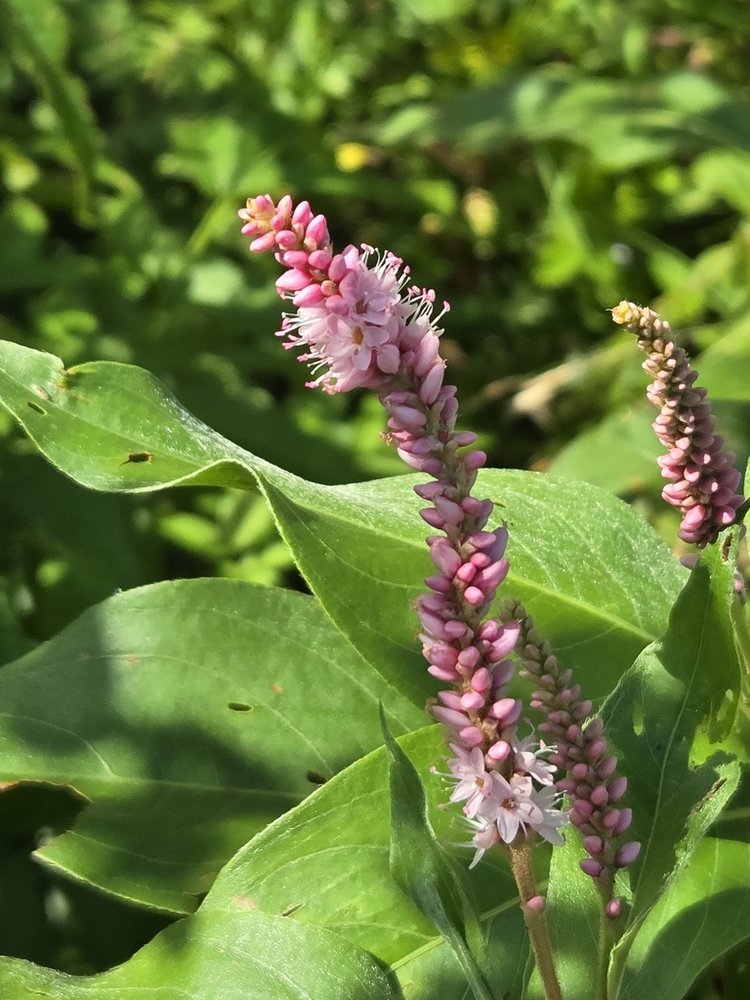
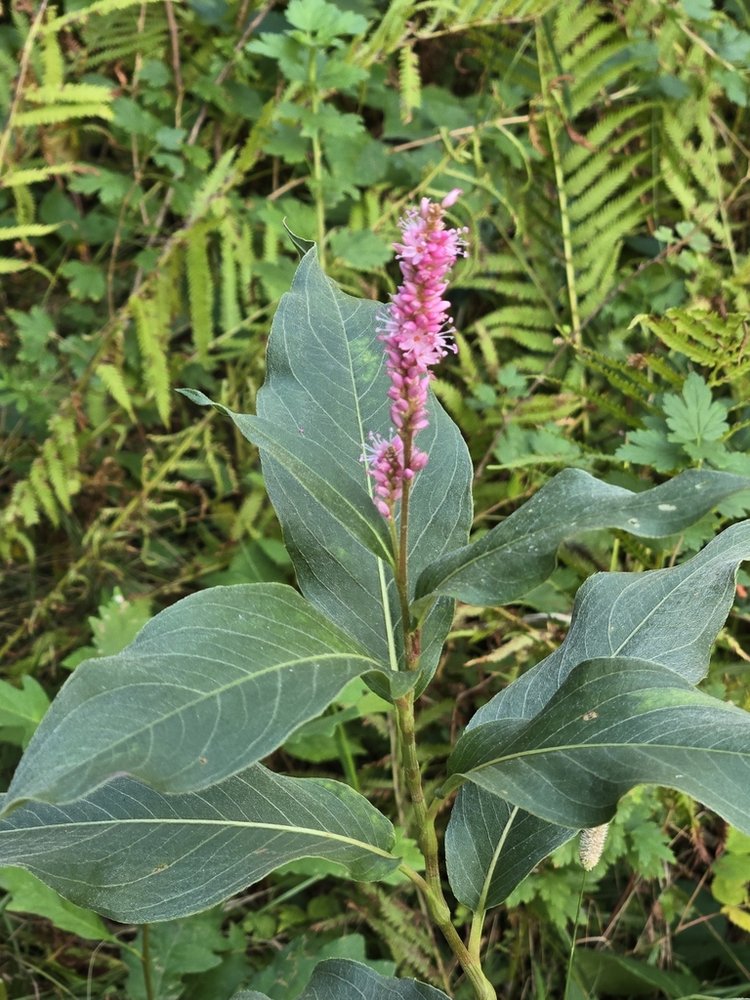
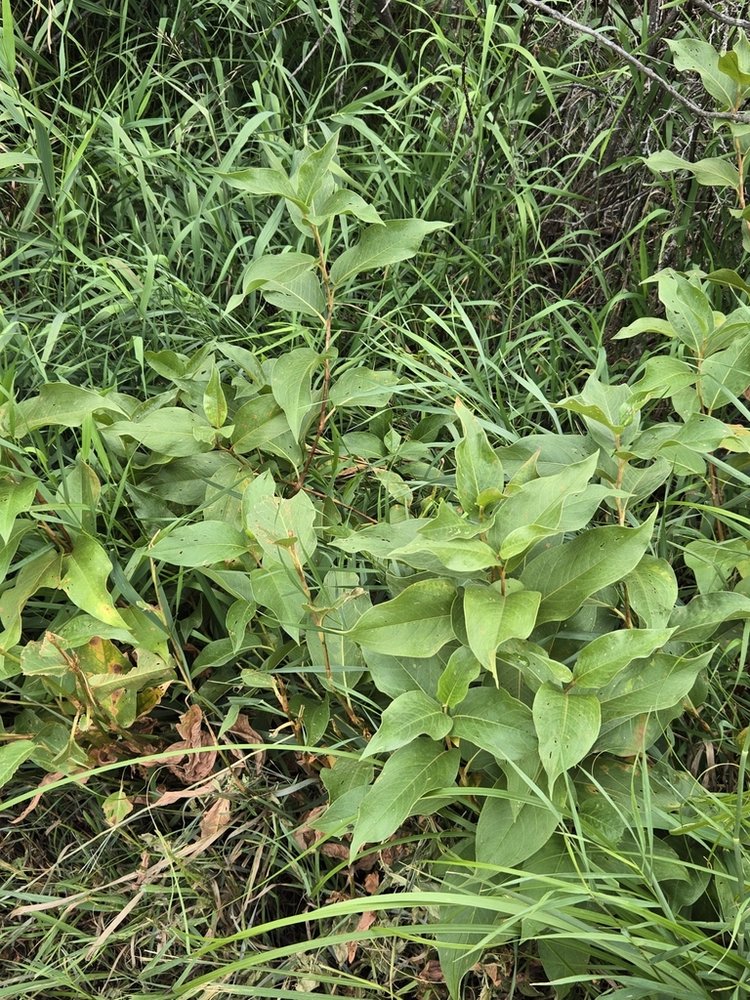
Look for one or two dense, upright spikes of bright pink flowers at the top of a stem, each spike 5–10 cm (2–4 in) long. The flowers are tiny, about 3 mm (1/8 in) across, with 5 pink petal-like parts and long, pink-tipped stamens. Minnesota Wildflowers says the spikes are long and slender on the land form and short and thimble-shaped on the water form. The leaves alternate along the stem, are toothless, up to 20 cm (8 in) long and 7.5 cm (3 in) wide, and each leaf stalk has a papery sheath around the stem. The stem may root at its lower nodes and form dense colonies. Minnesota Wildflowers says many smartweeds have pinkish spikes but this one has the brightest pink and is probably the easiest in its genus to recognize, and that references agree it lacks the dark blotch some other smartweeds carry on the leaf, though a blotch is not unheard of. Missouri Plants says the other smartweeds tend to branch more, while this one tends to be erect with erect spikes.
When does it bloom?
June into September.
Where does it grow?
Shallow water near shores, creek and stream margins, boggy edges, stockponds, lake shores and wet meadows, either floating on the water or rooted on wet ground. Herbarium labels from 1892 to 2009 record it in shallow water near the shore of a lake, floating on running water, on the saturated soil of a creek floodplain, on a muddy creek bank partly in water and at the margin of stockponds, and one label calls it occasional in a cold stream in an open pasture meadow. A label of 1892 gives an altitude of 4000 feet. The specimens come from Pennington, Custer, Lawrence, Meade and Fall River counties, South Dakota, and Crook County, Wyoming. Most were collected in July and August.
Buckwheat family (Polygonaceae): 4 other plants in this guide
Sources: Minnesota Wildflowers: Persicaria amphibia (Swamp Smartweed); Missouri Plants: Persicaria amphibia (Water Smartweed); USDA PLANTS Database: Polygonum amphibium (POAM8), water knotweed; GBIF backbone name match: Persicaria amphibia; Native American Ethnobotany Database (BRIT): Polygonum amphibium; Culturally Important Plants of the Lakota (Black Elk and Flying By, 1998), entry 234; GBIF specimen 1257619212 (Pennington County, SD, 2009; Black Hills National Forest); GBIF specimen 1257611863 (Crook County, WY, 2009; Black Hills National Forest, Bear Lodge Mountains); GBIF specimen 2512328738 (Pennington County, SD, 2009; saturated soil on a creek floodplain); GBIF specimen 5895803995 (Custer County, SD, 1892; altitude 4000 feet); GBIF specimen 3454994573 (Meade County, SD, 1997; shallow water near shore); GBIF occurrence search: Persicaria amphibia, preserved specimens, South Dakota and Wyoming.