Twinflower
Linnaea borealis
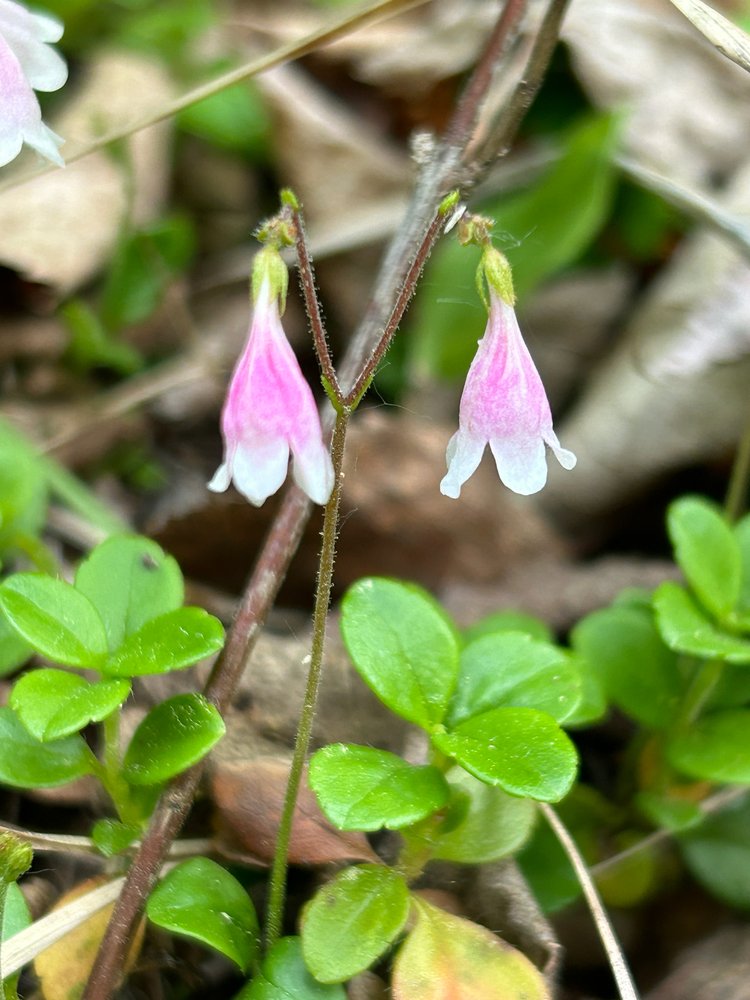
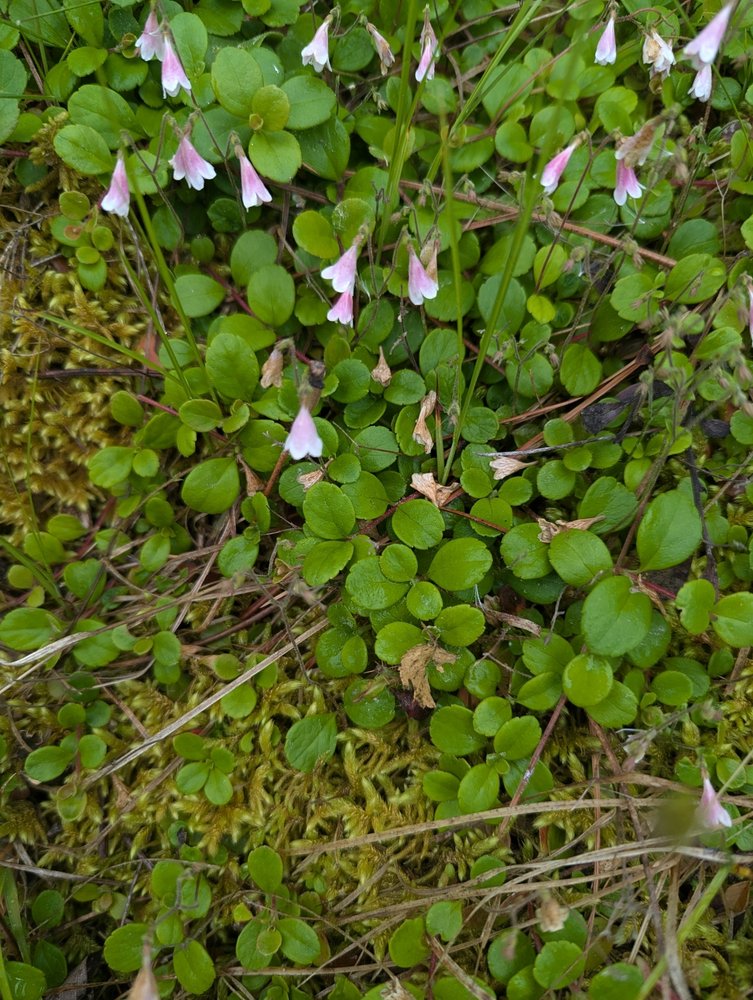
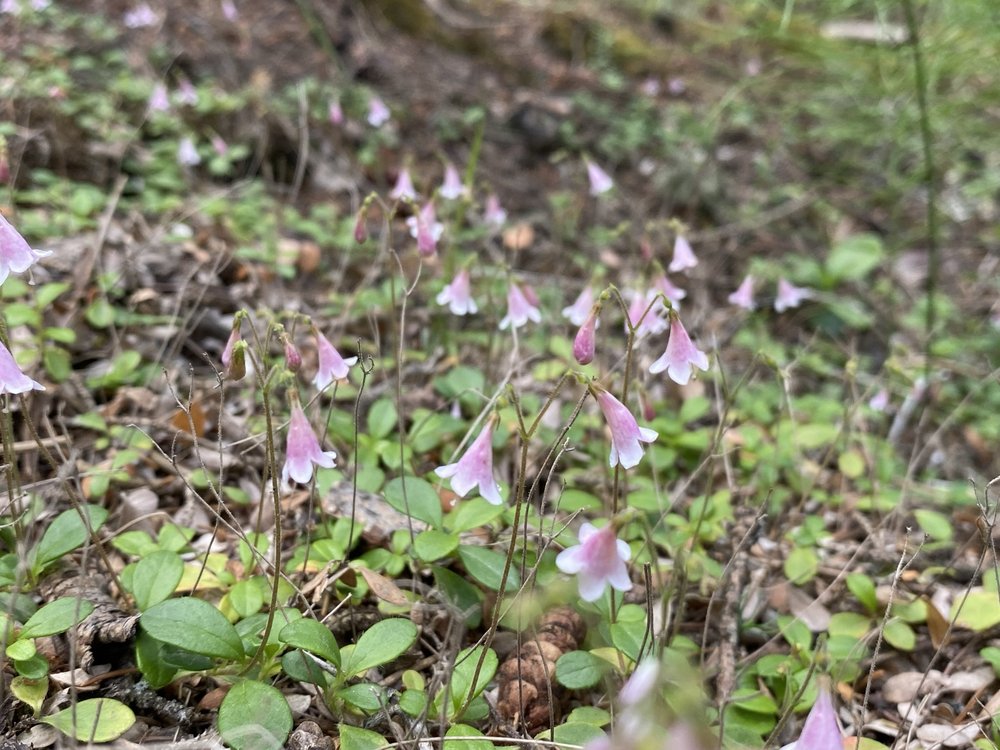
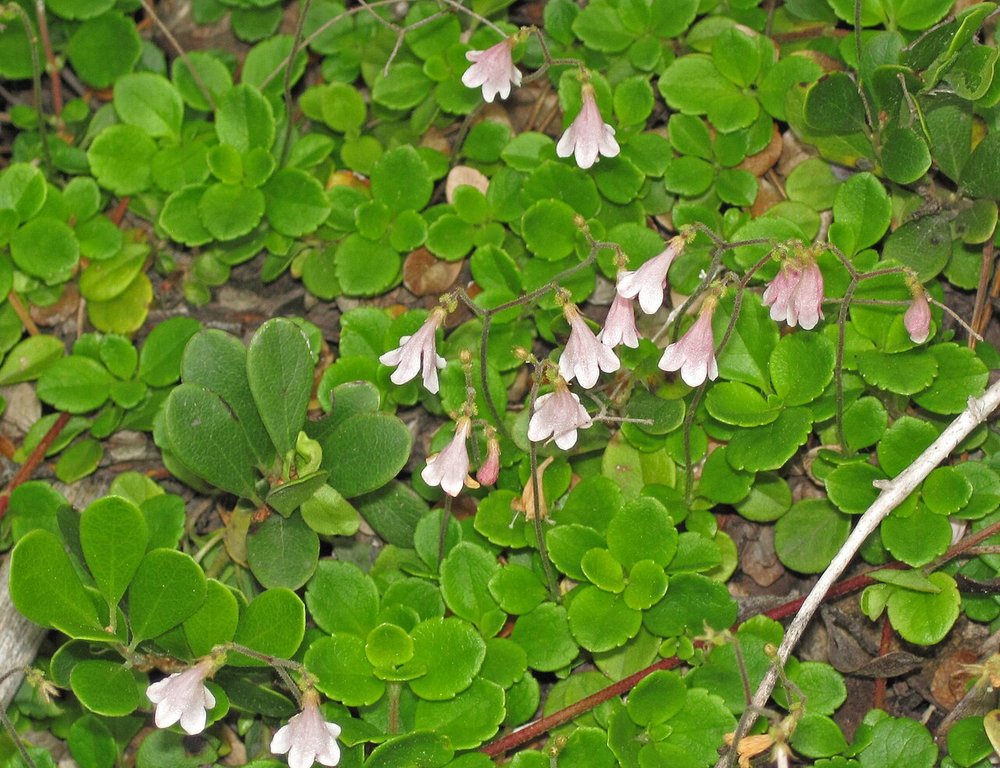
Twinflower (Linnaea borealis) is a native evergreen that creeps across the forest floor in long runners, sending up thread-thin stalks that each fork into two nodding pink bells. It blooms in June and July in the cool white spruce forests of the high northern and central Black Hills, where a Forest Service study named a whole forest type after it. It is the flower Carl Linnaeus chose as his own.
Free photos from other sources
| Family | Caprifoliaceae (formerly Linnaeaceae) · Honeysuckle |
|---|---|
| Status | Native perennial |
| Blooms | June and July, a few into August |
| Height | 5–15 cm (2–6 in) |
| Where | Cool, shaded, moist spruce and spruce-aspen forest on north-facing slopes and canyon bottoms |
| Also called | American Twinflower, Northern Twinflower, Longtube Twinflower |
| Synonym | Linnaea americana, Linnaea borealis var. americana, Linnaea borealis subsp. americana |
Roots, seeds & germination
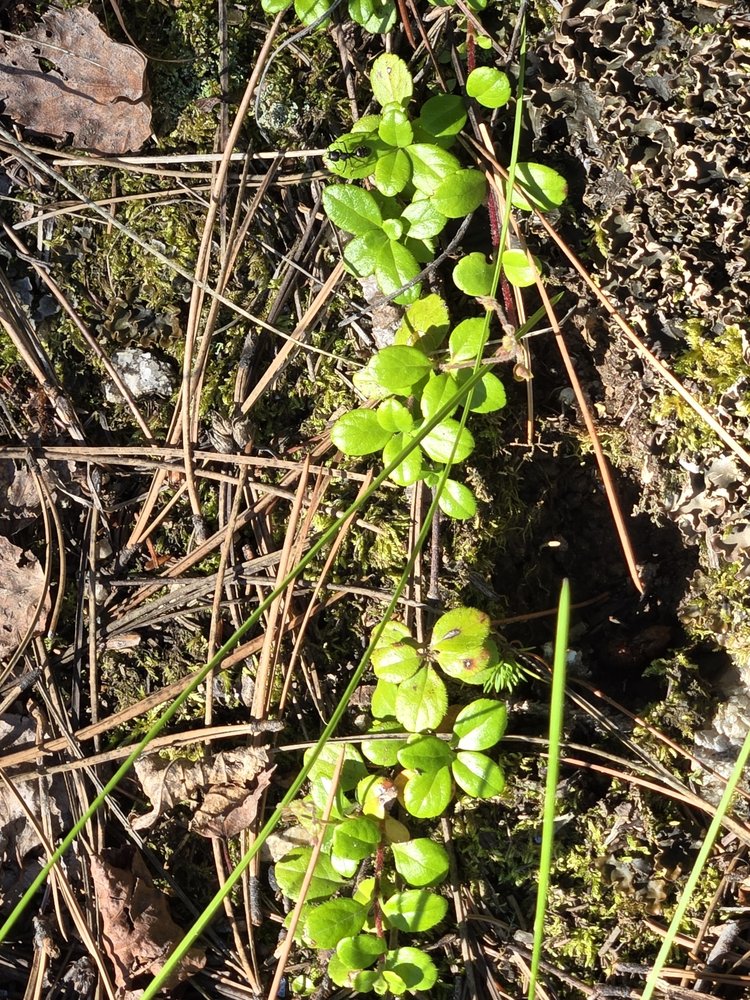
Root: It has no deep root. It spreads by slender runners that lie on or just under the moss and needle litter and root at the joints, and a single plant can run up to about 2 m (6 ft). The roots are extremely shallow, so hot fire or trampling kills it easily, but surviving runners fill in quickly.
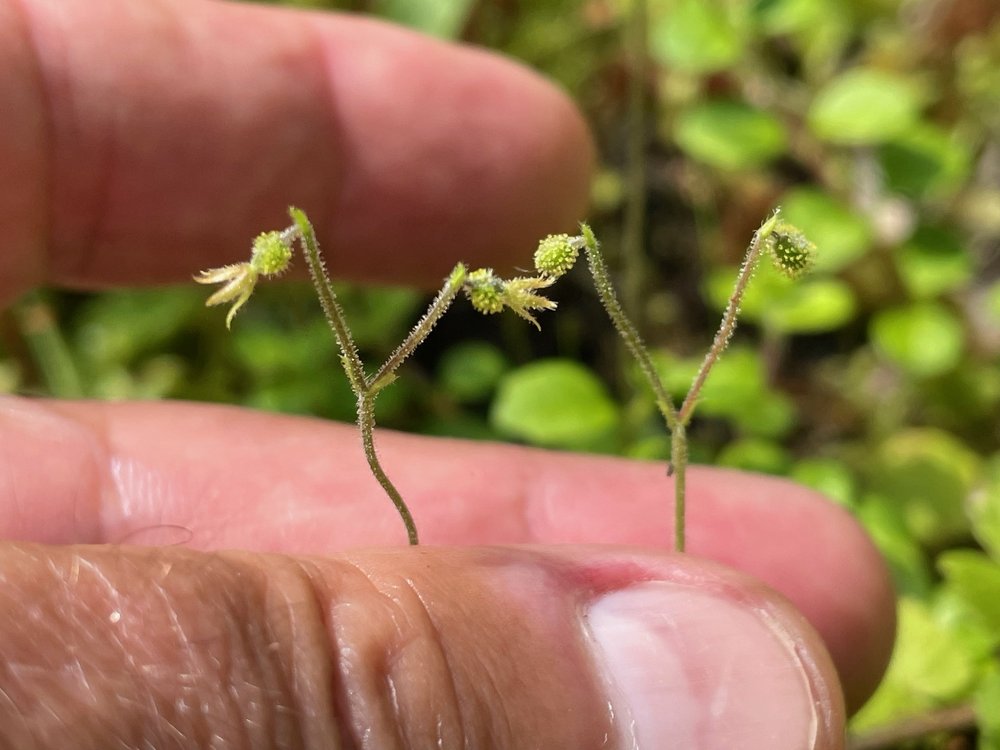
Seed: Each pollinated flower makes a tiny, dry, one-seeded fruit about 3 mm long, held in a pair of small bracts covered in sticky hairs that catch on fur and feathers. Much of the fruit isn't viable, and the seed doesn't last in the soil.
Germination: Seedlings are rare in the wild; colonies grow mostly from runners. In nursery trials at Glacier National Park, seed sown on the surface in fall and left outdoors under snow germinated at about 50% in late May, while University of Washington propagation notes report much poorer results and say dividing rooted pieces of runner is far easier.
How do you identify Twinflower?
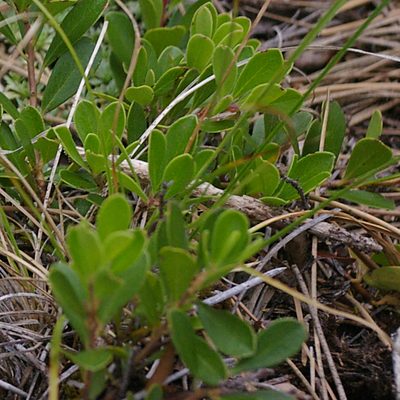
Look low for a carpet only a few centimeters high of small, roundish evergreen leaves, about 1–1.5 cm (⅜–⅝ in) long, in opposite pairs along thin, wiry runners that root as they go. A single bare, hair-thin stalk 5–10 cm (2–4 in) tall rises from the mat and forks at the top like a Y, with one pale pink, bell-shaped flower about 1 cm (⅜ in) long hanging from each branch. Two bells per stalk is the giveaway, and the flowers are fragrant. Kinnikinnick, the other trailing evergreen of Black Hills forests, has alternate, thick, leathery, spoon-shaped leaves, clusters of small white-to-pink urns in spring and shiny red berries, and it grows on dry, sunny pine slopes.
When does it bloom?
June and July, a few into August.
Where does it grow?
Cool, moist, shaded forest: white spruce and spruce-aspen-paper birch stands on north-facing slopes, canyon bottoms and spring-fed gulches, usually in moss. Hoffman and Alexander's 1987 Forest Service study defined a white spruce/twinflower habitat type on north-facing slopes at about 1,770–1,960 m (5,800–6,430 ft), part of a spruce-forest flora that reached the Hills during the Ice Age and has been cut off from its northern and Rocky Mountain relatives since. About 103 herbarium specimens from 1887 to 2013 come from Lawrence, Pennington, Custer and Meade counties and from Crook County in Wyoming, and the National Park Service lists it at Jewel Cave and Mount Rushmore.
Other flowers to compare

Sources: Hoffman, G.R. & R.R. Alexander 1987. Forest Vegetation of the Black Hills National Forest of South Dakota and Wyoming: A Habitat Type Classification (USDA Forest Service Res. Paper RM-276); USDA Forest Service 2023. Black Hills National Forest Revised Forest Assessment: Ecological Integrity of Forested Ecosystems; Howard, J.L. 1993. Linnaea borealis. Fire Effects Information System (USDA Forest Service); USDA Forest Service Celebrating Wildflowers: Plant of the Week, Twinflower; Oxford Botanic Garden & Herbaria, Plants 400: Linnaea; Trees and Shrubs Online: Linnaea borealis; Marriott, H. & D. Hartman 1986. Vegetation of Jewel Cave National Monument (plant list); NPSpecies species list, Jewel Cave National Monument; NPSpecies species list, Mount Rushmore National Memorial; GBIF occurrence search: Linnaea borealis, preserved specimens, South Dakota; GBIF occurrence search: Linnaea borealis, preserved specimens, Wyoming; Minnesota Wildflowers: Twinflower (Linnaea borealis); Luna, T., J. Evans & D. Wick 2008. Propagation protocol for Linnaea borealis, Native Plant Network (Glacier National Park); University of Washington, Propagation of Pacific Northwest Native Plants: Linnaea borealis; Plants of the World Online: Linnaea borealis; Plants of the World Online: Linnaea borealis var. americana; USDA PLANTS: Linnaea borealis ssp. americana (LIBOA); Virginia Tech Dendrology: Kinnikinnick (Arctostaphylos uva-ursi) fact sheet; South Dakota Game, Fish & Parks: Rare Plants of South Dakota; Gilmore, M.R. 1919. Uses of Plants by the Indians of the Missouri River Region (for the Dakota 'twin-flower' name, which belongs to pasqueflower); iNaturalist research-grade observations of Linnaea borealis within 90 km of the central Black Hills; Wikipedia: Linnaea (supporting only, for Linnaeus's emblem and taxonomy history).