Coneflowers of the Black Hills
All 4 coneflowers in this guide, side by side, A to Z. Compare the photos, bloom time, height and where each grows, then open the one that fits for more photos and the full ID notes. Each plant's page lists its sources.
| Plant | Color | Blooms | Height | Where | How to tell it apart |
|---|---|---|---|---|---|
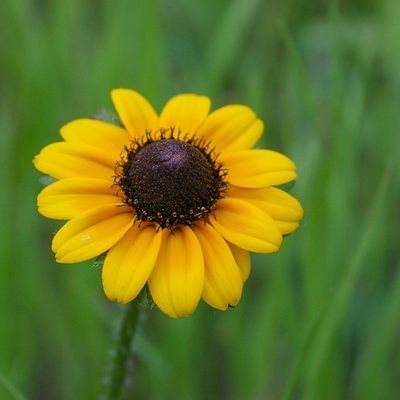 Black-eyed SusanRudbeckia hirta | Yellow | May through September, mainly midsummer in the Black Hills | 30–100 cm (12–39 in) | Moist meadows, open forests, roadsides and disturbed prairie | Look for long, stiff, spreading hairs on the stem and rough, hairy leaves with few or no teeth. The flower heads sit one to a few on long stalks, with yellow to yellow-orange rays, sometimes purplish at the base, around a dark brown to purplish-brown button or cone. |
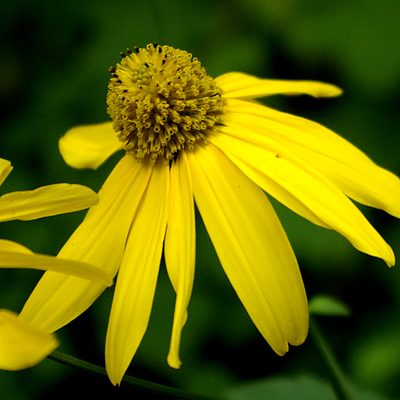 Cutleaf ConeflowerRudbeckia laciniata | Yellow | July into September | 1–3 m (39–118 in) | Moist woods, floodplains and stream banks | Look for a smooth to slightly hairy, often waxy stem, large lower leaves cut into 3–7 lobes, and drooping yellow rays around a green dome that turns greenish yellow. |
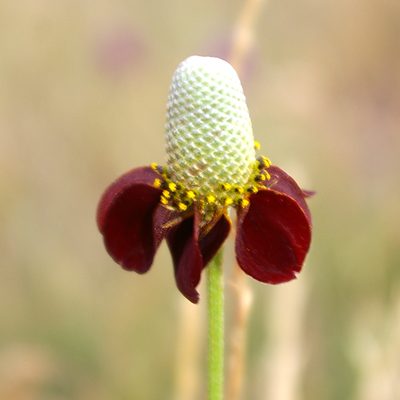 Prairie ConeflowerRatibida columnifera | Yellow | June into September | 30–100 cm (12–40 in) | Roadsides, open prairies and disturbed fields | Look for a column up to 5 cm tall, covered in purplish disk florets that open from the base up, held well above the leaves on a long stalk, with 4 to 12 drooping petals at its base. Petals can be yellow, maroon or both. Leaves are hairy, gland-dotted and deeply cut into narrow lobes. |
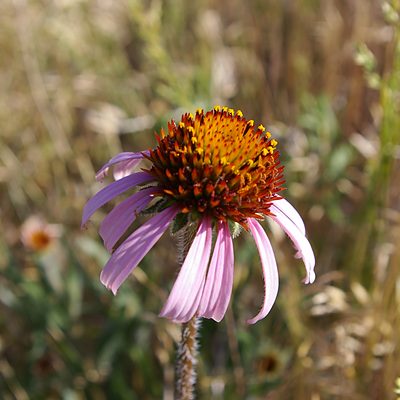 Purple ConeflowerEchinacea angustifolia | Purple | June into July, with a few into August | 10–60 cm (4–24 in) | Dry, open, often rocky prairie, grassy hillsides and open pine forest at low to mid elevations | Look for one flower head on each long, stiff stalk, with 12–20 pink to pale purple rays, 2–4 cm (¾–1½ in) long, drooping around a domed, prickly cone of brownish-purple disk flowers. The leaves are narrow and lance-shaped, rough with stiff hairs, with three to five veins running lengthwise. Prairie Coneflower has a tall, cylinder-shaped cone ringed by drooping yellow rays, and Black-eyed Susan has bright yellow rays around a brown, rounded head. The dark, spiny cones stand through winter. |
Other look-alike groups: 38 groups
- Anemones (4)
- Asters (4)
- Beardtongues (5)
- Buttercups (3)
- Cacti (4)
- Cinquefoils (7)
- Clovers (6)
- Currants and gooseberries (5)
- Daisies (5)
- Dandelions (3)
- Docks and buckwheats (4)
- Evening primroses (4)
- Ferns (4)
- Gentians (4)
- Grasses (11)
- Groundsels and ragworts (3)
- Lilies (5)
- Mayflowers and false Solomon's seals (3)
- Milkvetches and locoweeds (12)
- Milkweeds (6)
- Mints (8)
- Mustards (11)
- Orchids (8)
- Paintbrushes (3)
- Pines (3)
- Raspberries and thimbleberries (3)
- Sagebrushes and sageworts (3)
- Sedges (3)
- Speedwells and kittentails (3)
- Sunflowers (4)
- Thistles (6)
- Vervains (3)
- Vetches (4)
- Violets (7)
- Wild lettuces (3)
- Wild onions (3)
- Wild plums and cherries (3)
- Willows (3)