Violets of the Black Hills
All 7 violets in this guide, side by side, A to Z. Compare the photos, bloom time, height and where each grows, then open the one that fits for more photos and the full ID notes. Each plant's page lists its sources.
| Plant | Color | Blooms | Height | Where | How to tell it apart |
|---|---|---|---|---|---|
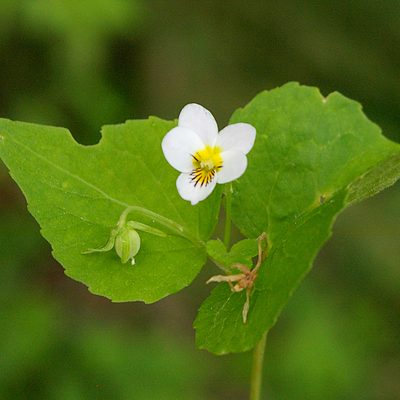 Canada VioletViola canadensis | White | May into August | 20–40 cm (8–16 in) | Shaded woods, ravines and creek banks | It has a leafy stem, with flowers borne one at a time in the upper leaf axils. Petals are white inside with a yellow base and purplish on the back, and the lower and two side petals have purple lines near the base. Leaves are heart-shaped with shallow teeth. Forms that spread into colonies by long creeping stems and have hairy foliage are var. rugulosa, which some botanists treat as a separate species. |
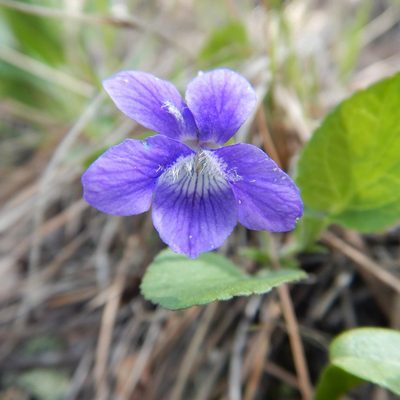 Hookedspur VioletViola adunca | Purple, Blue | May and June, with a few in April and July | 8–30 cm (3–12 in) | Open pine and oak woods, forest edges, meadows and rocky slopes | Follow a flower stalk down: it comes from a leaf joint on a short, leafy stem, not straight from the ground. The violet to blue-purple flowers are 1.5–2.5 cm (⅝–1 in) across; the lower three petals are white at the base with purple veins, and the two side petals are bearded with white hairs. From the side, the spur behind the flower is long for a violet, with a hooked tip. Northern Bog Violet has all its leaves rising from the base, a short spur, and grows on wet ground. Canada Violet has white petals with a yellow base. |
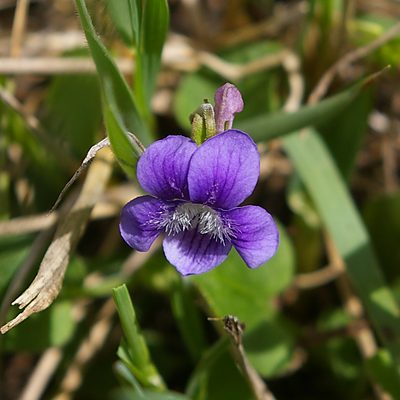 Northern Bog VioletViola nephrophylla | Purple | May and June | 5–15 cm (2–6 in) | Wet meadows, moist prairies, and stream and lake shores | The two side petals have beards of white hairs at the base, and the lower petal is white at the base with dark violet veins and a short spur. All the leaves rise from the base, with scalloped edges, and they are sometimes purplish underneath. Marsh Blue Violet is the closest look-alike; it has short, club-shaped hairs on its side petals. |
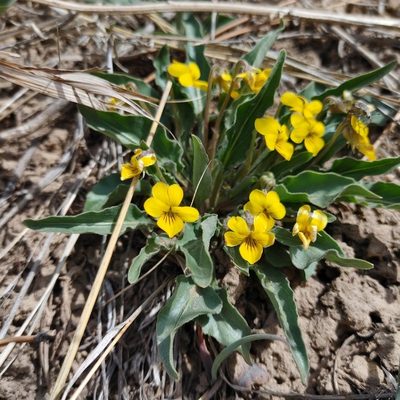 Nuttall's VioletViola nuttallii | Yellow | April into June, mostly April and May | 2–27 cm (1–11 in) | Dry open prairie, grassy hillsides, sagebrush and open pine edges on sandy, gravelly or rocky ground | Check the leaves first: they are narrow and lance-shaped, tapering into the stalk with no notch at the base, gray-green, minutely hairy, toothless or with a few small teeth, and usually at least three times as long as wide. The flower is yellow, about 1.5 cm (½ in) long, with dark brown to purple-brown veins on the lower three petals, a small tuft of hairs at the base of each side petal, a short yellow spur no more than 1.5 mm long, and backs of the upper petals often tinged brownish purple. The plant stands 2–27 cm (1–11 in) tall, with one to six short leafy stems that are about half underground, so all the leaves may look as if they rise from the ground, with the flowers held among them. Smooth Yellow Violet, the yellow violet of shaded woods, has broad, heart-shaped, toothed leaves on a leafy stem 10–35 cm (4–14 in) tall. Valley Violet, listed at Devils Tower, has oval leaves with a squared-off or slightly heart-shaped base, only about twice as long as wide; Flora of North America notes in-between leaf shapes where the two grow together. |
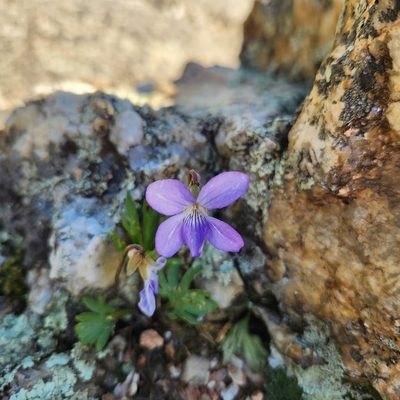 Prairie VioletViola pedatifida | Purple | April into June, sometimes again in September | 5–30 cm (2–12 in) | Prairie, grassy openings and edges of ponderosa pine forest, and burned slopes | Start with the leaves: each blade is deeply cut into 5 to 9 lobes, and the lobes often split again into narrow, finger-like segments, with tiny hairs fringing the edges. SDSU's native plant page notes that this foliage sets it apart from most other violets. The plant is stemless, so every leaf and flower stalk rises straight from the crown, and the flower stalk is usually longer than the leaves. The flower is light to reddish violet, with the lowest petal 10–25 mm long; the lower three petals are white at the base with dark violet veins, the two side petals carry a tuft of white hairs, and the spur at the back is a short pouch, 2–3 mm, the same color as the petals. Hookedspur Violet has egg-shaped to round leaves with small rounded teeth and a heart-shaped base, on leafy stems, and its single flowers come from the leaf joints; the University of Alberta herbarium separates the two by Prairie Violet's basal leaves with 6 to 15 finger-like lobes. Northern Bog Violet has kidney- to heart-shaped leaves with scalloped edges and grows on wet ground. |
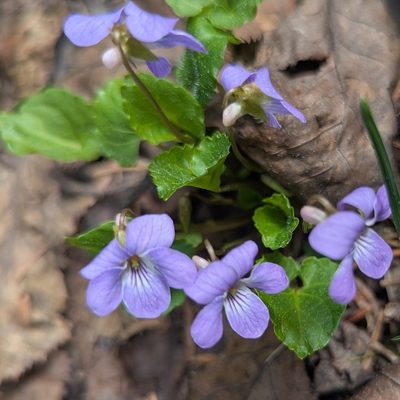 Selkirk's VioletViola selkirkii | Purple | June into early July | 4–15 cm (1½–6 in) | Cold, shady, mossy spruce forest in ravines, on benches, rocky slopes and cliff bases at high elevations | There is no leafy stem: each leaf and each flower stalk rises straight from the ground. The leaves are heart-shaped with a deep, narrow notch at the base, so the two basal lobes often touch or overlap; the edges are scalloped, the upper surface has short stiff hairs and the underside is usually smooth. The flower is up to about 15 mm (½ in) long and pale violet, with the lower three petals white at the base and marked with dark violet veins, and the two side petals have no tuft of hairs (no beard). Behind the flower is a thick spur 4–7 mm (⅙–¼ in) long. Hookedspur Violet has leafy stems with the flower stalks rising from the leaf joints, bearded side petals and a 5–7 mm spur whose tip is straight or curved up. Northern Bog Violet also has all its leaves at the base, but its side petals are bearded, its leaves are usually smooth on both sides, its spur is a short bump 2–3 mm long, and it grows in wet, saturated ground. Minnesota Wildflowers calls Selkirk's Violet the only beardless blue or purple violet with heart-shaped leaves in that state, and says it often grows in moss-covered crevices or on rotting logs. |
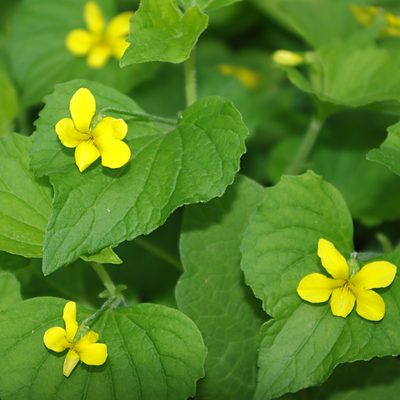 Smooth Yellow VioletViola pubescens var. scabriuscula | Yellow | April into June | 10–35 cm (4–14 in) | Shaded, moist woods: creek bottoms, aspen, birch and spruce stands, north-facing pine slopes and forest roadside banks | Look for a leafy stem, not a bare flower stalk from the ground: two to several stems rise from one crown, 10–35 cm (4–14 in) tall, often leaning at the base, with four or five broad heart-shaped leaves on the upper part of the stem and one to five more at the base. The leaves are 5–10 cm (2–4 in) long and about as wide, often a little wider than long, with finely toothed edges, a pointed tip and large leafy flaps (stipules) at the base of each leaf stalk. Each yellow flower, 10–15 mm long, nods at the end of a slender stalk from a leaf axil; the lower three petals carry dark purple-brown veins, the two side petals have a tuft of short white hairs at the base, and the spur is a short bump no more than 2.5 mm long. Nuttall's Violet, the yellow violet of open prairie, has narrow, lance-shaped, toothless leaves. Downy Yellow Violet, the hairy form that Flora of North America keeps as a separate variety, has one or two finely hairy stems, no basal leaves or rarely one, and only two or three stem leaves bunched near the tip; most Black Hills records don't say which of the two they are. Canada Violet, a leafy-stemmed violet with heart-shaped leaves, has white flowers with a yellow base. |
Other look-alike groups: 38 groups
- Anemones (4)
- Asters (4)
- Beardtongues (5)
- Buttercups (3)
- Cacti (4)
- Cinquefoils (7)
- Clovers (6)
- Coneflowers (4)
- Currants and gooseberries (5)
- Daisies (5)
- Dandelions (3)
- Docks and buckwheats (4)
- Evening primroses (4)
- Ferns (4)
- Gentians (4)
- Grasses (11)
- Groundsels and ragworts (3)
- Lilies (5)
- Mayflowers and false Solomon's seals (3)
- Milkvetches and locoweeds (12)
- Milkweeds (6)
- Mints (8)
- Mustards (11)
- Orchids (8)
- Paintbrushes (3)
- Pines (3)
- Raspberries and thimbleberries (3)
- Sagebrushes and sageworts (3)
- Sedges (3)
- Speedwells and kittentails (3)
- Sunflowers (4)
- Thistles (6)
- Vervains (3)
- Vetches (4)
- Wild lettuces (3)
- Wild onions (3)
- Wild plums and cherries (3)
- Willows (3)