Sunflowers of the Black Hills
All 4 sunflowers in this guide, side by side, A to Z. Compare the photos, bloom time, height and where each grows, then open the one that fits for more photos and the full ID notes. Each plant's page lists its sources.
| Plant | Color | Blooms | Height | Where | How to tell it apart |
|---|---|---|---|---|---|
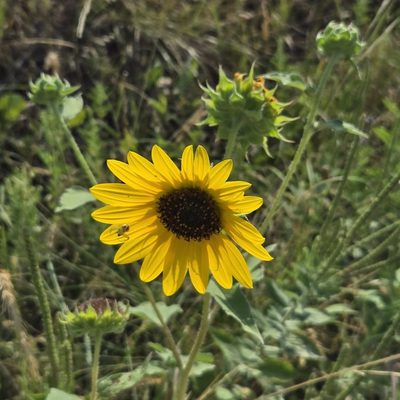 Common SunflowerHelianthus annuus | Yellow | Late July through September, sometimes into October | 60–300 cm (2–10 ft) | Roadsides, ditches, fields, pastures and other disturbed ground in full sun | Look for a stout, bristly main stem that branches upward and carries one to a dozen heads, each 7.5–15 cm (3–6 in) across, with 17–30 yellow rays around a reddish- to purplish-brown center. The leaves are mostly alternate, long-stalked, broadly egg- to heart-shaped, toothed and rough on both sides. Under the head, the green bracts are broad and narrow abruptly to a long, slender tip. Stiff Sunflower is a perennial with mostly opposite, nearly stalkless, gray-green leaves, most of them on the lower half of the stem. Prairie Sunflower is smaller, with narrower leaves and a smaller disk that looks whitish in the very center. |
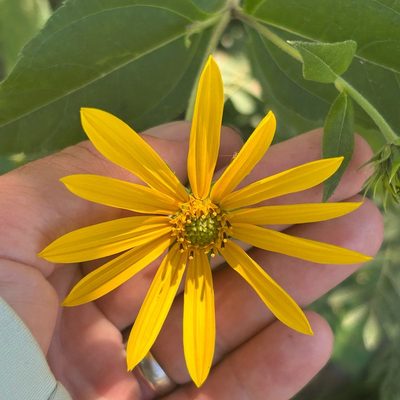 Jerusalem ArtichokeHelianthus tuberosus | Yellow | August into October | 1–3 m (3–10 ft) | Moist open or shaded ground: streambanks, floodplain woods, thickets, woodland edges and roadsides | Look for a tall plant, 1–3 m (3–10 ft), with a stout stem covered in stiff whitish hairs and large, rough, toothed leaves that are opposite on the lower stem and alternate higher up. The leaf blades are ovate to lanceolate, 10–25 cm (4–10 in) long, hairy underneath and tapered at the base into a winged stalk. Each head has 10 to 20 yellow rays around a yellow-orange disk, and the bracts beneath it are pointed and spread at the tips. Minnesota Wildflowers says this species has the largest and proportionately broadest leaves of the tall sunflowers it covers. Small tubers form on underground stems late in the season. |
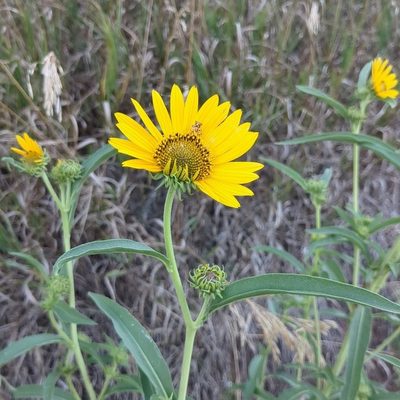 Maximilian SunflowerHelianthus maximiliani | Yellow | August into October | 50–250 cm (20–98 in) | Damp and open prairie, roadsides, ditches, stream banks and waste ground, often in sandy soil | Look for tall, usually unbranched stems 0.5–2.5 m (20–98 in) high, light green to purplish and covered in short white hairs, standing singly or in loose clusters. The lance-shaped leaves, 7–30 cm (3–12 in) long, are very pointed, grayish green, coarsely hairy and rough, and are folded upward along the central vein; SDSU says this narrow, folded, grayish-green leaf sets it apart from other sunflowers. Heads 2.5–7 cm (1–2¾ in) across sit on stalks from the upper leaf axils, often making a long column of flowers at the top, with 15–25 yellow rays, a greenish yellow to dark brown center and long, narrow, spreading bracts behind the head. Minnesota Wildflowers says it most resembles Sawtooth Sunflower (Helianthus grosseserratus), which has coarsely toothed leaves on longer stalks and a hairless stem, while Maximilian Sunflower's leaves are mostly toothless and its stem is rough with short hairs. |
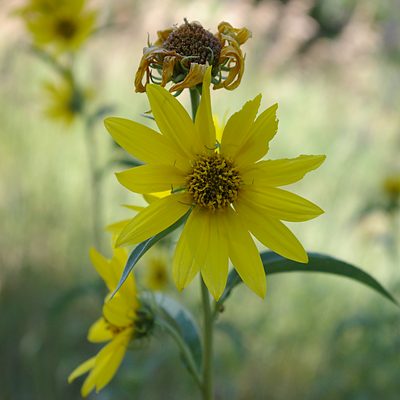 Stiff SunflowerHelianthus pauciflorus | Yellow | July into September | 50–200 cm (20–79 in) | Dry prairies, open woods and roadsides; sandy or rocky soil | Look for mostly opposite, nearly stalkless, very rough gray-green leaves crowded on the lower half of the plant, long and mostly bare upper stems, a usually purplish brown disk, and short, flat bracts held tight to the head. The disk is sometimes yellow, so check the leaves too. |
Other look-alike groups: 38 groups
- Anemones (4)
- Asters (4)
- Beardtongues (5)
- Buttercups (3)
- Cacti (4)
- Cinquefoils (7)
- Clovers (6)
- Coneflowers (4)
- Currants and gooseberries (5)
- Daisies (5)
- Dandelions (3)
- Docks and buckwheats (4)
- Evening primroses (4)
- Ferns (4)
- Gentians (4)
- Grasses (11)
- Groundsels and ragworts (3)
- Lilies (5)
- Mayflowers and false Solomon's seals (3)
- Milkvetches and locoweeds (12)
- Milkweeds (6)
- Mints (8)
- Mustards (11)
- Orchids (8)
- Paintbrushes (3)
- Pines (3)
- Raspberries and thimbleberries (3)
- Sagebrushes and sageworts (3)
- Sedges (3)
- Speedwells and kittentails (3)
- Thistles (6)
- Vervains (3)
- Vetches (4)
- Violets (7)
- Wild lettuces (3)
- Wild onions (3)
- Wild plums and cherries (3)
- Willows (3)