Common Sunflower
Helianthus annuus
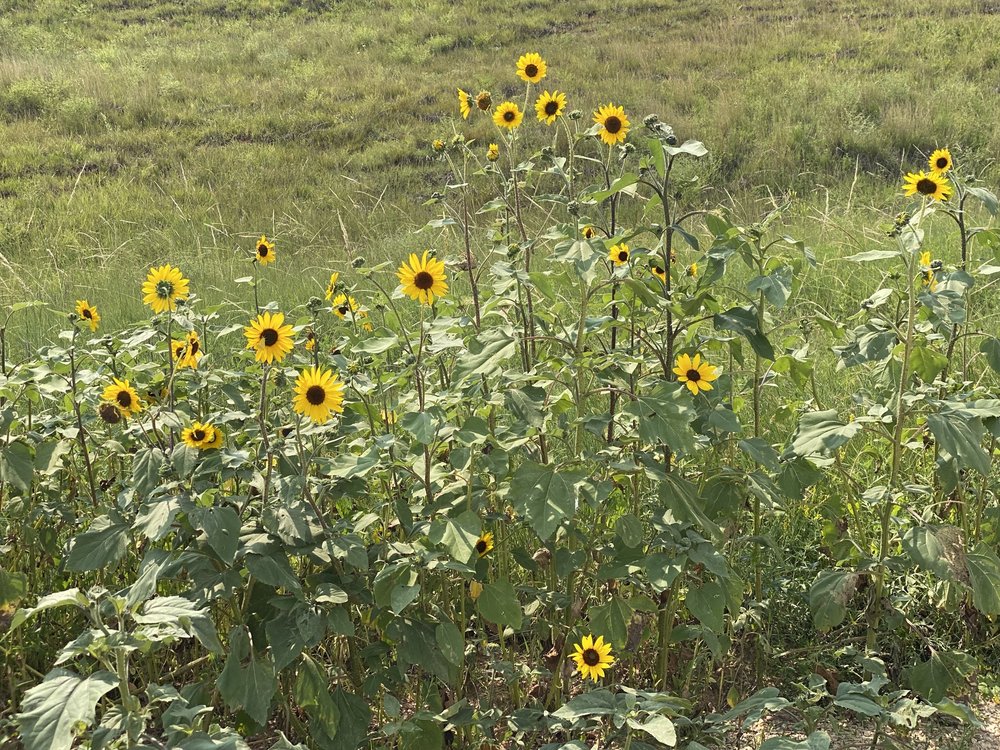
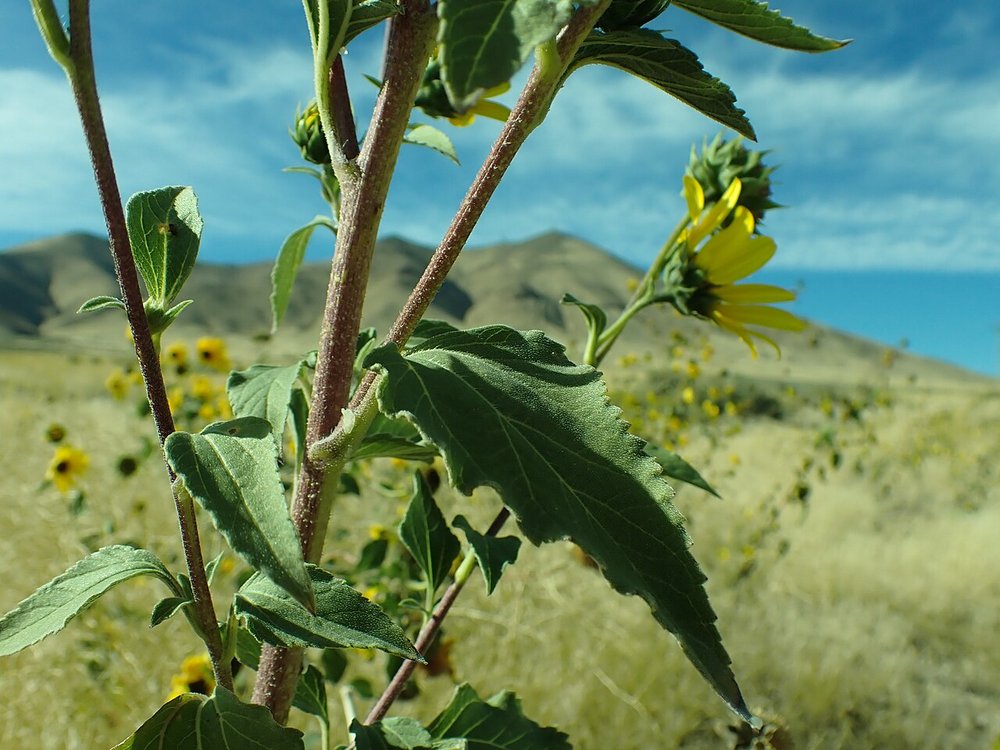
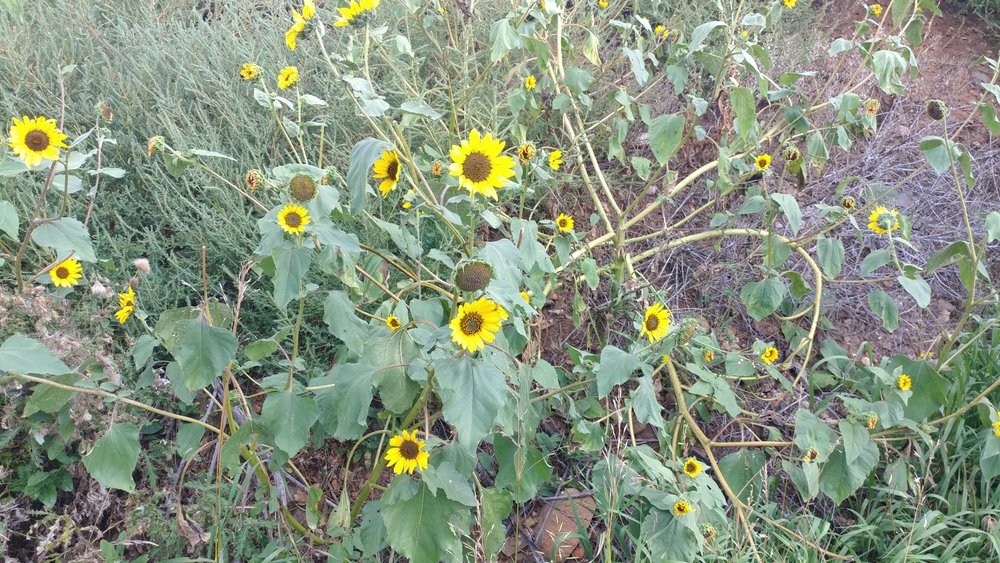
Common Sunflower (Helianthus annuus) is a native annual of the aster family and the wild parent of the garden sunflower, a coarse, branching plant with rough, heart-shaped leaves and several yellow heads with dark centers. In the Black Hills it blooms from late July into September along roadsides, in fields and pastures and on other disturbed ground.
Free photos from other sources
| Family | Asteraceae · Aster |
|---|---|
| Status | Native annual |
| Blooms | Late July through September, sometimes into October |
| Height | 60–300 cm (2–10 ft) |
| Where | Roadsides, ditches, fields, pastures and other disturbed ground in full sun |
| Also called | Annual Sunflower, Wild Sunflower, waȟčá zizí (Lakota), waȟčá zí tȟáŋka (Lakota) |
| Synonym | Helianthus aridus, Helianthus jaegeri, Helianthus lenticularis, Helianthus macrocarpus |
| Traditional use | Sitting Bull College's 1998 Culturally Important Plants of the Lakota says the Lakota boiled ripe heads and skimmed off the oil for hair and skin, boiled the heads with the bracts removed as a medicine for lung trouble, and ate the seeds. Gilmore (1919) recorded a Teton Dakota saying that when the sunflowers stood tall and in full bloom, the buffalo were fat and the meat was good. |
Roots, seeds & germination
Root: A seedling starts with a taproot, and a full-grown plant adds a large spread of fibrous roots. As an annual, it lives one season, and the stand comes back only from seed.
Seed: The fertile disk flowers make flattened achenes (dry, one-seeded fruits), about 3–5 mm (⅛–¼ in) long on wild plants, each tipped with two narrow scales. Wild seeds are far smaller than crop sunflower seeds.
Germination: Fresh wild seed is mostly dormant. In Chicago Botanic Garden trials on wild Colorado seed, 12 weeks of cold, moist treatment raised germination to as much as 40 percent, against 0–15 percent for untreated seed, so sowing outdoors in fall lets winter do the work. Seed needs warm, moist soil, at least about 7–10 °C (45–50 °F), and full sun.
How do you identify Common Sunflower?
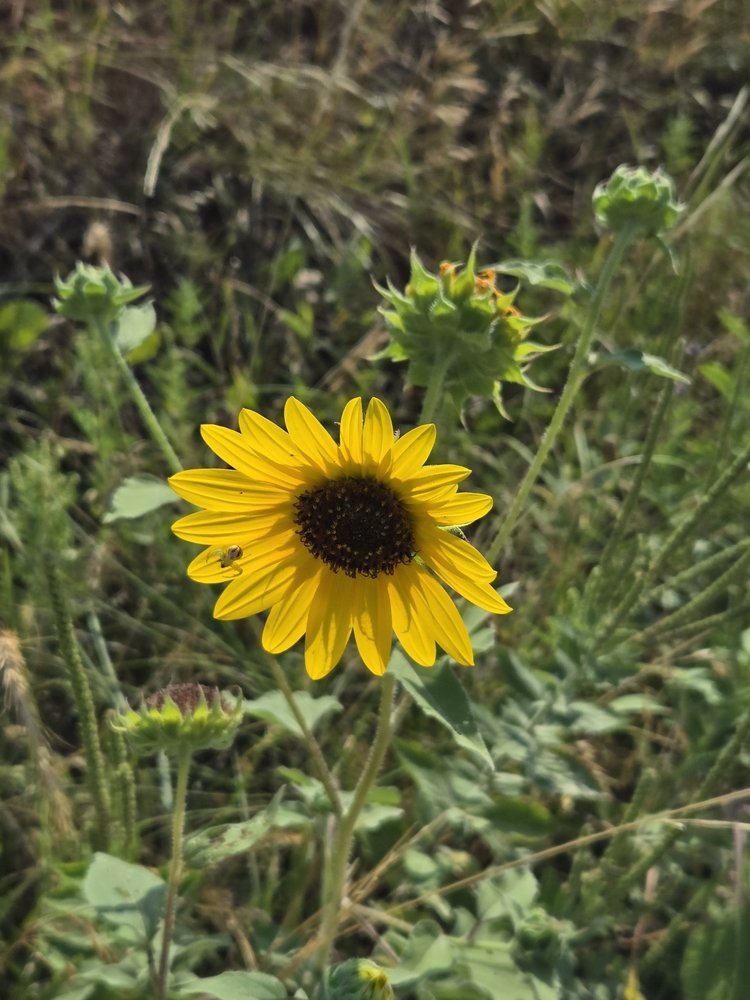
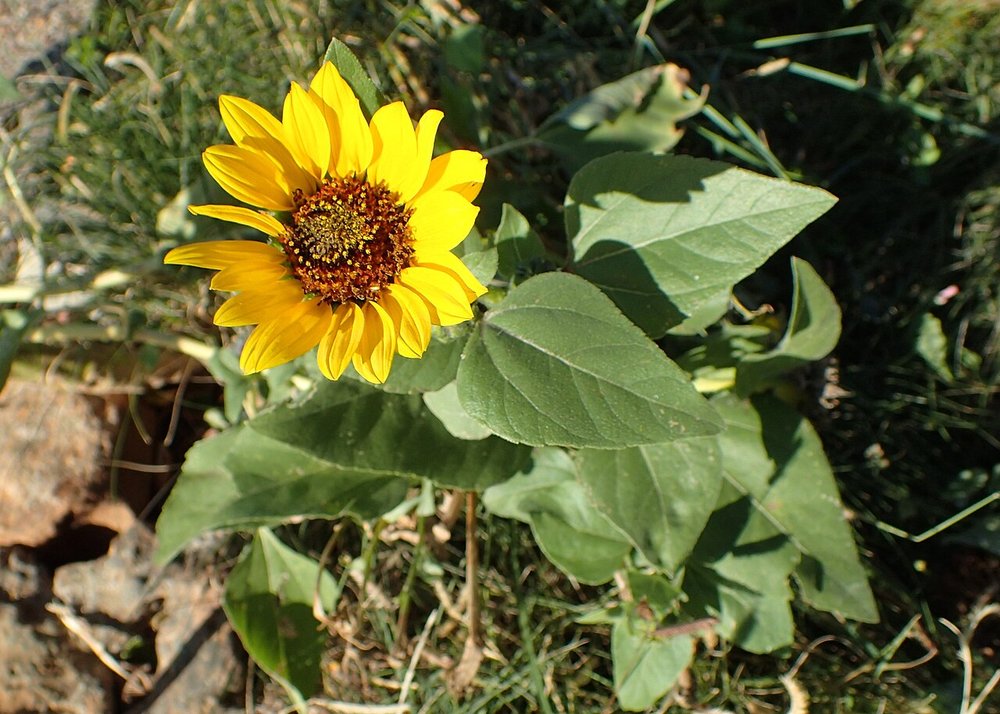
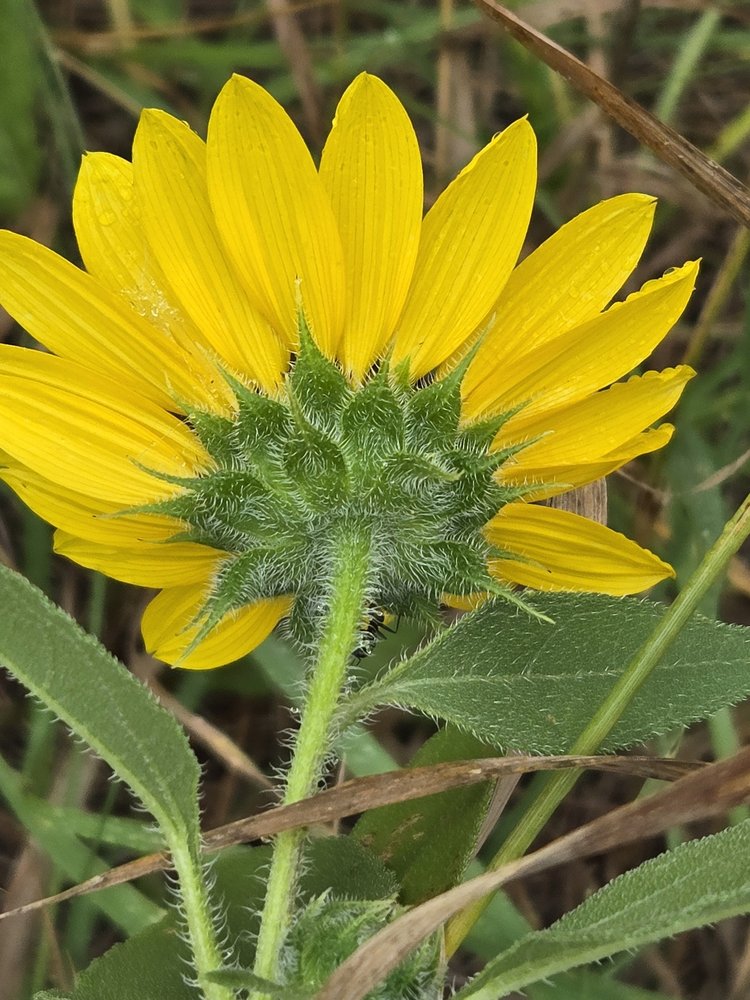
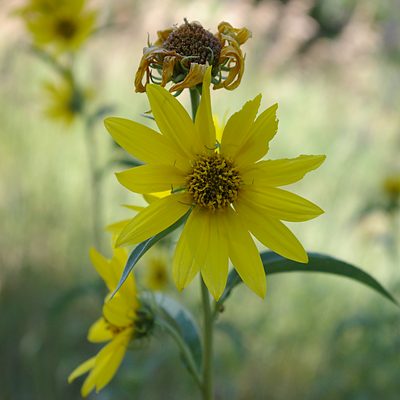
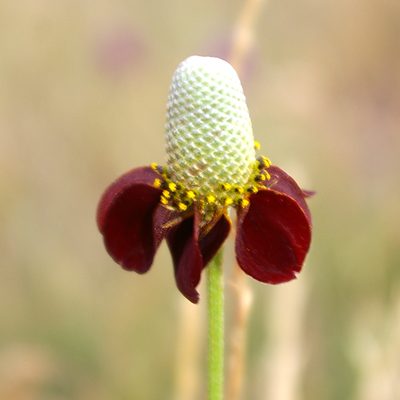
Look for a stout, bristly main stem that branches upward and carries one to a dozen heads, each 7.5–15 cm (3–6 in) across, with 17–30 yellow rays around a reddish- to purplish-brown center. The leaves are mostly alternate, long-stalked, broadly egg- to heart-shaped, toothed and rough on both sides. Under the head, the green bracts are broad and narrow abruptly to a long, slender tip. Stiff Sunflower is a perennial with mostly opposite, nearly stalkless, gray-green leaves, most of them on the lower half of the stem. Prairie Sunflower is smaller, with narrower leaves and a smaller disk that looks whitish in the very center.
When does it bloom?
Late July through September, sometimes into October.
Where does it grow?
Full sun on disturbed soil: roadsides and road ditches, fields, pastures and waste places. Black Hills herbarium labels name road ditches, roadsides, grazed and dry pastures, fields and open range, and specimens from the counties around the Hills, in South Dakota and Wyoming, go back to 1913. The National Park Service lists it at Wind Cave, Jewel Cave, Mount Rushmore and Devils Tower.
Other flowers to compare

Sources: Black Elk, L. S. & W. D. Flying By. 1998. Culturally Important Plants of the Lakota. Sitting Bull College (entry 141, Helianthus annuus); Gilmore, M. R. 1919. Uses of Plants by the Indians of the Missouri River Region. 33rd Annual Report of the Bureau of American Ethnology, p. 130; Flora of North America vol. 21 (eFloras): Helianthus annuus; USDA NRCS Plant Guide: Common Sunflower, Helianthus annuus (archived); Kansas Wildflowers and Grasses: Common Sunflower; Minnesota Wildflowers: Common Sunflower; Minnesota Wildflowers: Prairie Sunflower; Illinois Wildflowers: Plains (Prairie) Sunflower, Helianthus petiolaris (comparison with annual sunflower); Native Plant Network: Helianthus propagation protocols (Kramer & Foxx 2016, H. annuus); University of Washington ESRM 412: Helianthus annuus propagation protocol; Smith, B. D. & R. A. Yarnell. 2009. Initial formation of an indigenous crop complex in eastern North America at 3800 B.P. PNAS 106(16):6561–6566; Crites, G. D. 1993. Domesticated sunflower in fifth millennium B.P. temporal context: new evidence from Middle Tennessee. American Antiquity 58(1):146–148; Kansas Historical Society, Kansapedia: Sunflower (state flower, 1903); Marriott, H. & R. Hartman. 1986. Vegetation of Jewel Cave National Monument; NPSpecies checklist, Wind Cave National Park; NPSpecies checklist, Jewel Cave National Monument; NPSpecies checklist, Mount Rushmore National Memorial; NPSpecies checklist, Devils Tower National Monument; NPS, Mount Rushmore: Wildflowers; NPS, Devils Tower: Native Plants; GBIF occurrence search, Helianthus annuus, preserved specimens, Black Hills bounding box; Minnesota Wildflowers: Stiff Sunflower (Helianthus pauciflorus), for the comparison.