Raspberries and thimbleberries of the Black Hills
All 3 raspberries and thimbleberries in this guide, side by side, A to Z. Compare the photos, bloom time, height and where each grows, then open the one that fits for more photos and the full ID notes. Each plant's page lists its sources.
| Plant | Color | Blooms | Height | Where | How to tell it apart |
|---|---|---|---|---|---|
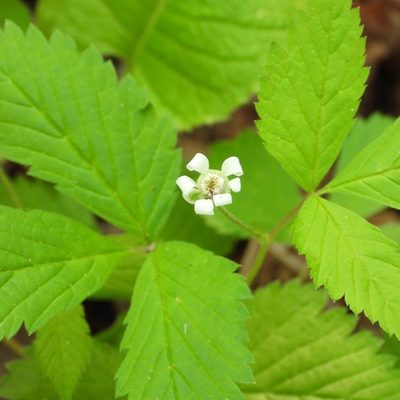 Dwarf RaspberryRubus pubescens | White | June into July | 10–30 cm (4–12 in) | Moist spruce, pine, birch and aspen woods, creek bottoms and boggy spots | Look for a low, creeping plant with stems that lack prickles or thorns of any kind. The leaves are alternate, each with three (sometimes five) sharply double-toothed leaflets 3–7.5 cm (1¼–3 in) long, with a pair of small leafy stipules at the base of the leaf stalk. One to three white flowers, sometimes light pink, 8–13 mm (⅓–½ in) across, sit on stalks at the stem tips; each has 5 narrow petals and 5 sepals bent back. The fruit is a round cluster of fleshy red drupelets (tiny single-seeded fruits) 6–13 mm (¼–½ in) wide. Minnesota Wildflowers says clumps of leaves can be mistaken for Wild Strawberry (also in this guide), and that the raspberry's leaves are more sharply pointed with double teeth. |
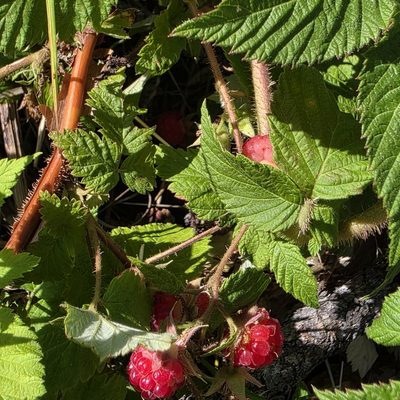 Red RaspberryRubus idaeus subsp. strigosus | White | June and July, a few into August | 0.5–3 m (1½–10 ft) | Rocky slopes, stream banks, forest openings and burned or logged forest | Look for a patch of upright to arching canes, knee- to chest-high, covered sparsely to thickly with bristles and small prickles. The leaves have three or five toothed leaflets, and the underside is white to silvery-gray with dense, woolly hairs. The small white flowers droop, single or a few together, from side shoots, with narrow petals 4–6 mm (about ¼ in) long. The red berry is 12–18 mm (½–¾ in) long and finely hairy. |
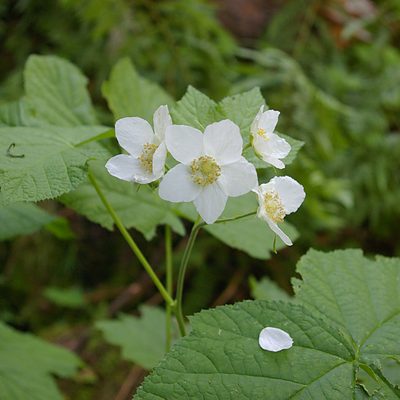 ThimbleberryRubus parviflorus | White | Mostly mid-June into early July, a few into August | 0.5–3 m (1½–10 ft) | Moist, shaded canyon bottoms, damp ravines and creek banks | Look for a patch of soft, upright canes with no prickles or bristles at all, glandular-hairy when young and later smooth with peeling gray-brown bark, and huge, fuzzy, maple-shaped leaves 10–20 cm (4–8 in) across with three to seven pointed lobes. The white flowers are 3–5 cm (1¼–2 in) across, with five broad petals like crumpled tissue paper around a big yellow center, in small clusters of 2–9. The berry is a red, thimble-shaped cap, 1.2–2 cm (½–¾ in) across, so soft it falls from the core at the slightest touch. Red Raspberry has prickly canes, leaves divided into three or five leaflets that are silvery-hairy underneath, and much smaller flowers, with petals 4–6 mm long. |
Other look-alike groups: 38 groups
- Anemones (4)
- Asters (4)
- Beardtongues (5)
- Buttercups (3)
- Cacti (4)
- Cinquefoils (7)
- Clovers (6)
- Coneflowers (4)
- Currants and gooseberries (5)
- Daisies (5)
- Dandelions (3)
- Docks and buckwheats (4)
- Evening primroses (4)
- Ferns (4)
- Gentians (4)
- Grasses (11)
- Groundsels and ragworts (3)
- Lilies (5)
- Mayflowers and false Solomon's seals (3)
- Milkvetches and locoweeds (12)
- Milkweeds (6)
- Mints (8)
- Mustards (11)
- Orchids (8)
- Paintbrushes (3)
- Pines (3)
- Sagebrushes and sageworts (3)
- Sedges (3)
- Speedwells and kittentails (3)
- Sunflowers (4)
- Thistles (6)
- Vervains (3)
- Vetches (4)
- Violets (7)
- Wild lettuces (3)
- Wild onions (3)
- Wild plums and cherries (3)
- Willows (3)