Thimbleberry
Rubus parviflorus
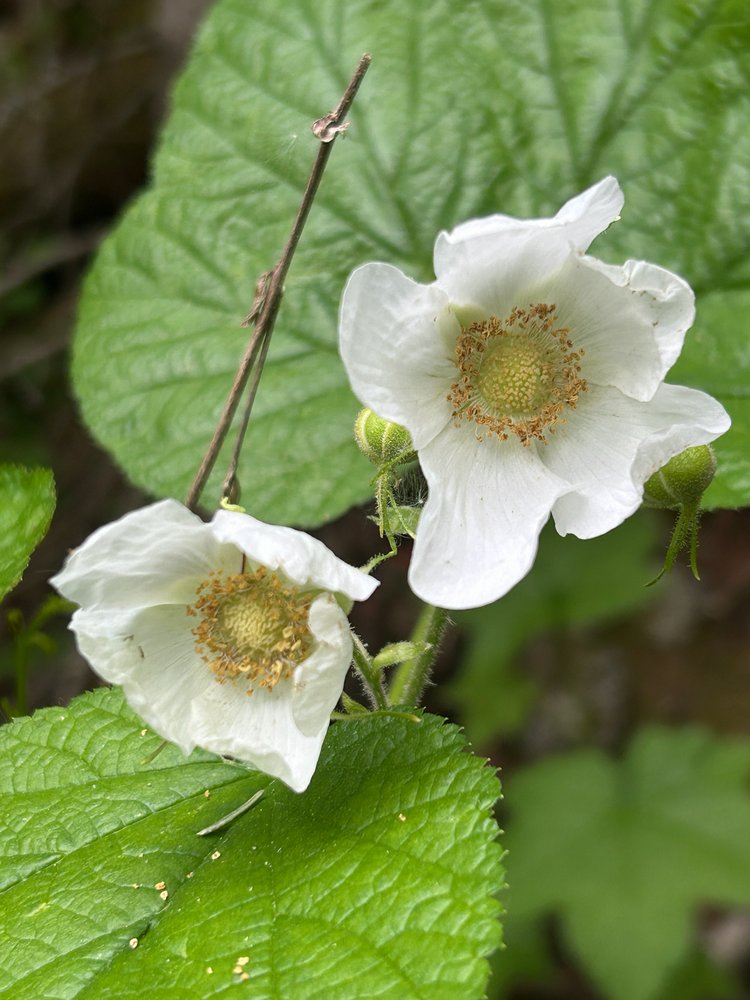
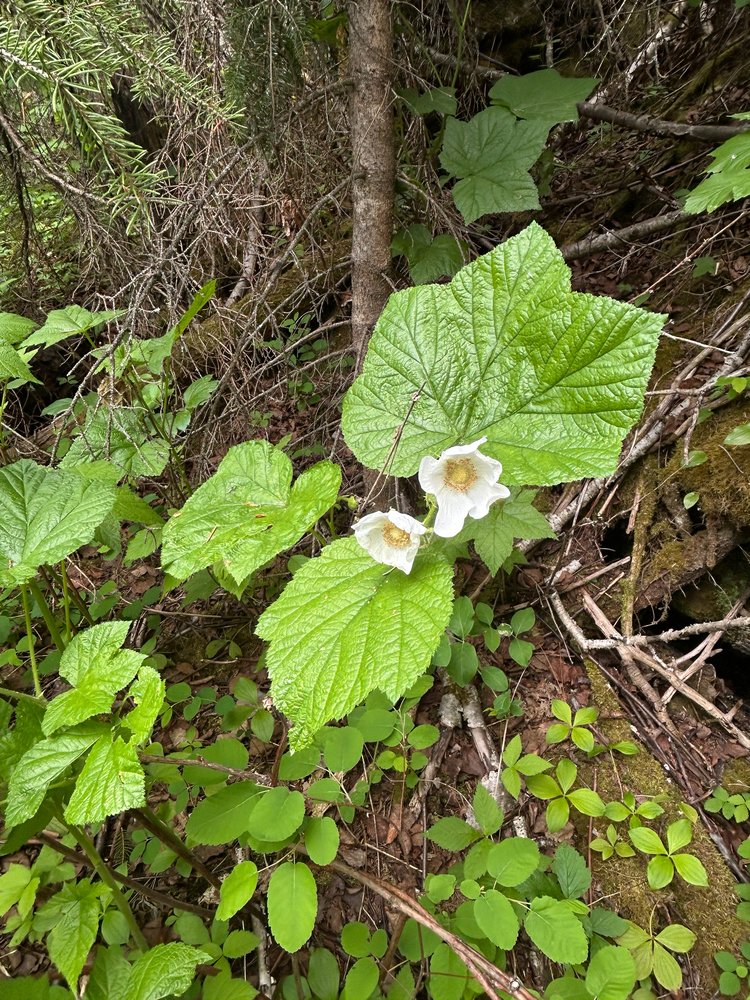
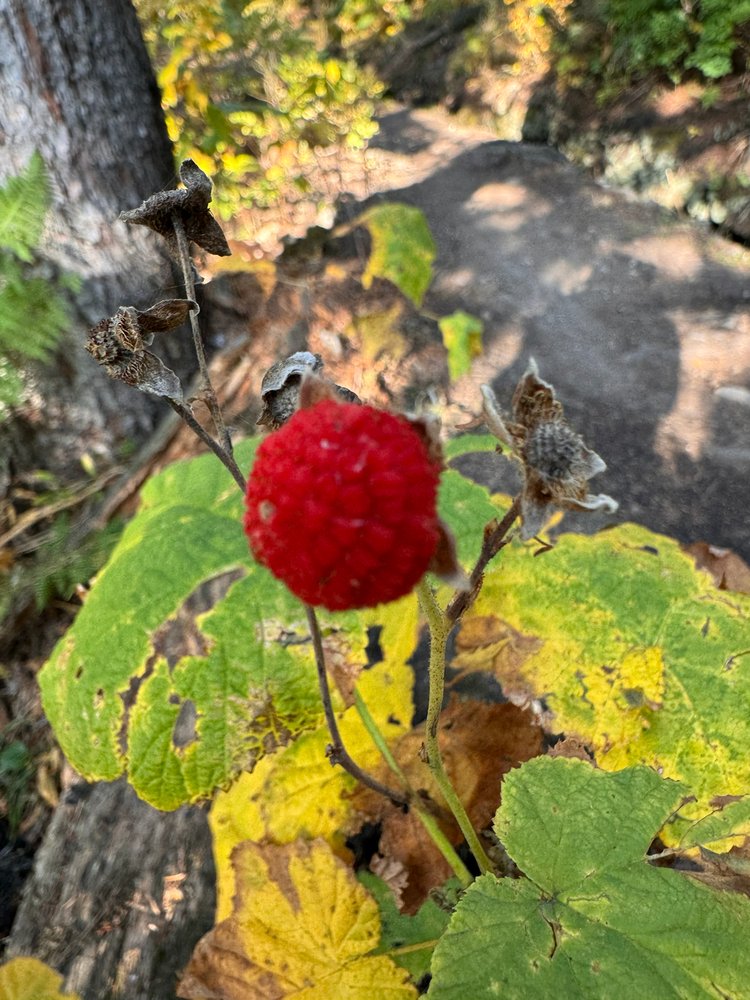
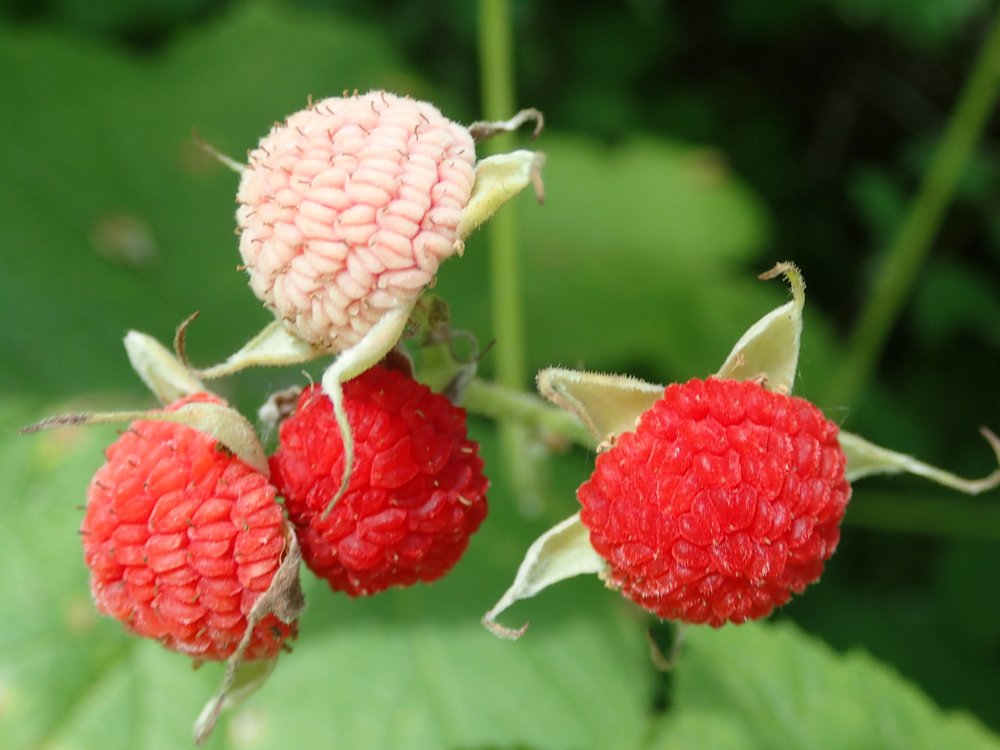
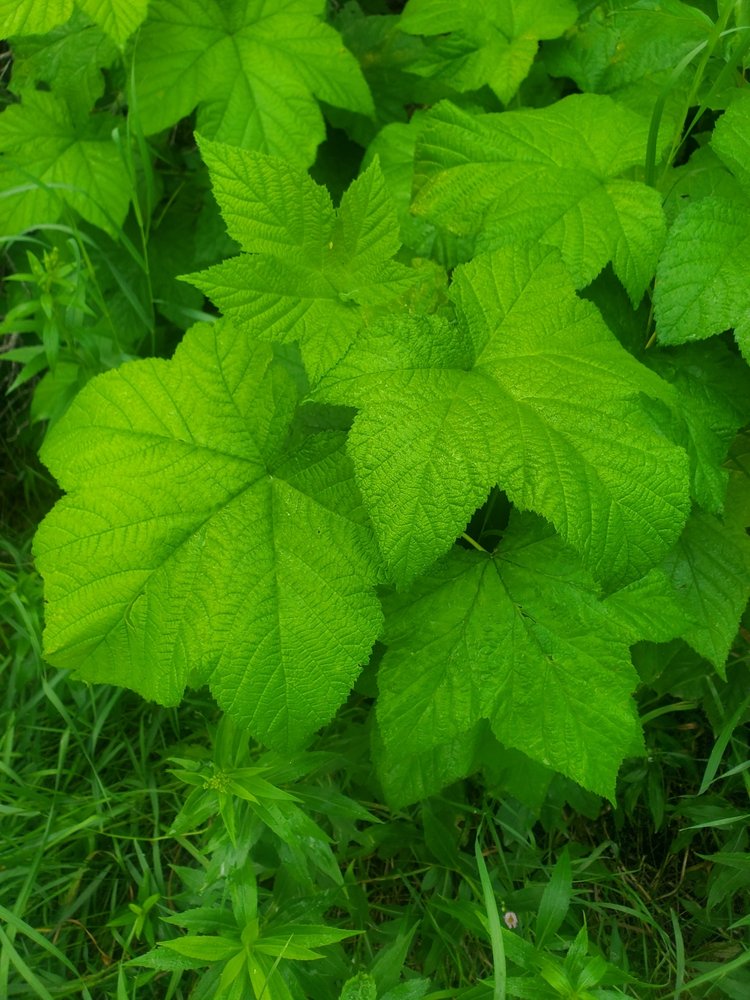
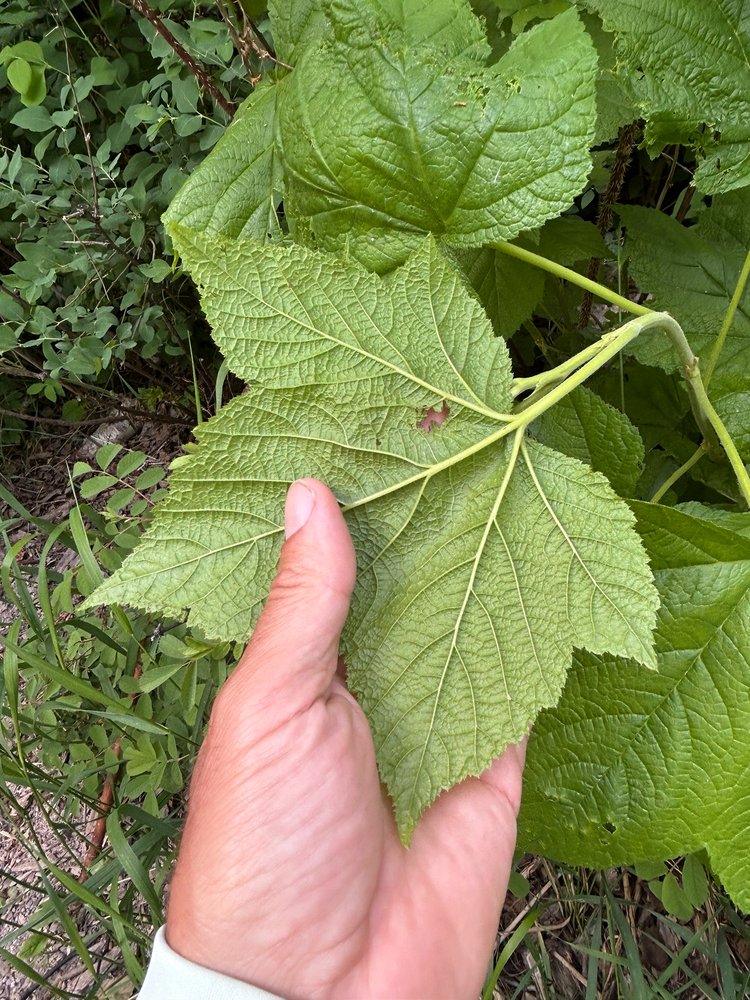
Thimbleberry (Rubus parviflorus) is a native, thornless shrub of the rose family, with maple-like leaves as big as a dinner plate, the largest white flowers of any Black Hills bramble, and soft red berries that come off as a hollow "thimble." It blooms in June and early July and grows almost only in cool, shady canyons of the northern Hills, an isolated outpost far east of its main Rocky Mountain range.
Free photos from other sources
| Family | Rosaceae · Rose |
|---|---|
| Status | Native shrub |
| Blooms | Mid-June into early July |
| Height | 0.5–3 m (1½–10 ft) |
| Where | Moist, shaded canyon bottoms, spring-fed ravines and creek banks |
| Also called | Western Thimbleberry, Thimble Raspberry |
| Synonym | Rubacer parviflorum, Rubus nutkanus, Rubus parviflorus var. grandiflorus, Rubus parviflorus var. bifarius, Rubus parviflorus var. heteradenius, Rubus parviflorus var. hypomalacus, Rubus parviflorus var. parvifolius |
| Traditional use | An ethnobotany database kept by the Botanical Research Institute of Texas, citing Hellson's 1974 study of Blackfoot plant use, records that the Blackfoot ate the ripe fruit, dyed tanned robes with the berries, and gave the berries to patients for chest disorders. |
Roots, seeds & germination
Root: Long, shallow rhizomes send up new canes, so one plant becomes a patch or thicket. A patch can live 45 years or more, though each cane lives only 2–3 years.
Seed: Each berry carries roughly 75–190 tiny hard-coated seeds. Birds, bears and small mammals eat the fruit and spread the seed, which lasts a long time in the top few centimeters of soil and can sprout years later when the canopy opens.
Germination: The seed is doubly dormant, with a hard, waterproof coat around a dormant embryo, and germination is slow and usually low. One protocol gives a warm, moist period followed by 90 days of cold, moist stratification at 2–5°C (36–41°F); SDSU recommends sowing outdoors in fall. Rhizome pieces and dormant cuttings root readily.
How do you identify Thimbleberry?
Look for a patch of soft, upright canes with no prickles or bristles at all, smooth or a little sticky to the touch, and huge, fuzzy, maple-shaped leaves 10–20 cm (4–8 in) across with three to seven pointed lobes. The white flowers are 3–5 cm (1¼–2 in) across, with five broad, crinkled petals like tissue paper around a big yellow center, in small clusters of 2–9. The berries are wider and flatter than a raspberry, bright red and very soft. Red Raspberry, often in the same canyons, has bristly, prickly canes, leaves divided into three to five leaflets that are whitish underneath, and much smaller flowers.
When does it bloom?
Mid-June into early July.
Where does it grow?
Cool, moist forest: shaded canyon bottoms, spring-fed ravines, creek banks and the foot of north-facing slopes, usually under white spruce, paper birch, aspen and pine, at about 1,220–1,830 m (4,000–6,000 ft). Nearly every Black Hills record is from the northern Hills: about 86 herbarium specimens from Lawrence County, many from Spearfish Canyon since 1908, plus specimens from the Bear Lodge Mountains of Crook County, Wyoming. Mount Rushmore's species list also includes it, but it isn't on the Wind Cave, Jewel Cave or Devils Tower lists. East of the Rockies it grows only here and around the upper Great Lakes.
Other plants to compare
Sources: USDA Forest Service, Fire Effects Information System (FEIS): Rubus parviflorus (distribution incl. Black Hills and Great Lakes disjuncts, description, rhizomes, seed, germination, phenology); USDA Forest Service, Celebrating Wildflowers: Thimbleberry (Rubus parviflorus); Reese, R.N. 2015. Rosaceae: Rubus parviflorus. South Dakota Native Plant Research, SDSU Open PRAIRIE; Minnesota Wildflowers: Thimbleberry (Rubus parviflorus); University of Washington, Propagation of Pacific Northwest Native Plants: Thimbleberry plant data sheet; USDA PLANTS Database: Rubus parviflorus Nutt. (RUPA); ITIS: Rubus parviflorus Nutt., TSN 25007; GBIF occurrence search: Rubus parviflorus, South Dakota (herbarium specimens, Lawrence County); GBIF occurrence search: Rubus parviflorus, Wyoming (Bear Lodge Mountains, Crook County); NPSpecies: Rubus parviflorus at Mount Rushmore National Memorial (Symstad & Bynum 2005; Marriott 2005); NPSpecies checklist: Mount Rushmore National Memorial, vascular plants; NPSpecies: Rubus parviflorus at Sleeping Bear Dunes National Lakeshore ("Western disjunct species"); NPSpecies checklist: Wind Cave National Park, vascular plants (thimbleberry absent); NPSpecies checklist: Devils Tower National Monument, vascular plants (thimbleberry absent); Marriott, H. & R. Hartman. 1986. Vegetation of Jewel Cave National Monument (thimbleberry not listed); Native American Ethnobotany Database (BRIT): Rubus parviflorus, 103 uses; Black Elk, L.S. & W.D. Flying By. 1998. Culturally Important Plants of the Lakota. Sitting Bull College (thimbleberry not included); Gilmore, M.R. 1919. Uses of Plants by the Indians of the Missouri River Region (thimbleberry not included); South Dakota Game, Fish & Parks: Rare Plants of South Dakota (no Rubus listed); Marriott, H. ("Hollis"). 2012. Pleistocene relics in the Black Hills. In the Company of Plants and Rocks (blog); iNaturalist: Rubus parviflorus observations within 90 km of the central Black Hills.