Anemones of the Black Hills
All 4 anemones in this guide, side by side, A to Z. Compare the photos, bloom time, height and where each grows, then open the one that fits for more photos and the full ID notes. Each plant's page lists its sources.
| Plant | Color | Blooms | Height | Where | How to tell it apart |
|---|---|---|---|---|---|
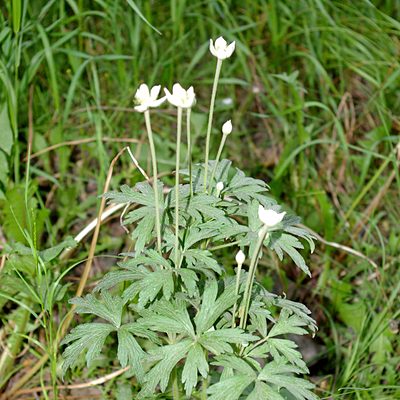 Candle AnemoneAnemone cylindrica | White | June into July | 30–70 cm (12–28 in) | Open prairies, pastures, dry open woods and roadsides | Look for small flowers, 1.5–2 cm across, with 4 to 6 white to greenish white sepals and no true petals, on long stalks above a whorl of leaves midway up the stem. The center lengthens into a cylinder 1.5–3.5 cm long and under ½ inch wide, which turns to white, cottony fluff and stays through winter. Tall Thimbleweed is taller, with cones usually under 1 inch and rounded, toothed leaflet lobes; this plant's leaflets are wedge-shaped with lobes that fan out. |
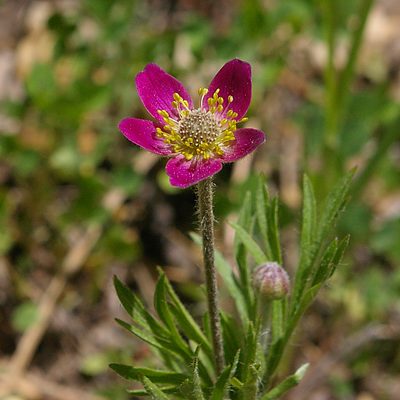 Cut-leaved AnemoneAnemone multifida | Pink, White | May and June | 10–60 cm (4–24 in) | Rocky banks, grassy slopes, open woods and meadows | Long-stalked leaves are divided into narrow, pointed lobes, and a whorl of smaller cut leaves sits on the stem below the flowers. Sepals are 5 to 15 mm long, and the flowers give way to a round, fluffy head of woolly seeds. Candle Anemone has a long, cylinder-shaped seed head instead, and Pasque Flower has a flower 4 to 8 cm across. |
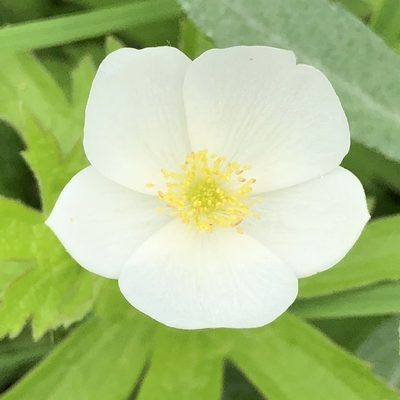 Meadow AnemoneAnemone canadensis | White | May into July | 30–60 cm (12–24 in) | Moist fields, thickets, ditches and shores, in sun or part shade | Look for a perennial 30–60 cm (1–2 ft) tall with erect, sparsely hairy stems, spreading by rhizomes (underground stems) into colonies. There are 1 to 5 long-stalked basal leaves, roundish in outline, 8–15 cm (3–6 in) long, deeply divided into 3 to 5 wedge-shaped lobes that are cut again and coarsely toothed. Higher on the stem is a whorl of 3 stalkless leaves, about 13 cm (5 in) across, much like the basal ones. One to three long-stalked flowers rise from the whorl, each 2.5–4 cm (1–1½ in) across, with 5 white petal-like sepals (there are no true petals), many yellow-tipped stamens around a small green center, and hairy flower stalks (Minnesota Wildflowers; Missouri Plants). The fruit is a round head 8–11 mm (about ⅓ in) across of flattened, hairy seeds, each with a beak 3–6 mm (⅛–¼ in) long (Minnesota Wildflowers; Missouri Plants). Missouri Plants lists the thimbleweeds, Anemone virginiana and Anemone cylindrica (the guide's Candle Anemone), as broadly similar plants. |
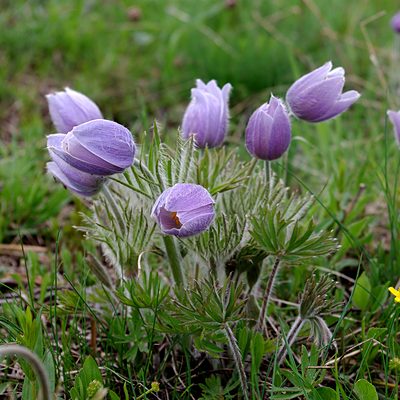 Pasque FlowerPulsatilla patens | Purple | March into May | 5–45 cm (2–18 in) | Mixed grass prairie and open pine forest, often on south-facing slopes | Look for a single flower, 4 to 8 cm across, on a fuzzy stem, with 5 to 7 petal-like sepals around many yellow stamens. The leaves are finely divided and soft-haired, and by mid-summer the flower has turned into a wispy tuft of feathery seed plumes. |
Other look-alike groups: 38 groups
- Asters (4)
- Beardtongues (5)
- Buttercups (3)
- Cacti (4)
- Cinquefoils (7)
- Clovers (6)
- Coneflowers (4)
- Currants and gooseberries (5)
- Daisies (5)
- Dandelions (3)
- Docks and buckwheats (4)
- Evening primroses (4)
- Ferns (4)
- Gentians (4)
- Grasses (11)
- Groundsels and ragworts (3)
- Lilies (5)
- Mayflowers and false Solomon's seals (3)
- Milkvetches and locoweeds (12)
- Milkweeds (6)
- Mints (8)
- Mustards (11)
- Orchids (8)
- Paintbrushes (3)
- Pines (3)
- Raspberries and thimbleberries (3)
- Sagebrushes and sageworts (3)
- Sedges (3)
- Speedwells and kittentails (3)
- Sunflowers (4)
- Thistles (6)
- Vervains (3)
- Vetches (4)
- Violets (7)
- Wild lettuces (3)
- Wild onions (3)
- Wild plums and cherries (3)
- Willows (3)