Currants and gooseberries of the Black Hills
All 5 currants and gooseberries in this guide, side by side, A to Z. Compare the photos, bloom time, height and where each grows, then open the one that fits for more photos and the full ID notes. Each plant's page lists its sources.
| Plant | Color | Blooms | Height | Where | How to tell it apart |
|---|---|---|---|---|---|
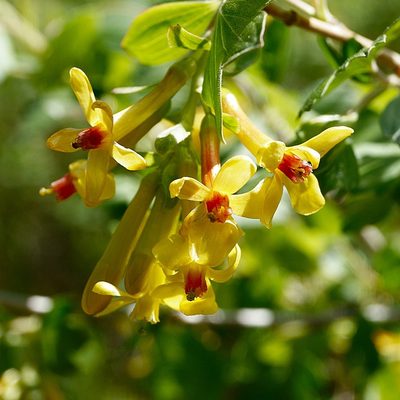 Golden CurrantRibes aureum | Yellow | Mostly May, from late April into mid-June | 1–3 m (3–10 ft) | Wooded draws, creek banks, springs, canyon bottoms and thickets | Look for a thornless, many-stemmed shrub 1–3 m (3–10 ft) tall with small, light green leaves cut into three rounded lobes, each with a few rounded teeth. In spring it carries drooping clusters of 5–15 bright yellow flowers, each a slender tube 6–20 mm (¼–¾ in) long that flares into five lobes, with short inner petals that turn orange or red as the flower ages, and a spicy, clove-like scent. The berries are smooth. Northern Gooseberry has one to three spines at each leaf node and small greenish-white to pinkish flowers, and Wax Currant has white to pinkish flowers and small, glandular, nearly kidney-shaped leaves. |
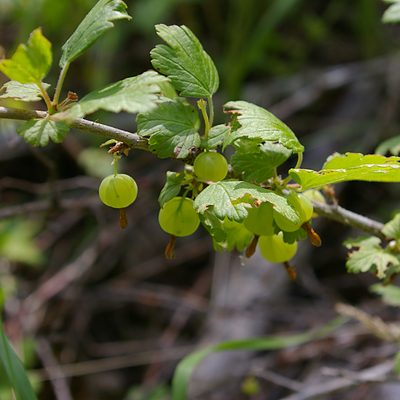 Hairystem GooseberryRibes hirtellum | – | May and June | 0.5–1.5 m (20–60 in) | Rocky woods, hillsides, ravines, thickets and stream banks, in full sun to partial shade | Look for a shrub 0.5–1.5 m (20–60 in) tall. Stems have 1–3 spines at the nodes (where leaves attach) or often none, and few prickles between the nodes; on upper stems the thin gray bark sheds along with any prickles (SDSU Open PRAIRIE). Minnesota Wildflowers adds that first-year twigs are green and smooth to sparsely prickly, and older lower stems are gray with scattered prickles. The leaves are nearly round, with 3 main lobes, 2 smaller lobes and shallow, rounded teeth, on hairy leaf stalks; SDSU Open PRAIRIE gives them as 2–4 cm (¾–1½ in) wide, and Minnesota Wildflowers as 2.5–6.4 cm (1–2½ in) long. Minnesota Wildflowers says the leaf surfaces have no glands and the base is wedge-shaped to straight across. The flowers hang in groups of 1 to 3 and are bell-shaped, 5–8 mm (about ¼ in) long, with five stamens that stick out past the petals, about twice as long as them (SDSU Open PRAIRIE; Minnesota Wildflowers). The berry is smooth, 8–10 mm (about ⅜ in) across, ripens blue to black and keeps the old flower parts at its tip (SDSU Open PRAIRIE). The guide's Northern Gooseberry (Ribes oxyacanthoides) is the plant most like it, and Minnesota Wildflowers says the two can be hard to separate and may hybridize. It reports that Northern Gooseberry has stamens barely longer than the petals, leaves glandular on one or both surfaces with a base straight to heart-shaped, and stems moderately to densely prickly, with the spines and prickles mostly staying on except on the uppermost stems. It adds that these marks come from a few small populations and may overlap. |
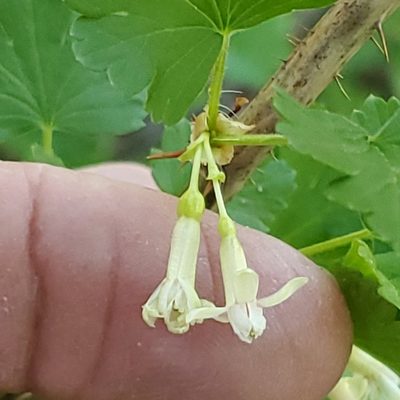 Northern GooseberryRibes oxyacanthoides | – | April into June | 0.5–1.5 m (20–60 in) | Moist woodlands, forest edges, streambanks and rocky hillsides | Look for slender young stems with dense prickles and 1 to 3 stouter spines at each node, and rounded leaves with 3 to 5 toothed lobes, usually 3–7 cm (1¼–2¾ in) long. Flowers come singly or in clusters of up to 3 or 4, and the berries are smooth. Prickly Currant (Ribes lacustre) also has prickly stems, but it has drooping clusters of 7 to 15 flowers and bristly berries. Hairystem Gooseberry (Ribes hirtellum) also has smooth berries, but its stamens reach well past the petals, while Northern Gooseberry's are barely longer than the petals. |
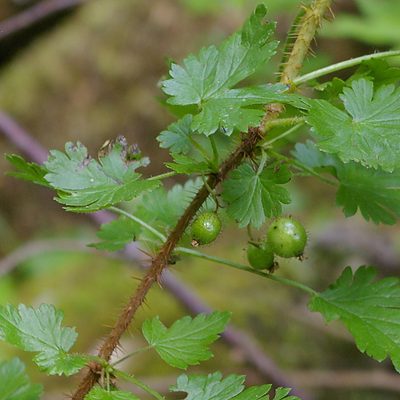 Prickly CurrantRibes lacustre | – | May into July | 1–1.5 m (3–5 ft) | Cool, moist, shaded places: streamsides, wet ravines, boggy woods and talus slopes | Look for a shrub 1–1.5 m (3–5 ft) tall whose stems are covered in slender prickles, with clusters of larger spines at the nodes, the points where the leaves come out (SDSU). The leaves are 2.5–7.5 cm (1–3 in) across with 3 to 5 deep lobes, deep shiny green on top, with stalked sticky glands along the veins underneath (SDSU). The flowers hang in drooping clusters (racemes) of 7 to 15 small saucer-shaped flowers, greenish yellow, pinkish or dark maroon-red (SDSU); Minnesota Wildflowers counts 4 to 18. The berries are 6–10 mm (¼–⅜ in) across, green at first and dark purple to black when ripe, and densely covered in stiff, gland-tipped bristles (SDSU; Minnesota Wildflowers). Minnesota Wildflowers says the very prickly stem together with glandular-hairy flowers and fruit makes it easy to tell. The guide's Northern Gooseberry (Ribes oxyacanthoides) also has prickly stems, with 1 to 4 stout spines at each node, but its nodding flowers come 1 to 3 together, sometimes 4 (SDSU); Minnesota Wildflowers says it has fewer flowers per cluster, no gland-tipped hairs on its fruit and hairier leaves, and calls its berry smooth. The Wind Cave and Devils Tower plant lists also name its subspecies setosum (once Ribes setosum), and Britton and Brown's 1913 flora says that plant's fruit is often smooth but can be sparingly bristly. A prickly stem alone doesn't separate them, since young Northern Gooseberry stems are also covered in prickles (SDSU), and the Forest Service's Black Hills forest survey says some Prickly Currant plants looked like Northern Gooseberry. So look at the flower cluster: Minnesota Wildflowers says gooseberries have only 1 to 4 flowers in a cluster, and this plant more than 4. |
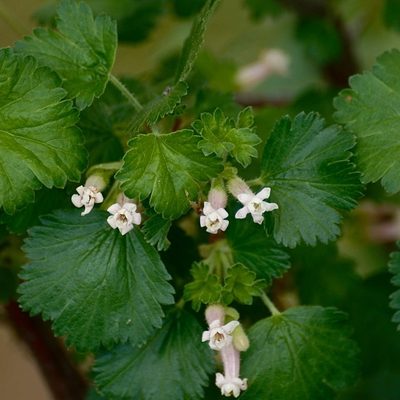 Wax CurrantRibes cereum | – | May into June | 0.2–2 m (0.7–6.5 ft) | Dry rocky slopes, rock outcrops and ridges in open ponderosa pine forest and its edges | Look for a compact, often mounded shrub with spreading or arching branches, smooth, cherry-like bark on old wood, and no spines or prickles anywhere on the stems. The leaves are small, mostly 1–2 cm (½–¾ in) across, almost kidney-shaped to fan-shaped with 3 to 5 shallow rounded lobes and coarse rounded teeth, and they are dotted with glands, most noticeable along the edges; the plant has a notably spicy smell. In May and June drooping clusters of 2 to 8 flowers hang from the branches, each a narrow tube 5–9 mm (¼–⅜ in) long, white to pinkish-white and hairy outside, with five short spreading lobes at the mouth and the stamens hidden inside; the bright green style turns brown as the flower ages. The berries are dull to bright red or orange-red, egg-shaped, 5–12 mm long and glandular. Golden Currant is also spineless but stands 1–3 m tall with golden-yellow flowers 6–20 mm long in evenly spaced clusters of 5 to 18, leaves 1.6–3.6 cm (⅝–1½ in) long cut about halfway into three lobes, and smooth berries. Northern Gooseberry has 1 to 3 spines at each leaf node, flowers alone or in twos and threes, and smooth berries. |
Other look-alike groups: 38 groups
- Anemones (4)
- Asters (4)
- Beardtongues (5)
- Buttercups (3)
- Cacti (4)
- Cinquefoils (7)
- Clovers (6)
- Coneflowers (4)
- Daisies (5)
- Dandelions (3)
- Docks and buckwheats (4)
- Evening primroses (4)
- Ferns (4)
- Gentians (4)
- Grasses (11)
- Groundsels and ragworts (3)
- Lilies (5)
- Mayflowers and false Solomon's seals (3)
- Milkvetches and locoweeds (12)
- Milkweeds (6)
- Mints (8)
- Mustards (11)
- Orchids (8)
- Paintbrushes (3)
- Pines (3)
- Raspberries and thimbleberries (3)
- Sagebrushes and sageworts (3)
- Sedges (3)
- Speedwells and kittentails (3)
- Sunflowers (4)
- Thistles (6)
- Vervains (3)
- Vetches (4)
- Violets (7)
- Wild lettuces (3)
- Wild onions (3)
- Wild plums and cherries (3)
- Willows (3)