Beardtongues of the Black Hills
All 5 beardtongues in this guide, side by side, A to Z. Compare the photos, bloom time, height and where each grows, then open the one that fits for more photos and the full ID notes. Each plant's page lists its sources.
| Plant | Color | Blooms | Height | Where | How to tell it apart |
|---|---|---|---|---|---|
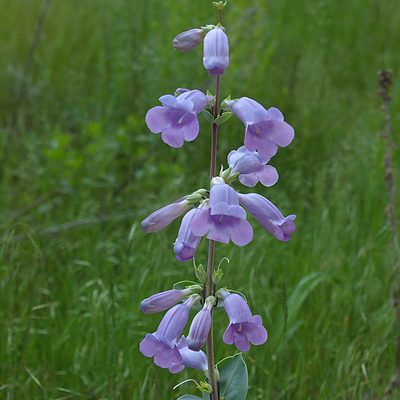 Large BeardtonguePenstemon grandiflorus | Purple, Pink | Late May through June, with some into July | 30–100 cm (12–40 in) | Dry sandy, gravelly or rocky prairie, foothills, limestone rims and open pine edges | The leaves are the best mark: thick, smooth and blue-gray to blue-green with a waxy bloom. The stem leaves come in opposite pairs, broadly egg-shaped to nearly round, stalkless and clasping the stem at the base. The lavender to purplish-pink flowers are 3.5–4.8 cm (1⅜–1⅞ in) long, with a tube that swells abruptly into a wide throat marked inside with purple guide lines. They come in 3–9 spaced clusters of 2–4 flowers, each cluster above a pair of leafy bracts. Narrowleaf Beardtongue shares the waxy blue leaves, but they are narrow, and its flowers are only 1.4–2 cm (½–¾ in) long. Smooth Beardtongue has blue flowers and glossy, dark green leaves. |
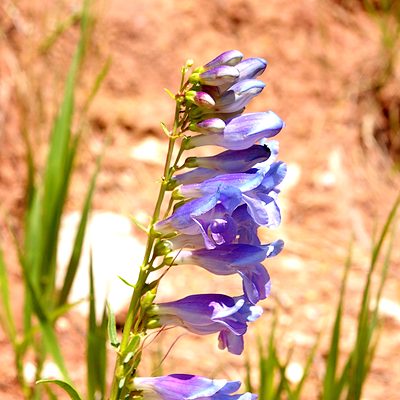 Narrowleaf BeardtonguePenstemon angustifolius | Blue | May and June | 15–50 cm (6–20 in) | Open prairies and sandhills | The whole plant looks blue-green from a waxy coating, with narrow stem leaves in opposite pairs that clasp the stem. Flowers are 14–20 mm long, in clusters paired up the stem, with violet to reddish purple lines inside and a sterile stamen with yellow hairs. White Beardtongue has white to light pink flowers, and Low Larkspur has a spur pointing back from the flower. |
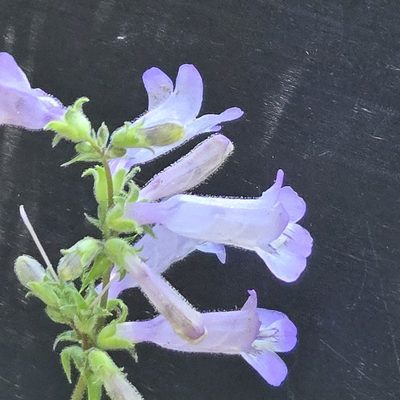 Slender BeardtonguePenstemon gracilis | Purple | June and July, with a few into August | 20–50 cm (8–20 in) | Grassy meadows, open ponderosa pine woods, rocky open hillsides and prairie | Look into the mouth of the small, pale lilac to pinkish flower, 1.5–2.2 cm (⅝–⅞ in) long: the sterile fifth stamen is yellow and covered in short hairs at its tip, a yellow beard against the paler throat. The flower stalks, calyx and outside of the flower are densely covered in short glandular hairs. The flowers stand in 3–7 pairs of small clusters along upright stems with narrow, mostly hairless green leaves. Narrowleaf Beardtongue also has a sterile stamen bearded with yellow hairs, but its thick leaves have a blue, waxy coating, its calyx is smooth and waxy, and its flowers run from white to lavender to blue. White Beardtongue has the same glandular hairs on its flower stalks, calyx and petals, but white flowers. |
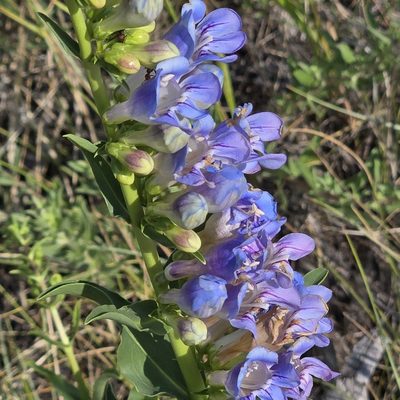 Smooth BeardtonguePenstemon glaber | Blue, Purple | June and July, from late May some years, a few into August | 10–65 cm (4–26 in), sometimes to about 90 cm (3 ft) | Rocky slopes, limestone outcrops, road cuts and openings in pine forest | Look for a crowded cluster of blue to lavender tubes, 2.2–3.5 cm (⅞–1⅜ in) long, near the top of the stem, with no hairs on the flower cluster. The stem leaves are lance-shaped and 3–12 cm (1¼–4¾ in) long, the upper ones clasping the stem, and the sepals are short, only 2–3 mm, with thin, papery edges. Large Beardtongue has bigger flowers, 3.5–4.8 cm (1⅜–1⅞ in) long, and thick blue-green leaves with a waxy bloom, broadly egg-shaped up the stem. Narrowleaf Beardtongue has smaller flowers, 1.4–2 cm (½–¾ in), a sterile stamen bearded with yellow hairs, and leaves with a blue, waxy coating. |
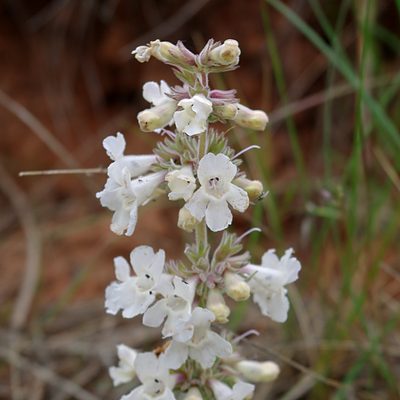 White BeardtonguePenstemon albidus | White | May into July | 15–50 cm (6–20 in) | Open prairies and hillsides, often in sandy or gravelly soil | Look for white funnel-shaped flowers, under 2 cm long, in clusters of 2 to 7 from the upper leaf joints, with reddish-purple lines in the throat. The flower stalks, calyx (the cup below the petals) and outside of the petals are covered in short, gland-tipped hairs. Beardtongue gets its name from the bearded sterile stamen inside. |
Other look-alike groups: 38 groups
- Anemones (4)
- Asters (4)
- Buttercups (3)
- Cacti (4)
- Cinquefoils (7)
- Clovers (6)
- Coneflowers (4)
- Currants and gooseberries (5)
- Daisies (5)
- Dandelions (3)
- Docks and buckwheats (4)
- Evening primroses (4)
- Ferns (4)
- Gentians (4)
- Grasses (11)
- Groundsels and ragworts (3)
- Lilies (5)
- Mayflowers and false Solomon's seals (3)
- Milkvetches and locoweeds (12)
- Milkweeds (6)
- Mints (8)
- Mustards (11)
- Orchids (8)
- Paintbrushes (3)
- Pines (3)
- Raspberries and thimbleberries (3)
- Sagebrushes and sageworts (3)
- Sedges (3)
- Speedwells and kittentails (3)
- Sunflowers (4)
- Thistles (6)
- Vervains (3)
- Vetches (4)
- Violets (7)
- Wild lettuces (3)
- Wild onions (3)
- Wild plums and cherries (3)
- Willows (3)