Orchids of the Black Hills
All 8 orchids in this guide, side by side, A to Z. Compare the photos, bloom time, height and where each grows, then open the one that fits for more photos and the full ID notes. Each plant's page lists its sources.
| Plant | Color | Blooms | Height | Where | How to tell it apart |
|---|---|---|---|---|---|
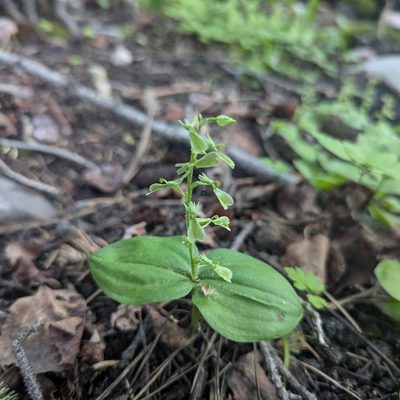 Broad-lipped TwaybladeNeottia convallarioides | Green & Brown | July and August; June to September across its range | 5–37 cm (2–15 in) | Saturated ground beside springs and creeks under white spruce | Look for two opposite, oval to nearly round leaves 2–7 cm (0.8–2.8 in) long, held flat out from a juicy green stem; above the leaves the stem and flower stalks are covered in fine, white, gland-tipped hairs. The flowers are yellowish green, sometimes faintly tinged with purple, with small sepals and petals bent back away from the lip. The lip is the big part: 8–13 mm (0.3–0.5 in) long, wedge-shaped, narrow at the base and widening to a shallowly notched tip with a small tooth in the notch, so it looks like a small pair of folded insect wings. The capsules are about 8 mm (0.3 in) long. Colorado's rare plant guide says the round, opposite leaves and the lip that narrows gradually to its base set it apart from the other orchids there. |
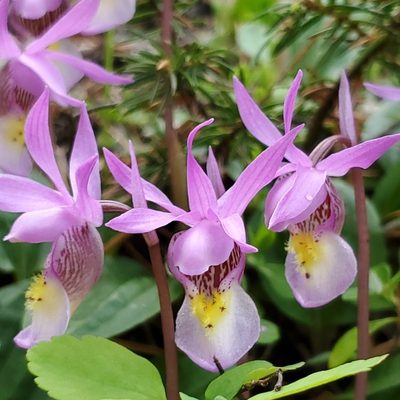 Fairy SlipperCalypso bulbosa var. americana | Pink | Late May into June | 5–20 cm (2–8 in) | Cool, moist, shaded spruce forest of the higher Hills, mostly in the north | Look for a single oval leaf, 3–6 cm (1¼–2¼ in) long with fine parallel pleats, which may already be withered at flowering, and one nodding flower on a leafless reddish stalk. Five narrow, pointed, pink to lavender sepals and petals stand up like a crown above a whitish to pale pink pouch streaked inside with maroon, with a thick tuft of bright yellow hairs on its front and two small horns beneath the tip. |
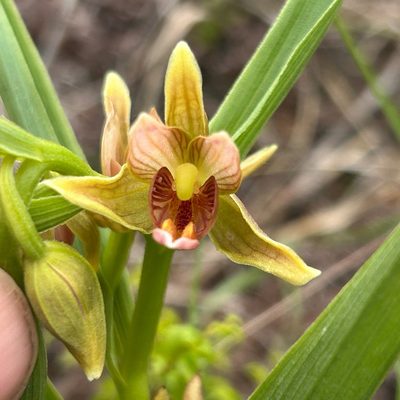 Giant HelleborineEpipactis gigantea | Green & Brown, Pink | Mid-June into August | 30–120 cm (12–47 in) | Wet, calcium-rich ground that stays warm all year | Look for a stem with 4 to 14 alternate, stalkless, pleated leaves 5–20 cm (2–8 in) long that clasp the stem, ending in a loose, mostly one-sided spike of 2 to 32 flowers, each above a leafy bract. The sepals are 16–24 mm (0.6–0.9 in) long, greenish to rose with rose or purple veins, and the two side petals are pink to orange with red or purple veins. The lip, 14–20 mm (0.6–0.8 in) long, is pinched in the middle into two parts: a cupped base veined with red or purple and dotted with small warty red bumps, and an orange-yellow, grooved tip. The capsules hang down and are 20–25 mm (0.8–1 in) long. Before it flowers, the leafy shoot can pass for a bog orchid, which is smaller with fewer, smaller leaves, or for Starry False Solomon's Seal, a much smaller plant that grows with it. |
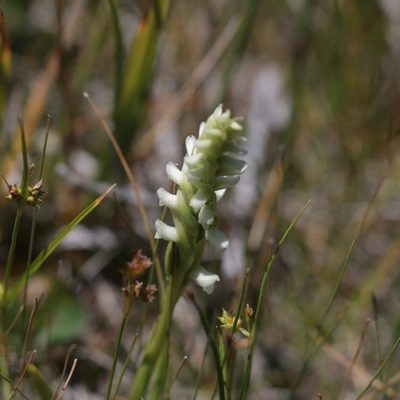 Hooded Ladies TressesSpiranthes romanzoffiana | White | July and August | 8–55 cm (3–22 in) | Moist ground: damp woods, brushy streamsides and wet meadows | Look for a stiff spike of white to ivory, tube-shaped flowers wound in a tight spiral, usually three flowers to each turn. Each flower is up to about 1.3 cm (½ in) long, with the sepals and upper petals drawn together into a hood and a lip that bends sharply down, wider at its wavy tip. The long, narrow leaves are mostly low on the stem, the lower ones up to about 23 cm (9 in) long, and they shrink to small bracts higher up. Minnesota Wildflowers says the hood is broader than in Nodding Ladies'-tresses (Spiranthes cernua) or Great Plains Ladies'-tresses (Spiranthes magnicamporum), and that Great Plains Ladies'-tresses usually has no basal leaves left by flowering. |
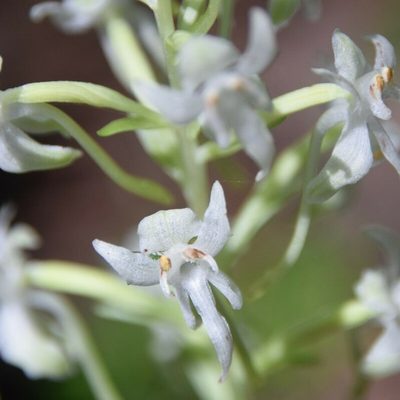 Lesser Roundleaved OrchidPlatanthera orbiculata | Green & Brown, White | July and August | 17–62 cm (7–24 in) | Moist, shady conifer forest and mixed spruce and birch woods | Two broad leaves, 5–21 cm (2–8 in) long and nearly as wide, lie flat on the ground opposite each other, glossy and dark green with fine parallel veins. The flower stalk, 17–62 cm (7–24 in) tall, carries no true leaves, only 1 to 6 small bract-like leaves scattered along it. The open spike holds up to about 30 greenish-white flowers: a squarish upper sepal forms a hood over the two creamy pollen sacs, two side petals spread up and out, two larger side sepals spread sideways, and a long narrow lip 7–17 mm (¼–⅔ in) hangs straight down, with a slender spur 14–27 mm (½–1 in) long behind the flower that is thickest toward its tip. Spotted Coralroot, another forest orchid in this guide, has no green leaves at all, only overlapping sheaths on a pale to brownish-yellow stem, and its flowers have a white lip spotted with purple. |
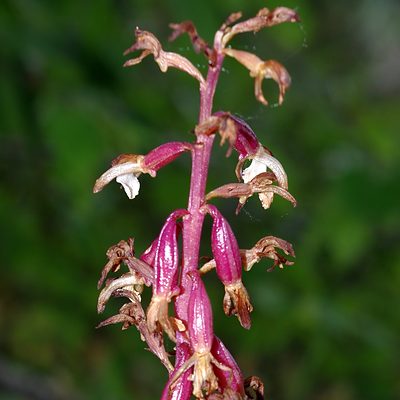 Spotted CoralrootCorallorhiza maculata | Purple, Green & Brown | June into August, most often June and July | 15–50 cm (6–20 in) | Shaded pine, spruce, birch and aspen forest floor with little other ground cover, often on north-facing slopes and in moist draws | Look for a leafless stalk 15–50 cm (6–20 in) tall, red-purple, brown or yellow, with a few thin sheaths where leaves would be, standing alone or in clumps. Each stalk carries 6 to 41 small flowers: the sepals are brown, tan, red or yellow, the petals are usually spotted with purple, and the lip is white, usually with purple spots, with two small rounded side lobes near its base. The Forest Service says pale yellow-green plants are sometimes mistaken for Early Coralroot (Corallorhiza trifida), which Go Orchids says is smaller and blooms earlier; Montana's field guide gives it a pale yellow stalk 5–25 cm tall, and herbarium specimens of it come from Lawrence, Pennington and Custer counties. Two varieties grow in the region: var. occidentalis has a lip that widens toward the tip and flowers 2 to 4 weeks ahead of var. maculata, whose lip is nearly straight-sided. Spring Coralroot (Corallorhiza wisteriana) also grows in the Hills; Montana's field guide gives it a yellow to purplish stalk 10–30 cm tall, 5 to 20 flowers, and a lip with no side lobes, a fringed edge and sometimes a few tiny spots. Woodland Pinedrops also has only scale leaves and grows in shaded conifer or mixed woods; the Forest Service describes it as 30–100 cm tall and densely glandular-hairy, with nodding reddish to white flowers crowded along the stalk. |
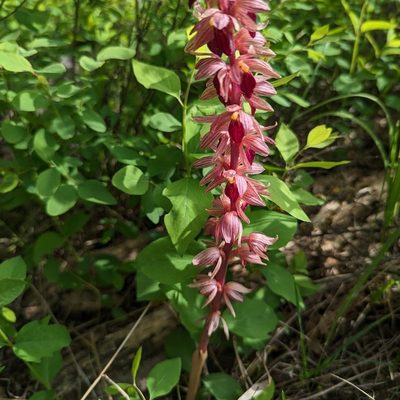 Striped CoralrootCorallorhiza striata | Purple | June into August | 10–65 cm (4–26 in) | Shaded, humus-rich woods of pine, spruce, aspen and birch | Look for an unbranched red-to-purple stem with no green leaves, only pale sheaths wrapped around it, topped by a spike of drooping flowers. Each flower is about 1.3 cm (½ in) across; the sepals and petals are creamy white to salmon-pink with dark red-purple stripes, and the lip below them is wider and nearly solid reddish purple, around a yellow center column. Wildflowers of the Pacific Northwest says the plant is similar to Spotted Coralroot (Corallorhiza maculata) but has the largest flowers of the coralroots. The Forest Service notes that some plants have creamy yellow flowers, because the red pigment is missing. |
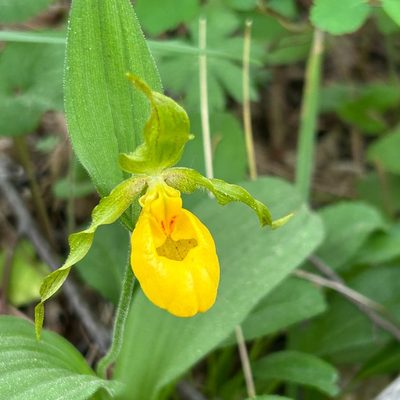 Yellow Lady's SlipperCypripedium parviflorum | Yellow | Late May into early July, mostly June | 15–60 cm (6–24 in) | Moist, shady woods, canyon bottoms, streambanks and damp limestone outcrops | Look for one or sometimes two flowers on top of a leafy stem. The lip is a hollow, glossy yellow pouch 2–5 cm (¾–2 in) long, often with red spots or veins inside, under a broad upper sepal, and two long, narrow side petals twist in a spiral, greenish yellow to deep purplish brown and often streaked. The stem carries 3–6 broad, hairy, pleated leaves with parallel veins, and plants often grow in clumps. Another lady's slipper, Cypripedium montanum, has similar magenta-brown petals and sepals but a white pouch, and Fairy Slipper is much smaller, 8–15 cm (3–6 in) tall, with pink to lavender petals and a single leaf at ground level. |
Other look-alike groups: 38 groups
- Anemones (4)
- Asters (4)
- Beardtongues (5)
- Buttercups (3)
- Cacti (4)
- Cinquefoils (7)
- Clovers (6)
- Coneflowers (4)
- Currants and gooseberries (5)
- Daisies (5)
- Dandelions (3)
- Docks and buckwheats (4)
- Evening primroses (4)
- Ferns (4)
- Gentians (4)
- Grasses (11)
- Groundsels and ragworts (3)
- Lilies (5)
- Mayflowers and false Solomon's seals (3)
- Milkvetches and locoweeds (12)
- Milkweeds (6)
- Mints (8)
- Mustards (11)
- Paintbrushes (3)
- Pines (3)
- Raspberries and thimbleberries (3)
- Sagebrushes and sageworts (3)
- Sedges (3)
- Speedwells and kittentails (3)
- Sunflowers (4)
- Thistles (6)
- Vervains (3)
- Vetches (4)
- Violets (7)
- Wild lettuces (3)
- Wild onions (3)
- Wild plums and cherries (3)
- Willows (3)