Wild onions of the Black Hills
All 3 wild onions in this guide, side by side, A to Z. Compare the photos, bloom time, height and where each grows, then open the one that fits for more photos and the full ID notes. Each plant's page lists its sources.
| Plant | Color | Blooms | Height | Where | How to tell it apart |
|---|---|---|---|---|---|
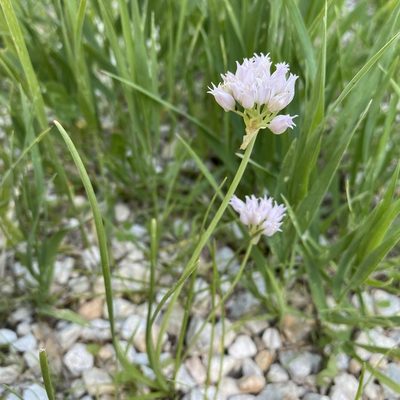 Geyer's OnionAllium geyeri | Pink, White | June and July | 10–50 cm (4–20 in) | Moist meadows, stream banks, moist roadside ditches, and open or limestone slopes in pine and spruce forest | Look for a single, erect, leafless stem 10–50 cm (4–20 in) tall topped by one upright, compact, rounded cluster of 10 to 25 pink to white, urn- to bell-shaped flowers 6–8 mm (¼ in) long, each with six tepals and the stamens tucked inside the flower, with two or three bracts at the base of the cluster. The three to five grass-like leaves are 1–3 mm wide, shorter than the stem and still green at flowering, the bulb is wrapped in a coarse, netted coat of gray or brown fibers, and the whole plant smells of onion. One form, var. tenerum, has only a few flowers and a head of small, pointed bulbils (tiny bulbs) in their place. Nodding Onion's stem bends sharply over at the top so its cluster hangs, its stamens stick out past the tepals, its bulb coat is papery rather than fibrous, and it blooms later, from July. Textile Onion has only two leaves and white flowers with a red or reddish-brown stripe down each tepal, and it grows on dry plains and hills in May and June. Meadow Deathcamas, which people have mistaken for wild onion, has no onion smell; a British Columbia seed manual calls that smell the best way to tell wild onion bulbs from deathcamas. |
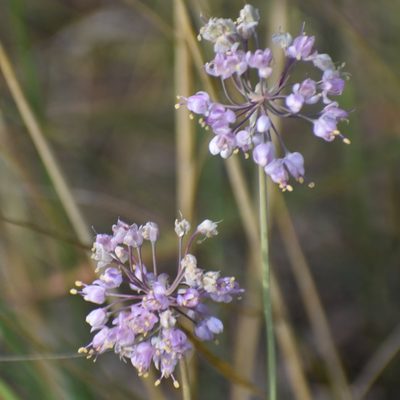 Nodding OnionAllium cernuum | Pink | July through August, a few into early September | 30–60 cm (12–24 in) | Open ponderosa pine forest, grassy meadows and rocky slopes | Look for a smooth, leafless flower stem 30–60 cm (12–24 in) tall that bends over at the top like a shepherd's crook, so the cluster of many small bell-shaped flowers hangs upside down. The pale pink to rose-lavender flowers have six tepals, the stamens stick out past them, and even the bud nods. The grass-like leaves all grow near the base, and a crushed leaf smells strongly of onion. Textile Onion is shorter, 10–30 cm (4–12 in), with white flowers in a compact cluster in May and June, and its stamens don't stick out past the tepals. Meadow Deathcamas, which is deadly, has no onion smell; a British Columbia seed manual calls that smell the best way to tell wild onion bulbs from deathcamas. |
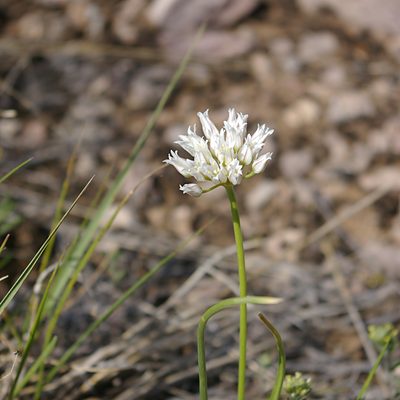 Textile OnionAllium textile | White | May through June | 10–30 cm (4–12 in) | Dry prairie, rocky and clay hillsides and grassy pine openings | Look for a short, leafless stem 10–30 cm (4–12 in) tall topped by a tight, rounded, upright cluster of 15 to 30 small flowers, all on short stalks from one point. Each flower has six white tepals 5–7 mm (¼ in) long, with a thin reddish to purplish stripe down the middle, and the stamens stay inside the flower. There are one or two narrow, grass-like leaves 1–3 mm wide, the bulb is wrapped in a gray to brown net of fibers, and the plant smells of onion. Meadow Deathcamas, which people have mistaken for wild onion, holds its creamy white flowers, each tepal with a gland at its base, in a longer cluster 5–20 cm (2–8 in) long, and its leaves are up to 1 cm (⅜ in) wide. Deathcamas has no onion smell; a British Columbia seed manual calls that smell the best way to tell wild onion bulbs from deathcamas. |
Other look-alike groups: 38 groups
- Anemones (4)
- Asters (4)
- Beardtongues (5)
- Buttercups (3)
- Cacti (4)
- Cinquefoils (7)
- Clovers (6)
- Coneflowers (4)
- Currants and gooseberries (5)
- Daisies (5)
- Dandelions (3)
- Docks and buckwheats (4)
- Evening primroses (4)
- Ferns (4)
- Gentians (4)
- Grasses (11)
- Groundsels and ragworts (3)
- Lilies (5)
- Mayflowers and false Solomon's seals (3)
- Milkvetches and locoweeds (12)
- Milkweeds (6)
- Mints (8)
- Mustards (11)
- Orchids (8)
- Paintbrushes (3)
- Pines (3)
- Raspberries and thimbleberries (3)
- Sagebrushes and sageworts (3)
- Sedges (3)
- Speedwells and kittentails (3)
- Sunflowers (4)
- Thistles (6)
- Vervains (3)
- Vetches (4)
- Violets (7)
- Wild lettuces (3)
- Wild plums and cherries (3)
- Willows (3)