Clovers of the Black Hills
All 6 clovers in this guide, side by side, A to Z. Compare the photos, bloom time, height and where each grows, then open the one that fits for more photos and the full ID notes. Each plant's page lists its sources.
| Plant | Color | Blooms | Height | Where | How to tell it apart |
|---|---|---|---|---|---|
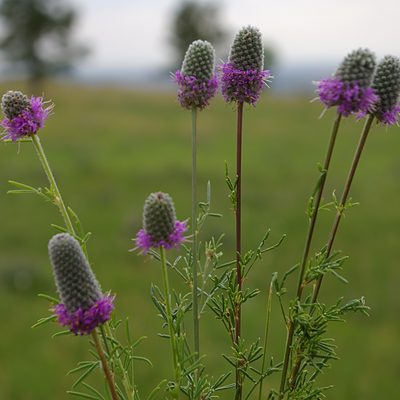 Purple Prairie CloverDalea purpurea | Purple | June into August, mostly July and August, with a few into September | 20–90 cm (8–36 in) | Dry, sunny prairie, grassy foothills, rocky slopes, roadsides and open pine parks | Look for a dense, thimble-shaped head 1–6 cm (½–2½ in) long on top of each slender, upright stem, where tiny rose-purple flowers with orange-tipped stamens open in a ring around the bottom first. The ring climbs as new buds open and old flowers fade, leaving faded flowers below and gray, woolly buds above. Each leaf has 3–7, usually 5, narrow leaflets less than 2.5 mm (1/10 in) wide, their edges usually rolled inward, which give the plant a fine, frilly look. White Prairie Clover has similar heads that also bloom from the bottom up, but white flowers and broader leaflets, and it starts blooming earlier. |
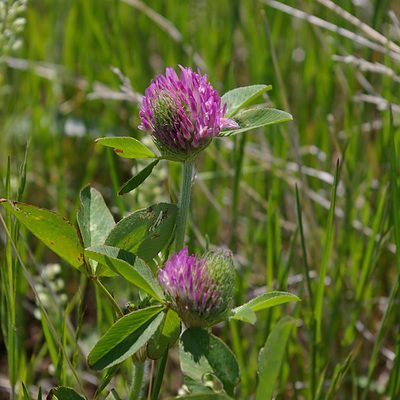 Red CloverTrifolium pratense | Pink, Purple | June into September, with stragglers into October | 15–90 cm (6–36 in) | Roadsides, pastures, fields, lawns and waste places, most abundant on heavy, fertile, well-drained soil | Look for a round to oval head, 2–2.5 cm (¾–1 in) across, packed with small pea-shaped flowers in dull pink to rosy purple, sitting stalkless or on a short stalk with one or two small leaves tucked right under it. Each leaf has three oval leaflets 1.5–4 cm (½–1½ in) long, soft-hairy, usually with a pale V across the middle, and the leaf stalk carries a pair of oval, sharp-tipped stipules with strong veins. The stems are hollow, covered with fine flattened hairs, upright or sprawling, and branch thickly at the base; plants stand 15–90 cm (6–36 in). Minnesota Wildflowers says Alsike Clover is similar, but Red Clover's flowers are more rosy purple; Alsike's heads are light pink to white, darkening with age for a two-tone look, on stalks 2.5–8 cm (1–3 in) long from the leaf axils, and its leaflets are hairless. The same page says White Clover also has a light V on its leaflets, and its leaves rise straight up from stems that run along the ground. |
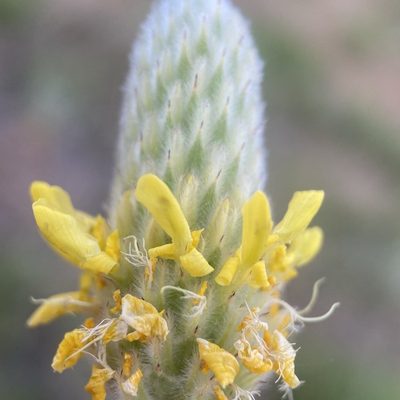 Silktop DaleaDalea aurea | Yellow | June into September | 20–75 cm (8–30 in) | Dry prairie, sandy or rocky open hillsides, ravines and stream valleys | Look for a dense, cone-like spike 1.5–7 cm (½–2¾ in) long, covered in silky hairs, with the yellow flowers blooming from the base upward and encircling the spike. The stems, 1 to several from the base, are erect and silky-hairy, and the gray-green leaves are divided into 5–7 small leaflets (4–16 mm long), largest near the base of the stem and smaller above. Each flower is pea-shaped, with an upper petal 6.5–8.6 mm long, and the fruit is a tiny silky-hairy pod holding one yellow seed. |
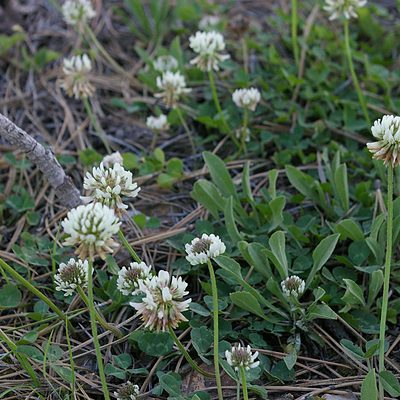 White CloverTrifolium repens | White | June into August | 8–15 cm (3–6 in) | Lawns, roadsides, pastures, meadows, creek banks and grassy openings in pine woods | Look for a low plant whose smooth stems creep along the ground and root at the joints, with each leaf and each flower stalk rising on its own from these runners. Each leaf has three broadly oval, finely toothed leaflets about 1.3–2 cm (½–¾ in) long, often with a pale crescent or V across the middle, though the mark can be faint or missing. Round heads 1.3–2 cm (½–¾ in) across hold 20 to 50 small white or pinkish-white pea flowers on long, leafless stalks a little taller than the leaves; as the flowers age they fade to a dirty pink and then turn brown. Illinois Wildflowers compares it with Alsike Clover (Trifolium hybridum), which the National Park Service also lists at Jewel Cave and Mount Rushmore: Alsike is taller and more upright, its heads are usually pinker, its leaflets have no pale chevron, and it has no creeping runners. |
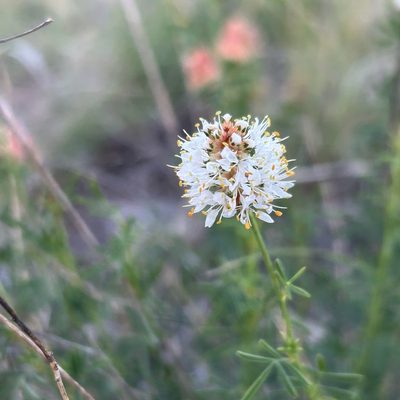 White Prairie CloverDalea candida | White | June into August | 30–100 cm (12–40 in) | Dry prairie, rocky hillsides, roadsides and open rocky pine woods | Look for one to several slender, upright, hairless stems 30–100 cm (12–40 in) tall, ribbed lengthwise, with alternate leaves 1.5–6 cm (⅝–2⅜ in) long made of 5 to 13, usually 7, narrow leaflets with sharp tips and gland dots underneath. Each stem or branch ends in a dense cylindrical spike 1.5–7.5 cm (⅝–3 in) long and about 12 mm (½ in) thick, where tiny white flowers about 6 mm (¼ in) across open from the bottom up, so a ring of open flowers with five white stamens sticking out climbs the spike below the unopened green-to-rusty buds. Purple Prairie Clover is nearly identical except for its purple flowers. |
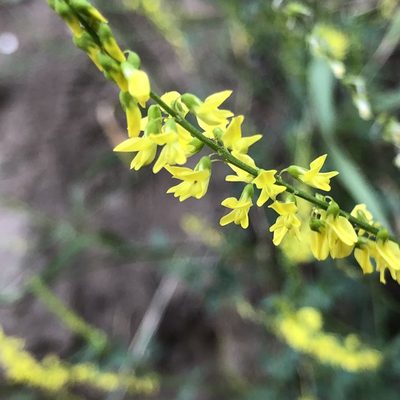 Yellow SweetcloverMelilotus officinalis | Yellow, White | June through September, a few into October; White Sweetclover from July | 60–180 cm (2–6 ft) | Roadsides, ditches, pastures, old fields, prairie dog towns, burns and other disturbed open ground | Crush a leaf or flower spike: sweetclover has a distinctive sweet smell. Dozens of tiny pea flowers, each 4–7 mm (¼ in), line slender spikes up to 15 cm (6 in) long on a tall, much-branched plant, and the three leaflets are toothed. White Sweetclover has white flowers, starts blooming a couple of weeks later and is often taller, and its side petals are clearly shorter than the top petal. Alfalfa has larger flowers in short, rounded clusters, leaflets toothed only near the tip and coiled pods, and Black Medic is low and sprawling, with tiny yellow flowers in round heads. |
Other look-alike groups: 38 groups
- Anemones (4)
- Asters (4)
- Beardtongues (5)
- Buttercups (3)
- Cacti (4)
- Cinquefoils (7)
- Coneflowers (4)
- Currants and gooseberries (5)
- Daisies (5)
- Dandelions (3)
- Docks and buckwheats (4)
- Evening primroses (4)
- Ferns (4)
- Gentians (4)
- Grasses (11)
- Groundsels and ragworts (3)
- Lilies (5)
- Mayflowers and false Solomon's seals (3)
- Milkvetches and locoweeds (12)
- Milkweeds (6)
- Mints (8)
- Mustards (11)
- Orchids (8)
- Paintbrushes (3)
- Pines (3)
- Raspberries and thimbleberries (3)
- Sagebrushes and sageworts (3)
- Sedges (3)
- Speedwells and kittentails (3)
- Sunflowers (4)
- Thistles (6)
- Vervains (3)
- Vetches (4)
- Violets (7)
- Wild lettuces (3)
- Wild onions (3)
- Wild plums and cherries (3)
- Willows (3)