White Clover Trifolium repens
Also called Dutch Clover, White Dutch Clover, Ladino Clover, blayé ziŋtká tȟačháŋ ská (Lakota)
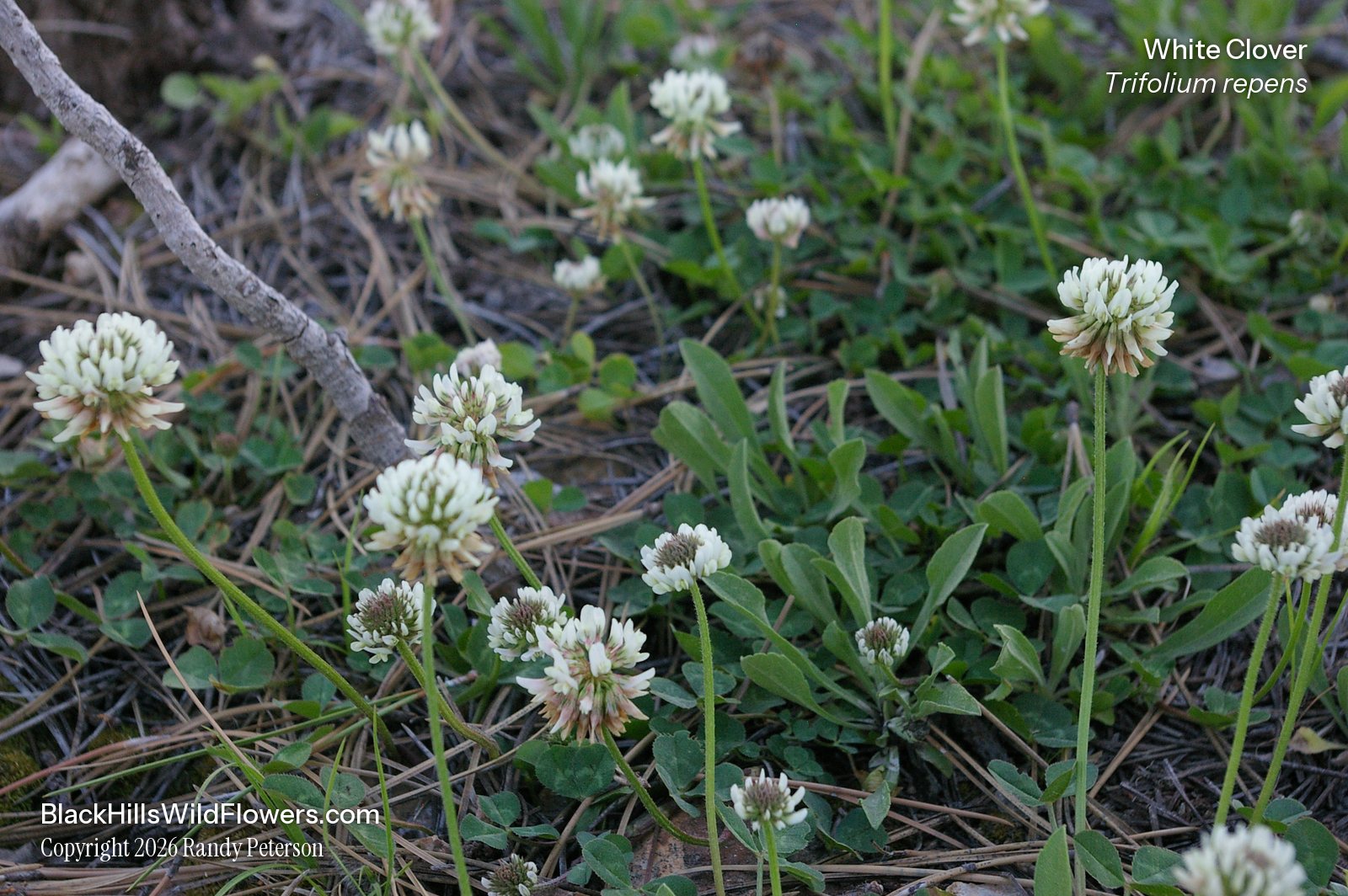
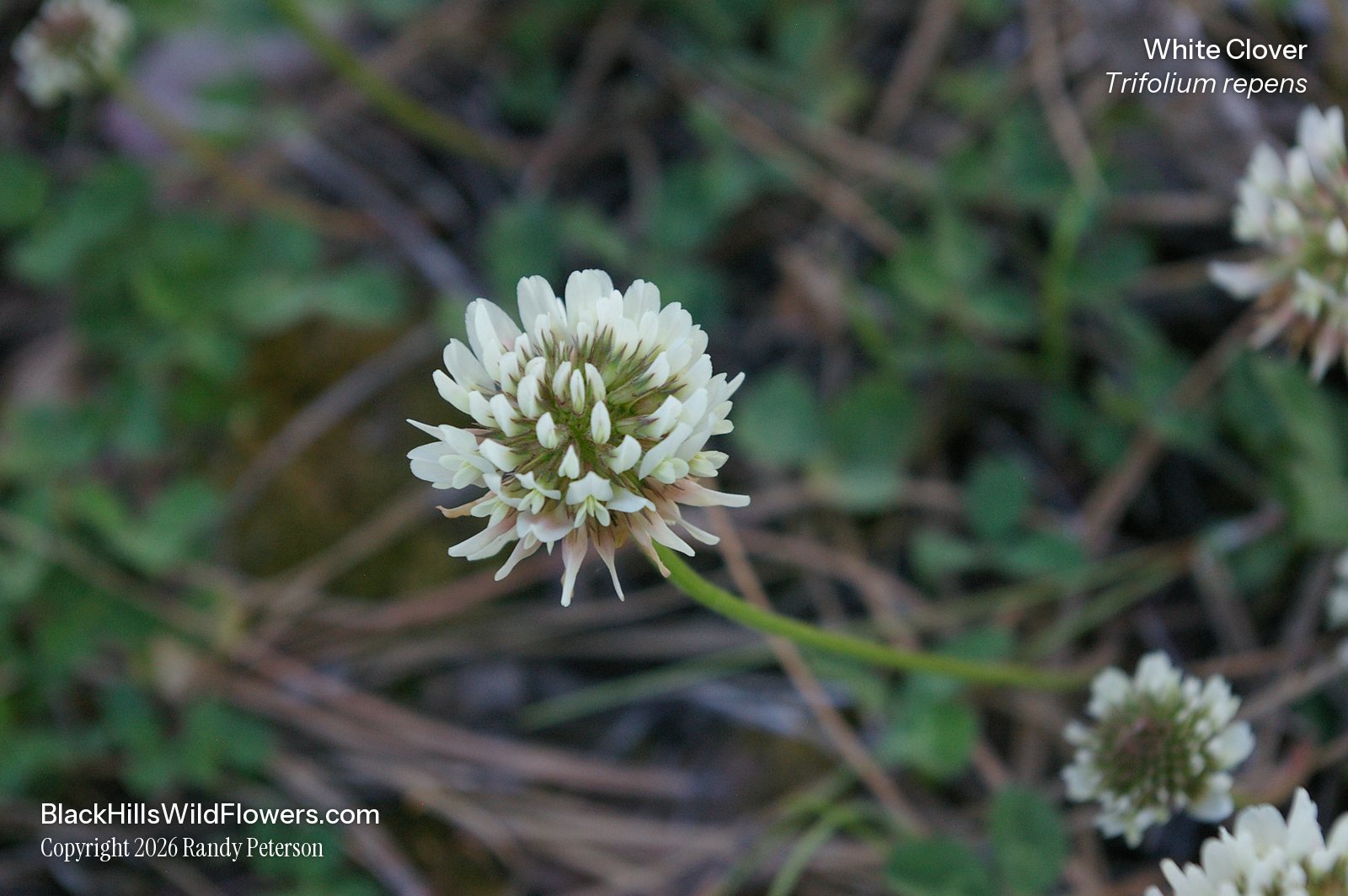
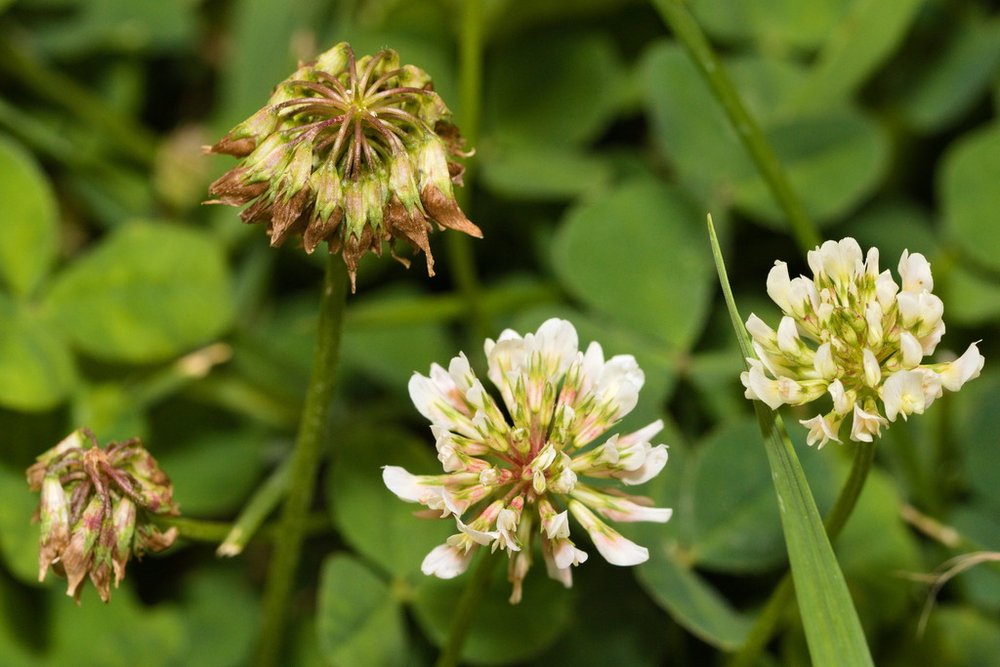
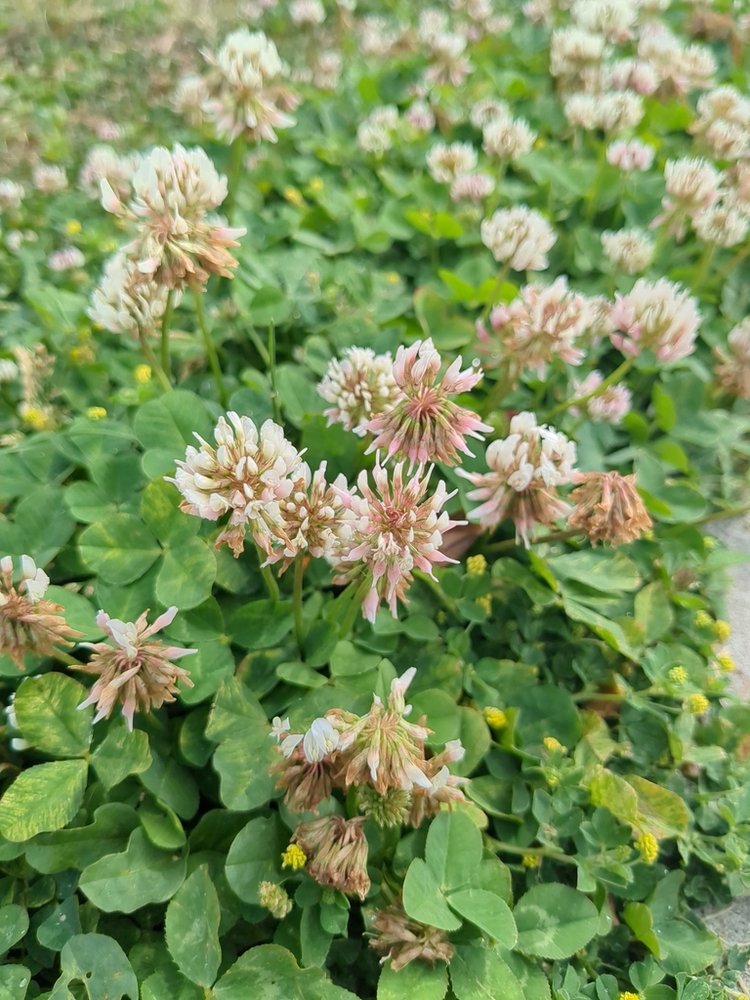
White Clover (Trifolium repens) is a low, creeping clover from Europe with round heads of small white pea flowers on leafless stalks and three-part leaves often marked with a pale V. It spreads by runners that root as they go, flowers from June into August in the region, and grows in lawns, roadsides, meadows and moist openings in the Black Hills, where the National Park Service lists it at Wind Cave, Jewel Cave, Mount Rushmore and Devils Tower. Photographed in the Black Hills.
Free photos from other sources
| Family | Fabaceae · Pea |
|---|---|
| Status | Introduced perennial |
| Blooms | June into August |
| Height | 8–15 cm (3–6 in) |
| Where | Lawns, roadsides, pastures, meadows, creek banks and grassy openings in pine woods |
| Also called | Dutch Clover, White Dutch Clover, Ladino Clover, blayé ziŋtká tȟačháŋ ská (Lakota) |
| Toxicity | Some wild strains carry a glycoside in the leaves that turns into prussic acid, and they can be mildly toxic to grazing animals that eat a lot of it. |
| Traditional use | Black Elk and Flying By (1998) include it, marked as introduced, among plants used by the Lakota; they record a tea of the flowers for coughs, colds and fevers, and a decoction (a tea boiled down) or poultice of the flowers for sore eyes. |
Roots, seeds & germination
Root: Young plants grow a taproot that lasts from less than a year to about two years. After that, most roots are shallow and fibrous, growing from the joints of the runners, mostly in the top 10–25 cm (4–10 in) of soil, with a few as deep as 60 cm (24 in). Most clones live about 20 years, and some may live 100 years or more.
Seed: Each small pod holds only a few flat, round to slightly heart-shaped seeds of various colors, which ripen about 3 to 4 weeks after flowering. The seeds have a hard coat and are spread by wind, water, birds and grazing animals.
Germination: The hard seed coat lets the seed last a long time: seed stored for 25 years in unheated sheds still sprouted at 73 percent.
How do you identify White Clover?
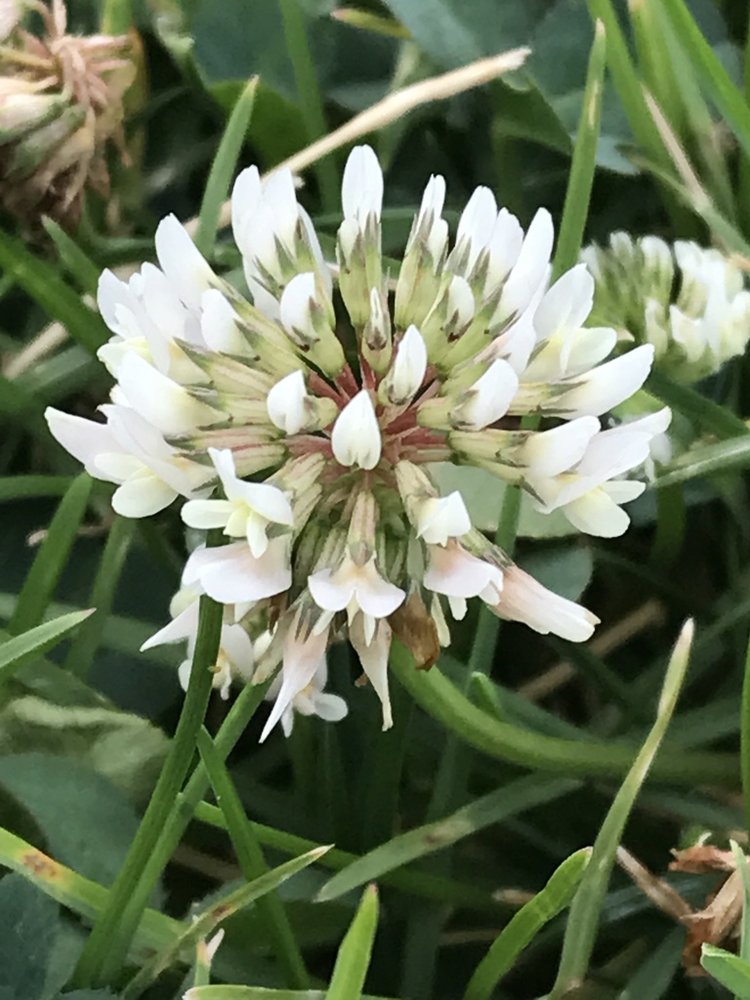
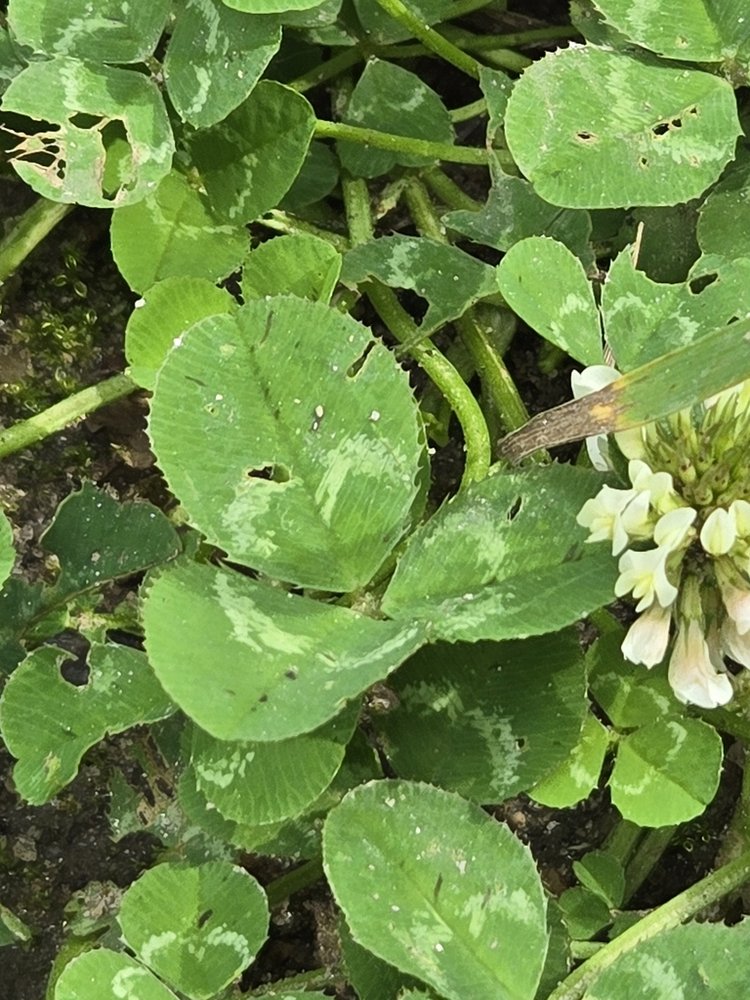
Look for a low plant whose smooth stems creep along the ground and root at the joints, with each leaf and each flower stalk rising on its own from these runners. Each leaf has three broadly oval, finely toothed leaflets about 1.3–2 cm (½–¾ in) long, often with a pale crescent or V across the middle, though the mark can be faint or missing. Round heads 1.3–2 cm (½–¾ in) across hold 20 to 50 small white or pinkish-white pea flowers on long, leafless stalks a little taller than the leaves; as the flowers age they fade to a dirty pink and then turn brown. Illinois Wildflowers compares it with Alsike Clover (Trifolium hybridum), which the National Park Service also lists at Jewel Cave and Mount Rushmore: Alsike is taller and more upright, its heads are usually pinker, its leaflets have no pale chevron, and it has no creeping runners.
When does it bloom?
June into August.
Where does it grow?
Lawns, roadsides, pastures, meadows, creek banks and grassy openings in pine woods. Black Hills herbarium labels record it in moist rich soil (1904), in damp grassy lawns and along creeks (1905), in an open pine glade (1938), in riparian ponderosa pine (1975) and in logged pine forest on a ridgetop in Crook County, Wyoming (1982); the oldest dates from 1892. Specimens come from Lawrence, Pennington, Custer, Meade and Fall River counties, SD, and Crook County, WY. The National Park Service lists it at Wind Cave, Jewel Cave, Mount Rushmore and Devils Tower, and the 1986 Jewel Cave survey recorded it as an introduced plant.
Other clovers in this guide
Pea family (Fabaceae): 31 other plants in this guide
- Alfalfa
- Alpine Sweetvetch
- American Vetch
- Barr's Milkvetch
- Black Medic
- Canada Milkvetch
- Canada Tickclover
- Cream Milkvetch
- Crown Vetch
- Drummond's Milkvetch
- Field Locoweed
- Field Milkvetch
- Golden Pea
- Groundplum Milkvetch
- Indian Milkvetch
- Lambert's Crazyweed
- Laxmann's Milkvetch
- Lead Plant
- Missouri Milkvetch
- Pale Vetchling
- Prairie Turnip
- Purple Prairie Clover
- Red Clover
- Silktop Dalea
- Silverleaf Scurfpea
- Silvery Lupine
- Slimflower Scurfpea
- Tufted Milkvetch
- White Prairie Clover
- Wild Licorice
- Yellow Sweetclover
Sources: National Park Service, Devils Tower: Native Plants (wildflower list with bloom months); NPSpecies checklist, Wind Cave National Park vascular plants; NPSpecies checklist, Jewel Cave National Monument vascular plants; NPSpecies checklist, Mount Rushmore National Memorial vascular plants; NPSpecies checklist, Devils Tower National Monument vascular plants; Marriott and Hartman 1986, A Survey of the Vegetation of Jewel Cave National Monument; Minnesota Wildflowers: Trifolium repens (White Clover); Illinois Wildflowers: White Clover, Trifolium repens; USDA Forest Service Fire Effects Information System: Trifolium repens (Coladonato 1993); USDA PLANTS Database: Trifolium repens (TRRE3); GBIF occurrence search: Trifolium repens herbarium specimens, South Dakota and Wyoming; GBIF specimen 1563343065: 1892, Black Hills, Custer County (Smithsonian); GBIF specimen 3023457157: 1905, southern Black Hills, Custer County, "damp grassy lawns, creeks" (BHSU); GBIF specimen 3023457165: 1904, northern Black Hills, Lawrence County, "moist rich soil" (BHSU); GBIF specimen 3023457159: 1938, northern Black Hills, Lawrence County, "wide open pine, grassy glade" (BHSU); GBIF specimen 5159162813: 1975, Custer County, "riparian ponderosa pine" (CSCN); GBIF specimen 3051777714: 1982, Black Hills, Crook County WY, "ridgetop logged pine forest" (RSA); Black Elk and Flying By 1998, Culturally Important Plants of the Lakota (filed with the South Dakota PUC), entry 312.