Silvery Lupine
Lupinus argenteus
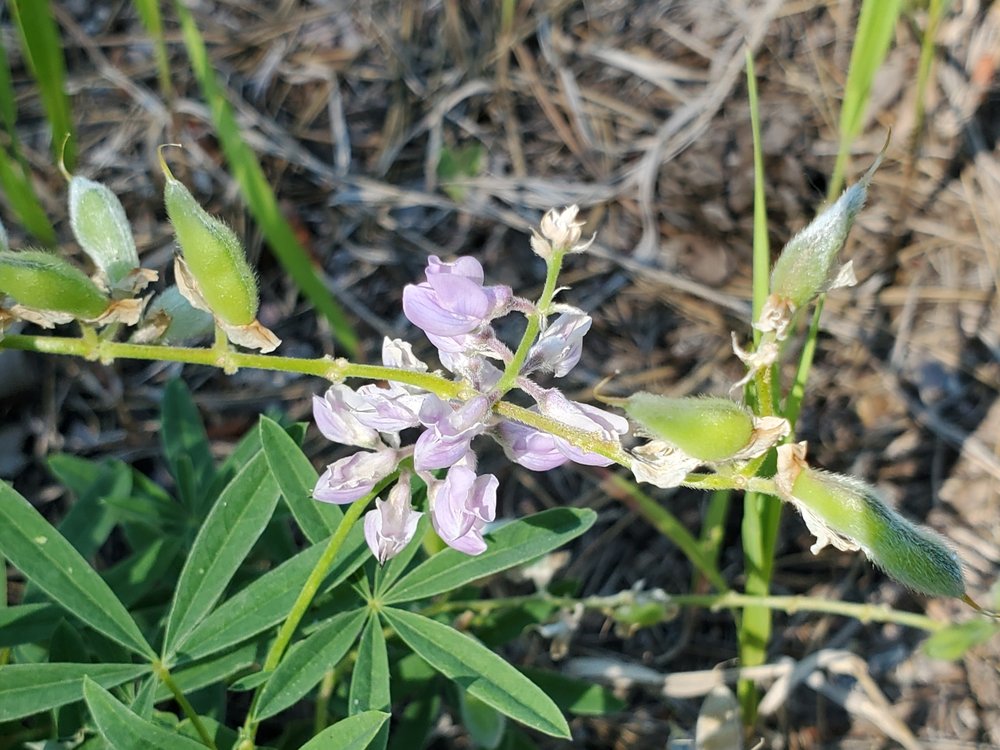
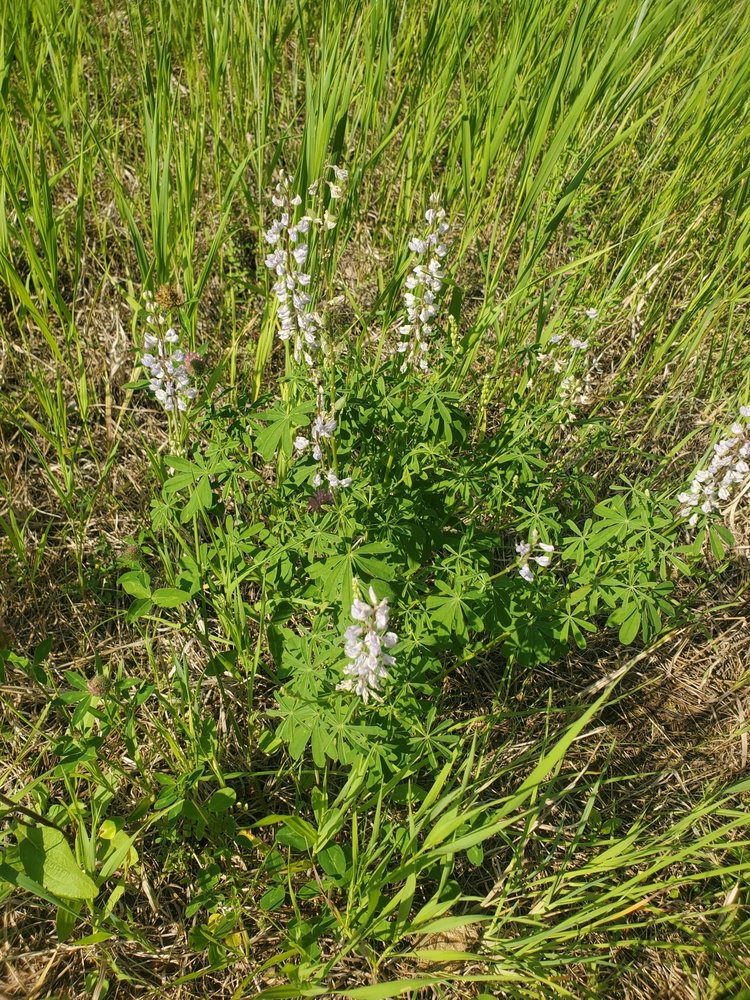
Silvery Lupine (Lupinus argenteus) is a native perennial of the pea family, with upright spikes of blue to violet pea flowers above leaves divided like the fingers of a hand. In the Black Hills it blooms from June into August, mostly in open pine and aspen woods and meadows of the northern and western Hills. The 1986 plant survey of Jewel Cave lists it, and the National Park Service records it at Wind Cave and Devils Tower.
Free photos from other sources
| Family | Fabaceae · Pea |
|---|---|
| Status | Native perennial |
| Blooms | June into August, with a few into September |
| Height | 20–70 cm (8–28 in) |
| Where | Open pine and aspen woods, forest openings, meadows and grassy hillsides |
| Also called | Lupine |
| Synonym | Lupinus parviflorus, Lupinus argenteus var. parviflorus, Lupinus argenteus var. rubricaulis, Lupinus argenteus var. argentatus, Lupinus floribundus, Lupinus spathulatus |
| Toxicity | It is poisonous to livestock, most of all the seeds and pods, and USDA ARS lists it among six lupines linked to crooked calf disease. |
| Traditional use | Vestal (1952) records that the Ramah Navajo put a poultice of crushed leaves on poison ivy blisters. |
Roots, seeds & germination
Root: A woody crown at or just below the ground, with fibrous roots and occasional short rhizomes. Like most legumes it carries root nodules whose bacteria turn nitrogen from the air into a form plants can use.
Seed: A flattened, densely hairy pod 2–3 cm (about 1 in) long holds 2–6 tan to brown seeds. The pods ripen from late summer into fall and shatter when dry, throwing out the seeds.
Germination: The hard seed coat keeps water out, so stored seed needs scarification. A 2016 Native Plants Journal trial found it sprouted better after mechanical scarification, sulfuric acid, or a 60-second soak in water at 95 °C (203 °F), and USDA PLANTS says cold stratification is not needed.
How do you identify Silvery Lupine?
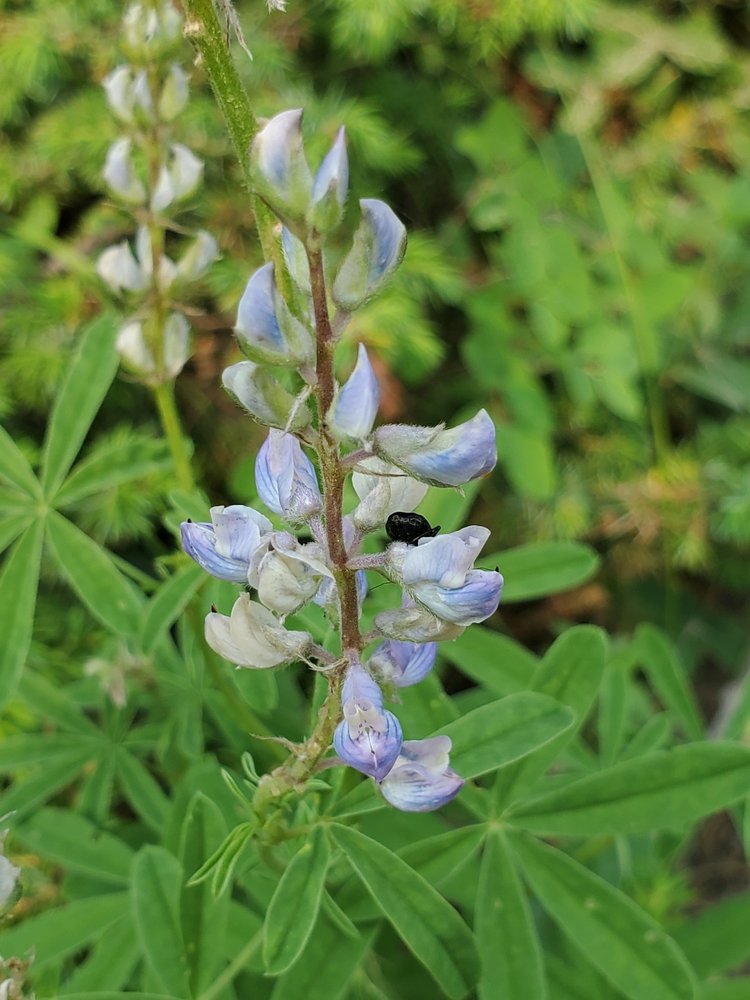
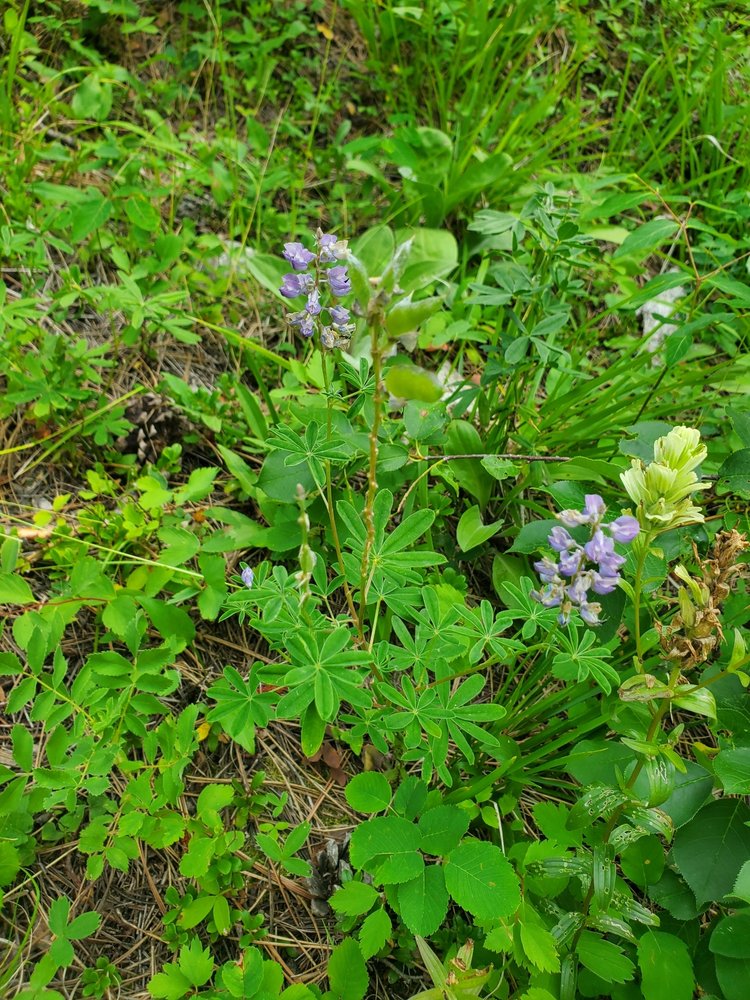
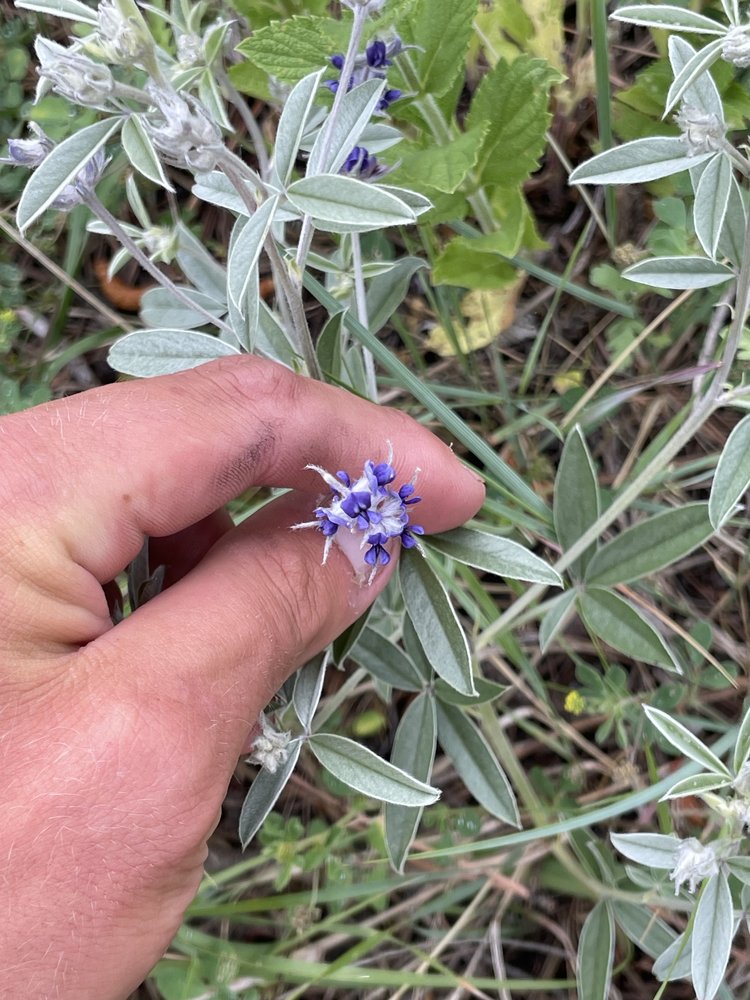
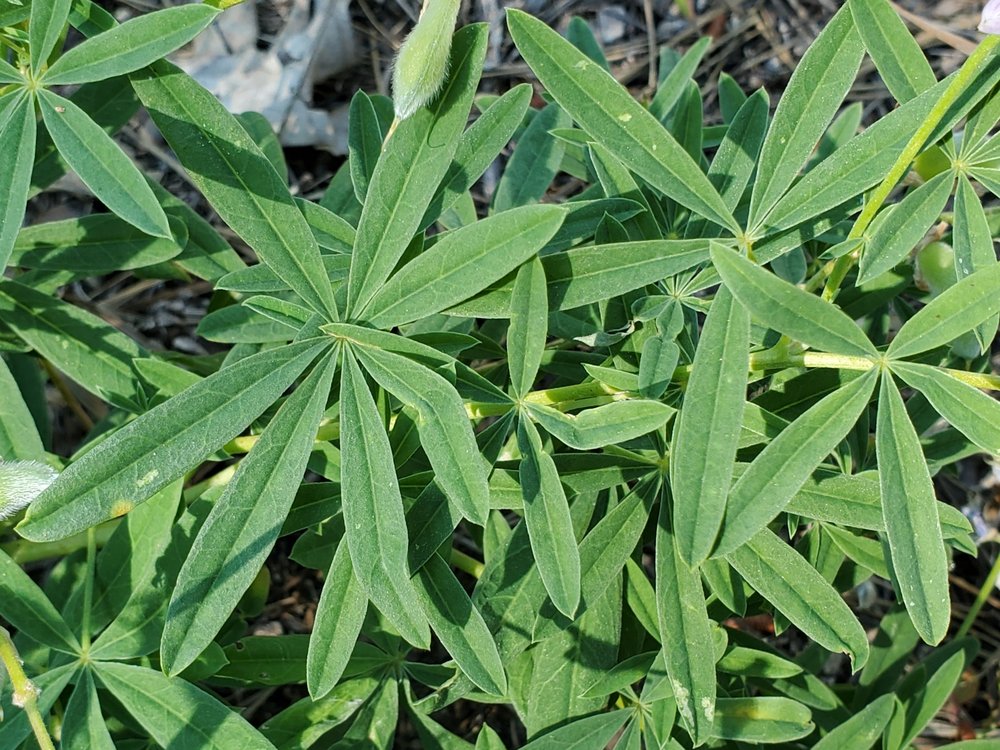
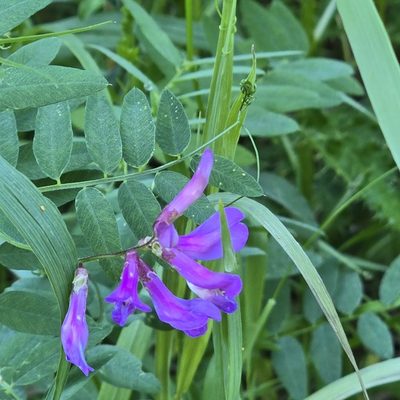
Look for leaves divided like a hand into 5 to 9 narrow leaflets, each 2–6 cm (¾–2½ in) long, all spreading from the tip of a long stalk, green to silvery with flat-lying hairs. The pea flowers, about 1 cm (⅜ in) long and blue to violet, are packed in whorls along a spike 5–25 cm (2–10 in) long, and the upper petal has a white or yellowish spot that turns reddish purple with age. Flattened, densely hairy pods follow in midsummer. Silverleaf Scurfpea has only 3 to 5 leaflets and small flowers in widely spaced clusters, and Canada Milkvetch and American Vetch have leaflets in pairs along a central stalk.
When does it bloom?
June into August, with a few into September.
Where does it grow?
Open ponderosa pine woods, aspen stands, forest openings, meadows, grassy hillsides, limestone outcrops and roadsides, at about 1,070–2,140 m (3,500–7,025 ft). It is local rather than everywhere: most herbarium specimens come from Lawrence County, the central limestone plateau in Pennington County, and Crook and Weston counties in the Wyoming Black Hills, with only a few from Custer and Fall River counties. The 1986 Jewel Cave survey lists it, and the National Park Service records it at Wind Cave and Devils Tower.
Other flowers to compare
Sources: Marriott and Hartman 1986, A Survey of the Vegetation of Jewel Cave National Monument; NPSpecies checklist, Wind Cave National Park vascular plants; NPSpecies checklist, Jewel Cave National Monument vascular plants; NPSpecies checklist, Devils Tower National Monument vascular plants; NPSpecies checklist, Mount Rushmore National Memorial vascular plants; NPSpecies profile: Lupinus argenteus var. argenteus, Devils Tower; GBIF occurrence search: Lupinus, South Dakota; GBIF occurrence search: Lupinus, Wyoming; iNaturalist research-grade observations of Lupinus argenteus within 80 km of the central Black Hills; USDA ARS Poisonous Plant Research Laboratory: Lupine (Lupinus spp.); USDA ARS Poisonous Plant Research: lupine published research (includes "Beef cattle losses after grazing Lupinus argenteus"); Washington State University Veterinary Extension: Lupine-induced Crooked Calf Syndrome; USDA PLANTS Database: Lupinus argenteus (LUAR3); ITIS: Lupinus argenteus Pursh (TSN 503575); Reese 2025, Fabaceae: Lupinus argenteus, SDSU Open PRAIRIE Native Plant profiles; Native Plant Network propagation protocol: Lupinus argenteus (Fabaceae); Jones et al. 2016, Evaluation of thermal, chemical, and mechanical seed scarification methods for 4 Great Basin lupine species, Native Plants Journal 17(1); Skinner 2007, Propagation protocol for container Lupinus sericeus, USDA NRCS Pullman Plant Materials Center; O'Neil 2009, Lupinus argenteus propagation protocol, University of Washington ESRM 412; Wild Ones Front Range: Silvery Lupine (Lupinus argenteus) plant sheet; Oregon State University Extension EM 9486: Lupinus argenteus (silvery lupine); USDA Forest Service Fire Effects Information System: Lupinus sericeus (Matthews 1993); Culturally Important Plants of the Lakota (Black Elk and Flying By, Sitting Bull College, 1998), filed with the South Dakota PUC; Native American Ethnobotany Database: Lupinus argenteus; Kansas Wildflowers and Grasses: Lupinus pusillus (Small Lupine); Rocky Mountain Flora: Lupines (silvery, silky, tailcup, rusty); NEON Biorepository flora portal: Lupinus argenteus description; Wikipedia: Lupinus argenteus; custersd.com: Wildflowers of the Black Hills; South Dakota Magazine: Black Hills Blooms (Maibaum, June 26, 2024).