White Prairie Clover Dalea candida
Also called Prairie Clover, Slender Prairie Clover, Slender White Prairie Clover, White Dalea, tȟokȟála tȟapȟéžuta hú bloká (Lakota)
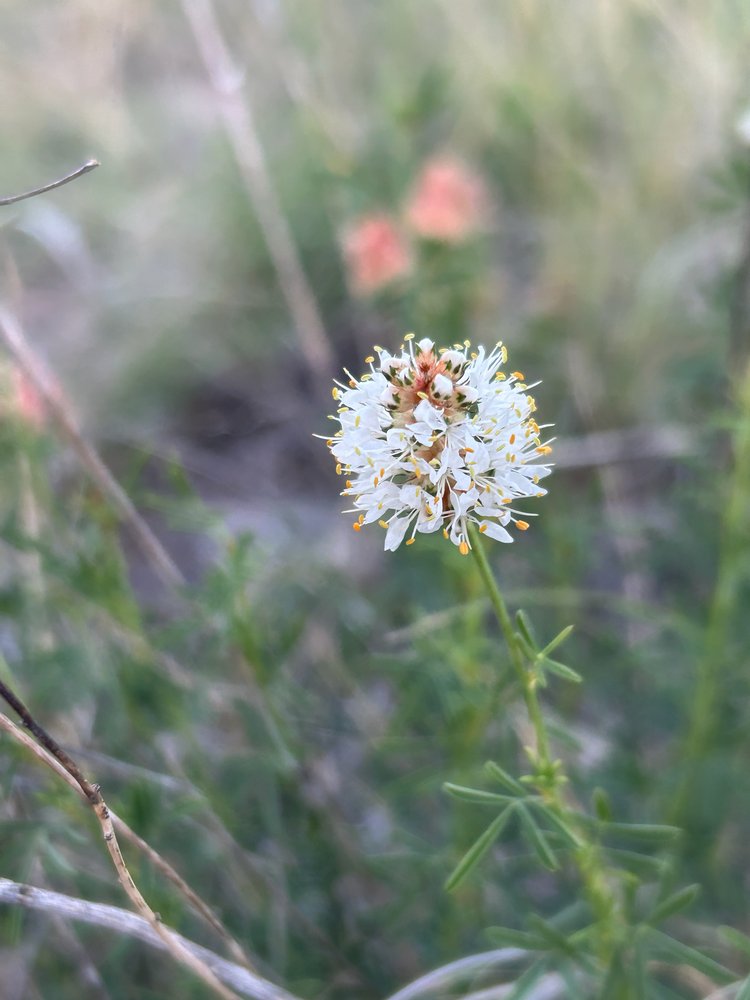
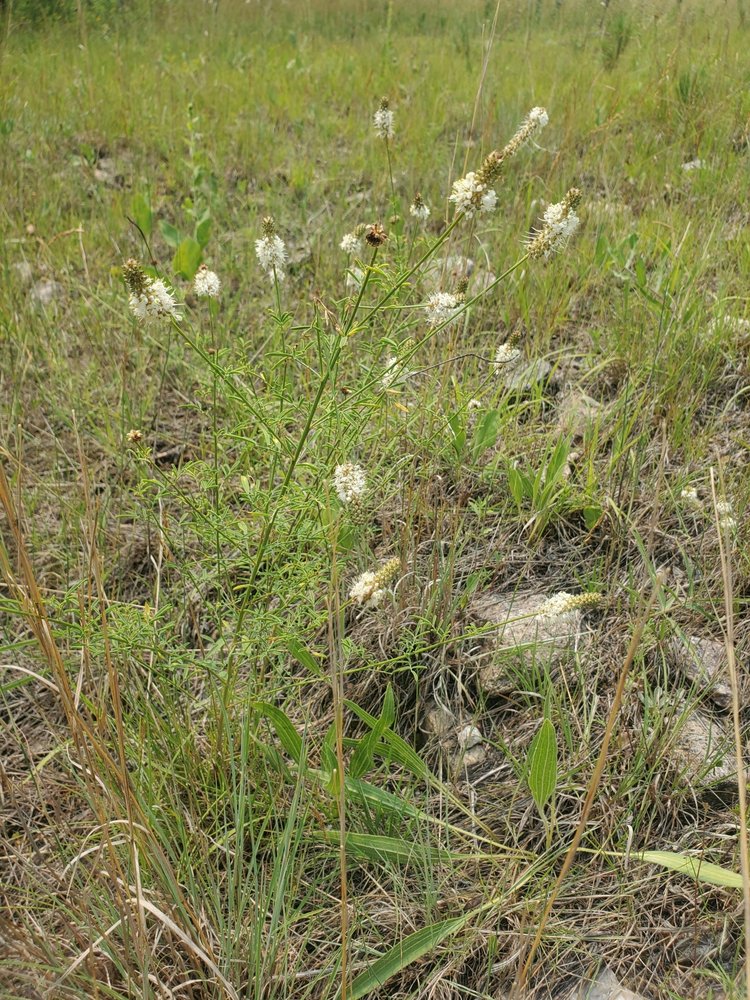
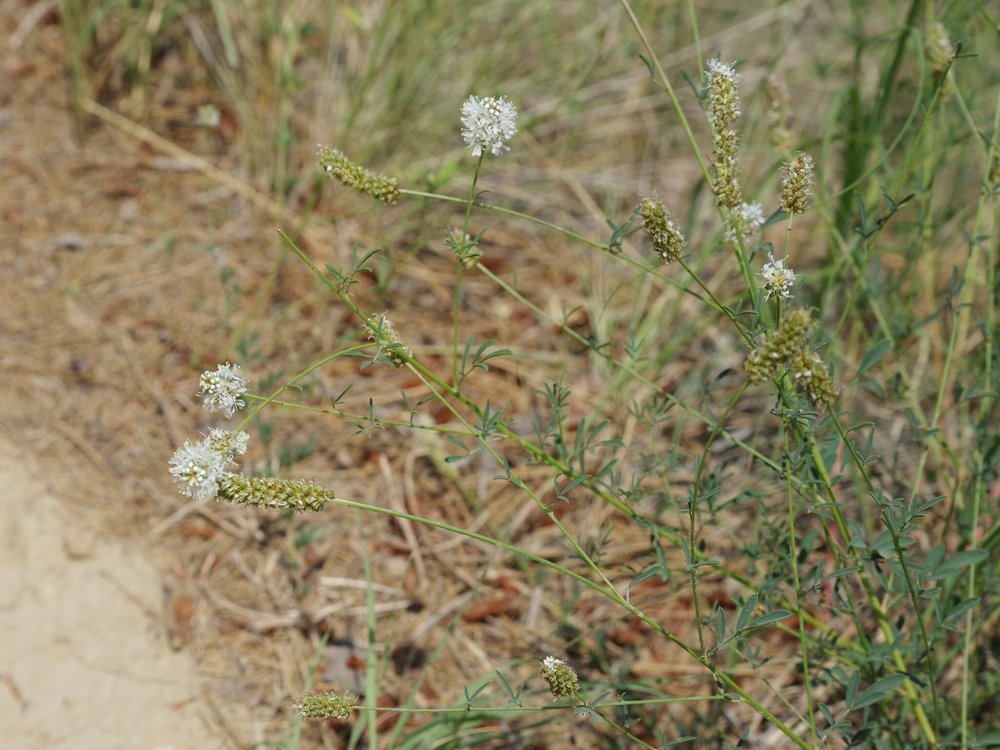
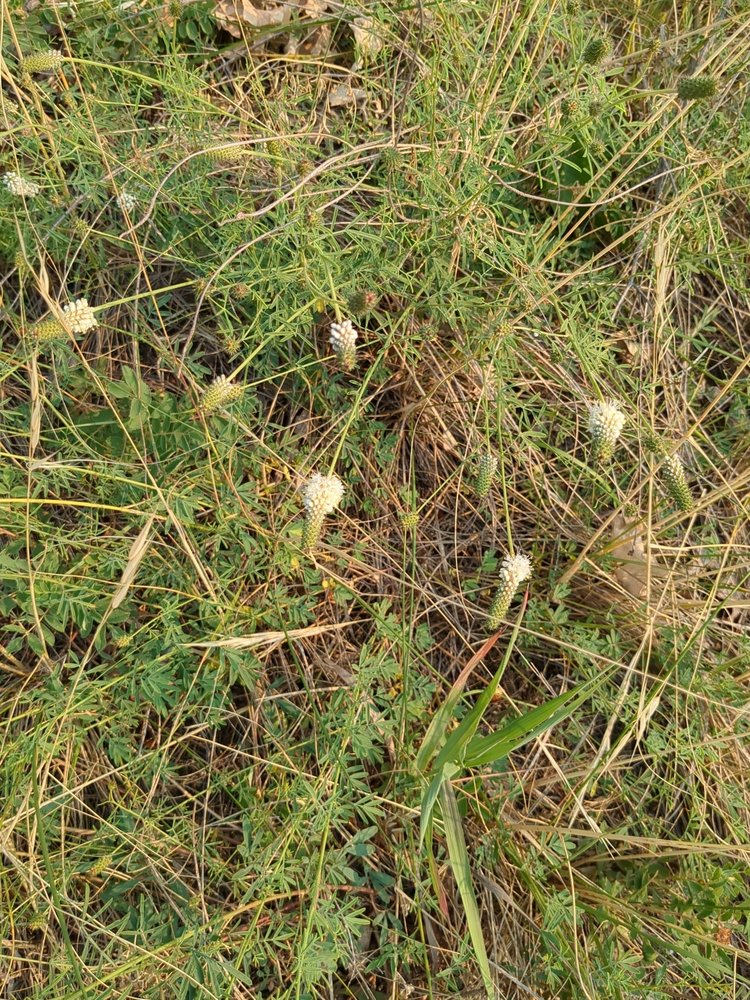
White Prairie Clover (Dalea candida) is a native perennial legume, 30–100 cm (12–40 in) tall, with slender ribbed stems, small leaves of 5 to 13 narrow leaflets and a cylindrical spike at each stem tip, where tiny white flowers open in a ring from the bottom up from June into August. In the Black Hills it grows on dry prairie, rocky hillsides and roadsides, and the National Park Service lists it at Wind Cave, Jewel Cave, Mount Rushmore and Devils Tower.
Free photos from other sources
| Family | Fabaceae · Pea |
|---|---|
| Status | Native perennial |
| Blooms | June into August |
| Height | 30–100 cm (12–40 in) |
| Where | Dry prairie, rocky hillsides, roadsides and open rocky pine woods |
| Also called | Prairie Clover, Slender Prairie Clover, Slender White Prairie Clover, White Dalea, tȟokȟála tȟapȟéžuta hú bloká (Lakota) |
| Synonym | Petalostemon candidus, Petalostemon occidentalis, Petalostemon oligophyllus |
| Toxicity | The Nebraska toxic-plants guide says it may cause bloat, as Purple Prairie Clover rarely does in cattle that eat large amounts. |
| Traditional use | Black Elk and Flying By (1998) record that the Lakota peeled and chewed the roots for their sweetness and drank an infusion of the dried roots to prevent disease. |
Roots, seeds & germination
Root: A thick taproot, which can reach 1.8 m (6 ft) deep, topped by a crown at or just below the surface that sends up one to several stems. It fixes nitrogen, and it doesn't spread aggressively by seed or by spreading roots.
Seed: A tiny oval pod 2.5–4.5 mm long, dotted with glands, pokes out of the old calyx and holds one smooth, brown, kidney-shaped seed 1.5–2 mm long. SDSU says to collect in July and August when the seed turns brown.
Germination: The USDA plant guide says scarification (nicking or sanding the seed coat) improves germination, and most seed sprouts in 6 to 9 days, some taking up to 30, at 15–30 °C (59–86 °F), planted 6–12 mm (¼–½ in) deep. SDSU says to remove the pod tissue first, or sow in fall with the seed still in the pod; it is easy from seed and self-sows. Division is difficult, but branch-tip cuttings root under mist.
How do you identify White Prairie Clover?
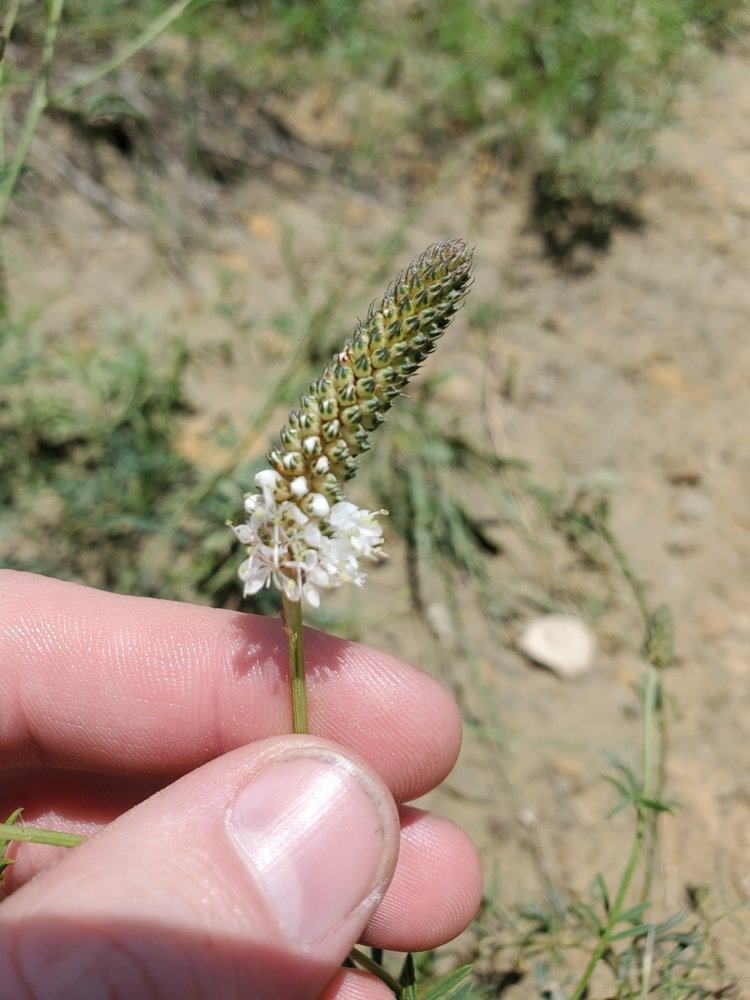
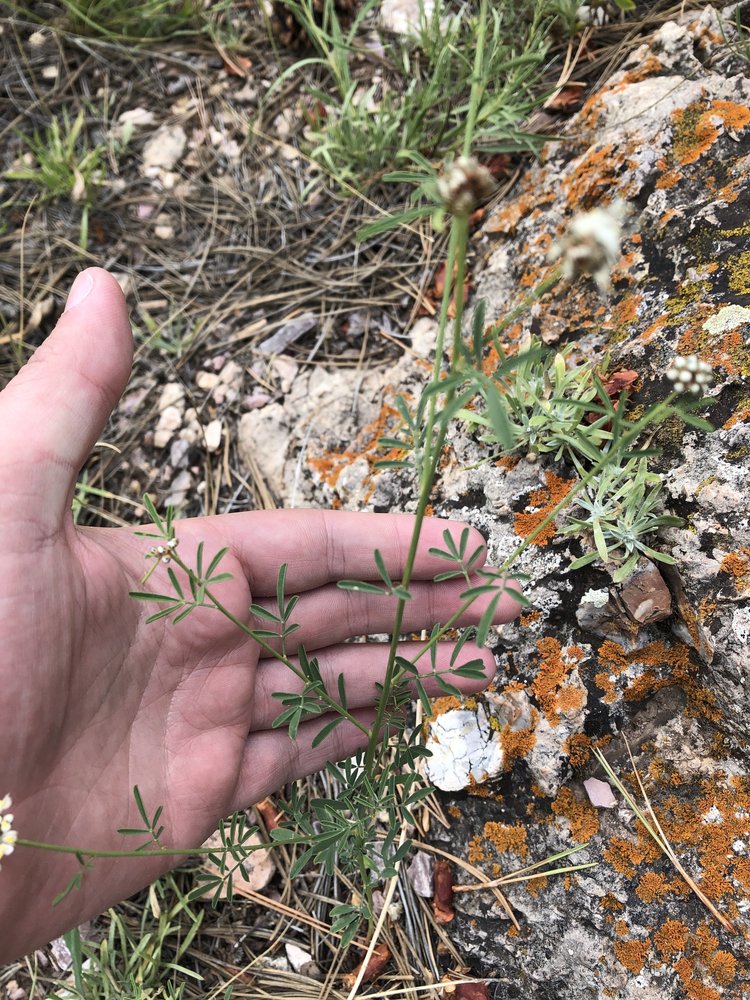
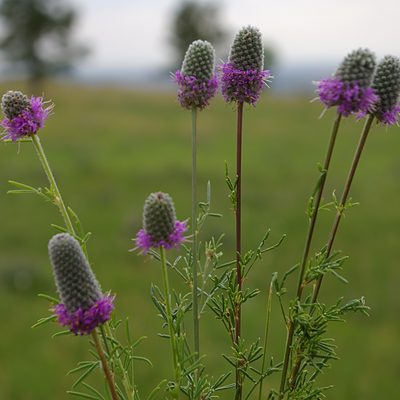
Look for one to several slender, upright, hairless stems 30–100 cm (12–40 in) tall, ribbed lengthwise, with alternate leaves 1.5–6 cm (⅝–2⅜ in) long made of 5 to 13, usually 7, narrow leaflets with sharp tips and gland dots underneath. Each stem or branch ends in a dense cylindrical spike 1.5–7.5 cm (⅝–3 in) long and about 12 mm (½ in) thick, where tiny white flowers about 6 mm (¼ in) across open from the bottom up, so a ring of open flowers with five white stamens sticking out climbs the spike below the unopened green-to-rusty buds. Purple Prairie Clover is nearly identical except for its purple flowers.
When does it bloom?
June into August.
Where does it grow?
Dry prairie, rocky hillsides, roadsides and open rocky pine woods, mostly on well-drained sandy, gravelly, rocky or silty ground. The National Park Service lists it at Wind Cave, Jewel Cave, Mount Rushmore and Devils Tower, where the monument's wildflower list gives July, and the 1986 plant survey of Jewel Cave lists it. More than a hundred herbarium specimens come from Lawrence, Fall River, Custer, Pennington and Meade counties in South Dakota and Crook and Weston counties in Wyoming, the earliest collected in 1892, with labels from hillsides, roadsides, open pine and pine-oak woods, limestone rims, red-bed slopes and the pine understory at Devils Tower. Labels inside the Hills that give an elevation say about 1,000–1,750 m (3,300–5,700 ft).
Other clovers in this guide
Pea family (Fabaceae): 31 other plants in this guide
- Alfalfa
- Alpine Sweetvetch
- American Vetch
- Barr's Milkvetch
- Black Medic
- Canada Milkvetch
- Canada Tickclover
- Cream Milkvetch
- Crown Vetch
- Drummond's Milkvetch
- Field Locoweed
- Field Milkvetch
- Golden Pea
- Groundplum Milkvetch
- Indian Milkvetch
- Lambert's Crazyweed
- Laxmann's Milkvetch
- Lead Plant
- Missouri Milkvetch
- Pale Vetchling
- Prairie Turnip
- Purple Prairie Clover
- Red Clover
- Silktop Dalea
- Silverleaf Scurfpea
- Silvery Lupine
- Slimflower Scurfpea
- Tufted Milkvetch
- White Clover
- Wild Licorice
- Yellow Sweetclover
Sources: SDSU Open PRAIRIE: Dalea candida (R. Neil Reese); USDA NRCS Plant Guide: White Prairie Clover, Dalea candida (Wynia 2008); USDA PLANTS Database: Dalea candida (DACA7); Kansas Wildflowers and Grasses: Dalea candida, white prairie-clover; Minnesota Wildflowers: Dalea candida (White Prairie Clover); Nebraska Plants Toxic to Livestock, EC3037 (Stubbendieck et al., University of Nebraska–Lincoln Extension, 2018); National Park Service, Devils Tower National Monument: Native Plants; Marriott and Hartman 1986, A Survey of the Vegetation of Jewel Cave National Monument; NPSpecies checklist, Wind Cave National Park vascular plants; NPSpecies checklist, Jewel Cave National Monument vascular plants; NPSpecies checklist, Mount Rushmore National Memorial vascular plants; NPSpecies checklist, Devils Tower National Monument vascular plants; GBIF backbone: Dalea candida Willd., with synonyms; GBIF occurrence search: Dalea candida, South Dakota and Wyoming herbarium specimens; GBIF specimen 5895761932: Fall River County, 1892; GBIF specimen 2989955382: Devils Tower National Monument, ponderosa pine understory, 1981; Culturally Important Plants of the Lakota (Black Elk and Flying By, 1998), filed with the South Dakota PUC.