Red Clover Trifolium pratense
Also called blayé ziŋtká (Lakota), tȟačȟáŋ (Lakota)
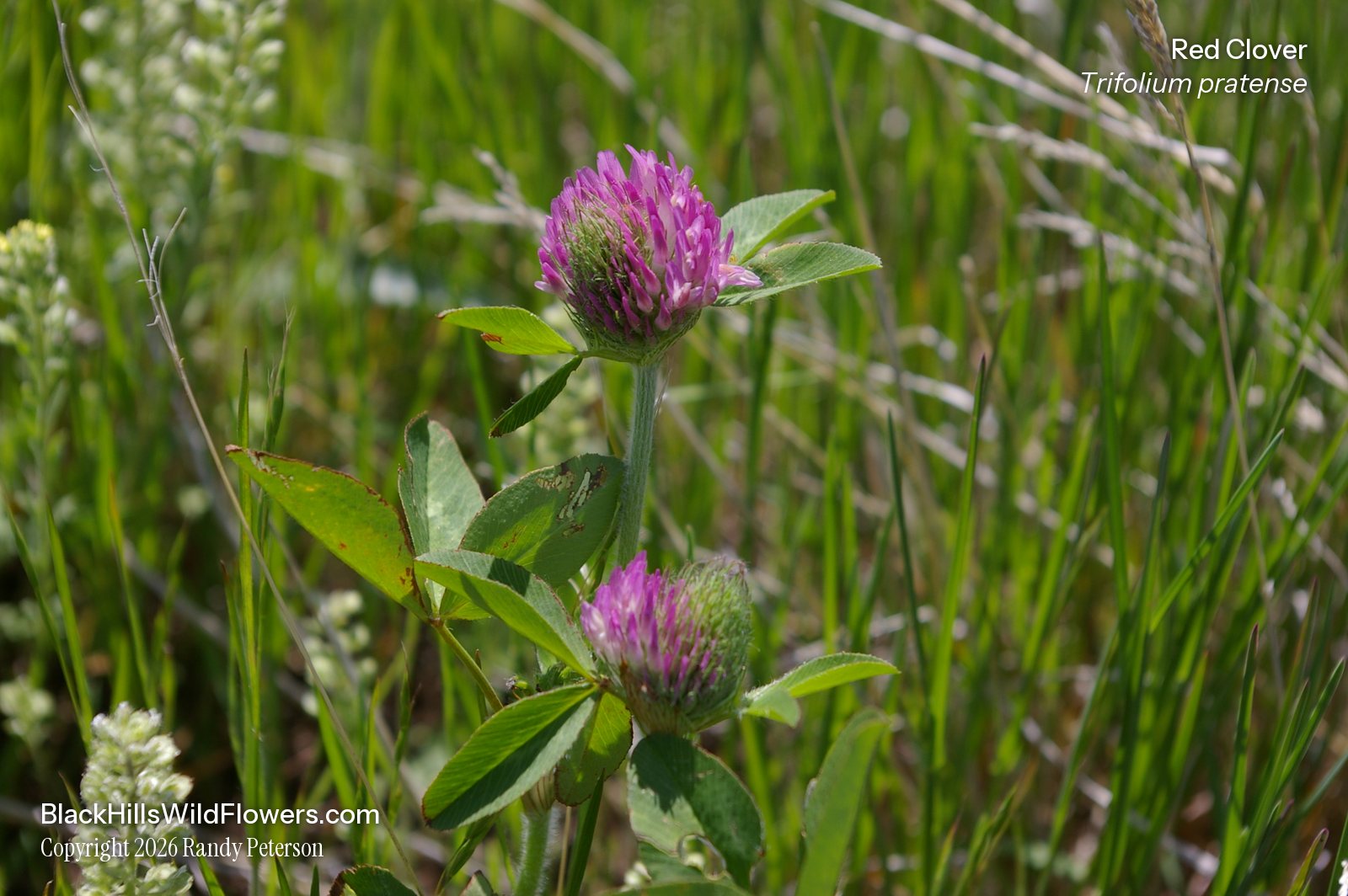
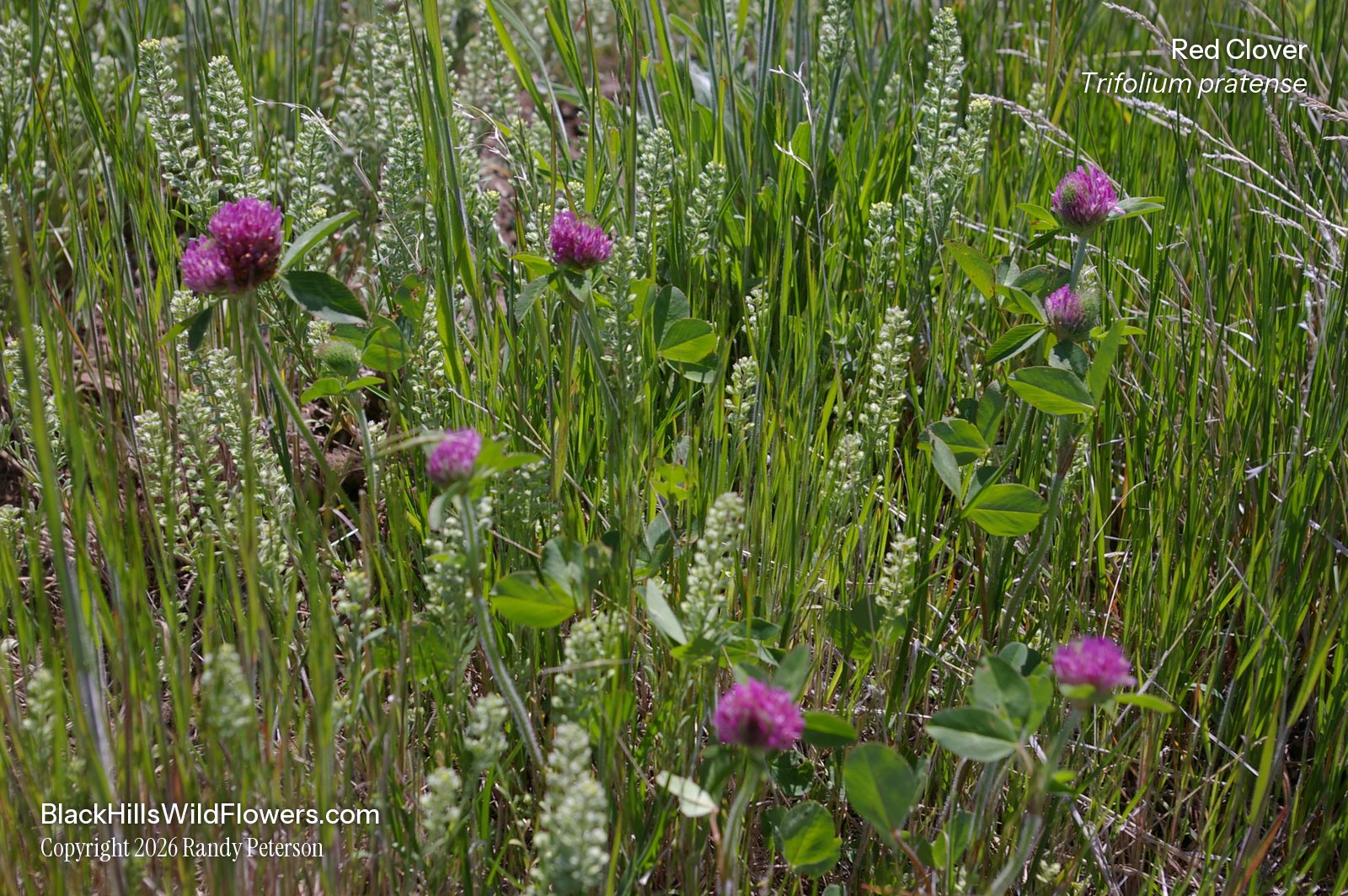
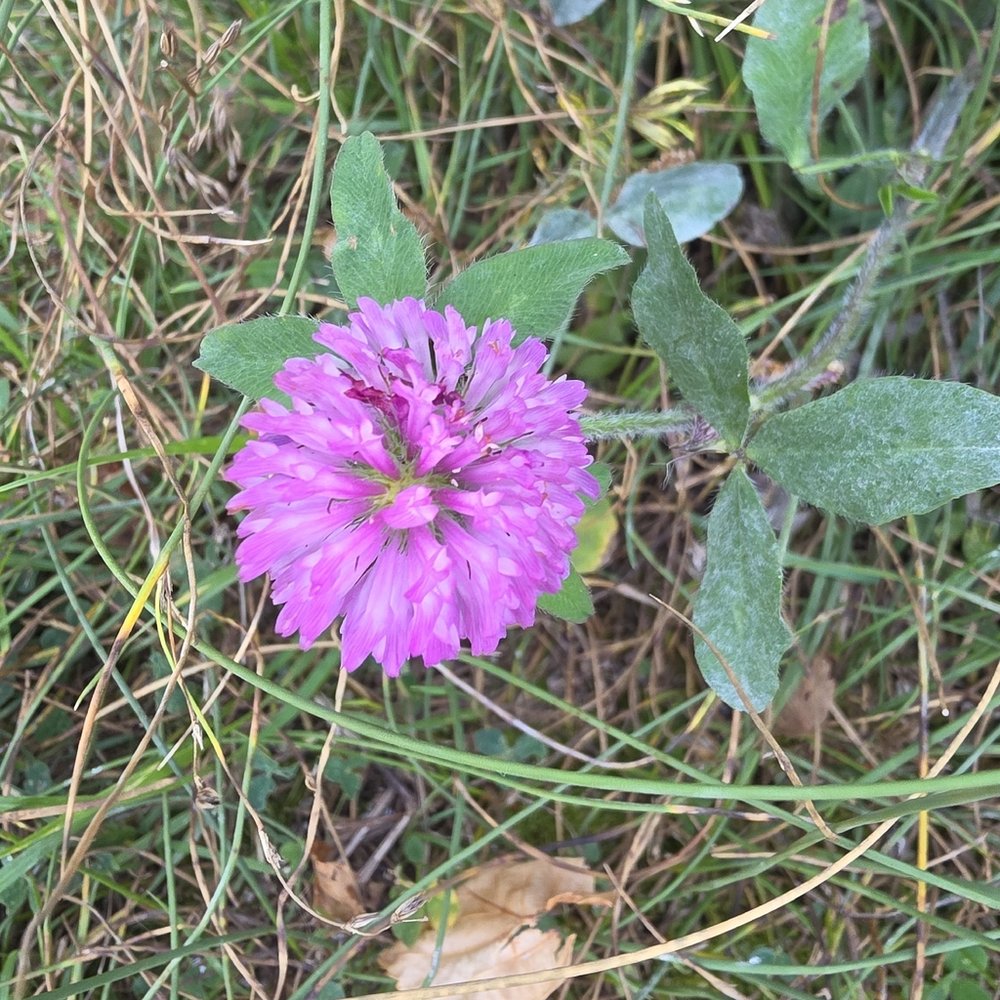
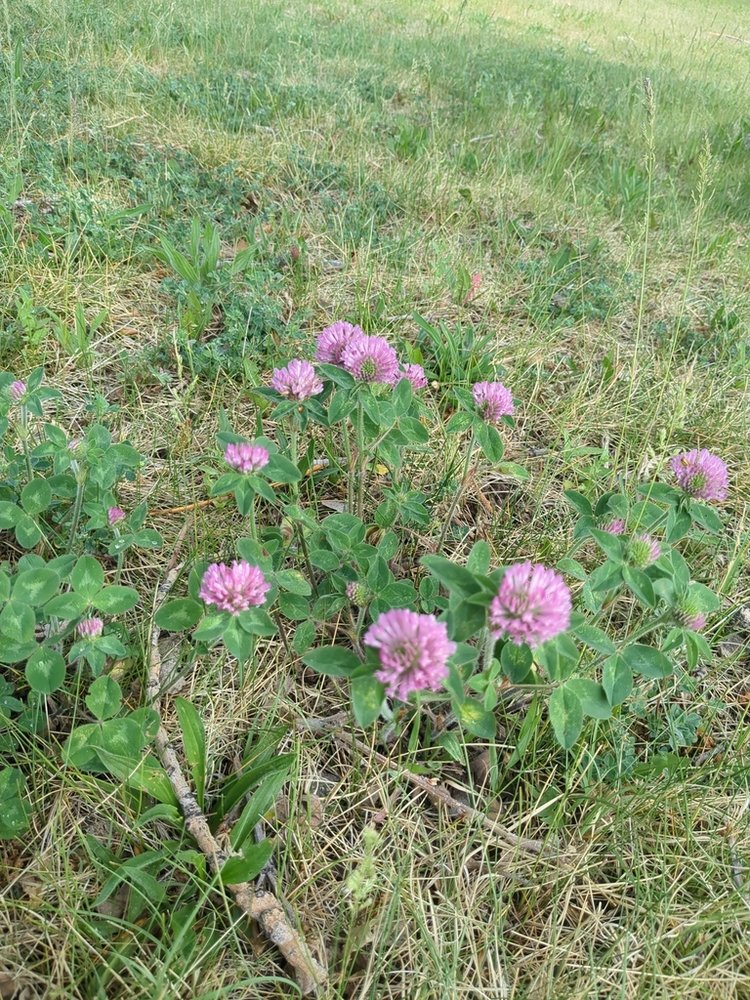
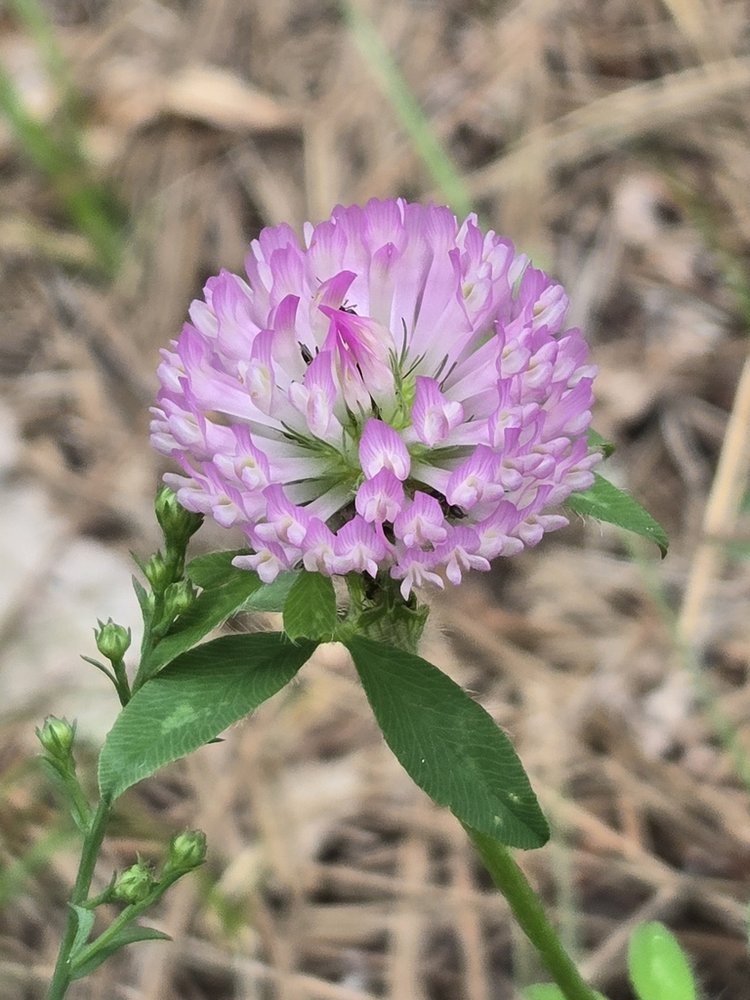
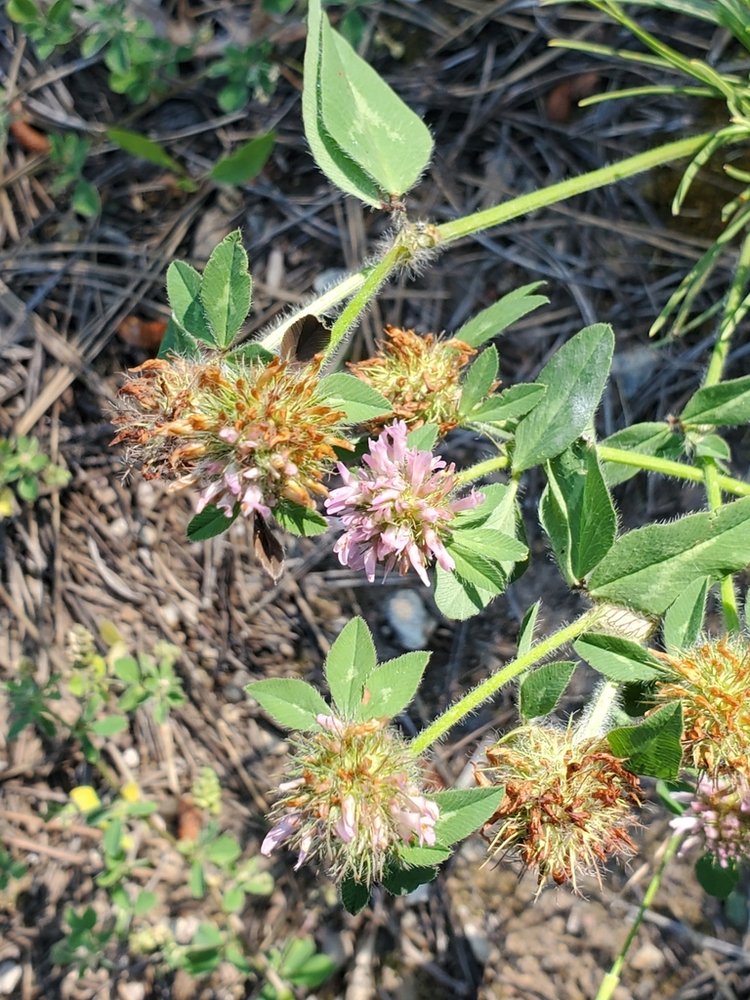
Red Clover (Trifolium pratense) is an introduced forage plant from Europe, Asia and Africa that has escaped onto roadsides, fields, lawns, meadows and stream banks across the Black Hills, where herbarium records go back to 1892. Its round, rosy-pink heads, 2–2.5 cm (¾–1 in) across, sit on hairy stems over leaves of three oval leaflets, usually marked with a pale V, from June into September. Photographed in the Black Hills.
Free photos from other sources
| Family | Fabaceae · Pea |
|---|---|
| Status | Introduced biennial or short-lived perennial |
| Blooms | June into September, with stragglers into October |
| Height | 15–90 cm (6–36 in) |
| Where | Roadsides, pastures, fields, lawns and waste places, most abundant on heavy, fertile, well-drained soil |
| Also called | blayé ziŋtká (Lakota), tȟačȟáŋ (Lakota) |
| Toxicity | Grazing animals can bloat on it almost as readily as on alfalfa, and sheep grazing solid stands occasionally have breeding problems from the plant's high estrogen levels. |
| Traditional use | Black Elk and Flying By (1998) list it as an introduced plant with the Lakota names blayé ziŋtká and tȟačȟáŋ, and record a salve or poultice of red clover, usually with burdock and curly dock, for skin conditions, and an infusion of the whole plant for psoriasis, whooping cough and dry coughs. |
Roots, seeds & germination
Root: Growth starts from the crown. The taproot usually breaks down in the plant's second year, and plants that live on have grown a wide set of branched secondary roots.
Seed: Each head holds up to 125 flowers, pollinated mainly by bumblebees. The pods are small and short, each with one or two kidney-shaped seeds that range from yellow to deep violet; there are about 275,000 seeds to the pound.
Germination: Farmers drill the seed 3–6 mm (⅛–¼ in) deep into a firm seedbed from early April to mid May. Single-cut types make a leafy rosette with no flowers the first year; double-cut types flower in their first season. Plants are short-lived, productive for about three years.
How do you identify Red Clover?
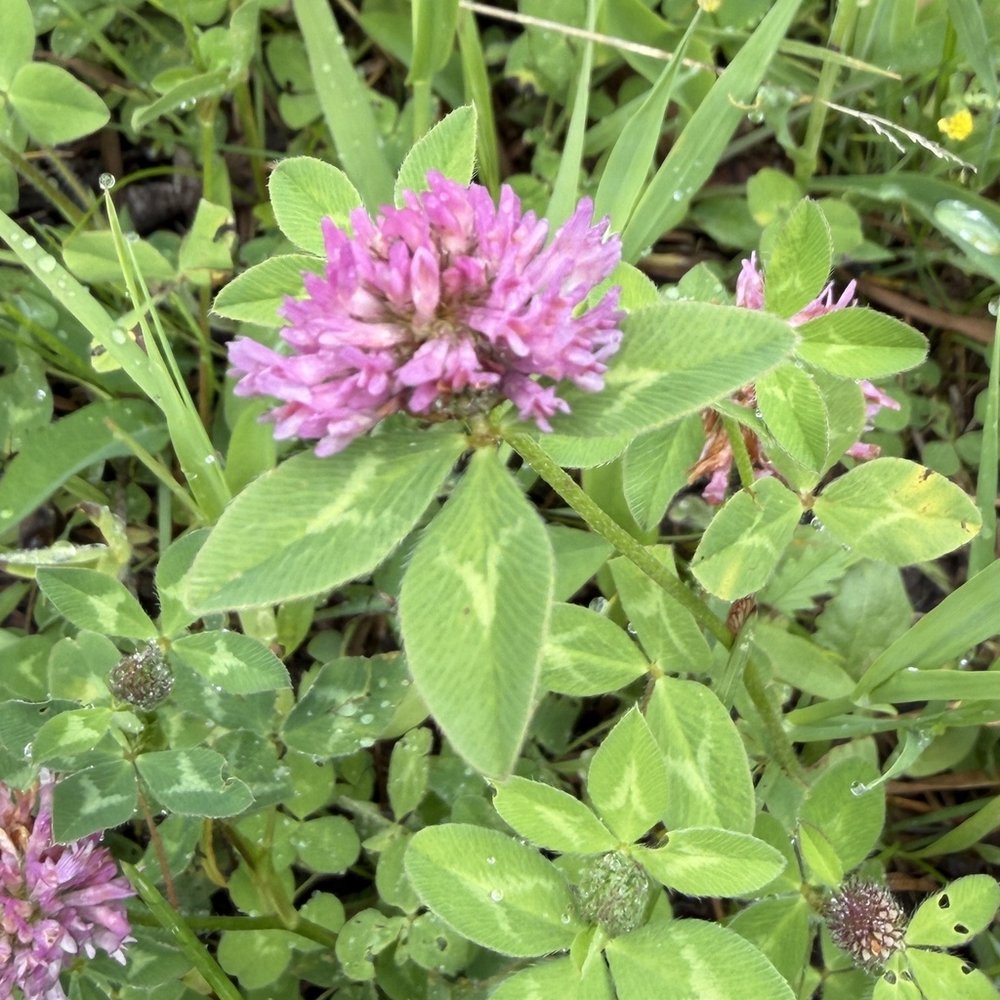
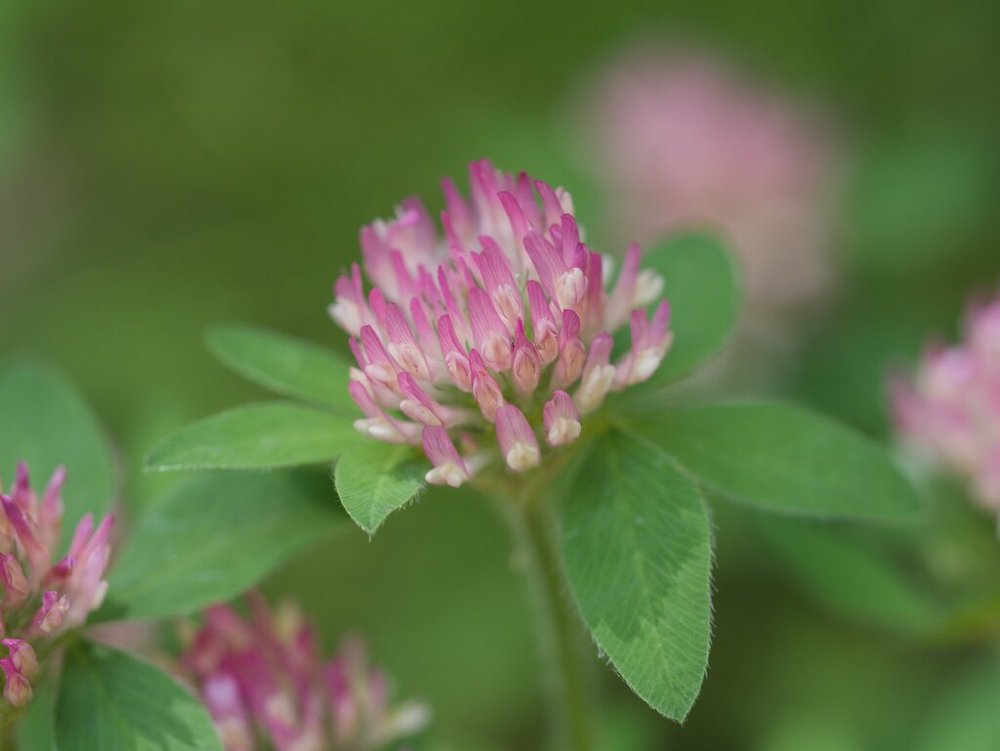
Look for a round to oval head, 2–2.5 cm (¾–1 in) across, packed with small pea-shaped flowers in dull pink to rosy purple, sitting stalkless or on a short stalk with one or two small leaves tucked right under it. Each leaf has three oval leaflets 1.5–4 cm (½–1½ in) long, soft-hairy, usually with a pale V across the middle, and the leaf stalk carries a pair of oval, sharp-tipped stipules with strong veins. The stems are hollow, covered with fine flattened hairs, upright or sprawling, and branch thickly at the base; plants stand 15–90 cm (6–36 in). Minnesota Wildflowers says Alsike Clover is similar, but Red Clover's flowers are more rosy purple; Alsike's heads are light pink to white, darkening with age for a two-tone look, on stalks 2.5–8 cm (1–3 in) long from the leaf axils, and its leaflets are hairless. The same page says White Clover also has a light V on its leaflets, and its leaves rise straight up from stems that run along the ground.
When does it bloom?
June into September, with stragglers into October.
Where does it grow?
Roadsides, pastures, fields, lawns and waste places, most abundant on heavy, fertile, well-drained soil; Minnesota Wildflowers calls it a forage crop that easily escapes into pastures, field margins and road ditches. The National Park Service lists it at Wind Cave National Park, Jewel Cave National Monument and Mount Rushmore National Memorial, and the 1986 Jewel Cave plant survey records it as an exotic. Herbarium specimens from 1892 to 2013 come from all five Black Hills counties in South Dakota (Lawrence, Meade, Pennington, Custer and Fall River) and from Crook and Weston counties in Wyoming. Their labels name damp grassy lawns along creeks, a field of rich soil, moist roadsides, creek banks, meadows, an abandoned field, open pine and white spruce forest, and open spruce forest by a lake in Custer State Park, at about 1,070–2,070 m (3,500–6,800 ft). iNaturalist has 246 research-grade records within 100 km of the central Hills.
Other clovers in this guide
Pea family (Fabaceae): 31 other plants in this guide
- Alfalfa
- Alpine Sweetvetch
- American Vetch
- Barr's Milkvetch
- Black Medic
- Canada Milkvetch
- Canada Tickclover
- Cream Milkvetch
- Crown Vetch
- Drummond's Milkvetch
- Field Locoweed
- Field Milkvetch
- Golden Pea
- Groundplum Milkvetch
- Indian Milkvetch
- Lambert's Crazyweed
- Laxmann's Milkvetch
- Lead Plant
- Missouri Milkvetch
- Pale Vetchling
- Prairie Turnip
- Purple Prairie Clover
- Silktop Dalea
- Silverleaf Scurfpea
- Silvery Lupine
- Slimflower Scurfpea
- Tufted Milkvetch
- White Clover
- White Prairie Clover
- Wild Licorice
- Yellow Sweetclover
Sources: USDA NRCS Plant Guide: Red Clover, Trifolium pratense; USDA PLANTS Database: Trifolium pratense (TRPR2); Minnesota Wildflowers: Trifolium pratense (Red Clover); Minnesota Wildflowers: Trifolium hybridum (Alsike Clover); Kansas Wildflowers and Grasses: Trifolium pratense; Black Elk and Flying By 1998, Culturally Important Plants of the Lakota (SD PUC docket HP14-001), entry 311; NPSpecies checklist, Wind Cave National Park vascular plants; NPSpecies checklist, Jewel Cave National Monument vascular plants; NPSpecies checklist, Mount Rushmore National Memorial vascular plants; Marriott and Hartman 1986, A Survey of the Vegetation of Jewel Cave National Monument; GBIF occurrence search: Trifolium pratense herbarium specimens, South Dakota and Wyoming; GBIF specimen 1931332674: Black Hills, 1892, 3,500 ft; GBIF specimen 3023457169: Custer County, 1905, damp grassy lawns along creeks, flowering; GBIF specimen 3023457170: Lawrence County, 1906, field with rich soil, flowering; GBIF specimen 3010195632: Fall River County, 1932, in flower; GBIF specimen 3023457253: Meade County, 1990, open basin, flowering; GBIF specimen 3023457092: Weston County, Wyoming, 1980, open abandoned field, flowering; GBIF specimen 3051797708: Bear Lodge Mountains, Crook County, Wyoming, 1982, moist weedy bottom with oak, 1,158 m, in flower; GBIF specimen 3023457185: Pennington County, 2007, white spruce forest in a steep drainage, 6,800 ft, flowering; GBIF specimen 5159167567: Custer State Park, 1981, open spruce forest near a lake, in flower September 26; GBIF specimen 3023457263: Lawrence County, 1986, moist soil along a creek bed, flowering October 1; GBIF specimen 2859452181: Black Hills National Forest, Meade County, 2013, edge of pine forest and roadside, 1,205 m, in flower June 18; iNaturalist: research-grade Trifolium pratense observations within 100 km of the Black Hills.