Prairie Smoke
Geum triflorum
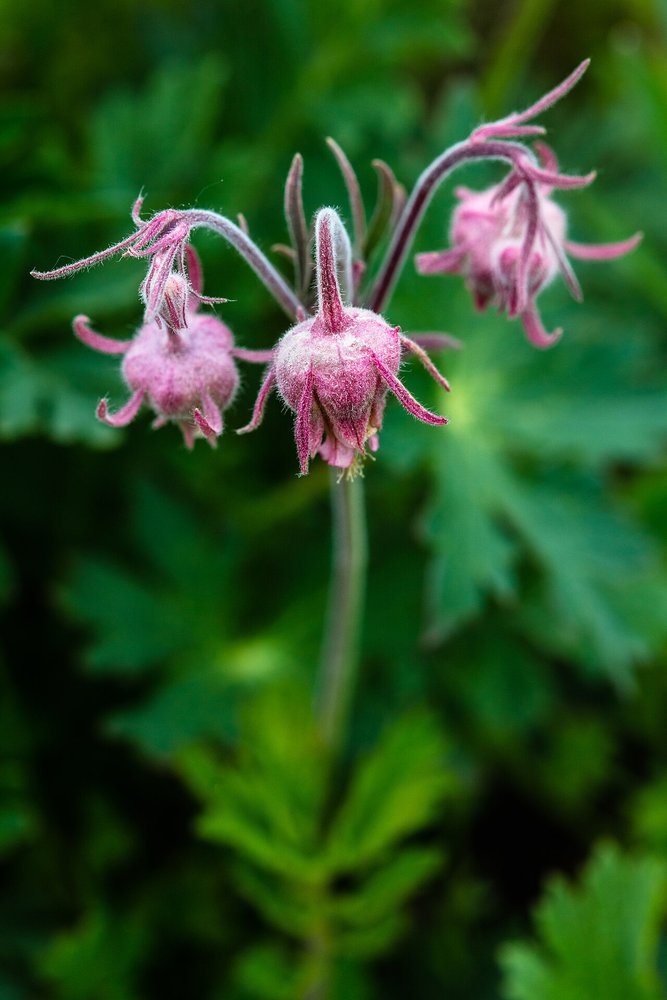
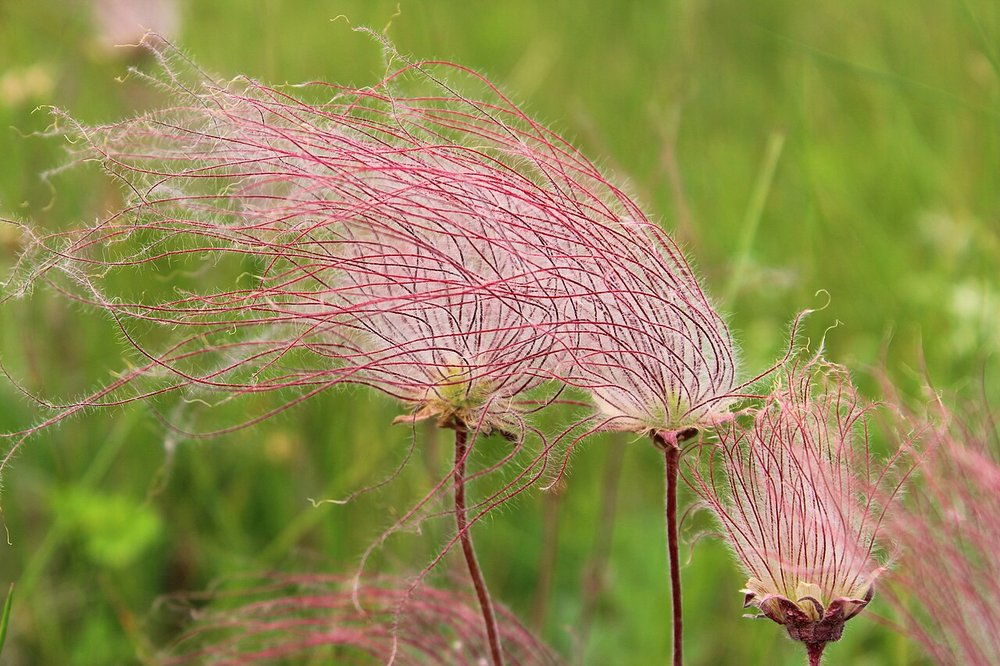
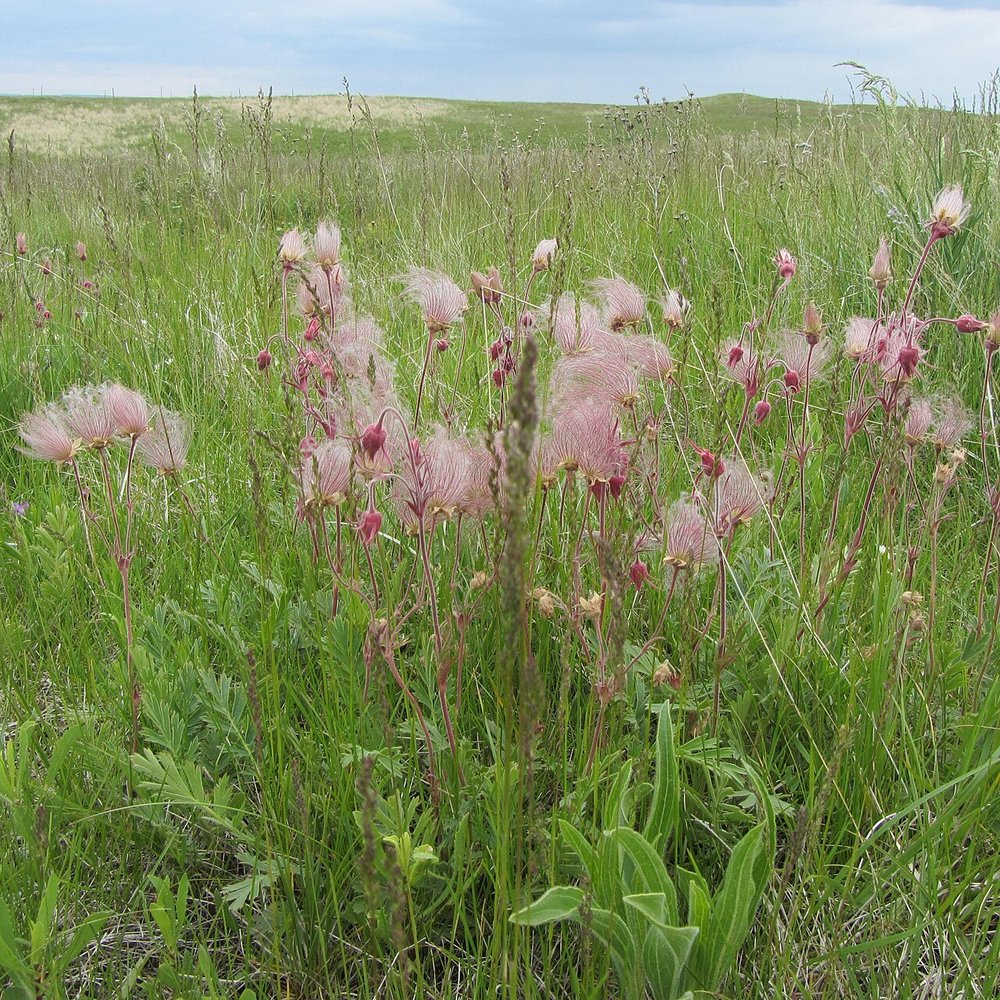
Prairie Smoke (Geum triflorum) is a low native perennial of the rose family with nodding, maroon-pink flowers in threes, whose styles stretch after bloom into long feathery pink plumes that look like smoke over the grass. It blooms in May and June on prairie, mountain meadows and grassy openings in pine forest, from the foothills to the high ridges of the Black Hills.
Free photos from other sources
| Family | Rosaceae · Rose |
|---|---|
| Status | Native perennial |
| Blooms | May into June, with feathery plumes into July |
| Height | 15–40 cm (6–16 in) |
| Where | Prairie, mountain meadows and grassy openings in ponderosa pine forest |
| Also called | Old Man's Whiskers, Three-flowered Avens, Pink Avens, Purple Avens, Torch Flower, Lion's Beard, piŋkpá hiŋšmá (Lakota) |
| Synonym | Sieversia triflora, Erythrocoma triflora, Sieversia ciliata, Geum ciliatum, Sieversia rosea |
| Traditional use | Sitting Bull College's 1998 Culturally Important Plants of the Lakota says the Lakota used a root decoction as a mouthwash for canker sores and sore throat and to wash wounds, and added scraped root to smoking mixtures. Hellson (1974) records the Blackfoot using a root tea as a mouthwash for cankers and sore throat and on wounds, and Johnston (1987) records a root decoction for sore or swollen eyes. |
Roots, seeds & germination
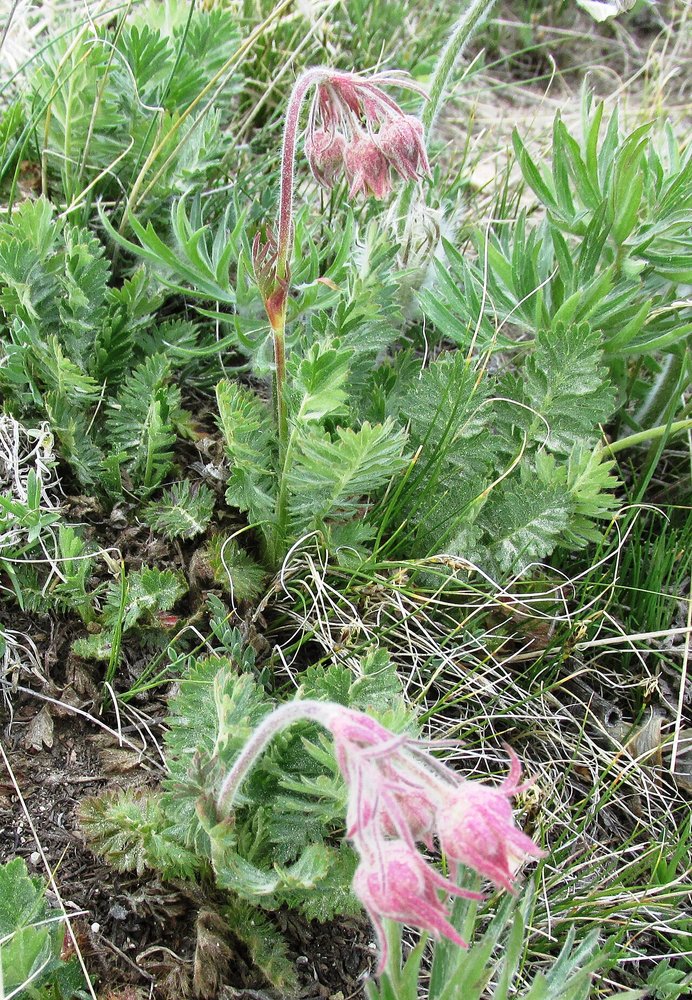
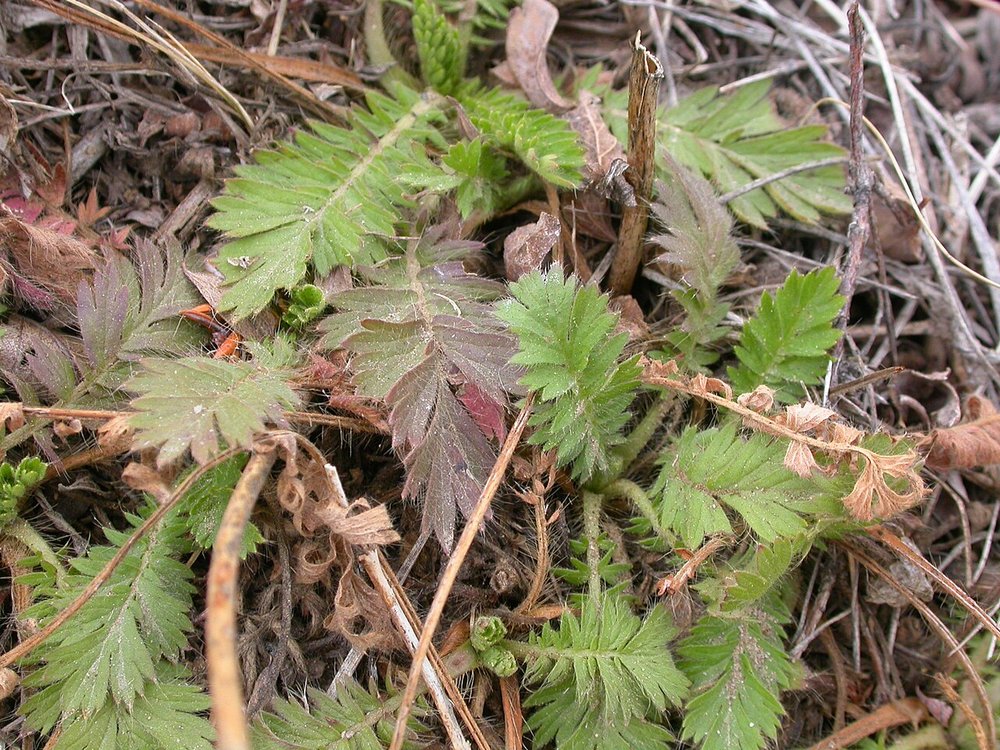
Root: A thick, scaly crown with short, stout rhizomes. The plant spreads slowly by these rhizomes into clumps 20–40 cm (8–16 in) wide or more, which can grow into large, mat-like patches.
Seed: A small, flattened, hairy achene about 2.5–3.5 mm long, carrying a feathery style 3–5 cm (1¼–2 in) long that the wind carries off. SDSU suggests collecting in June to July, when the achenes darken and the plumes stand upright.
Germination: Sources disagree. The Fire Effects Information System and a University of Washington protocol say fresh seed isn't dormant and sprouts within about 10 days at 16–27 °C (60–80 °F) if kept moist, while Prairie Moon Nursery recommends 60 days of cold, moist stratification and SDSU says fall sowing gives the best results. The seed is sensitive to drying out, and clumps can also be divided in spring or fall.
How do you identify Prairie Smoke?
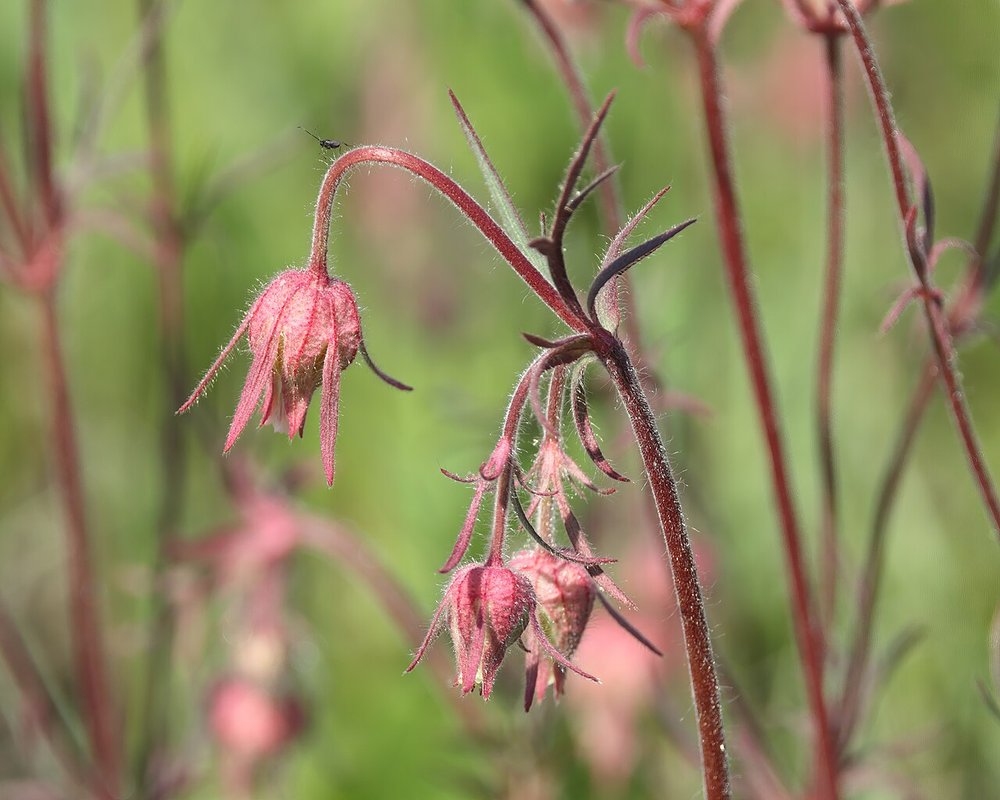
Look for usually three flowers on each reddish, softly hairy stem, hanging down on curved stalks and staying mostly closed like small lanterns. What shows is the maroon-pink sepals, with long, narrow bractlets curling out between them. The leaves are almost all in a low, fern-like rosette, each cut into about 7–19 toothed leaflets that get larger toward the tip. After bloom the flowers turn upward and the styles stretch into feathery pink to silvery plumes 3–5 cm (1¼–2 in) long.
When does it bloom?
May into June, with feathery plumes into July.
Where does it grow?
Prairie, mountain meadows and grassy parks, the edges of pine stands, and open ridgetops and limestone slopes, from the foothills at about 1,100 m (3,600 ft) to about 2,030 m (6,660 ft) in the high central Hills. The Black Hills National Forest lists it in mixed-grass prairie and montane grassland, the 1986 plant survey of Jewel Cave lists it, and the National Park Service lists it at Wind Cave and Devils Tower. Herbarium specimens come from Lawrence, Pennington, Custer, Meade and Fall River counties in South Dakota and Crook and Weston counties in Wyoming.
Other flowers to compare


Sources: Black Hills National Forest: Black Hills Native Plants (USDA Forest Service); Devils Tower National Monument: Native Plants (NPS); Marriott & Hartman 1986, Vegetation of Jewel Cave National Monument (npshistory.com); NPSpecies (IRMA), park species lists for WICA, JECA, DETO, MORU; GBIF occurrence search: Geum triflorum, Black Hills area; GBIF species page: Geum triflorum Pursh (synonyms); Fire Effects Information System (FEIS): Geum triflorum (USDA Forest Service); USDA Forest Service Celebrating Wildflowers, Plant of the Week: Prairie Smoke (Charlie McDonald); USDA PLANTS: Geum triflorum (GETR); SDSU Open PRAIRIE: Rosaceae: Geum triflorum (R. Neil Reese); SDSU Extension: Native Plants to Know, Prairie Smoke (Puetz et al., 2024); Black Elk & Flying By 1998, Culturally Important Plants of the Lakota (SD PUC docket HP14-001 exhibit); Native American Ethnobotany Database (BRIT): Geum triflorum; Galt Museum & Archives ethnobotany garden: Three-flowered Avens, Prairie Smoke (citing Johnston 1987); University of Washington ESRM 412 propagation protocol: Geum triflorum (2014); Prairie Moon Nursery: Geum triflorum; NYBG World Flora monograph page: Geum triflorum (Gleason & Cronquist 1991 description); Missouri Plants: Geum triflorum; Putnam Park Wildflowers (UW–Eau Claire): Geum triflorum notes.