Field Locoweed Oxytropis campestris
Also called Slender Crazyweed, Slender Locoweed, Yellow Locoweed, Yellow-flowered Crazyweed, Yellow Loco
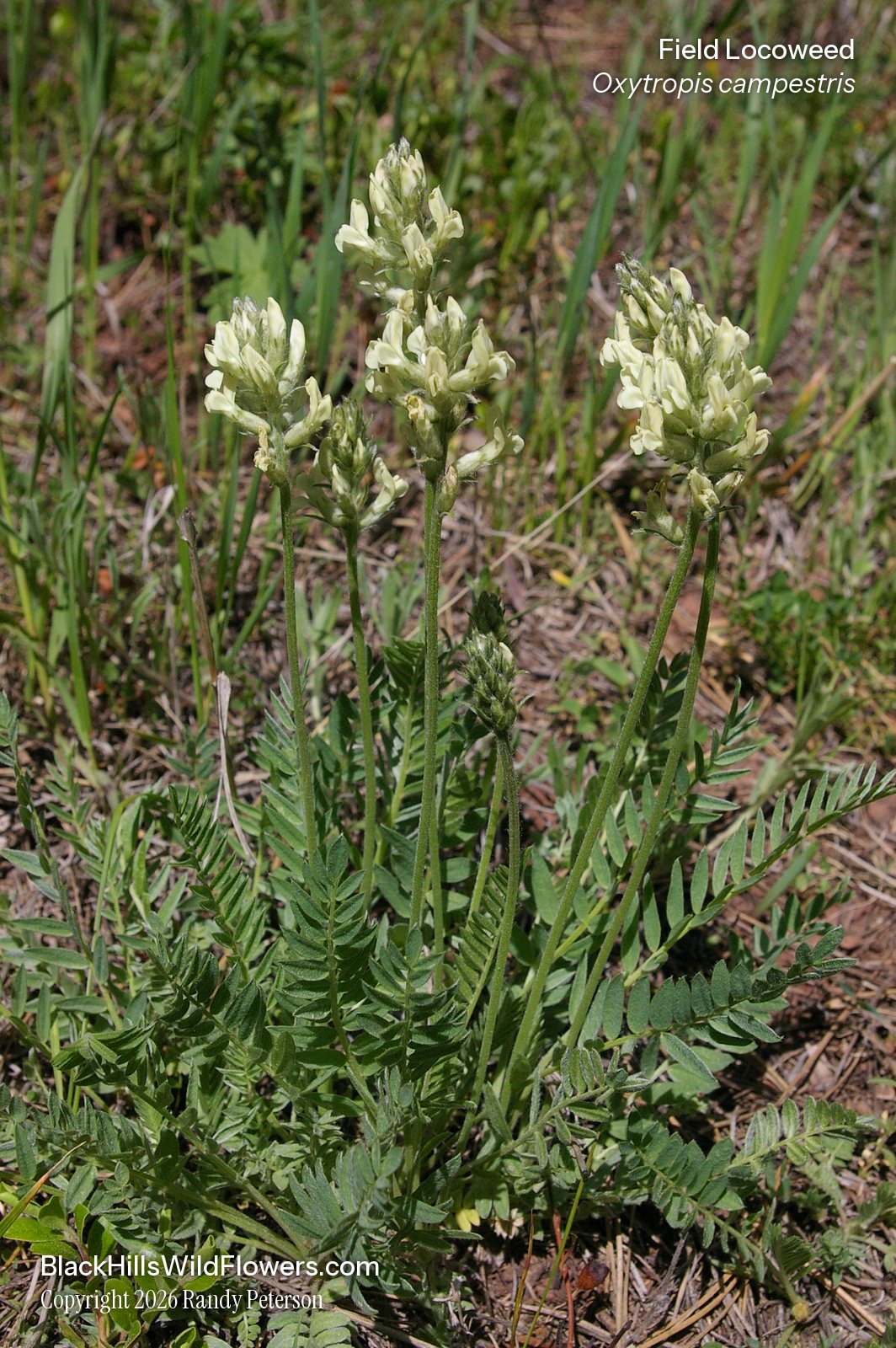
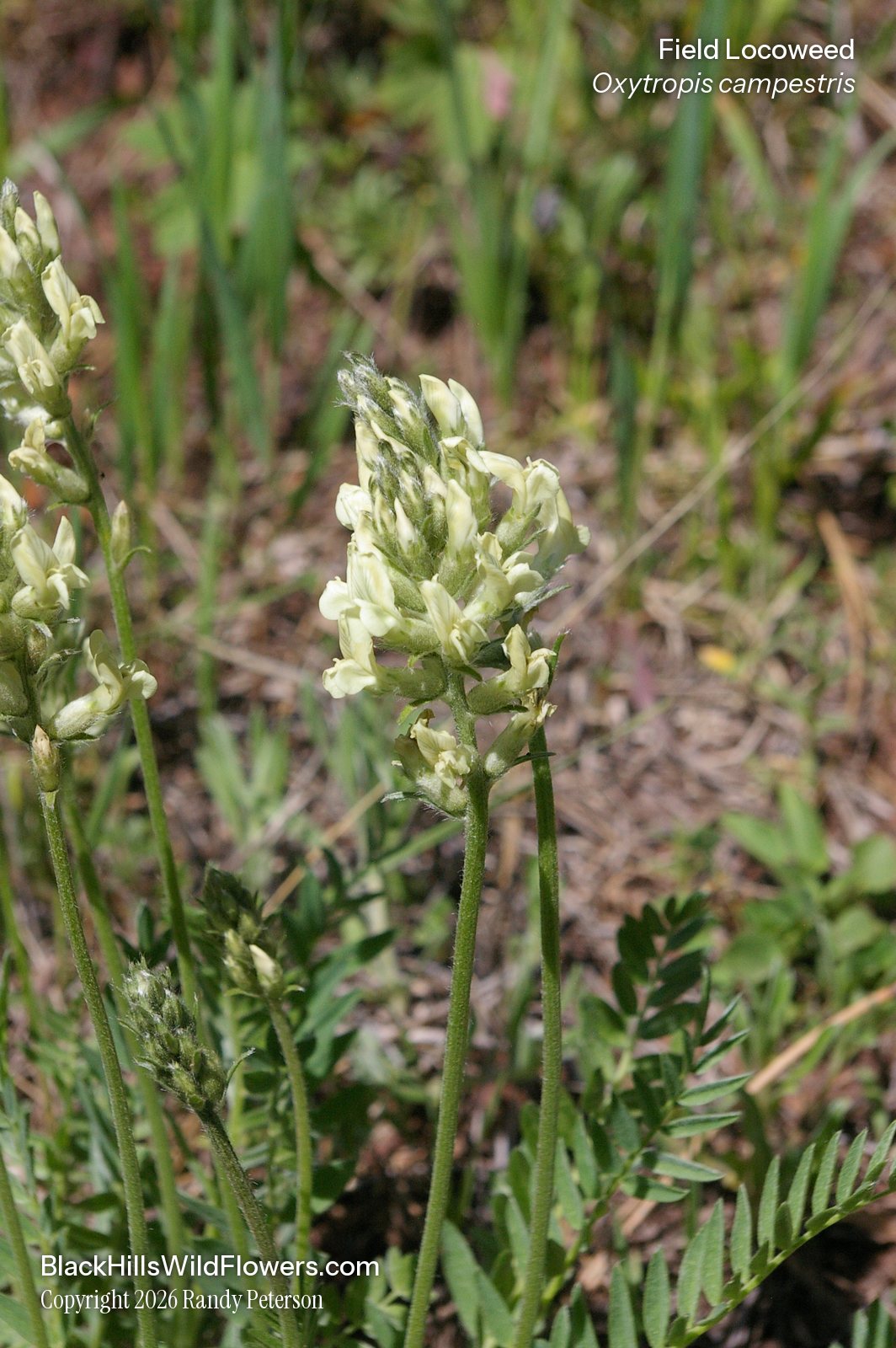
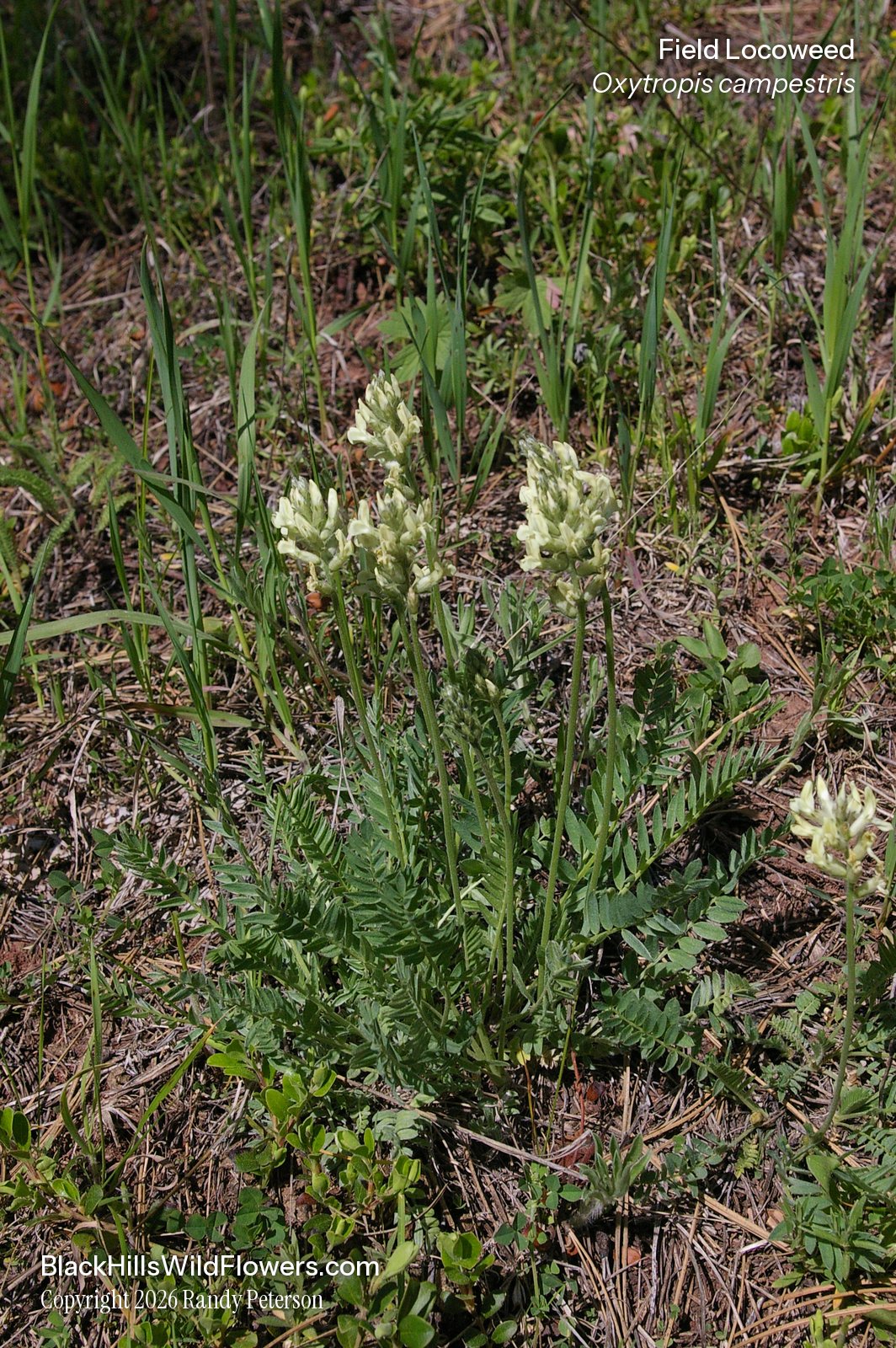
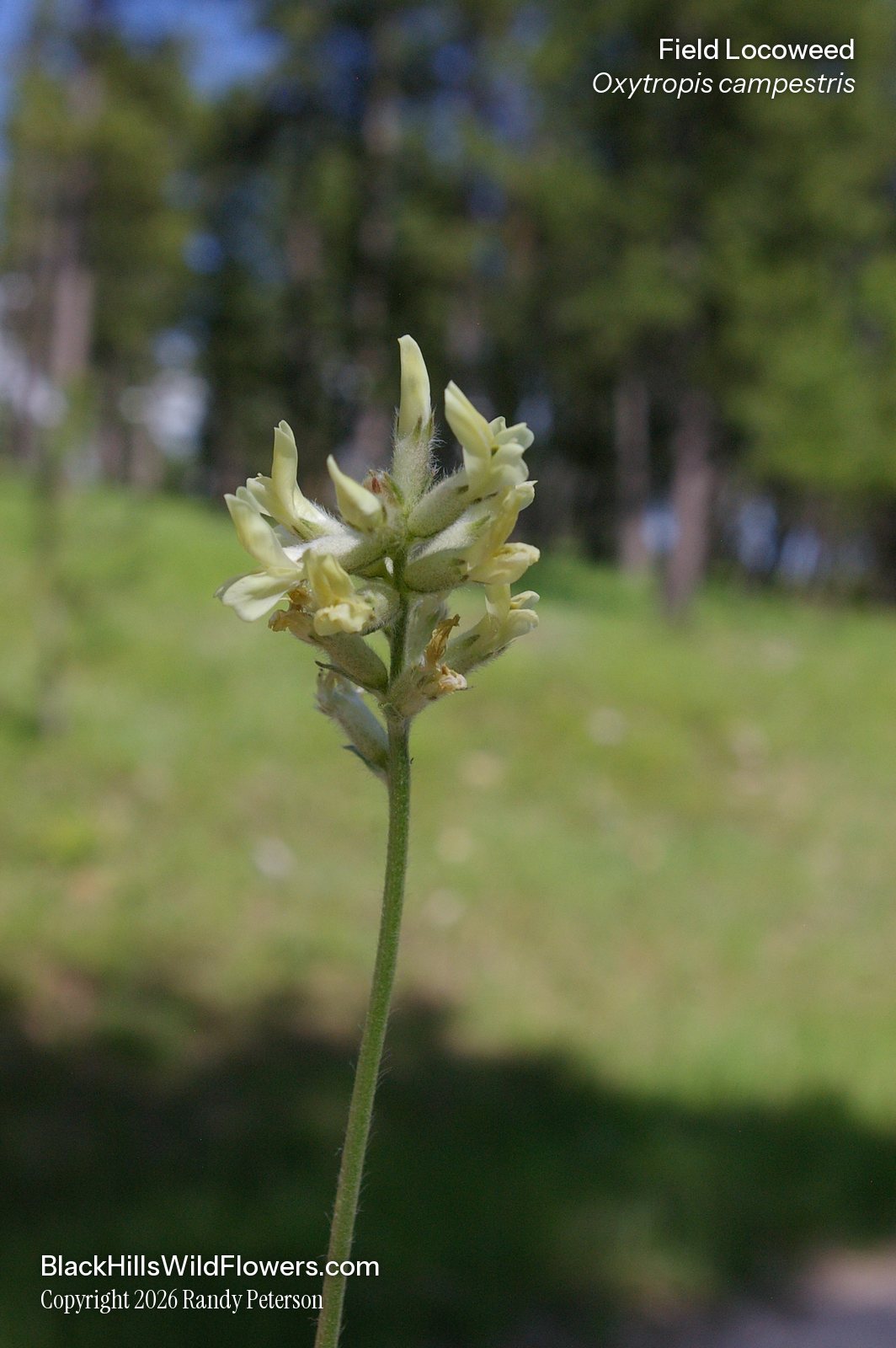
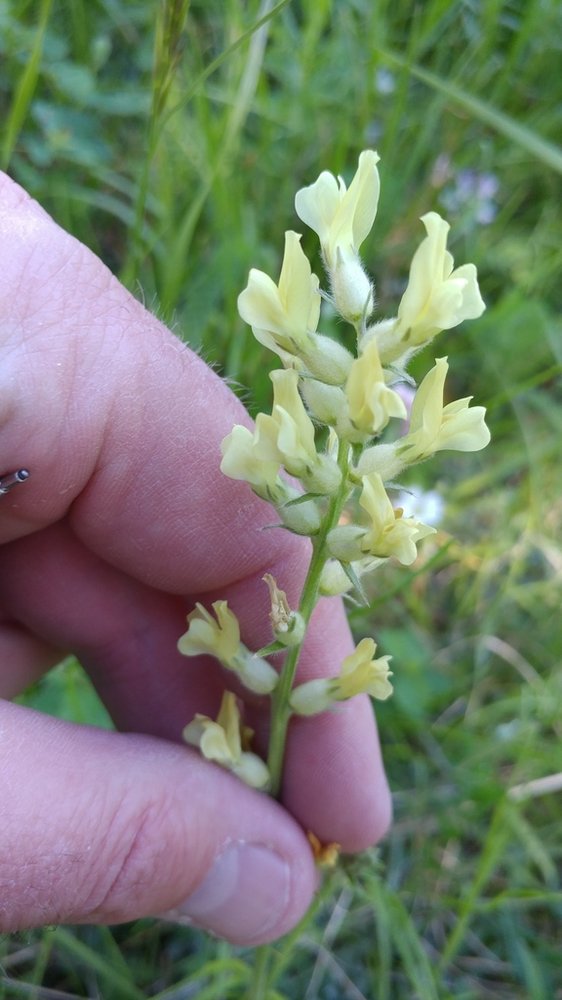
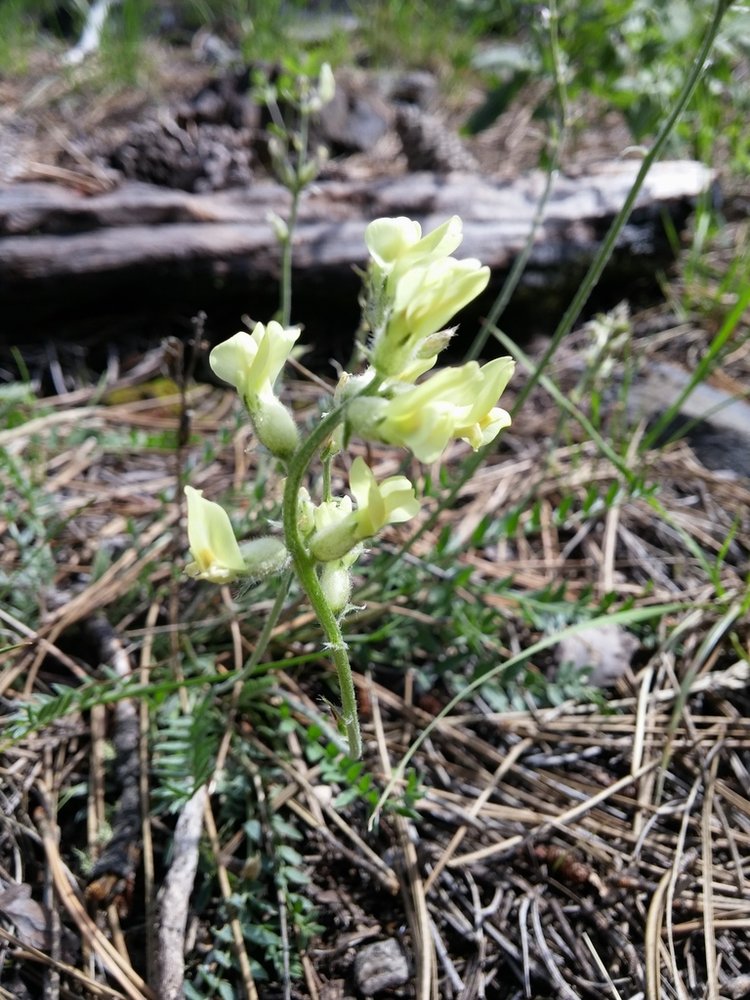
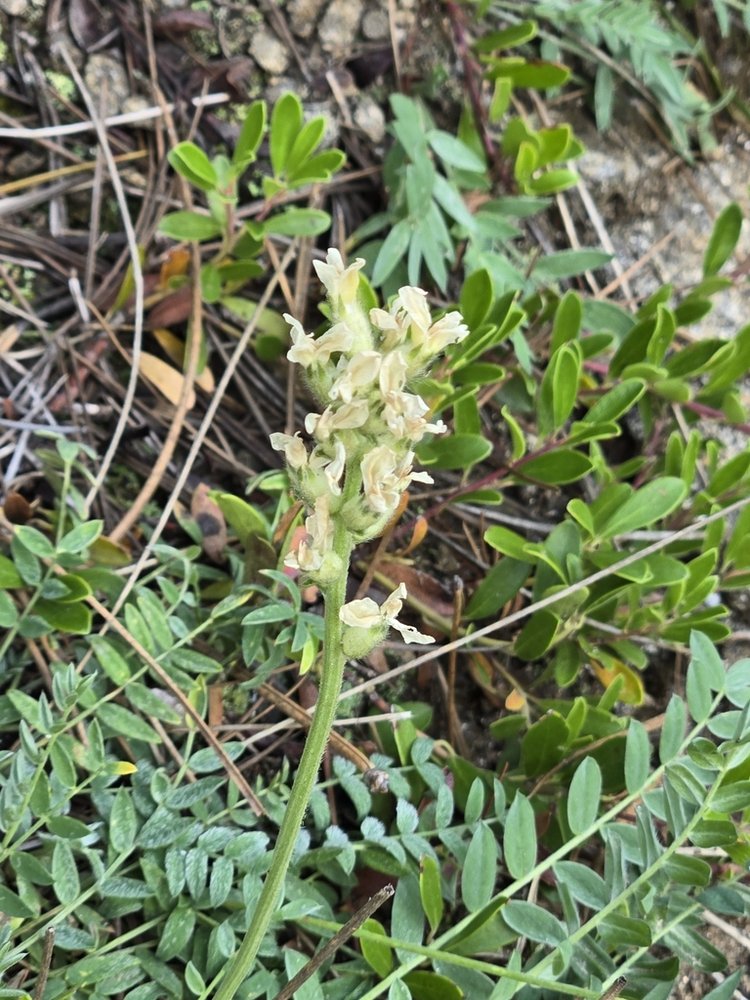
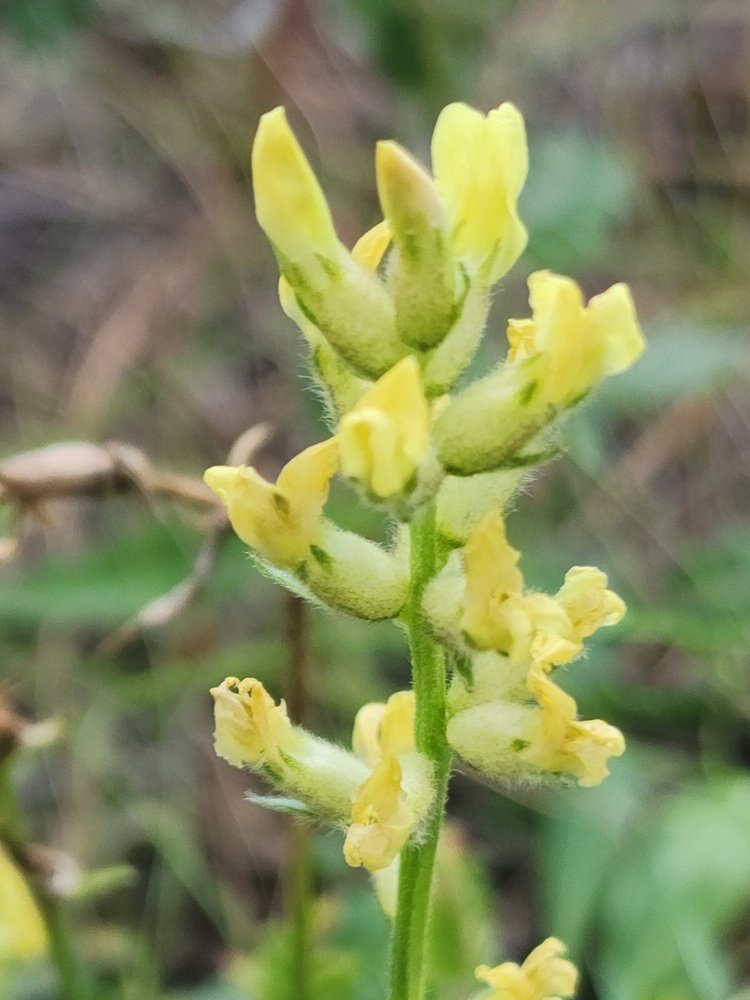
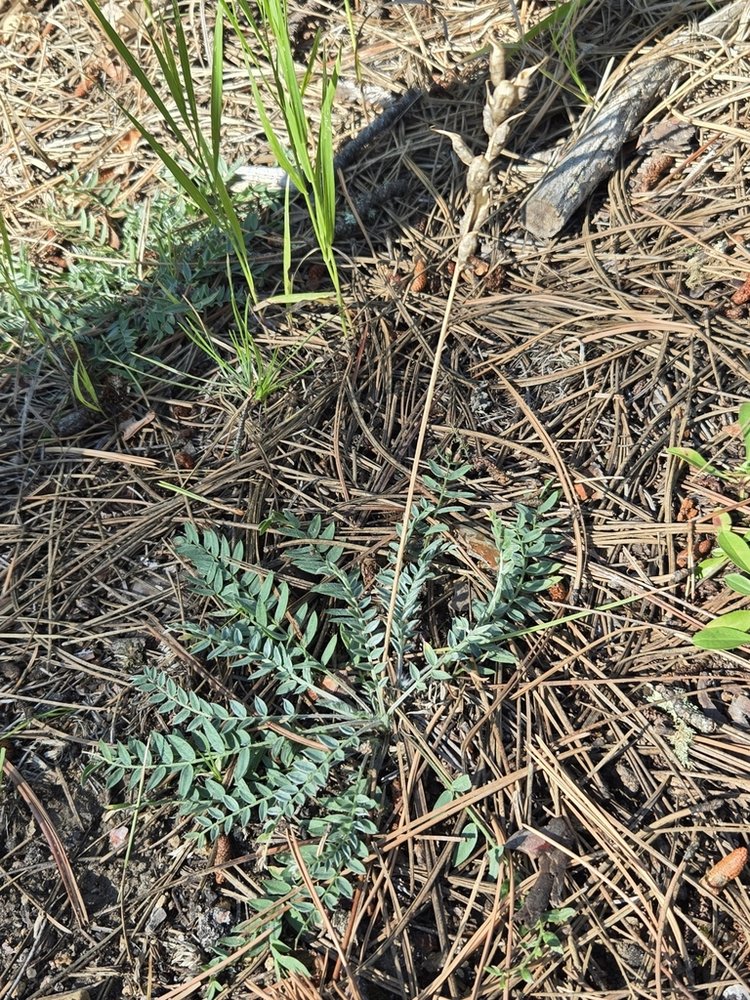
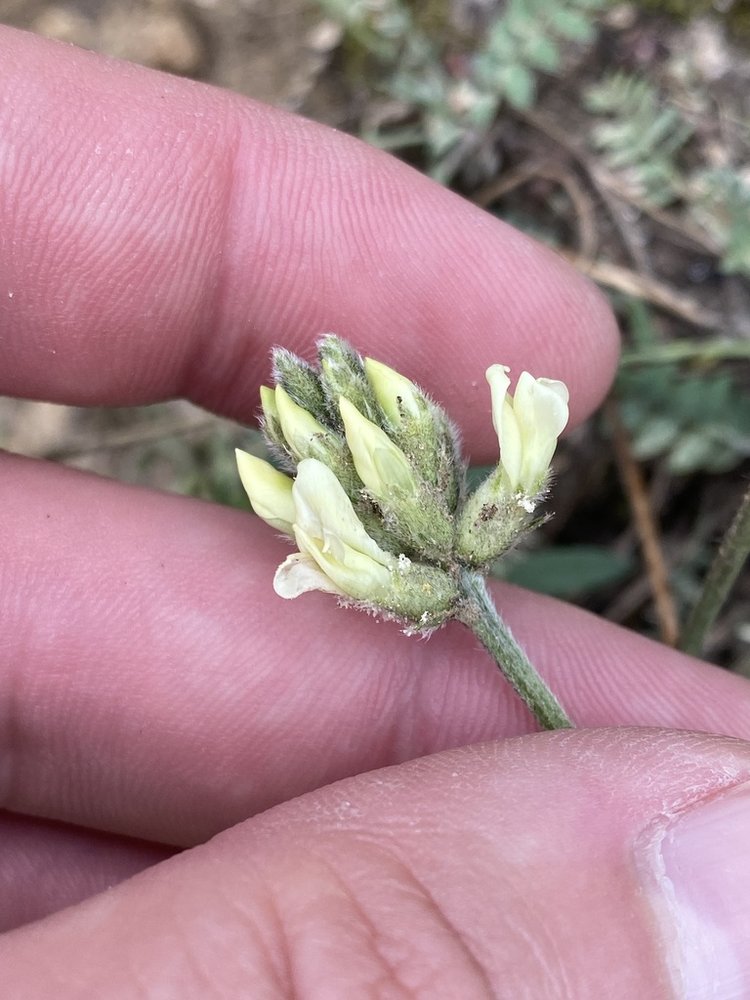
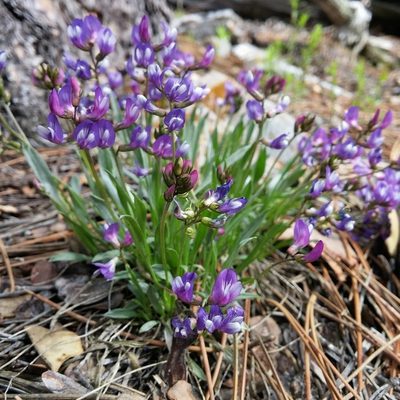
Field Locoweed (Oxytropis campestris) is a native perennial that grows as a stemless tuft 5–30 cm (2–12 in) tall from a deep taproot, with silky gray-green pinnate leaves and leafless hairy stalks topped by a dense spike of cream-white to pale yellow pea flowers whose keel ends in a sharp point. It blooms from April into July on limestone plateaus, high ridges, gravelly slopes, meadows and open ponderosa pine in the Black Hills, where the National Park Service lists it at Wind Cave, Jewel Cave, Mount Rushmore and Devils Tower. Photographed in the Black Hills.
Free photos from other sources
| Family | Fabaceae · Pea |
|---|---|
| Status | Native perennial |
| Blooms | April into July |
| Height | 5–30 cm (2–12 in) |
| Where | Limestone plateaus, high ridges, gravelly slopes, meadows and open ponderosa pine |
| Also called | Slender Crazyweed, Slender Locoweed, Yellow Locoweed, Yellow-flowered Crazyweed, Yellow Loco |
| Synonym | Oxytropis campestris var. spicata, Oxytropis campestris var. gracilis, Oxytropis campestris subsp. gracilis, Oxytropis gracilis, Oxytropis monticola |
| Toxicity | The plant contains swainsonine, an alkaloid that causes loco disease, a nerve disorder, in horses, cattle and sheep that graze it heavily over a long period. |
| Traditional use | Moerman's database lists Cheyenne women using the powdered root of a locoweed (Oxytropis, species not named) to increase milk flow (Grinnell 1972). |
Traditional use: first drafted by Google AI, then checked against the sources on this page.
Roots, seeds & germination
Root: A deep, woody taproot under a branched crown. South Dakota State University notes that the roots host nitrogen-fixing bacteria and that the plant is extremely difficult to propagate vegetatively, from pieces of the plant.
Seed: The pods are oblong, 10–20 mm (⅜–¾ in) long, with a short hooked beak and short hairs, and they ripen from July into September, turning from light green to a brittle dark brownish-black with thin, papery walls. South Dakota State University collects them in August and September once they are dark brown and brittle.
Germination: The seed coat is hard and waterproof. South Dakota State University scuffs the seed with sandpaper and then gives it 30 to 60 days of cold, moist treatment; seed planted in fall sprouts in part the next spring without scuffing. It wants full sun and well-drained gravelly, sandy or coarse loamy soil that is neutral to slightly alkaline.
How do you identify Field Locoweed?
Look for a tuft with no leafy stem: every leaf and flower stalk rises from the crown. The leaves are pinnate, 3–20 cm (1–8 in) long, with 11 to 35 leaflets 5–25 mm (¼–1 in) long that are silky with silvery hairs on both sides, and a papery, finely hairy stipule sits at the base of each leaf. The flowers crowd into a dense spike of 8 to 30 at the top of a hairy, leafless stalk 5–25 cm (2–10 in) tall; each is a pea flower 10–20 mm (⅜–¾ in) long, creamy white to pale yellow, now and then tinged purple, with a calyx covered in mixed white and black hairs. The mark that puts it in the locoweeds rather than the milkvetches is the keel, the lowest pair of petals, which ends in a sharp, abrupt point; on a milkvetch (Astragalus) the keel is rounded or pointed but usually not beaked, and the leaves are arranged along the stems. The pods are 10–20 mm (⅜–¾ in) long with a short hooked beak, and their walls stay thin and papery when dry. White Locoweed, listed at Wind Cave, Jewel Cave and Devils Tower, is the closest look-alike: the Montana Field Guide says the two are most alike, with whitish flowers, but that White Locoweed's pods become bony rather than papery and its flowers run somewhat larger, averaging 15 mm; its banner petal is 16–25 mm (⅝–1 in) and its pod walls thick and rigid. Lambert's Crazyweed has magenta flowers that dry purple and a leathery or woody pod.
When does it bloom?
April into July.
Where does it grow?
Exposed, well-drained, poor ground: limestone ridges and plateaus, gravelly slopes, rocky outcrops, dry short grassland, meadows at the edge of ponderosa pine, open pine ridges and roadsides, and now and then a creek floodplain or moist pine forest with birch, from about 1,340 to 2,210 m (4,400–7,240 ft) on labeled Black Hills specimens. South Dakota State University says that in South Dakota it mainly follows the limestone plateaus, high ridges and gravelly slopes of the Black Hills. The National Park Service lists it at Wind Cave, Jewel Cave, Mount Rushmore and Devils Tower, the 1986 plant survey of Jewel Cave records it, Devils Tower's wildflower list gives it flowering from April to June, and herbarium specimens from 1892 to 2018 come from all seven Black Hills counties, most from Pennington, Lawrence and Custer.
Other milkvetches and locoweeds in this guide
Compare all 12 milkvetches and locoweeds side by side
Barr's Milkvetch
Astragalus barrii
Canada Milkvetch
Astragalus canadensis
Cream Milkvetch
Astragalus racemosus
Drummond's Milkvetch
Astragalus drummondii
Field Milkvetch
Astragalus agrestis
Groundplum Milkvetch
Astragalus crassicarpus
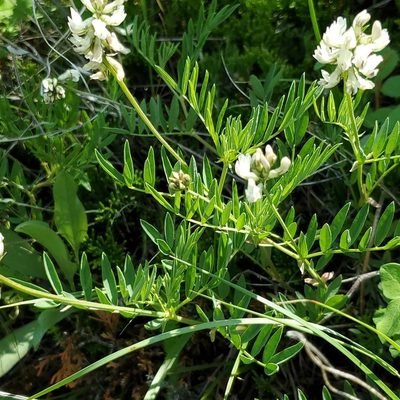
Indian Milkvetch
Astragalus australis
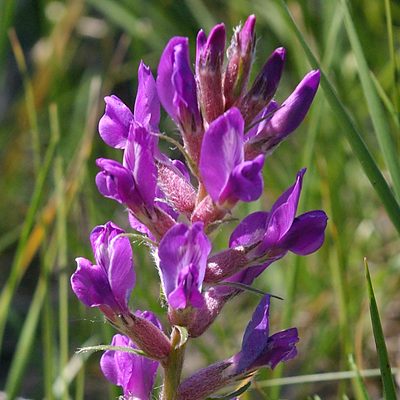
Lambert's Crazyweed
Oxytropis lambertii
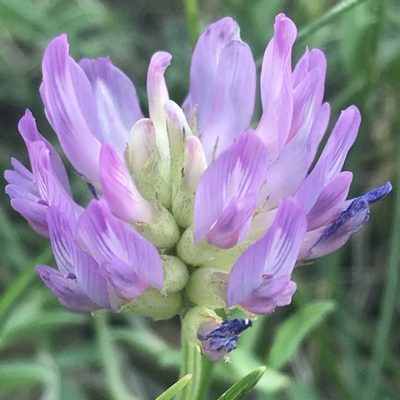
Laxmann's Milkvetch
Astragalus laxmannii var. robustior
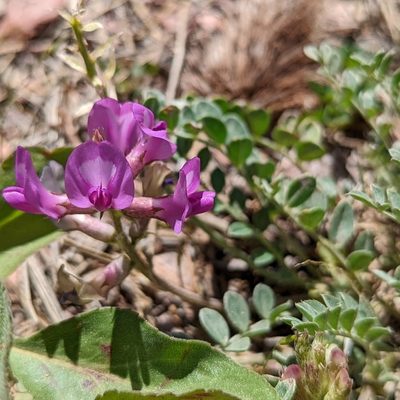
Missouri Milkvetch
Astragalus missouriensis
Tufted Milkvetch
Astragalus spatulatus
Pea family (Fabaceae): 31 other plants in this guide
- Alfalfa
- Alpine Sweetvetch
- American Vetch
- Barr's Milkvetch
- Black Medic
- Canada Milkvetch
- Canada Tickclover
- Cream Milkvetch
- Crown Vetch
- Drummond's Milkvetch
- Field Milkvetch
- Golden Pea
- Groundplum Milkvetch
- Indian Milkvetch
- Lambert's Crazyweed
- Laxmann's Milkvetch
- Lead Plant
- Missouri Milkvetch
- Pale Vetchling
- Prairie Turnip
- Purple Prairie Clover
- Red Clover
- Silktop Dalea
- Silverleaf Scurfpea
- Silvery Lupine
- Slimflower Scurfpea
- Tufted Milkvetch
- White Clover
- White Prairie Clover
- Wild Licorice
- Yellow Sweetclover
Sources: Fabaceae: Oxytropis campestris (R. Neil Reese) — SDSU Open PRAIRIE; Oxytropis campestris — Burke Herbarium Image Collection, University of Washington; Field Locoweed, Oxytropis campestris — Montana Field Guide; Columbia Locoweed, Oxytropis campestris var. columbiana (Oxytropis campestris compared with O. sericea) — Montana Field Guide; White Locoweed, Oxytropis sericea — Montana Field Guide; Purple Locoweed, Oxytropis lambertii — Montana Field Guide; Oxytropis campestris var. spicata — Washington Native Plant Society; Oxytropis lambertii (Lambert's Locoweed) — Minnesota Wildflowers; Ralphs and Stegelmeier, Locoweed Toxicity, Ecology, Control, and Management — USDA ARS Poisonous Plant Research Laboratory; Native Plants, wildflowers by color — Devils Tower National Monument, National Park Service; Oxytropis campestris (L.) DC. (OXCA4) — USDA PLANTS Database; Oxytropis campestris (L.) DC., TSN 26166 — ITIS; NPSpecies checklist, Wind Cave National Park vascular plants — National Park Service; NPSpecies checklist, Jewel Cave National Monument vascular plants — National Park Service; NPSpecies checklist, Mount Rushmore National Memorial vascular plants — National Park Service; NPSpecies checklist, Devils Tower National Monument vascular plants — National Park Service; Marriott and Hartman 1986, A Survey of the Vegetation of Jewel Cave National Monument — NPS History; Oxytropis campestris, South Dakota and Wyoming herbarium specimens — GBIF; Moerman, Native American Ethnobotany database: Oxytropis sp.