Buttercups of the Black Hills
All 3 buttercups in this guide, side by side, A to Z. Compare the photos, bloom time, height and where each grows, then open the one that fits for more photos and the full ID notes. Each plant's page lists its sources.
| Plant | Color | Blooms | Height | Where | How to tell it apart |
|---|---|---|---|---|---|
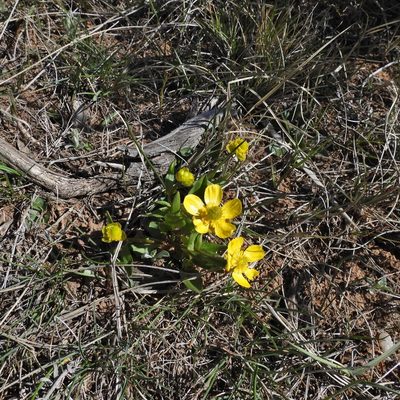 Sagebrush ButtercupRanunculus glaberrimus | Yellow | March into May, one of the earliest wildflowers | 4–15 cm (1½–6 in) | Dry open hillsides, grassland, pine glades and rimrock, and moist seeps and low spots in grassland | Look for a plant a few centimeters tall with hairless stems lying on the ground or rising, each carrying 1 to 4 flowers. Each flower is 1–2 cm (½–¾ in) across with 5 or more yellow petals, about twice as long as the hairless sepals, which are often tinged purple. The basal leaves are hairless, 1–3 cm (½–1¼ in) long, elliptic to spoon-shaped and undivided or with 3 shallow rounded teeth at the tip, while the leaves up the stem are deeply lobed. After bloom each flower leaves a rounded seed head 5–10 mm high made of many tiny, finely hairy seeds, each with a short beak. It is one of the earliest wildflowers to bloom. |
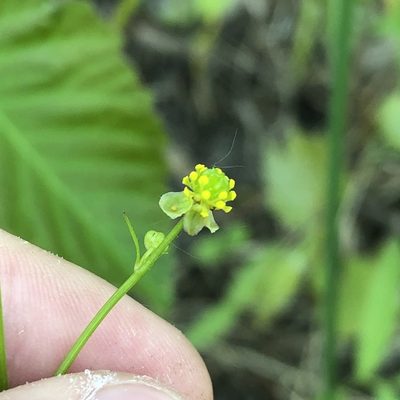 Small-flowered ButtercupRanunculus abortivus | Yellow | May into July | 10–60 cm (4–24 in) | Moist, shaded woods, stream banks, clearings and ditches | Look for a nearly hairless, hollow stem, often branched above, that carries many tiny flowers only 4–6 mm (⅛–¼ in) across. Each has 5 spreading, greenish-yellow sepals with pale margins and 5 golden-yellow petals that are shorter than the sepals and fade whitish, so the flower does not look much like a typical buttercup. The long-stalked lower leaves are kidney- or heart-shaped with scalloped edges, 1.4–4.2 cm by 2–5.2 cm, while the stem leaves are cut into 3–5 lobes and the upper ones are divided to the base into narrow segments. The fruit is a small, egg-shaped head of 10–50 tiny, shiny achenes. |
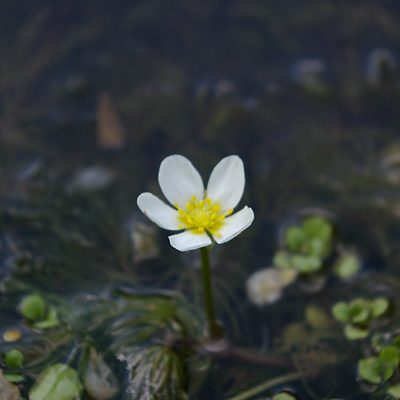 White Water CrowfootRanunculus aquatilis | White | June into October; Black Hills herbarium specimens are in flower from early June to late October | Flowers stand 2–15 cm (1–6 in) above the water; stems trail underwater | Cool creeks, springs, ponds, beaver ponds and small reservoirs, in still or flowing water | Look for white, buttercup-shaped flowers dotting the surface of a creek or pond, each on its own stalk from a leaf joint, with nothing but fine green threads below. Each flower is 8–17 mm (⅓–⅔ in) across, with 5 white petals that are yellow at the base, many yellow stamens around a yellow center, and 5 short green sepals behind. The leaves are cut into many thread-like segments, round to fan-shaped in outline and up to about 2 cm (¾ in) long, and they all stay underwater. Flora of North America separates a western form, var. aquatilis, recorded in Wyoming and Montana but not South Dakota, which also has flat, kidney-shaped, 3-parted leaves floating on the surface; the plants recorded in South Dakota, var. diffusus, have thread-like leaves only. After bloom the flower stalk usually bends back, and the center becomes a small round head of tiny beaked fruits. |
Other look-alike groups: 38 groups
- Anemones (4)
- Asters (4)
- Beardtongues (5)
- Cacti (4)
- Cinquefoils (7)
- Clovers (6)
- Coneflowers (4)
- Currants and gooseberries (5)
- Daisies (5)
- Dandelions (3)
- Docks and buckwheats (4)
- Evening primroses (4)
- Ferns (4)
- Gentians (4)
- Grasses (11)
- Groundsels and ragworts (3)
- Lilies (5)
- Mayflowers and false Solomon's seals (3)
- Milkvetches and locoweeds (12)
- Milkweeds (6)
- Mints (8)
- Mustards (11)
- Orchids (8)
- Paintbrushes (3)
- Pines (3)
- Raspberries and thimbleberries (3)
- Sagebrushes and sageworts (3)
- Sedges (3)
- Speedwells and kittentails (3)
- Sunflowers (4)
- Thistles (6)
- Vervains (3)
- Vetches (4)
- Violets (7)
- Wild lettuces (3)
- Wild onions (3)
- Wild plums and cherries (3)
- Willows (3)