Small-flowered Buttercup Ranunculus abortivus
Also called Littleleaf Buttercup, Kidney-leaf Buttercup, Early Wood Buttercup, Small-flowered Crowfoot
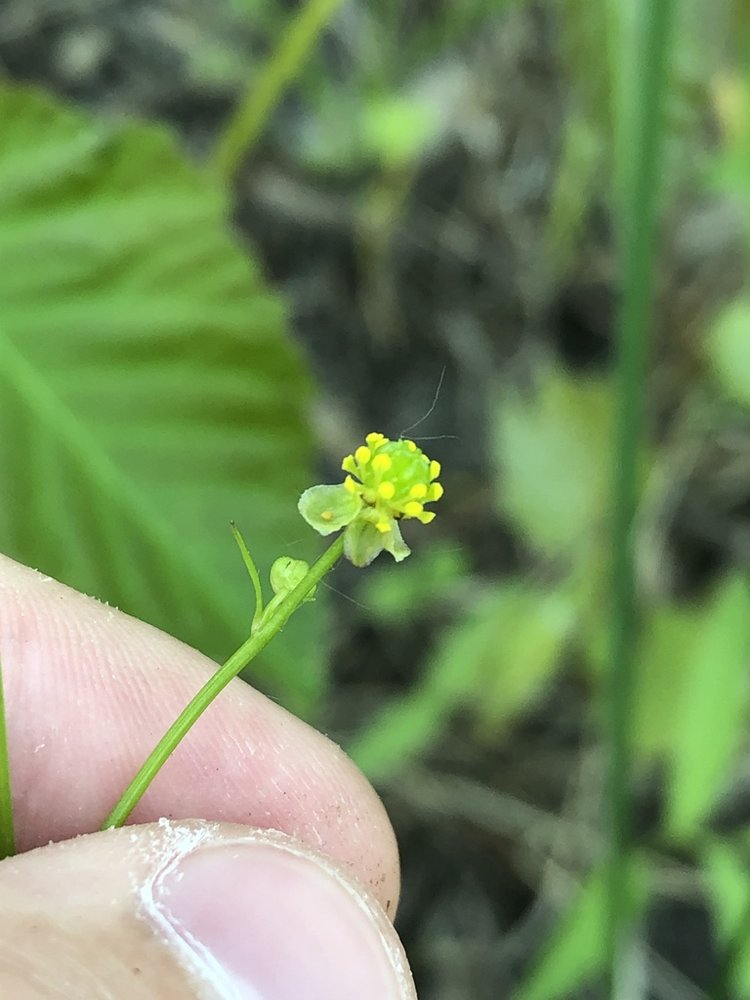
Small-flowered Buttercup (Ranunculus abortivus) is a native biennial or short-lived perennial with tiny golden-yellow flowers, whose petals are shorter than the sepals, and kidney-shaped lower leaves. It blooms from May into July in moist woods, along stream banks and in clearings, and in the Black Hills the National Park Service lists it at Wind Cave National Park, Mount Rushmore National Memorial and Devils Tower National Monument.
Free photos from other sources
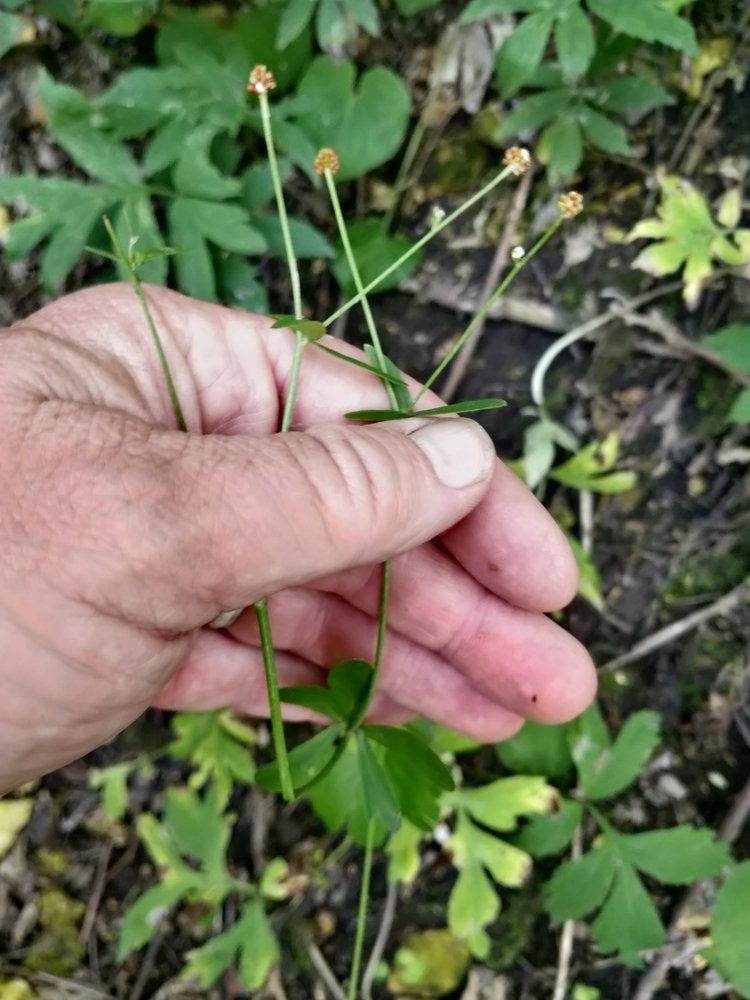
| Family | Ranunculaceae · Buttercup |
|---|---|
| Status | Native biennial or short-lived perennial |
| Blooms | May into July |
| Height | 10–60 cm (4–24 in) |
| Where | Moist, shaded woods, stream banks, clearings and ditches |
| Also called | Littleleaf Buttercup, Kidney-leaf Buttercup, Early Wood Buttercup, Small-flowered Crowfoot |
| Toxicity | The Lady Bird Johnson Wildflower Center lists all parts as poisonous, with low toxicity if eaten, and says the sap can irritate the skin of susceptible people. |
| Traditional use | Moerman's database records that the Cherokee cooked the leaves and ate them as greens, used a poultice for abscesses, gargled an infusion for sore throat and took the juice as a sedative (Hamel and Chiltoskey 1975). It also records that the Iroquois took root decoctions for stomach trouble, to counteract poison and for epilepsy (Herrick 1977), and that the Meskwaki used the root as a styptic for nosebleeds (Smith 1928). |
Traditional use: first drafted by Google AI, then checked against the sources on this page.
Roots, seeds & germination
Root: The roots are thread-like, 0.5–1.5 mm thick, sometimes swollen at the base (Flora of North America).
Seed: The achenes are 1.4–1.6 mm long and hairless, each with a short, curved beak, and 10–50 of them form an egg-shaped head 3–6 mm long (Flora of North America).
How do you identify Small-flowered Buttercup?
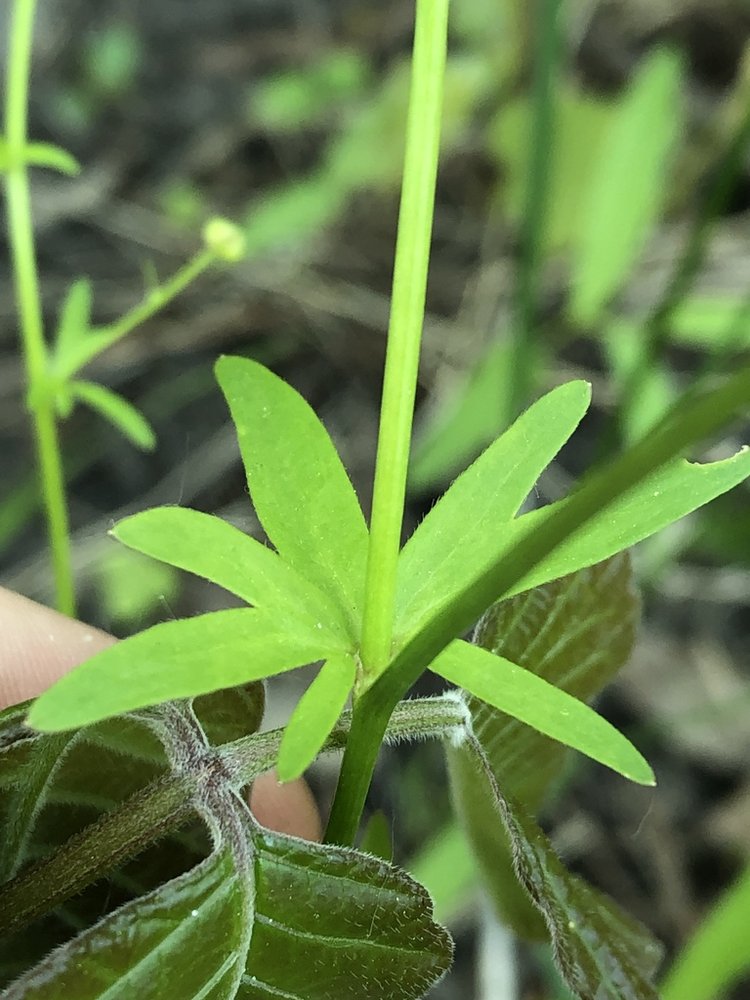
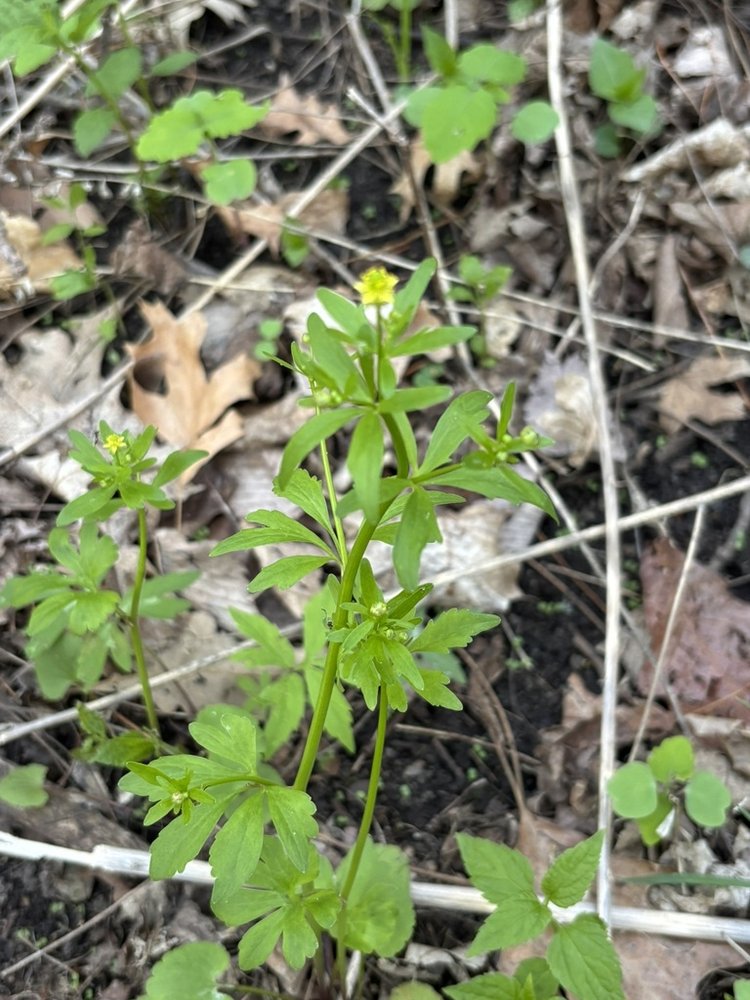
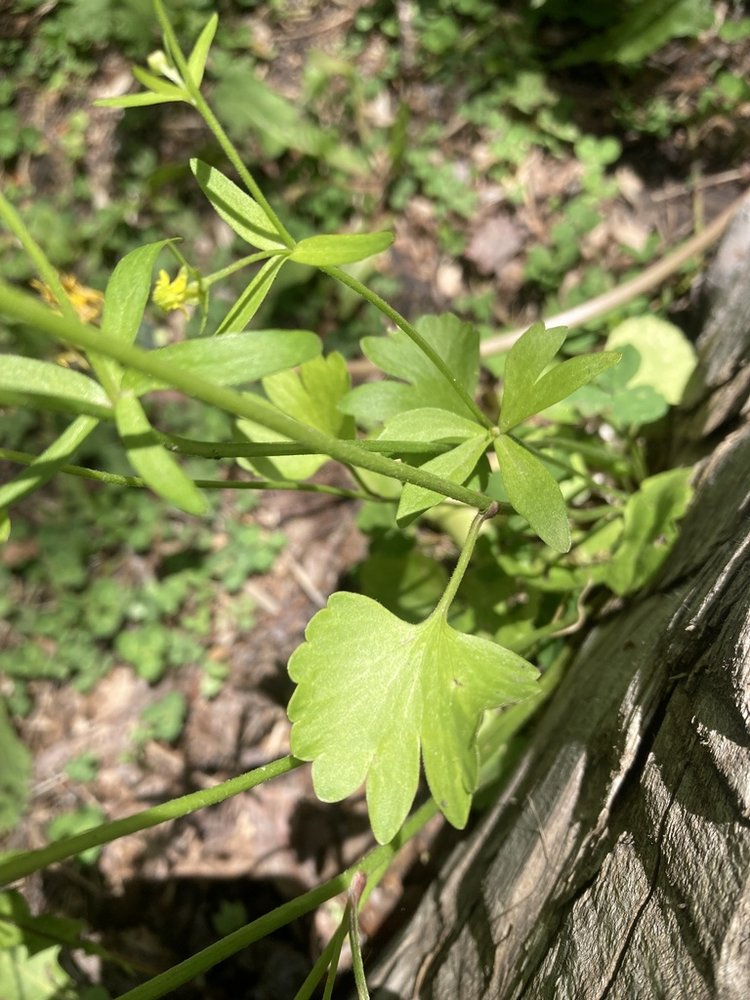
Look for a nearly hairless, hollow stem, often branched above, that carries many tiny flowers only 4–6 mm (⅛–¼ in) across. Each has 5 spreading, greenish-yellow sepals with pale margins and 5 golden-yellow petals that are shorter than the sepals and fade whitish, so the flower does not look much like a typical buttercup. The long-stalked lower leaves are kidney- or heart-shaped with scalloped edges, 1.4–4.2 cm by 2–5.2 cm, while the stem leaves are cut into 3–5 lobes and the upper ones are divided to the base into narrow segments. The fruit is a small, egg-shaped head of 10–50 tiny, shiny achenes.
When does it bloom?
May into July.
Where does it grow?
Moist, shaded ground: damp woods, woodland borders and clearings, stream banks, ditches and roadsides (Kansas Wildflowers, Flora of North America). Black Hills herbarium labels describe white spruce and ponderosa pine forest in canyon drainages, moist and wet streamsides and creek floodplains, and a spring-fed pond edge. The National Park Service lists it at Wind Cave, Mount Rushmore and Devils Tower, and GBIF holds 64 herbarium specimens from Pennington, Lawrence, Crook, Custer, Meade and Weston counties, collected between 1892 and 2013.
Other buttercups in this guide
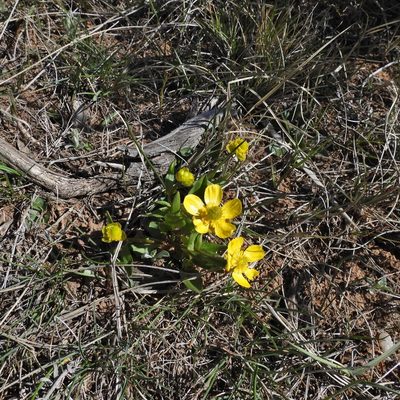
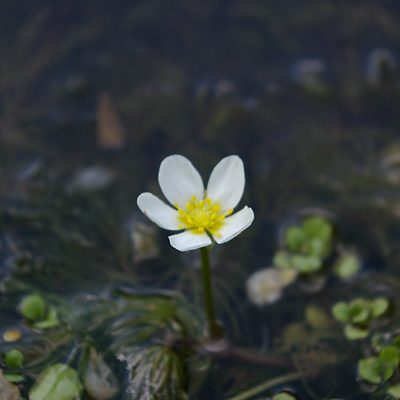
Buttercup family (Ranunculaceae): 15 other plants in this guide
Sources: Flora of North America Vol. 3: Ranunculus abortivus (Linnaeus), eFloras; Kansas Wildflowers and Grasses: Early wood buttercup (Ranunculus abortivus); Lady Bird Johnson Wildflower Center: Ranunculus abortivus (Littleleaf Buttercup); USDA PLANTS Database: Ranunculus abortivus (RAAB); NPSpecies checklist, Wind Cave National Park vascular plants; NPSpecies checklist, Mount Rushmore National Memorial vascular plants; NPSpecies checklist, Devils Tower National Monument vascular plants; GBIF occurrence search: Ranunculus abortivus herbarium specimens, South Dakota and Wyoming; GBIF specimen 2859430834: Black Hills National Forest 2013, floodplain of a creek and coniferous forest; GBIF specimen 2859136878: Black Hills National Forest 2013, mesic coniferous forest; Native American Ethnobotany Database (BRIT): Ranunculus abortivus; South Dakota locally noxious weed list, updated 2024 (DANR); Wyoming Weed and Pest Council: Designated Weed List.