Plains Larkspur Delphinium carolinianum subsp. virescens
Also called Prairie Larkspur, White Larkspur, wanáǧi thíŋpsila (Lakota)
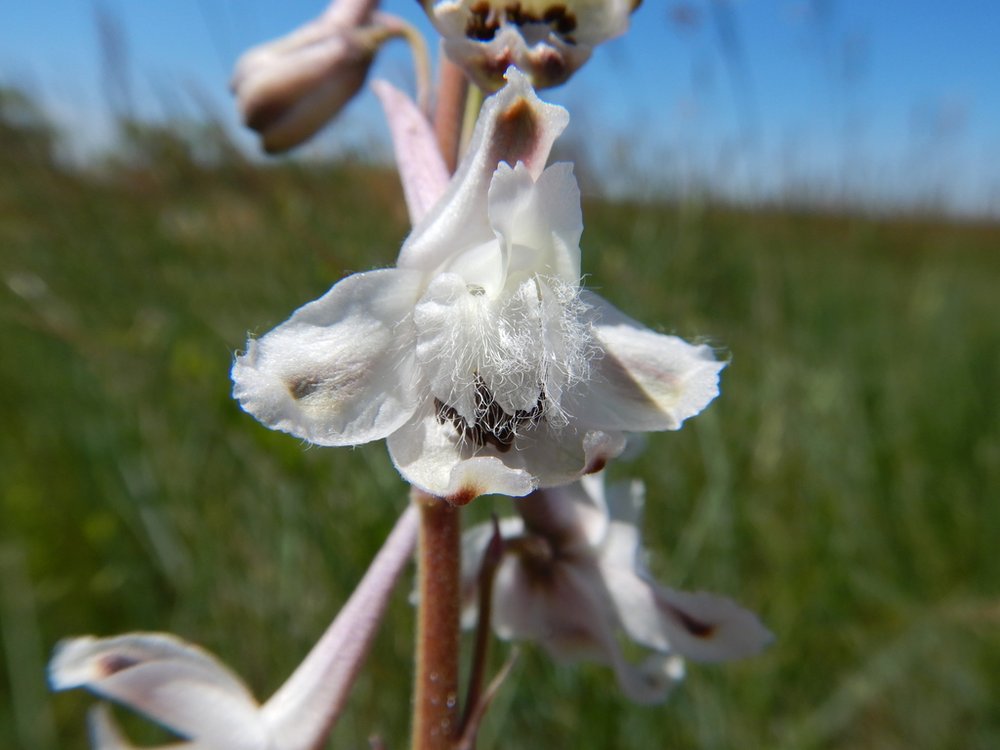
Plains Larkspur (Delphinium carolinianum subsp. virescens) is a native perennial with a tall, narrow spike of white, spurred flowers, sometimes tinged with blue, that blooms in May and June on prairies and pastures in South Dakota. Herbarium specimens record it in Pennington and Custer counties, east and southeast of the Black Hills.
Free photos from other sources
| Family | Ranunculaceae · Buttercup |
|---|---|
| Status | Native perennial |
| Blooms | May and June |
| Height | 25–120 cm (10–47 in) |
| Where | Prairies and pastures |
| Also called | Prairie Larkspur, White Larkspur, wanáǧi thíŋpsila (Lakota) |
| Synonym | Delphinium virescens, Delphinium albescens, Delphinium penardii |
| Toxicity | Prairie larkspur is poisonous to cattle, which find it palatable, and all parts of the plant are toxic, whether fresh or dried in hay (Kansas Wildflowers and Grasses). |
| Traditional use | The Lakota plant guide by Black Elk and Flying By (1998) lists it as wanáǧi thíŋpsila and says a tincture of the flowers or seeds was mixed with shampoo to get rid of lice. Rogers' 1980 study of Sicangu (Brule) Lakota plant names, as recorded in Moerman's database, notes it as poisonous to cattle. The Kiowa used the small seeds in peyote rattles (Vestal and Schultes 1939, via Moerman's database). |
Traditional use: first drafted by Google AI, then checked against the sources on this page.
Roots, seeds & germination
Root: Open PRAIRIE describes a fibrous to tuberous root system; Missouri Plants says the roots are fibrous, sometimes stout, and not tuberous.
Seed: Missouri Plants gives the seeds as scaly and 1.4–2.0 mm long. The pods turn brown and begin to open in June and July, according to Open PRAIRIE.
Germination: Open PRAIRIE says the seeds need 60 days of cold, moist treatment for spring planting, or can be sown in fall.
How do you identify Plains Larkspur?
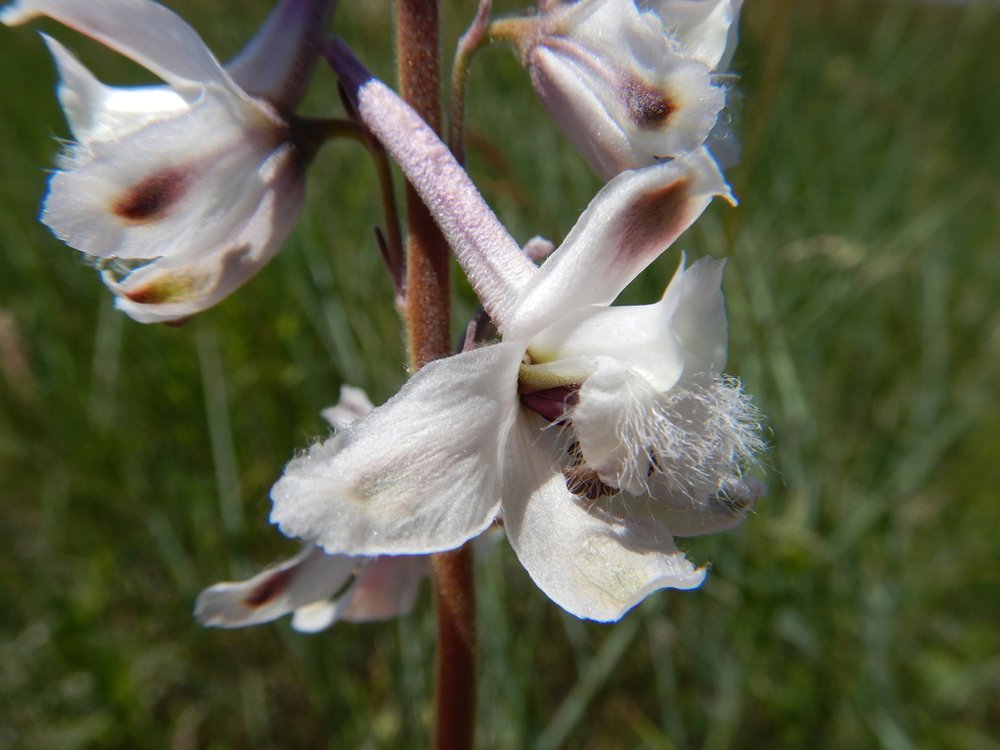
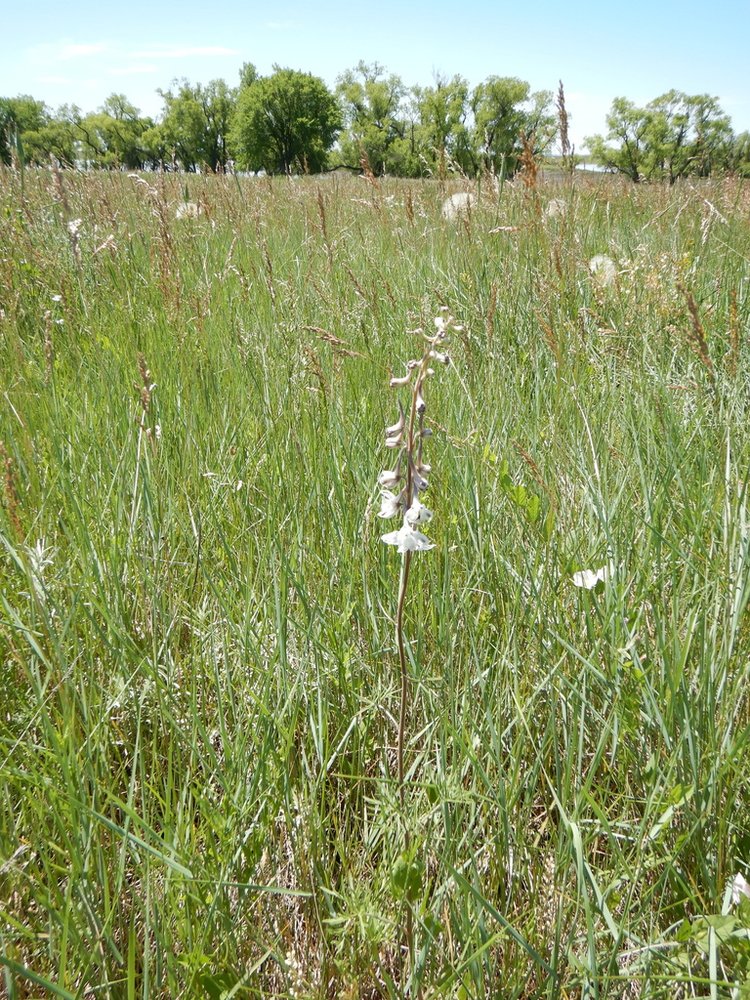
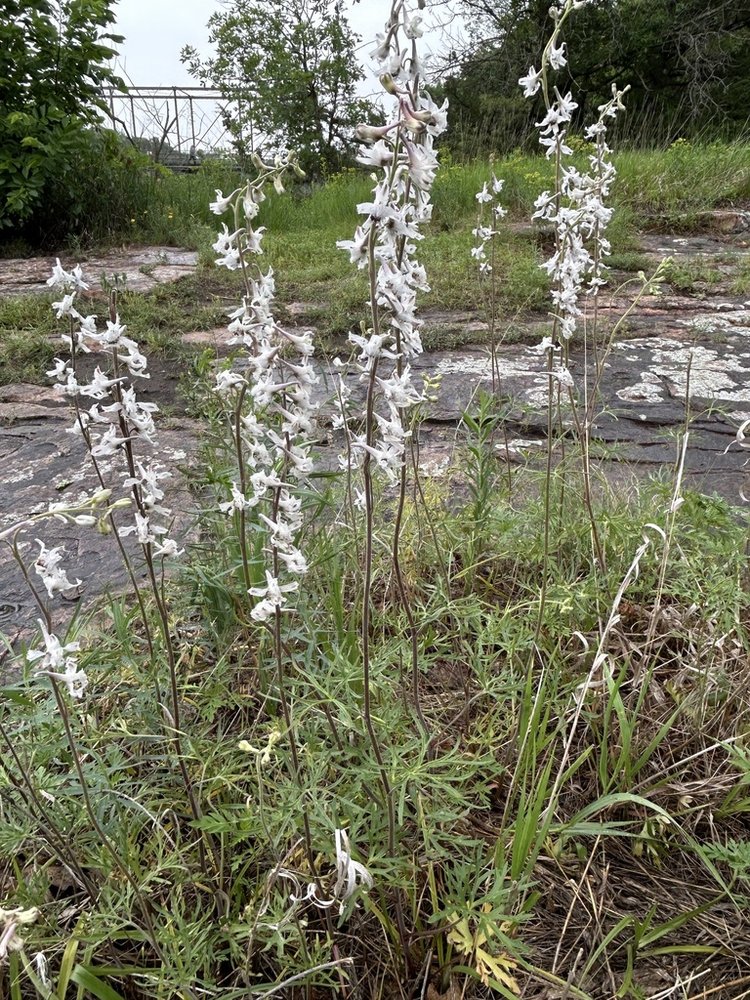
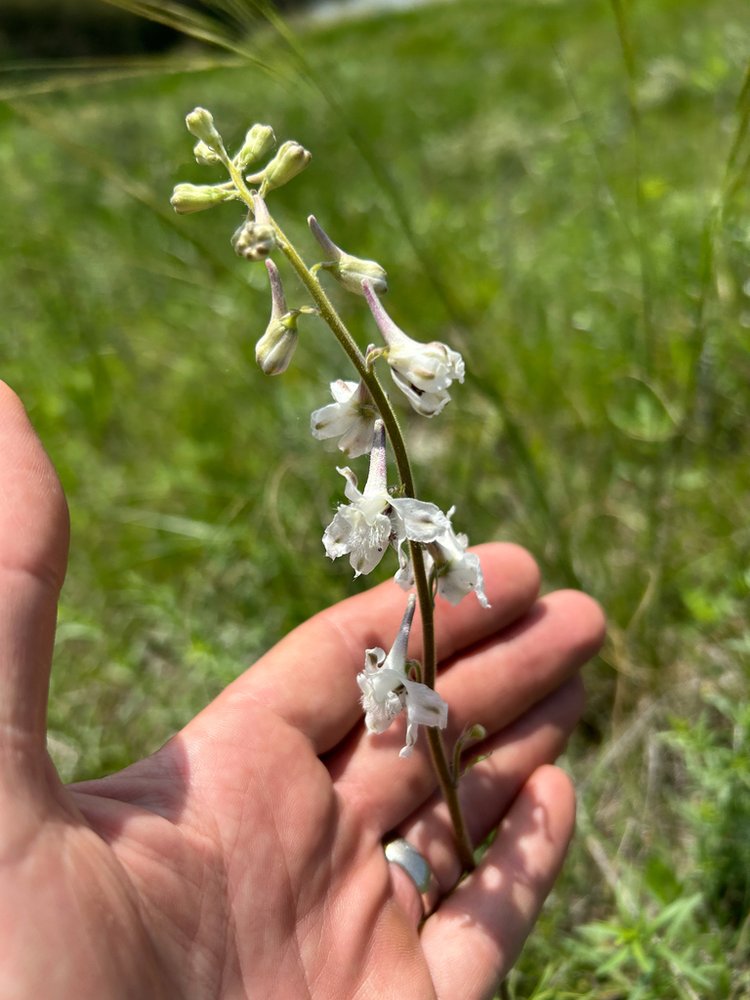
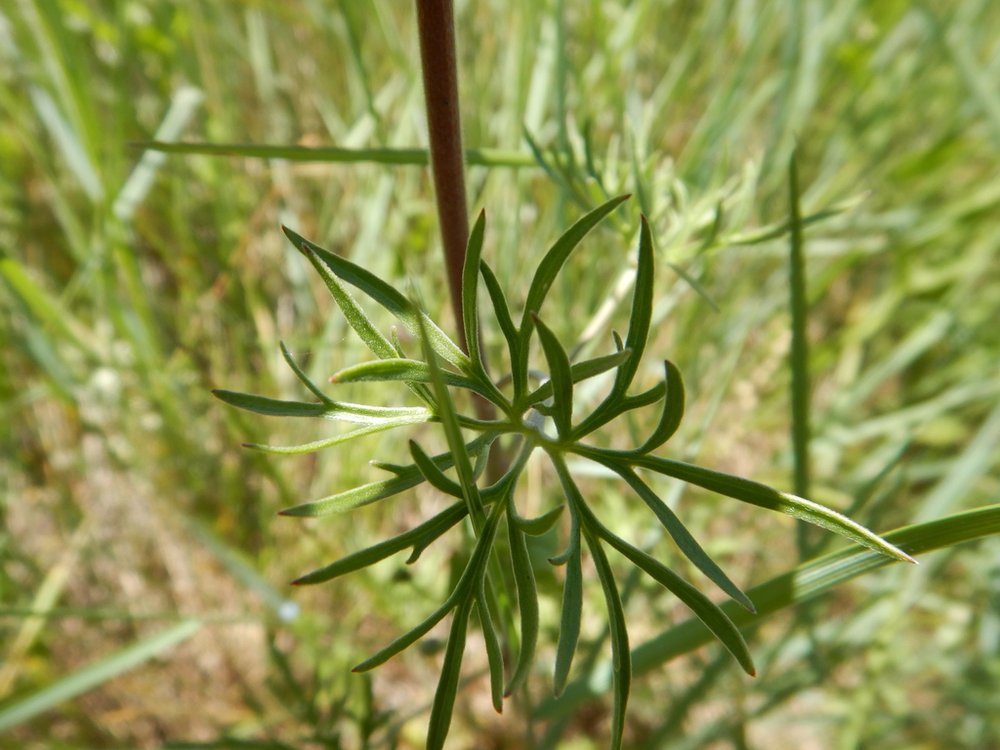
Look for an erect, hairy stem 25–120 cm (10–47 in) tall, sometimes branched, topped by a narrow, spike-like cluster of 5 to 30 flowers. The flowers are white, sometimes tinged with blue or green, and sit on short stalks held close to the stem, which gives the spike a rumpled look. Each flower has 5 petal-like sepals, and the top one ends in a backward-pointing spur 11–20 mm (about ½–¾ in) long; the 4 small true petals are white, and the lower pair are cleft and bearded. The leaves are deeply cut into narrow, linear segments. Lower leaves have long stalks and are usually gone by flowering, and the stem leaves are smaller. The fruit is a group of 3 pods about 20 mm (¾ in) long.
When does it bloom?
May and June.
Where does it grow?
Prairies and pastures. Open PRAIRIE says it grows on prairies and pastures throughout South Dakota, and Kansas Wildflowers adds hillsides. Herbarium specimens in GBIF come from Pennington County (1951 to 1996) and Custer County (2008), east and southeast of the Black Hills. Badlands National Park's plant list includes it. No specimen from Lawrence, Meade or Fall River counties in South Dakota or Crook or Weston counties in Wyoming turned up in GBIF, and the plant lists for Wind Cave, Jewel Cave, Mount Rushmore and Devils Tower don't name it.
Other larkspurs in this guide
Buttercup family (Ranunculaceae): 15 other plants in this guide
Sources: Open PRAIRIE, South Dakota Native Plant Research: Ranunculaceae, Delphinium carolinianum ssp. virescens (Reese, SDSU); Kansas Wildflowers and Grasses: Prairie larkspur, Delphinium carolinianum subsp. virescens; Missouri Plants: Delphinium carolinianum ssp. virescens, Prairie Larkspur; USDA PLANTS: Delphinium carolinianum ssp. virescens (symbol DECAV2), profile data; ITIS: Delphinium carolinianum ssp. virescens (TSN 523944), accepted name, synonyms and common names; Black Elk and Flying By 1998, Ethnobotany of the Oceti Sakowin (Sitting Bull College), entry 104; Native American Ethnobotany Database (BRIT): Delphinium carolinianum ssp. virescens, 2 uses; GBIF: preserved specimens of Delphinium carolinianum subsp. virescens, South Dakota and Wyoming; NPSpecies checklist, Badlands National Park vascular plants; NPSpecies checklist, Wind Cave National Park vascular plants; NPSpecies checklist, Jewel Cave National Monument vascular plants; NPSpecies checklist, Mount Rushmore National Memorial vascular plants; NPSpecies checklist, Devils Tower National Monument vascular plants.