Sagebrush Buttercup Ranunculus glaberrimus
Also called Shiny-leaved Buttercup, Early Buttercup, Elliptical Buttercup
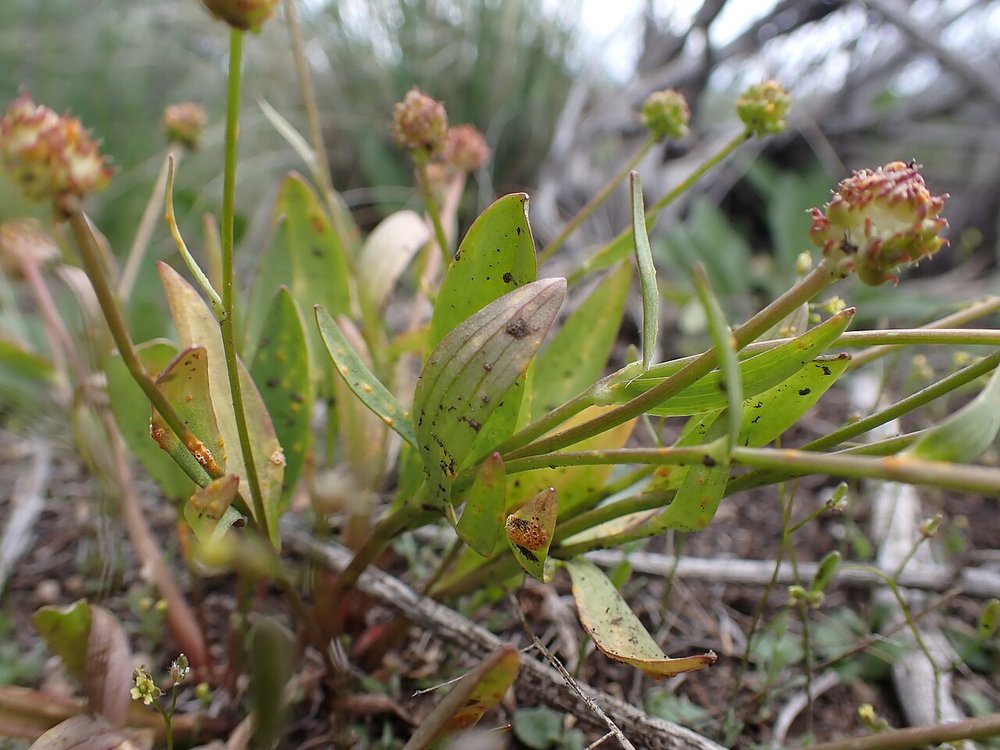
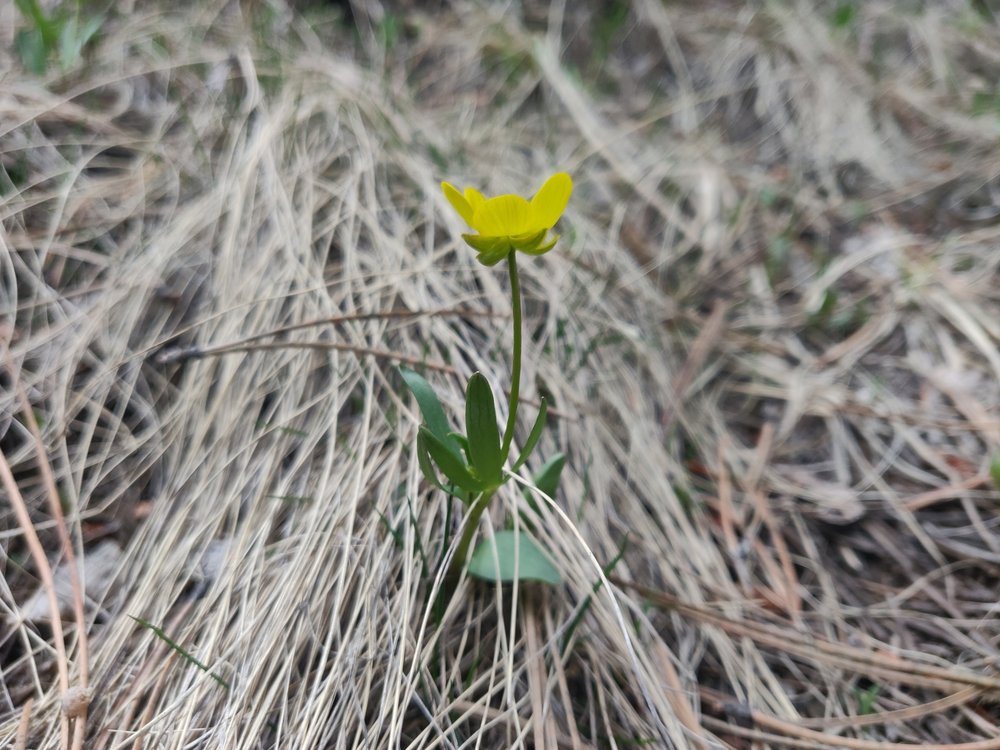
Sagebrush Buttercup (Ranunculus glaberrimus) is a native perennial only 4–15 cm (1½–6 in) tall that opens yellow flowers 1–2 cm (½–¾ in) across, usually with five petals, from March into May, one of the earliest wildflowers of spring. Its basal leaves are spoon-shaped to narrowly elliptic and usually undivided, and in the Black Hills it grows on open hillsides, in pine glades and in grassland, where the National Park Service lists it at Wind Cave and Devils Tower.
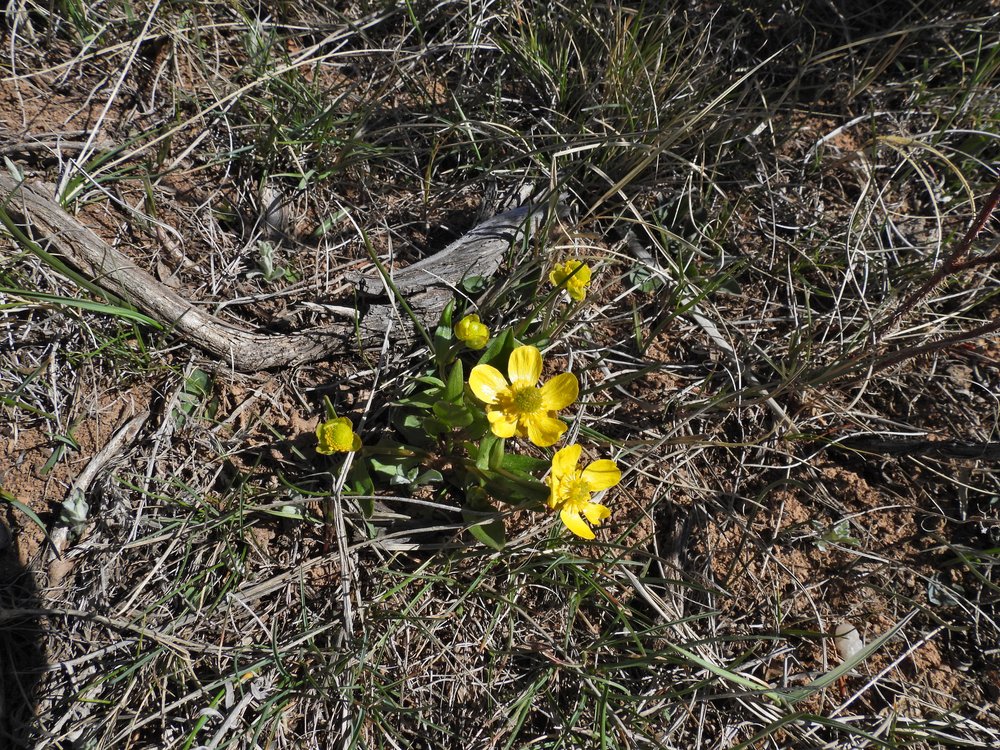
Free photos from other sources
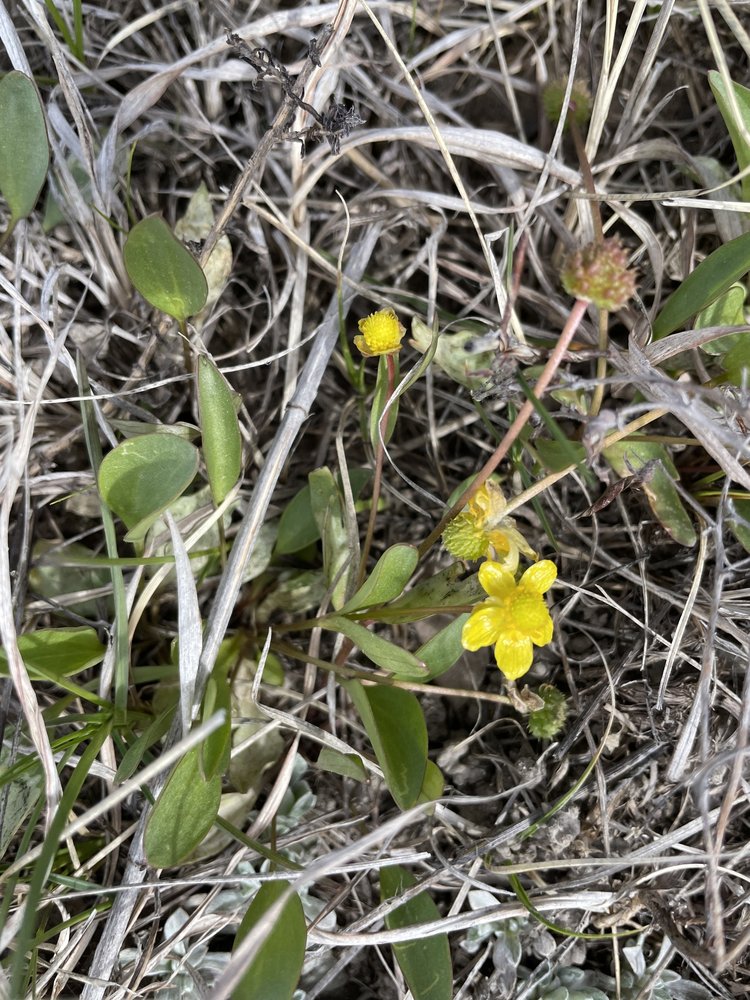
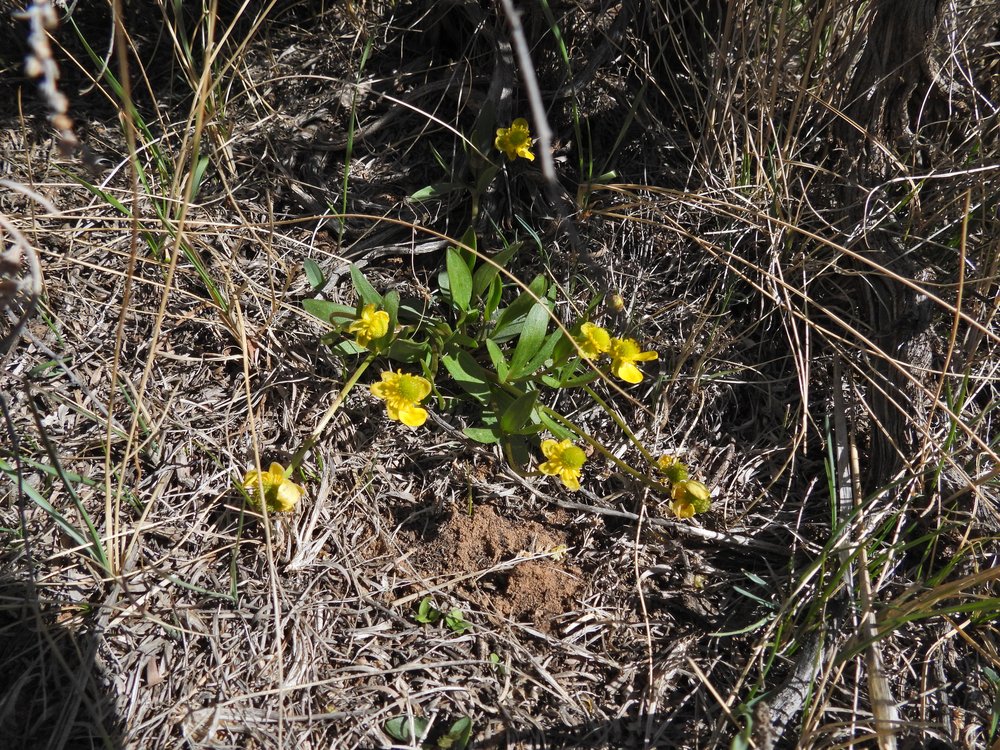
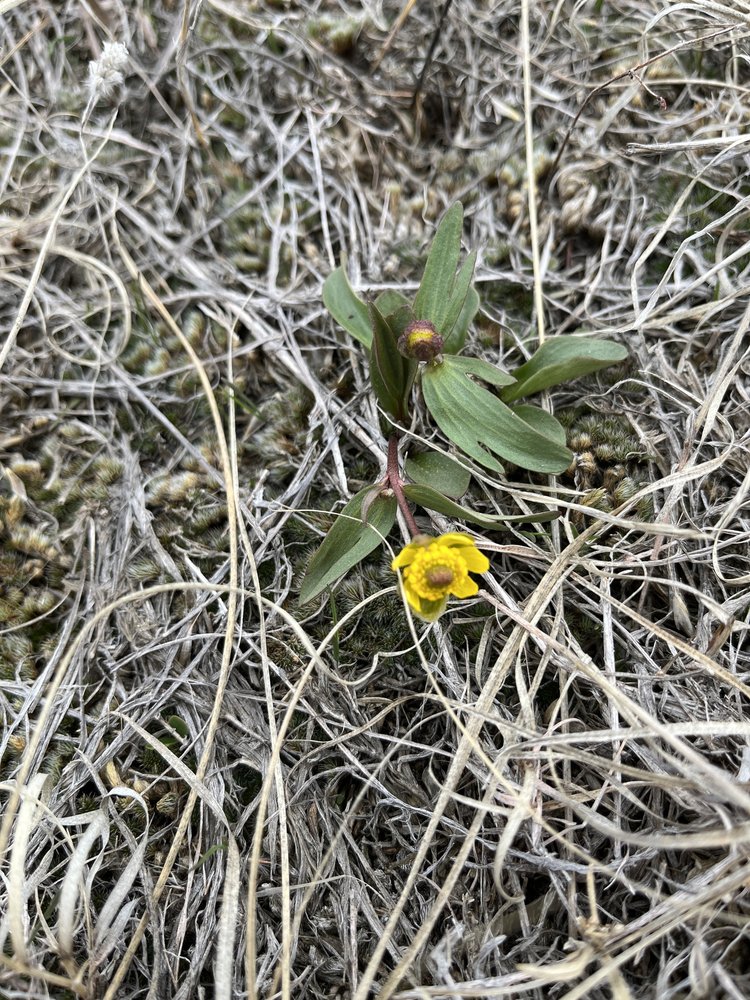
| Family | Ranunculaceae · Buttercup |
|---|---|
| Status | Native perennial |
| Blooms | March into May, one of the earliest wildflowers |
| Height | 4–15 cm (1½–6 in) |
| Where | Dry open hillsides, grassland, pine glades and rimrock, and moist seeps and low spots in grassland |
| Also called | Shiny-leaved Buttercup, Early Buttercup, Elliptical Buttercup |
| Synonym | Ranunculus ellipticus |
| Toxicity | All buttercups have an acrid taste and, depending on the species, plant part and season, may be toxic to cattle and horses; the toxins are lost as the plant dries, so it is not toxic in hay. |
| Traditional use | Flora of North America, citing Moerman's 1986 survey, says the Thompson people rubbed the flowers or the whole plant on arrow points as a poison. |
Roots, seeds & germination
Root: A cluster of fleshy, fibrous roots 2–3 mm thick. It spreads by seed, by root sprouts and by division of older plants.
Seed: Each flower makes a round head 7–12 mm long of 30 to 180 small, finely hairy, one-seeded fruits, each 1.4–2.2 mm long with a short straight or curved beak, though usually fewer than half of them develop. Whether the seed lasts in the soil was not known as of 2012.
How do you identify Sagebrush Buttercup?
Look for a plant a few centimeters tall with hairless stems lying on the ground or rising, each carrying 1 to 4 flowers. Each flower is 1–2 cm (½–¾ in) across with 5 or more yellow petals, about twice as long as the hairless sepals, which are often tinged purple. The basal leaves are hairless, 1–3 cm (½–1¼ in) long, elliptic to spoon-shaped and undivided or with 3 shallow rounded teeth at the tip, while the leaves up the stem are deeply lobed. After bloom each flower leaves a rounded seed head 5–10 mm high made of many tiny, finely hairy seeds, each with a short beak. It is one of the earliest wildflowers to bloom.
When does it bloom?
March into May, one of the earliest wildflowers.
Where does it grow?
Open hillsides, grassland, pine glades and rimrock, and moist seeps and low spots in grassland, from the plains into the mountains. The National Park Service lists it at Wind Cave and Devils Tower as var. ellipticus, the variety with elliptic, usually undivided basal leaves, and Devils Tower gives its bloom as March and April. Herbarium specimens from 1887 to 1997 come from Lawrence, Pennington, Custer and Meade counties and from Crook County, Wyoming: a hillside, rimrock in open pine, a pine glade and a moist wood edge in Lawrence County; a creek floodplain on moist, rocky gravel and an upland at 1,829 m (6,000 ft) in Pennington County; the edge of a watercourse in Custer County; a creek bank in bur oak shade in Meade County; and a moist sunny meadow, an open prairie hillside and a cool, rocky open summit in Crook County. The labels show it in flower from April to late May, with one in June. iNaturalist has 8 research-grade Black Hills records, 6 of them in April.
Other buttercups in this guide
Buttercup family (Ranunculaceae): 15 other plants in this guide
Sources: Flora of North America Vol. 3: Ranunculus glaberrimus (Whittemore), eFloras; Flora of North America Vol. 3: Ranunculus glaberrimus var. ellipticus, eFloras; Flora of North America Vol. 3: Ranunculus glaberrimus var. glaberrimus, eFloras; USDA Forest Service Fire Effects Information System: Ranunculus glaberrimus (Fryer 2012); Montana Field Guide: Sagebrush Buttercup, Ranunculus glaberrimus; NPS Devils Tower National Monument, Wildflowers (bloom months); NPSpecies checklist, Wind Cave National Park vascular plants; NPSpecies checklist, Devils Tower National Monument vascular plants; USDA PLANTS Database: Ranunculus glaberrimus (RAGL), profile API; GBIF occurrence search: Ranunculus glaberrimus, South Dakota and Wyoming herbarium specimens; iNaturalist: research-grade Ranunculus glaberrimus observations in the Black Hills.