White Water Crowfoot Ranunculus aquatilis also listed as Ranunculus aquatilis var. diffusus
Also called White Water Crowsfoot, Water Crowfoot, Water Buttercup, Long-beak Buttercup, Threadleaf Crowfoot
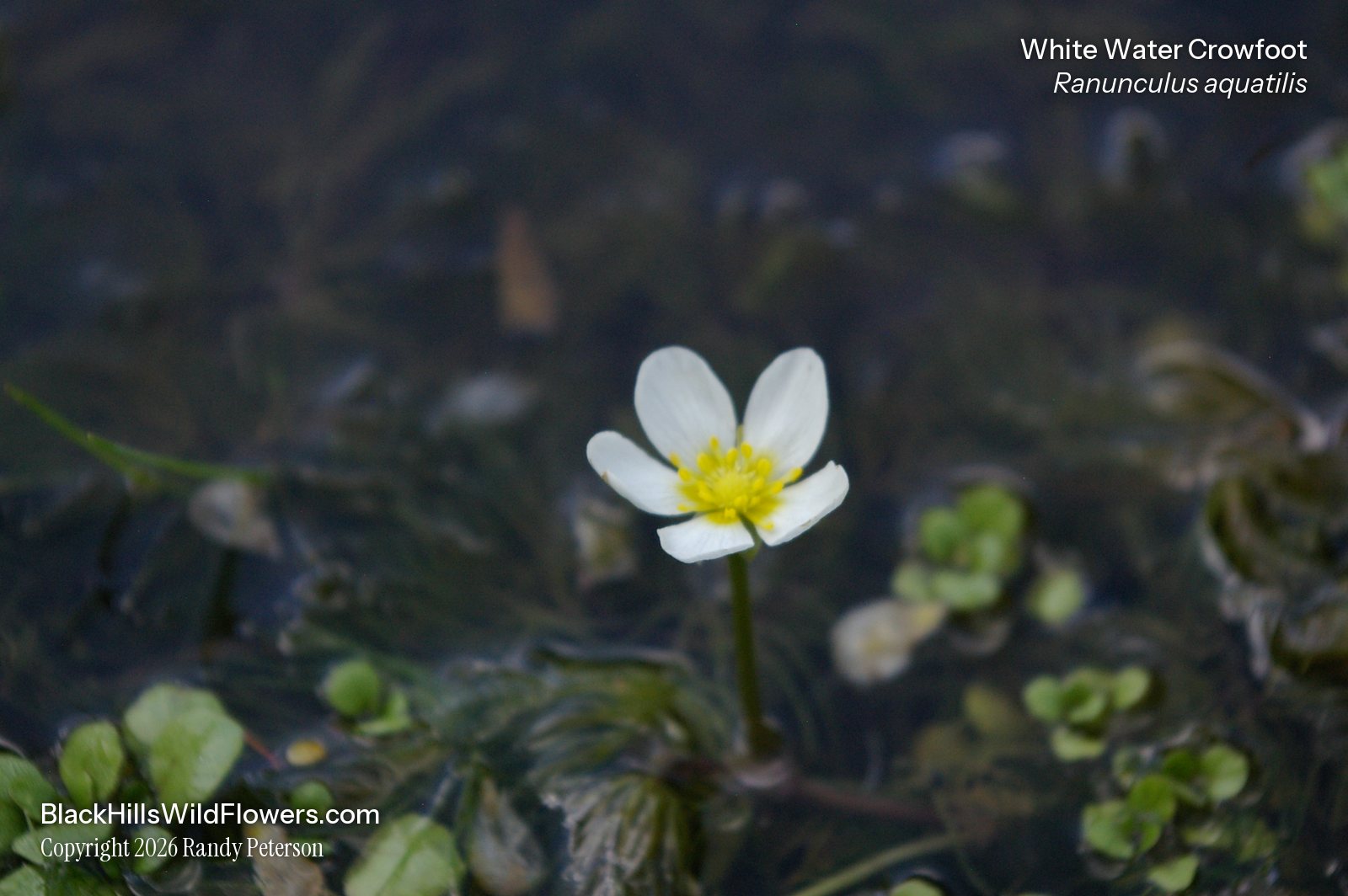
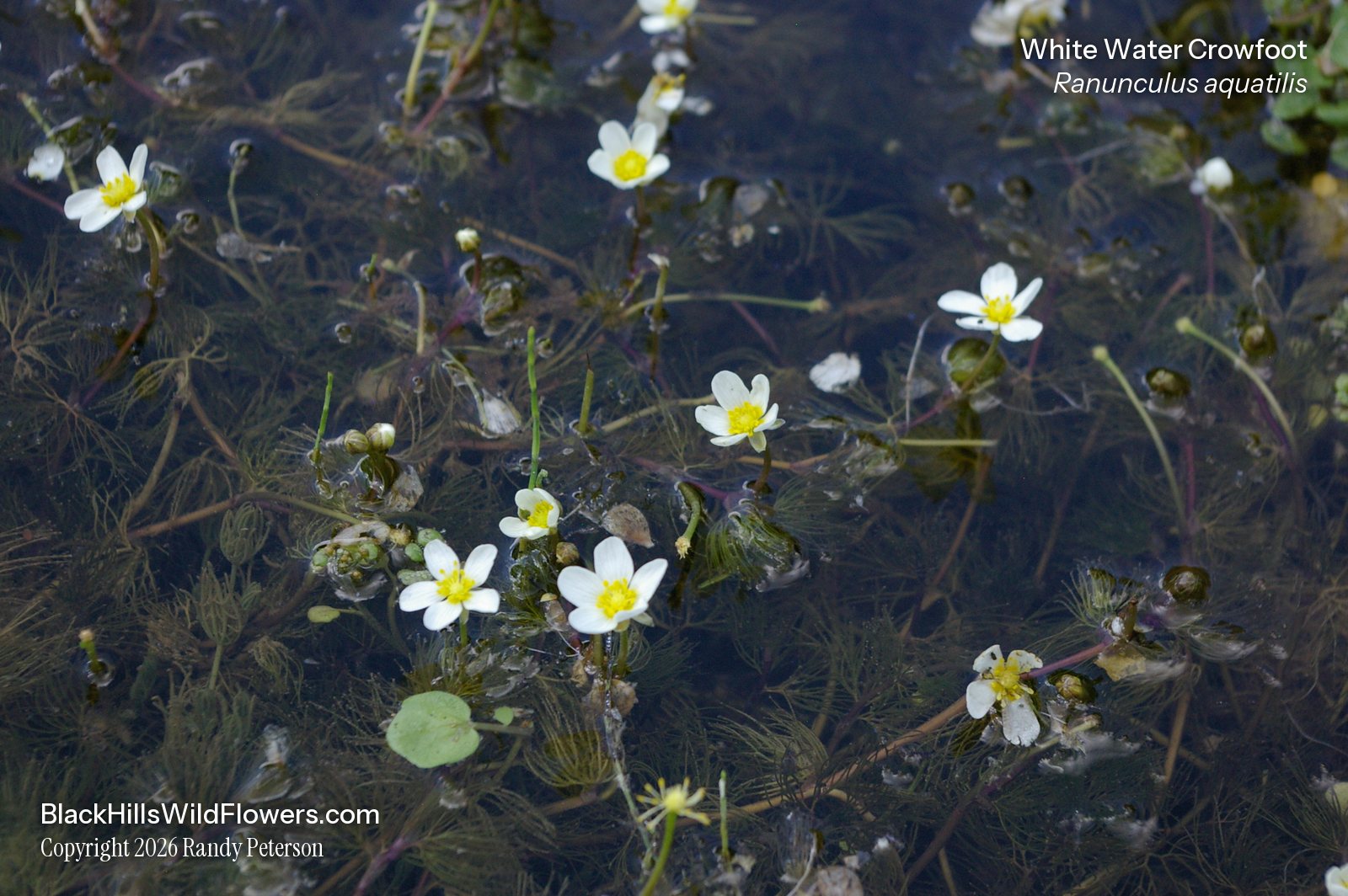
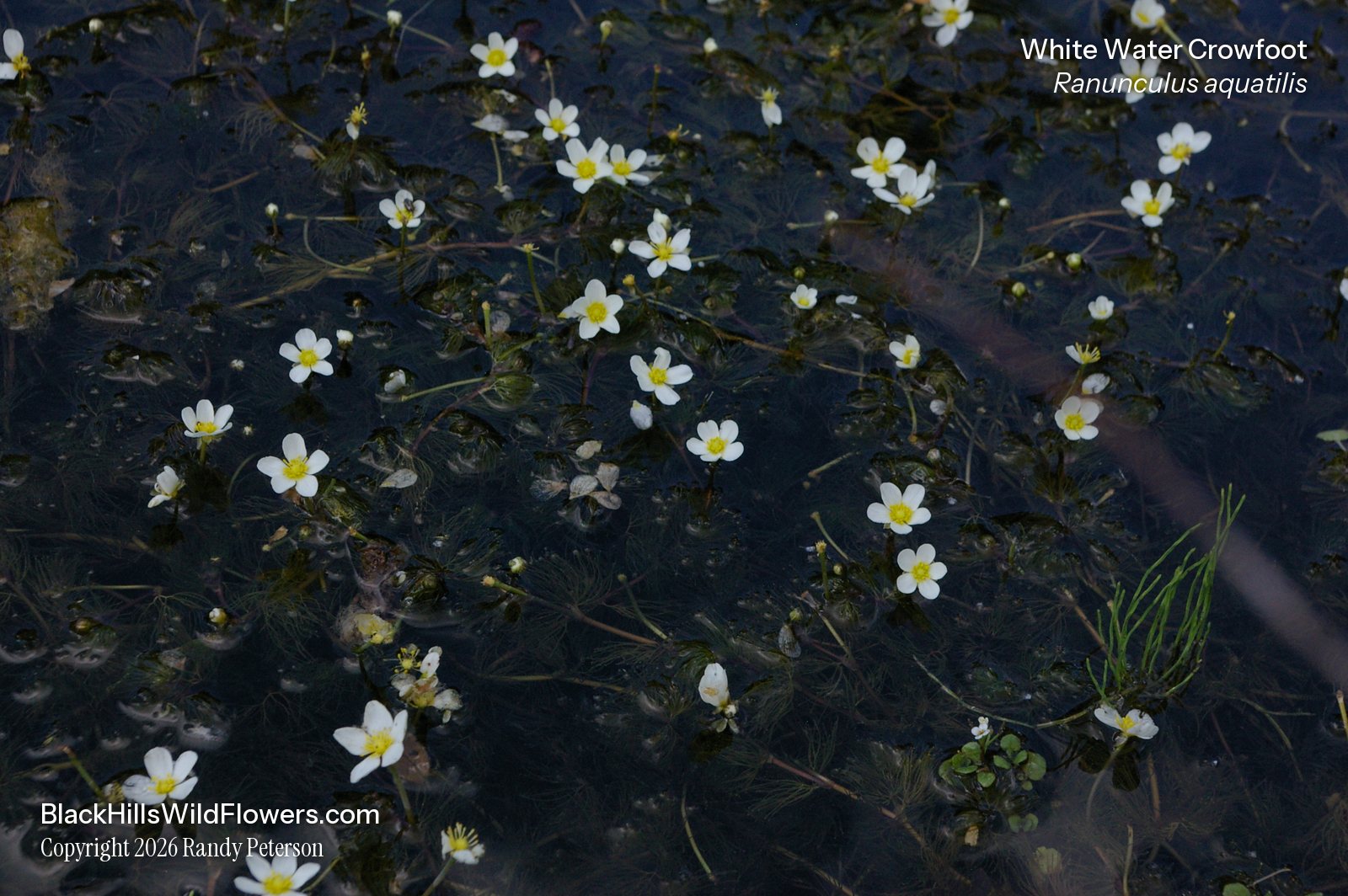
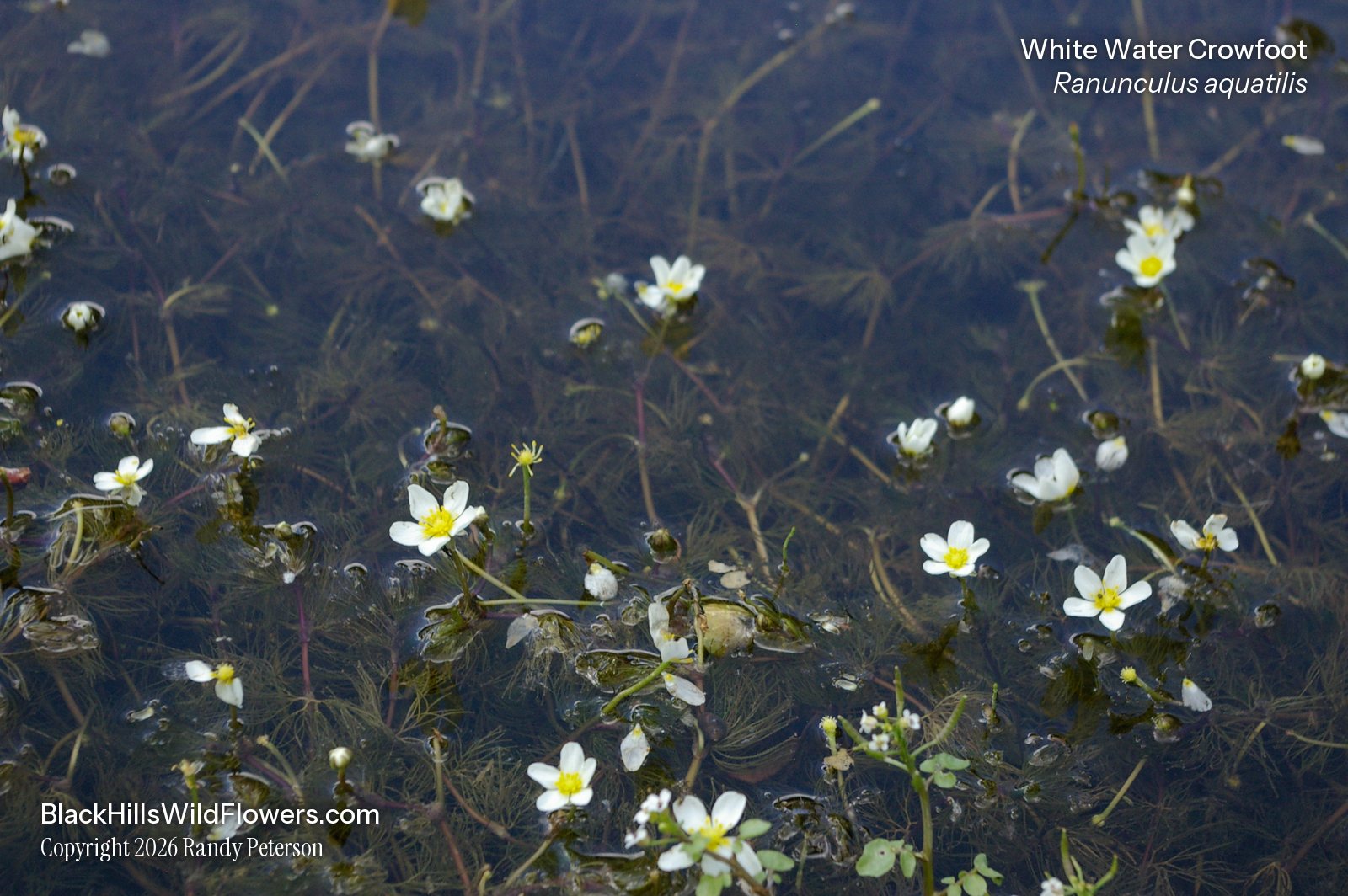
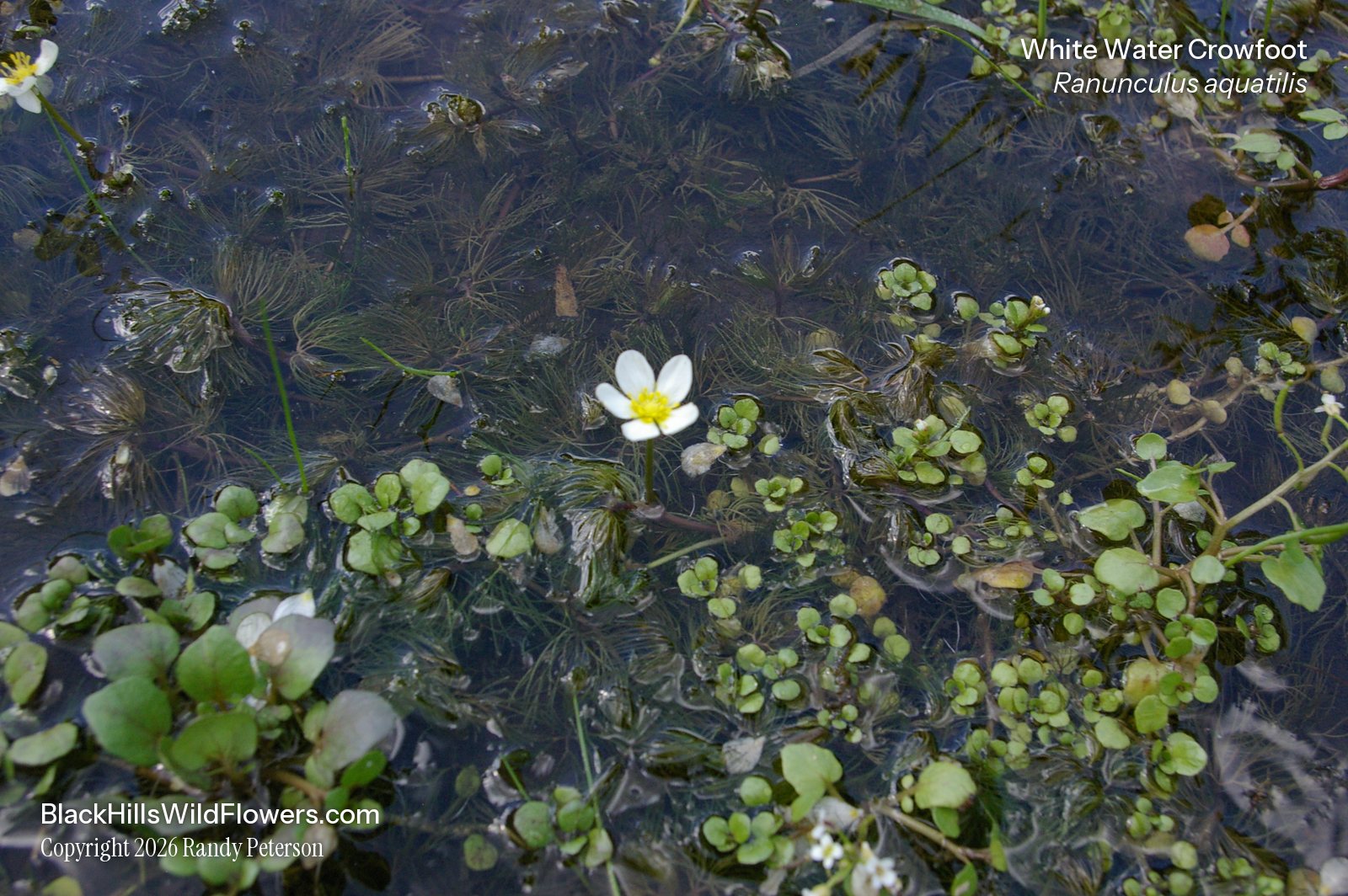
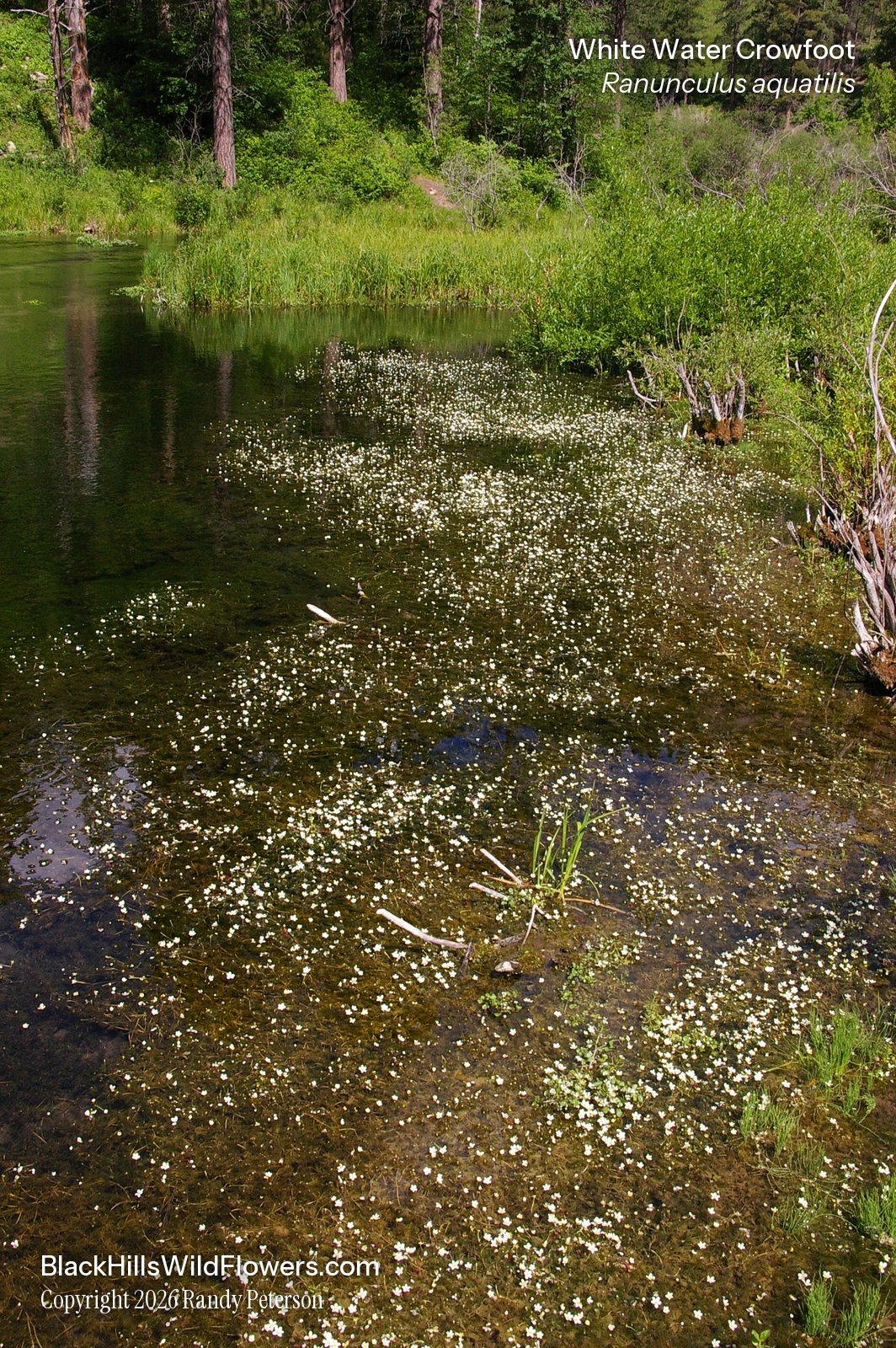
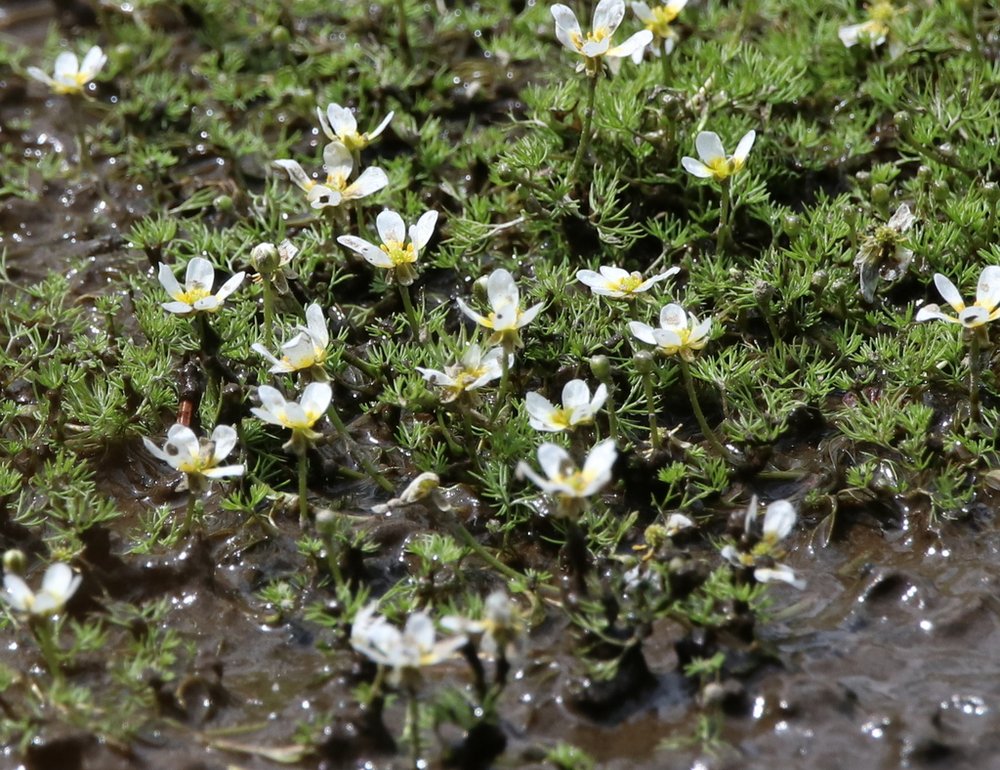
White Water Crowfoot (Ranunculus aquatilis) is a native water buttercup whose stems and thread-fine leaves stay underwater while single white flowers with yellow centers open just above the surface, from June into October. In the Black Hills it grows in cool creeks, ponds and beaver ponds; herbarium specimens record it from 1892 on, and the National Park Service lists it at Wind Cave and Devils Tower. Photographed in the Black Hills.
Free photos from other sources
| Family | Ranunculaceae · Buttercup |
|---|---|
| Status | Native perennial |
| Blooms | June into October; Black Hills herbarium specimens are in flower from early June to late October |
| Height | Flowers stand 2–15 cm (1–6 in) above the water; stems trail underwater |
| Where | Cool creeks, springs, ponds, beaver ponds and small reservoirs, in still or flowing water |
| Also called | White Water Crowsfoot, Water Crowfoot, Water Buttercup, Long-beak Buttercup, Threadleaf Crowfoot |
| Synonym | Ranunculus trichophyllus, Ranunculus longirostris, Batrachium aquatile, Batrachium trichophyllum |
| Note | Botanists split this plant in different ways. Flora of North America treats the South Dakota plants as Ranunculus aquatilis var. diffusus and says the long-beaked form can't be kept apart, while USDA PLANTS and many herbarium labels call them Ranunculus trichophyllus or Ranunculus longirostris. |
Roots, seeds & germination
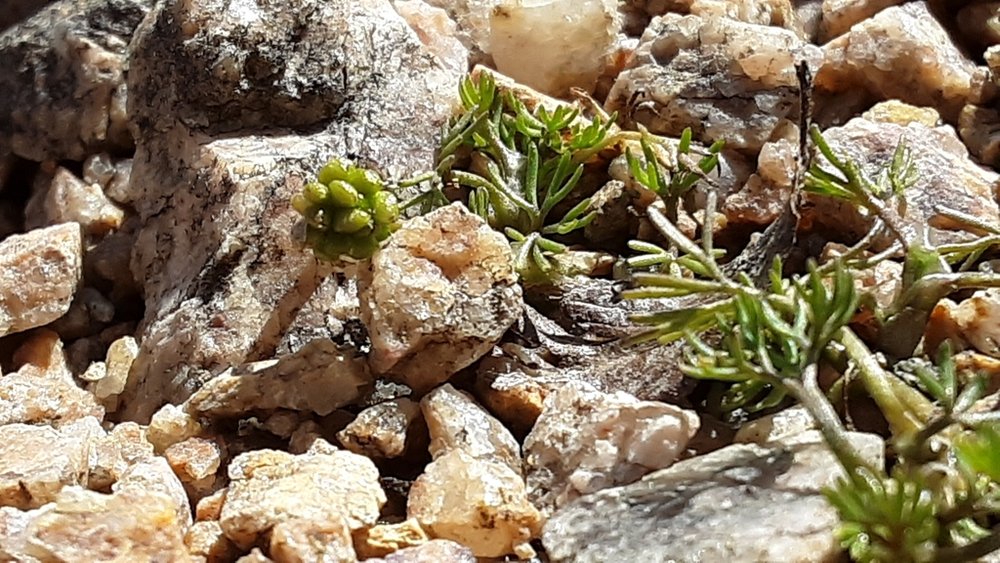
Seed: The flower center grows into a small round to egg-shaped head of fruits 2–4 mm long. Each fruit (an achene: a dry, one-seeded fruit) is 1–1.8 mm long, smooth or bristly, with a thread-like beak 0.2–1.2 mm long, and the fruiting stalks usually curve back.
How do you identify White Water Crowfoot?
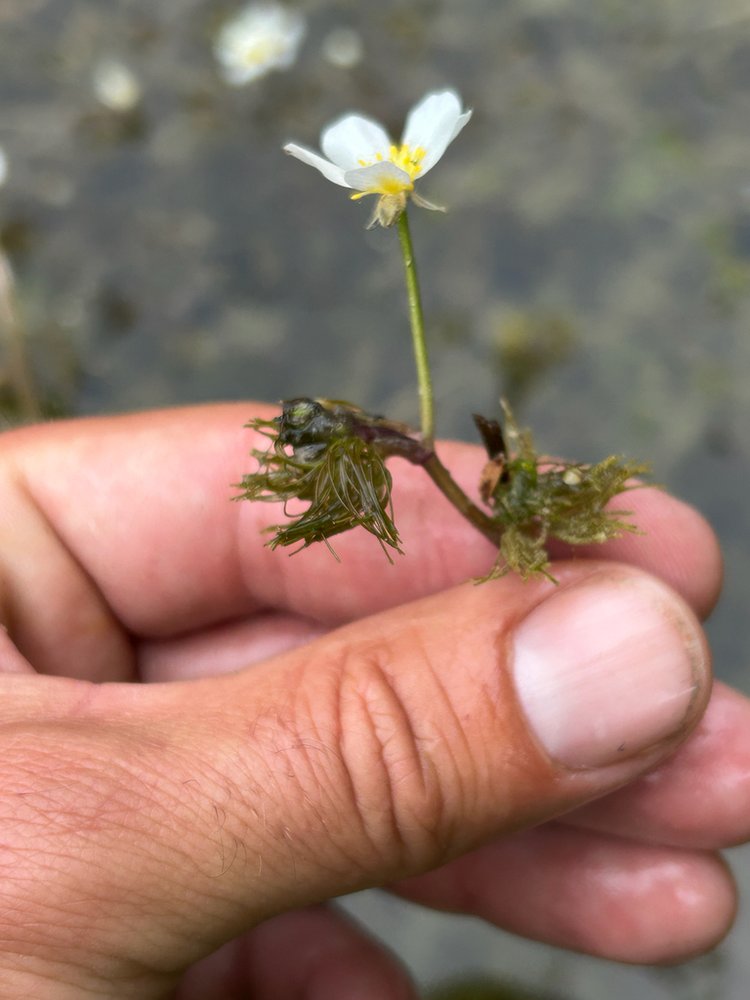
Look for white, buttercup-shaped flowers dotting the surface of a creek or pond, each on its own stalk from a leaf joint, with nothing but fine green threads below. Each flower is 8–17 mm (⅓–⅔ in) across, with 5 white petals that are yellow at the base, many yellow stamens around a yellow center, and 5 short green sepals behind. The leaves are cut into many thread-like segments, round to fan-shaped in outline and up to about 2 cm (¾ in) long, and they all stay underwater. Flora of North America separates a western form, var. aquatilis, recorded in Wyoming and Montana but not South Dakota, which also has flat, kidney-shaped, 3-parted leaves floating on the surface; the plants recorded in South Dakota, var. diffusus, have thread-like leaves only. After bloom the flower stalk usually bends back, and the center becomes a small round head of tiny beaked fruits.
When does it bloom?
June into October; Black Hills herbarium specimens are in flower from early June to late October.
Where does it grow?
Cool creeks, springs, ponds, beaver ponds, stock ponds and small reservoirs, rooted on stone or mud bottoms in still or swift water. Herbarium specimens from 1892 to 2013 record it in the Black Hills in Lawrence, Pennington, Custer and Meade counties, including Custer State Park, and in Crook County, Wyoming, at labelled elevations of 1,140 to 1,680 m (3,750–5,500 ft). The National Park Service lists it at Wind Cave National Park and Devils Tower National Monument.
Other flowers to compare
Other buttercups in this guide
Buttercup family (Ranunculaceae): 15 other plants in this guide
Sources: Flora of North America Vol. 3: Ranunculus aquatilis (A. T. Whittemore), eFloras; Flora of North America Vol. 3: Ranunculus aquatilis var. diffusus, eFloras; Flora of North America Vol. 3: Ranunculus aquatilis var. aquatilis, eFloras; Flora of North America Vol. 3: Ranunculus subg. Batrachium and key, eFloras; Minnesota Wildflowers: Ranunculus aquatilis (White Water Crowfoot); USDA PLANTS Database: Ranunculus aquatilis (RAAQ); USDA PLANTS Database: Ranunculus longirostris (RALO2); USDA PLANTS Database: Ranunculus trichophyllus (RATR); ITIS: Ranunculus aquatilis var. diffusus (TSN 566544); VASCAN (Canadensys): Ranunculus aquatilis var. diffusus; NPSpecies checklist, Wind Cave National Park vascular plants; NPSpecies checklist, Devils Tower National Monument vascular plants; GBIF occurrence search: Ranunculus aquatilis, South Dakota herbarium specimens; GBIF occurrence search: Ranunculus longirostris, South Dakota herbarium specimens; GBIF specimen 4433277534: Rossbach 1963, Custer State Park, beds in a flowing creek, 1524 m; GBIF specimen 3454978873: Larson 1982, submerged in a beaver pond; GBIF specimen 3454978784: Taylor et al. 1971, Pennington County, 1411 m, submerged in swift water; GBIF specimen 3454978981: Taylor 1949, Meade County, 1143 m, in running water; GBIF specimen 5159133339: Rolfsmeier 2003, Lawrence County, 1646 m, submersed in a creek; GBIF specimen 1931082638: Rydberg 1892, Custer County; GBIF specimen 3454995630: Marriott 1984, Crook County, WY, 1677 m, in water, in flower; GBIF specimen 2512333230: McIntosh 1924, Pennington County, quiet water, in flower 8 June; GBIF specimen 3051415701: Karlen 1992, Lawrence County, submerged, flowers at the water line 21 October; GBIF occurrence search: Ranunculus trichophyllus, South Dakota herbarium specimens.