Speedwells and kittentails of the Black Hills
All 3 speedwells and kittentails in this guide, side by side, A to Z. Compare the photos, bloom time, height and where each grows, then open the one that fits for more photos and the full ID notes. Each plant's page lists its sources.
| Plant | Color | Blooms | Height | Where | How to tell it apart |
|---|---|---|---|---|---|
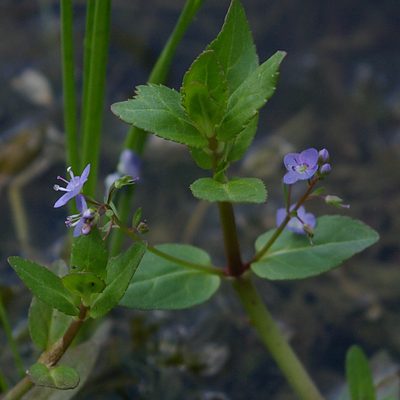 American SpeedwellVeronica americana | Blue | May into October | 10–50 cm (4–20 in) | Stream banks, seeps, swamps and pond edges, often partly in the water | Look for hairless, opposite leaves on short stalks, and a stem that often roots where it touches wet ground. Each cluster holds 10 to 15 stalked flowers, ¼ to ⅓ inch across, with four pale petals streaked darker and white at the base; three petals are about equal and one is smaller. Water Speedwell (Veronica catenata), not in this guide, is very similar but its leaves have no stalks. |
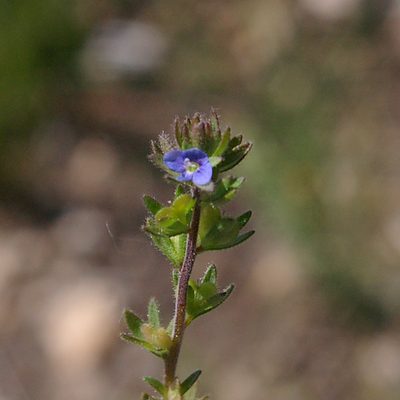 Corn SpeedwellVeronica arvensis | Blue | May into September | 5–30 cm (2–12 in) | Lawns, roadsides, fields, gardens and other disturbed ground | Flowers are only about ⅛ inch across, on very short stalks or nearly stalkless, set in the leaf joints near the stem tips. Lower leaves are oval, hairy and short-stalked with rounded teeth; upper leaves are narrow, stalkless and alternate. The fruit is a flat, heart-shaped capsule fringed with hairs. American Speedwell has hairless leaves and larger flowers in stalked clusters, and grows in wet places. Forget-me-not has five lobes. |
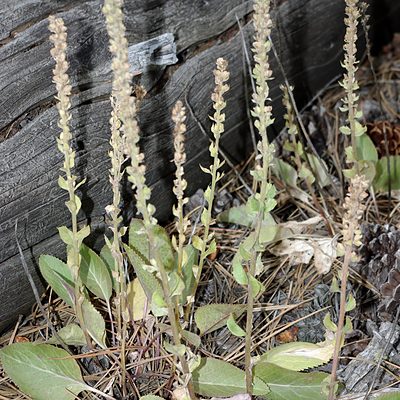 Wyoming KittentailsVeronica wyomingensis | Purple, Blue | April into June | 10–30 cm (4–12 in) | Rocky prairie, grassy openings and open ponderosa pine woods in the foothills and Hills | Look first for a low rosette of long-stalked leaves, oval to oblong with scalloped edges, often tinged reddish. A hairy stem 10–30 cm (4–12 in) tall carries a dense, fuzzy spike like a kitten's tail. The flowers have no petals: each is a small, hairy green calyx with two long purple to blue-violet stamens sticking out, so all the purple comes from stamens. As it goes to seed, the spike stretches to 5–15 cm (2–6 in) and fills with flattened, notched capsules. |
Other look-alike groups: 38 groups
- Anemones (4)
- Asters (4)
- Beardtongues (5)
- Buttercups (3)
- Cacti (4)
- Cinquefoils (7)
- Clovers (6)
- Coneflowers (4)
- Currants and gooseberries (5)
- Daisies (5)
- Dandelions (3)
- Docks and buckwheats (4)
- Evening primroses (4)
- Ferns (4)
- Gentians (4)
- Grasses (11)
- Groundsels and ragworts (3)
- Lilies (5)
- Mayflowers and false Solomon's seals (3)
- Milkvetches and locoweeds (12)
- Milkweeds (6)
- Mints (8)
- Mustards (11)
- Orchids (8)
- Paintbrushes (3)
- Pines (3)
- Raspberries and thimbleberries (3)
- Sagebrushes and sageworts (3)
- Sedges (3)
- Sunflowers (4)
- Thistles (6)
- Vervains (3)
- Vetches (4)
- Violets (7)
- Wild lettuces (3)
- Wild onions (3)
- Wild plums and cherries (3)
- Willows (3)