Wild lettuces of the Black Hills
All 3 wild lettuces in this guide, side by side, A to Z. Compare the photos, bloom time, height and where each grows, then open the one that fits for more photos and the full ID notes. Each plant's page lists its sources.
| Plant | Color | Blooms | Height | Where | How to tell it apart |
|---|---|---|---|---|---|
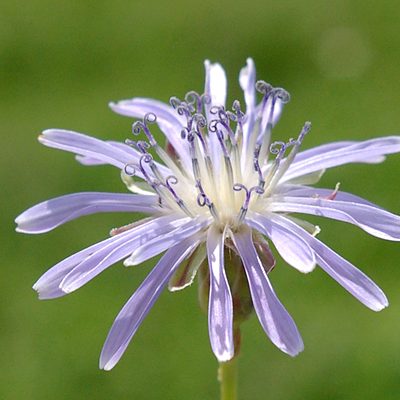 Blue LettuceLactuca tatarica | Blue | June into September | 30–100 cm (12–39 in) | Dry to moist prairies, open woods, meadows, river valleys, roadsides and railroad edges | Cut stems leak a bitter milky sap. Leaves are hairless, stalkless and bluish-green; lower ones may be deeply cut with backward-pointing lobes, and upper ones are smaller and smooth-edged. The heads have only strap-shaped florets with five small teeth at the tip, in a loose, branching cluster at the top of a stem that is otherwise unbranched. Chicory has larger flowers, is taller, and carries its heads in elongated spikes rather than a branching cluster. |
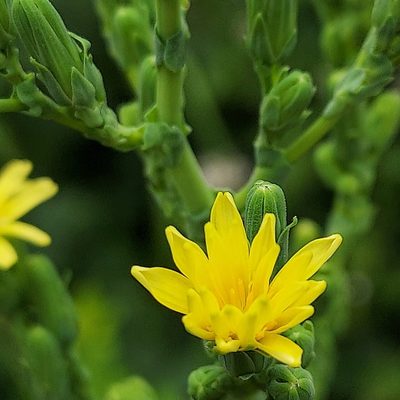 Canada LettuceLactuca canadensis | Yellow | July into September | 40–200 cm (16–79 in), sometimes taller | Moist, shady hardwood bottoms, grassy openings along streams and disturbed ground | Break a leaf or a bit of stem: the sap is pale orange-brown, not milky white like most other wild lettuces. The flower heads are small, 6–8 mm (¼–⅓ in) across, with 15 to 20 or more yellow rays, sometimes tinged red or orange, and the green, often purple-tipped bracts under each head form a tube 10–12 mm long; they spread and usually bend back as the seeds ripen. The stem is single, erect, mostly smooth, green to purplish or purple-spotted, sometimes with a waxy bloom, and branches only in the flower cluster. The leaves are alternate and vary a great deal: the lower ones deeply lobed and 10–35 cm (4–14 in) long, the upper ones smaller and often unlobed, mostly stalkless and often clasping the stem with a pair of small lobes, hairless except for a few hairs along the midrib underneath. The seed is brown, often mottled, flat and oval, 2.5–3.5 mm, with a thread-like beak half to about as long as the seed body and a tuft of white hairs at its tip. Prickly Lettuce, a non-native weed, may grow as tall but has somewhat larger yellow heads, prickly hairs along the leaf edges and midrib, milky sap, and paler seeds that taper at the base with a beak one to two times as long as the seed body. Blue Lettuce is a perennial with much larger blue to violet flowers, 1.3–2.5 cm (½–1 in) across, and its mid and upper stem leaves are usually unlobed and toothless; most other lettuces have lobed or toothed leaves, though Canada Lettuce varies a lot in this. |
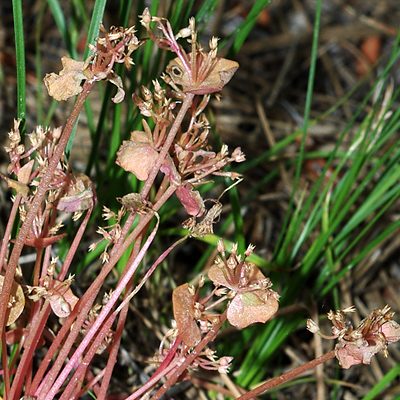 Miner's LettuceClaytonia perfoliata | White | Mid-May into early July | 3–20 cm (1–8 in) | Open ponderosa pine and pine-oak woods, pine needle litter, burned slopes and logged openings | Look for a small plant, often in pine needle litter, with a single pair of stem leaves joined into a round or notched disc that the stem passes through, and a short spray of flowers rising from the middle of the disc. The flowers are 3–10 mm across, with white or pink petals 2–5 mm long, and each ripens into a small capsule holding about 3 shiny seeds. The leaves at the base have long stalks and broadly diamond-shaped, triangular or kidney-shaped blades 1–7 cm long, usually with only a weak red tinge. Redstem Springbeauty (Claytonia rubra), also collected in the Black Hills, is very similar; Flora of North America separates it by its flatter rosettes of narrower, diamond- to spoon-shaped basal leaves that are strongly red even on young plants, and the Montana Field Guide describes its stem-leaf pair as joined but not fully united into a disc. |
Other look-alike groups: 38 groups
- Anemones (4)
- Asters (4)
- Beardtongues (5)
- Buttercups (3)
- Cacti (4)
- Cinquefoils (7)
- Clovers (6)
- Coneflowers (4)
- Currants and gooseberries (5)
- Daisies (5)
- Dandelions (3)
- Docks and buckwheats (4)
- Evening primroses (4)
- Ferns (4)
- Gentians (4)
- Grasses (11)
- Groundsels and ragworts (3)
- Lilies (5)
- Mayflowers and false Solomon's seals (3)
- Milkvetches and locoweeds (12)
- Milkweeds (6)
- Mints (8)
- Mustards (11)
- Orchids (8)
- Paintbrushes (3)
- Pines (3)
- Raspberries and thimbleberries (3)
- Sagebrushes and sageworts (3)
- Sedges (3)
- Speedwells and kittentails (3)
- Sunflowers (4)
- Thistles (6)
- Vervains (3)
- Vetches (4)
- Violets (7)
- Wild onions (3)
- Wild plums and cherries (3)
- Willows (3)