Ferns of the Black Hills
All 4 ferns in this guide, side by side, A to Z. Compare the photos, bloom time, height and where each grows, then open the one that fits for more photos and the full ID notes. Each plant's page lists its sources.
| Plant | Blooms | Height | Where | How to tell it apart |
|---|---|---|---|---|
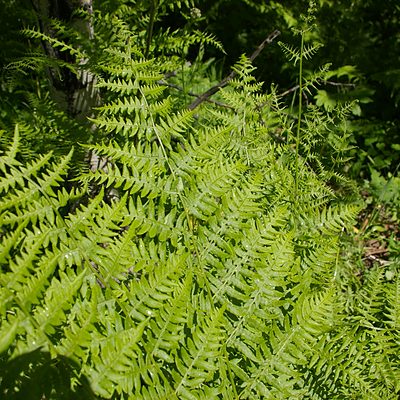 Bracken FernPteridium aquilinum | No flowers; fronds come up in spring, spores ripen under the rolled frond edges from July into September, and frost kills the fronds | 30–130 cm (1–4 ft) | Aspen, birch and ponderosa pine woods, woodland openings, draws, creek bottoms, old fields and burns, in part shade to sun | Start with the frond: broadly triangular, divided two or three times, papery to leathery, and often held nearly flat on a long stalk; the bottom pair of leaflets can be nearly as large as the rest of the frond, so it may look three-parted. The fronds come up one at a time from the buried rhizome rather than in a clump, so a patch is a colony of single fronds. The stalk is grooved, green or reddish at first and dark brown by late season, and often as long as the blade or longer. The underside of the blade is usually hairy, densely so in the western variety (var. pubescens), and the top is smooth. The lobes are oblong with their edges rolled under, and in summer a dark band of spore cases runs along the rolled edge of fertile lobes. The fronds are the first plant killed by frost, and the dead fronds make a highly flammable mat; the buried rhizomes survive fire and sprout again. Oak ferns also hold triangular fronds flat, but they stand under 40 cm (16 in) tall and carry round spore clusters at the vein tips rather than a band along the edge. |
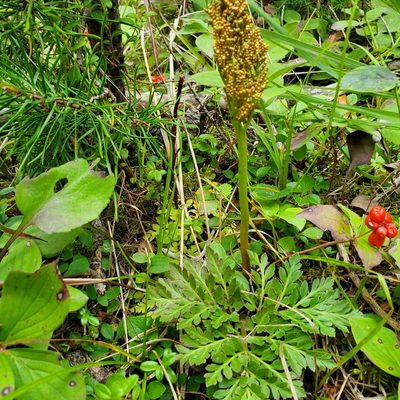 Leathery GrapefernBotrychium multifidum | No flowers; Leathery Grapefern's spore stalks ripen from August into October, and the moonworts' spores from June into August | 10–45 cm (4–18 in) | Conifer forest and groundwater-fed wet ground on igneous and metamorphic rock; the moonworts in native grassland | Leathery Grapefern has one leaf on a stalk 2–15 cm (1–6 in) long: shiny green, thick and leathery, triangular in outline and divided two or three times into rounded lobes with nearly smooth or scalloped edges, up to 25 by 35 cm (10 by 14 in) but often much smaller. A separate fertile stalk, about 1 to 2 times as long as the leaf, rises above it and branches into clusters of round spore cases; the leaf comes up in spring and stays green over winter. Each moonwort has one small, once-divided leaf with a few widely spaced, narrow lobes: Prairie Moonwort stands 6–12 cm (2–5 in) and Slender Moonwort 6–18 cm (2–7 in). Prairie Moonwort (Botrychium campestre) has a fleshy, dull whitish-green leaf that is usually stalkless, with linear to spatula-shaped lobes that are usually notched at the tip; its fertile stalk is 1 to 1.5 times as long as the leaf, and the leaf comes up in early spring and dies in late spring or early summer. Slender Moonwort (Botrychium lineare) is less whitish, with a narrower, less fleshy central stalk and a longer, less fleshy fertile stalk, and it has the narrowest lobes of any moonwort: linear, often forked into two fingers, with the lowest pair usually the longest. |
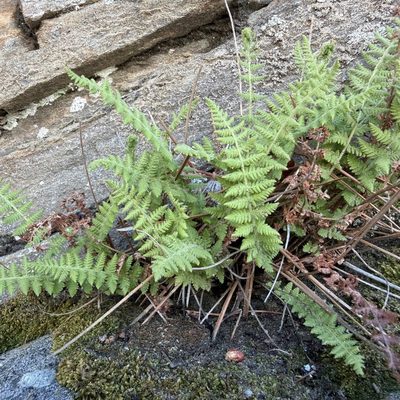 Rocky Mountain WoodsiaWoodsia scopulina | No flowers; spores ripen on the undersides of the fronds from summer into fall | 9–35 cm (4–14 in) | Cracks, ledges and bases of cliffs and rock outcrops, granite and limestone, in sun or part shade | Look for a tuft of fronds growing straight out of a rock crack, with a brush of old brown leaf-stalk bases of different lengths at its foot. Each frond is lance-shaped, 9–35 cm (4–14 in) long and 1–8 cm (½–3 in) wide, divided twice at the base into 6 to 15 pairs of pinnae (leaflets), the largest with 5 to 14 pairs of blunt, toothed lobes. Both surfaces carry a mix of short gland-tipped hairs and longer flattened hairs that gather along the midribs, and the stalk is reddish brown to dark purple at the base and snaps easily. The faint veins end near the edge in a tiny pore (hydathode), best seen from above but often hard to find. The spore clusters (sori) are round and sit in one row between the midrib and the edge on the underside, each ringed by a cup cut into narrow, thread-like segments. Brittle bladder fern (Cystopteris fragilis) also grows on rock, and its genus is often confused with Woodsia, but it has no gland-tipped hairs, no pore at the vein tips, a single flap over each spore cluster instead of a cup of segments, and a stalk that is green to straw-colored above a dark base. Oregon woodsia (Woodsia oregana) lacks the longer flattened hairs along the midribs, its stalk bends rather than snapping, and its sori are ringed by short, hair-like segments. |
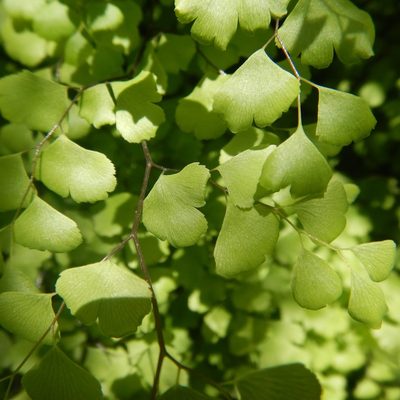 Southern Maidenhair FernAdiantum capillus-veneris | No flowers; spores ripen in July and August | 15–75 cm (6–30 in) | Warm, lime-rich seeps: wet limestone rock, stream banks and rocks standing in the water, in part shade to full sun | Look for lax, drooping fronds 15–75 cm (6–30 in) long on thin, hairless, shiny black stalks. The leaflets are fan- or wedge-shaped and about as long as wide, with lobed outer edges that are finely toothed on leaflets without spores, and the dark color of each little stalk runs right into the base of the leaflet. On a fertile frond the outer edge of a leaflet rolls back over the spore cases in small crescent-shaped or oblong flaps. Northern Maidenhair Fern (Adiantum pedatum), a close relative that does not grow with it in the Black Hills and that South Dakota ranks as historical (last collected in 1941), has a leaf stalk that forks into two main branches and leaflets at least twice as long as wide. |
Other look-alike groups: 38 groups
- Anemones (4)
- Asters (4)
- Beardtongues (5)
- Buttercups (3)
- Cacti (4)
- Cinquefoils (7)
- Clovers (6)
- Coneflowers (4)
- Currants and gooseberries (5)
- Daisies (5)
- Dandelions (3)
- Docks and buckwheats (4)
- Evening primroses (4)
- Gentians (4)
- Grasses (11)
- Groundsels and ragworts (3)
- Lilies (5)
- Mayflowers and false Solomon's seals (3)
- Milkvetches and locoweeds (12)
- Milkweeds (6)
- Mints (8)
- Mustards (11)
- Orchids (8)
- Paintbrushes (3)
- Pines (3)
- Raspberries and thimbleberries (3)
- Sagebrushes and sageworts (3)
- Sedges (3)
- Speedwells and kittentails (3)
- Sunflowers (4)
- Thistles (6)
- Vervains (3)
- Vetches (4)
- Violets (7)
- Wild lettuces (3)
- Wild onions (3)
- Wild plums and cherries (3)
- Willows (3)