Leathery Grapefern Botrychium multifidum also listed as Sceptridium multifidum
Also called Leather Grapefern, Broadleaf Grapefern
Leathery Grapefern (Botrychium multifidum) is a small native fern, 10–45 cm (4–18 in) tall, with a single leathery, shiny green, triangular leaf that lasts through the winter and a separate stalk of round spore cases from August into October. In the Black Hills it is a rare fern of forest and groundwater-fed wet ground on igneous and metamorphic rock, and the Forest Service lists it and two small grassland relatives covered on this page, Prairie Moonwort and Slender Moonwort, as sensitive plants.
Free photos from other sources
| Family | Ophioglossaceae · Adder's-tongue |
|---|---|
| Status | Native perennial fern |
| Blooms | No flowers; Leathery Grapefern's spore stalks ripen from August into October, and the moonworts' spores from June into August |
| Height | 10–45 cm (4–18 in) |
| Where | Conifer forest and groundwater-fed wet ground on igneous and metamorphic rock; the moonworts in native grassland |
| Also called | Leather Grapefern, Broadleaf Grapefern |
| Synonym | Sceptridium multifidum, Osmunda multifida, Botrychium silaifolium |
| Note | The Forest Service lists all three as Region 2 sensitive plants in the Black Hills, and its 2023 draft assessment names Leathery Grapefern a likely species of conservation concern. South Dakota ranks Leathery Grapefern and Slender Moonwort S1, critically imperiled, and Prairie Moonwort S2S3. This page gives no locations. |
Roots, seeds & germination
Root: Prairie Moonwort grows dense clusters of tiny round buds (gemmae) at the base of its roots.
Seed: No seeds. Leathery Grapefern's spore cases release their spores from late September. Prairie Moonwort's mature in June and turn brown as they shed their spores by mid-July.
Germination: Moonwort spores germinate underground and grow into minute plants (gametophytes) that live below the surface and do not make their own food from sunlight.
How do you identify Leathery Grapefern?
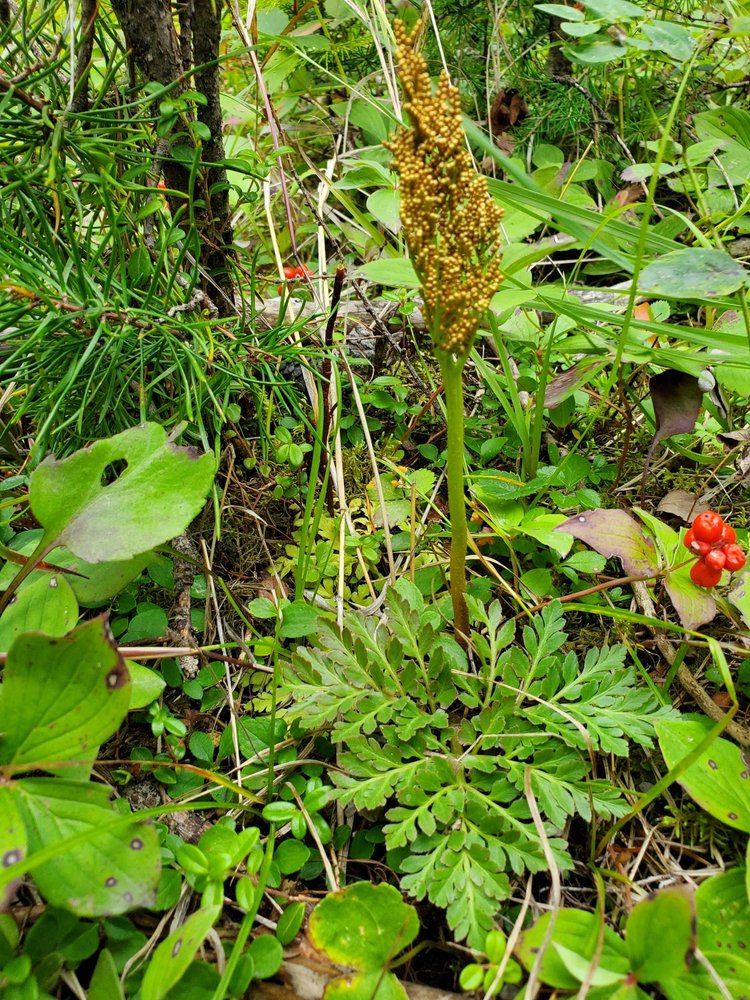
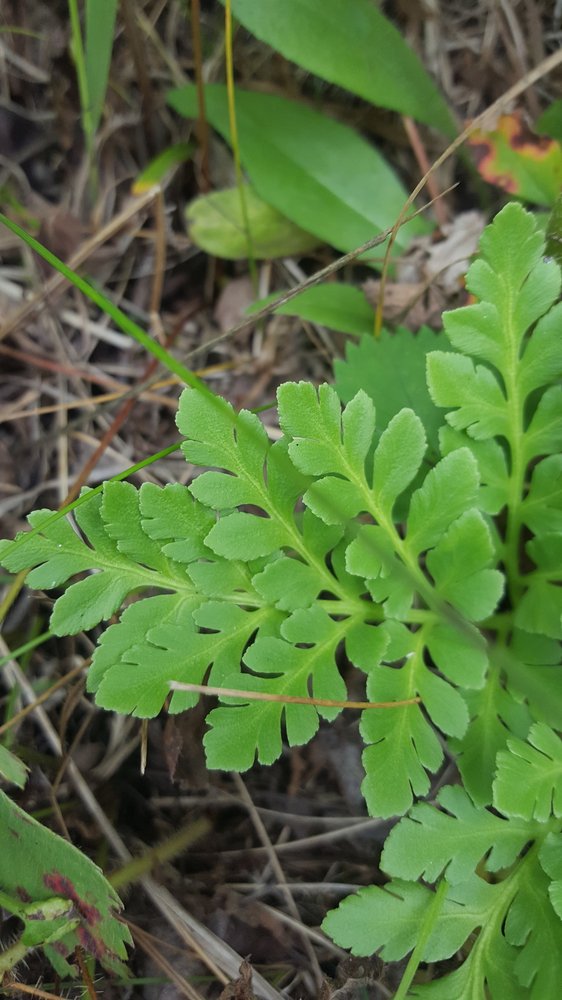
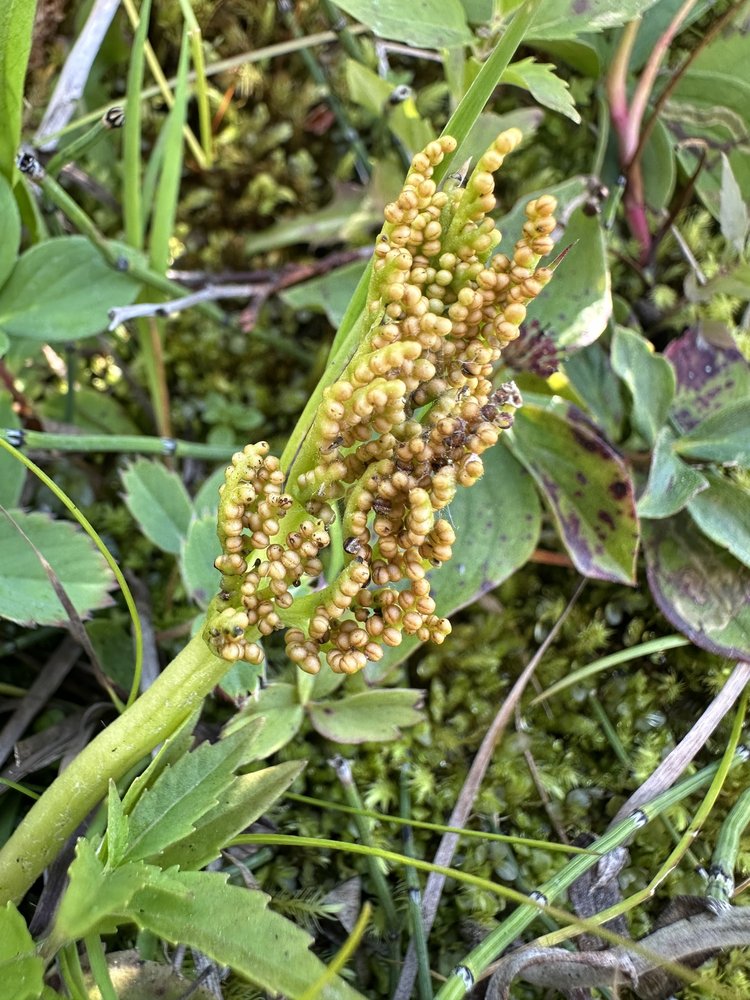
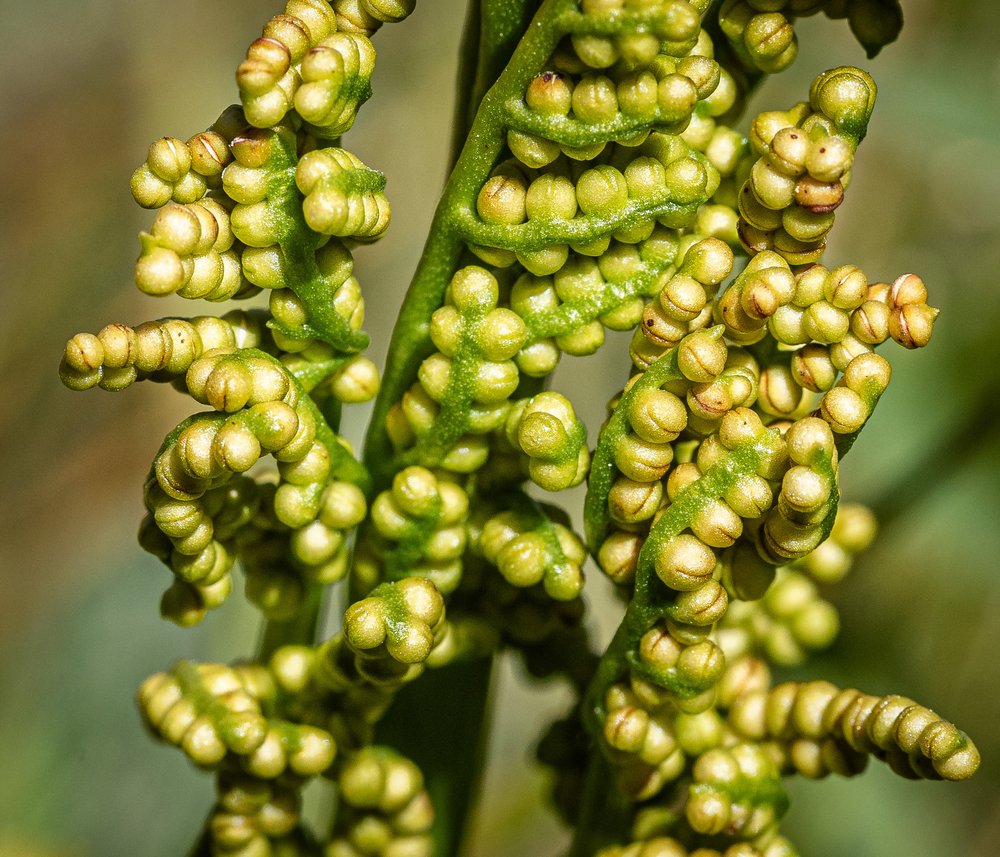
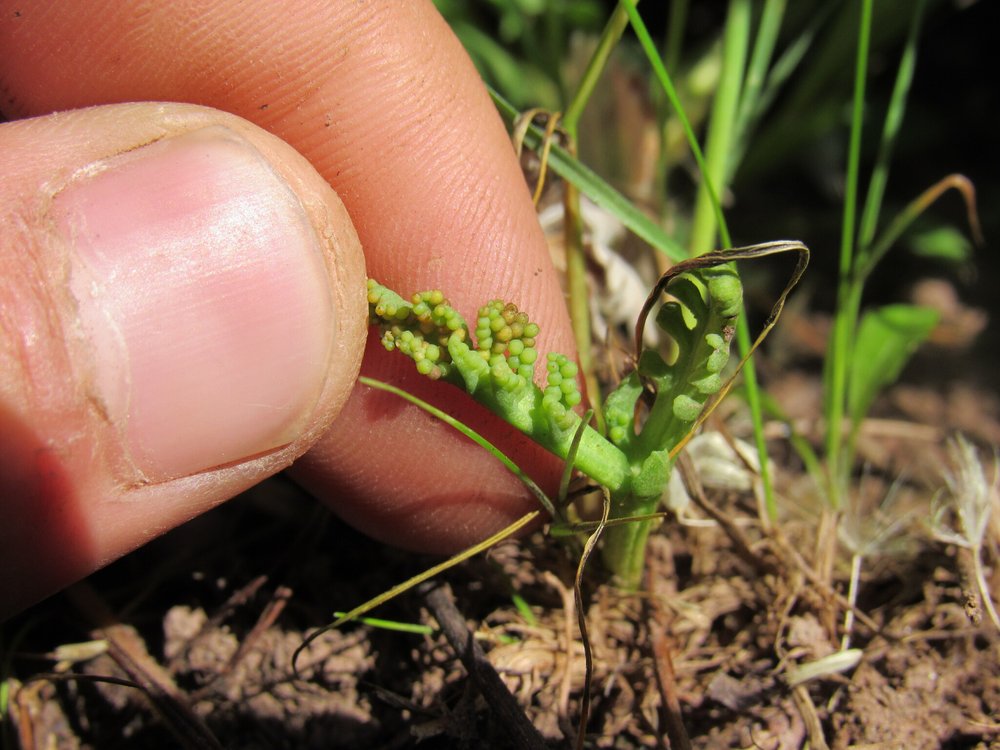
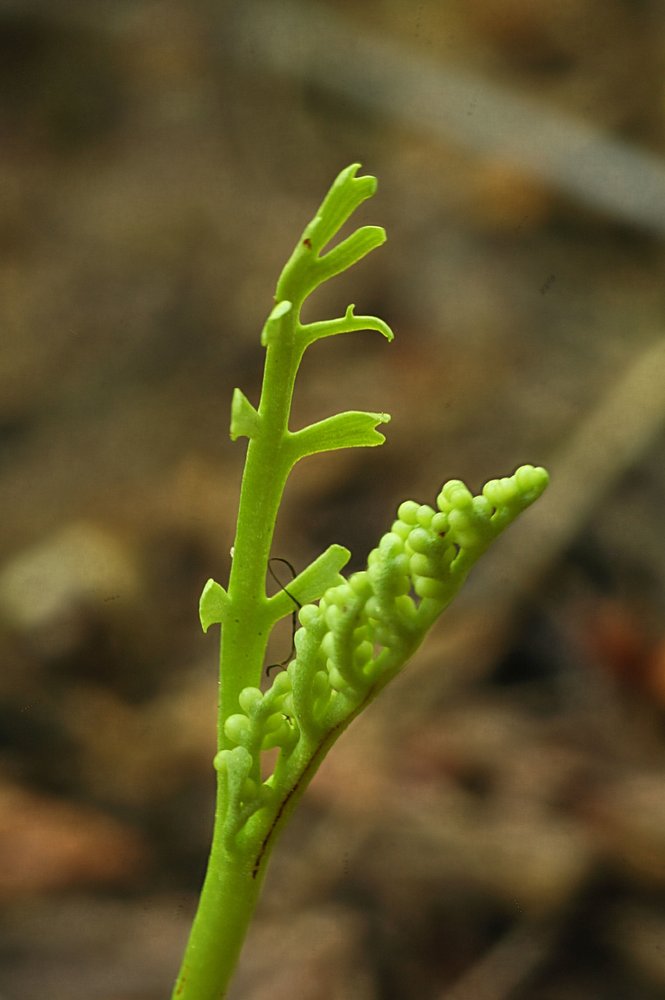
Leathery Grapefern has one leaf on a stalk 2–15 cm (1–6 in) long: shiny green, thick and leathery, triangular in outline and divided two or three times into rounded lobes with nearly smooth or scalloped edges, up to 25 by 35 cm (10 by 14 in) but often much smaller. A separate fertile stalk, about 1 to 2 times as long as the leaf, rises above it and branches into clusters of round spore cases; the leaf comes up in spring and stays green over winter. Each moonwort has one small, once-divided leaf with a few widely spaced, narrow lobes: Prairie Moonwort stands 6–12 cm (2–5 in) and Slender Moonwort 6–18 cm (2–7 in). Prairie Moonwort (Botrychium campestre) has a fleshy, dull whitish-green leaf that is usually stalkless, with linear to spatula-shaped lobes that are usually notched at the tip; its fertile stalk is 1 to 1.5 times as long as the leaf, and the leaf comes up in early spring and dies in late spring or early summer. Slender Moonwort (Botrychium lineare) is less whitish, with a narrower, less fleshy central stalk and a longer, less fleshy fertile stalk, and it has the narrowest lobes of any moonwort: linear, often forked into two fingers, with the lowest pair usually the longest.
When does it bloom?
No flowers; Leathery Grapefern's spore stalks ripen from August into October, and the moonworts' spores from June into August.
Where does it grow?
Leathery Grapefern: in the Black Hills on igneous and metamorphic bedrock, and also under paper birch and hazelnut on sandstone, at 1,410–1,960 m (4,620–6,440 ft). The Forest Service lists it among the at-risk plants of ponderosa pine, white spruce and mixed conifer forest, streamsides and wetlands, fens and other groundwater-fed ground, and among the plants hurt when the forest loses its shade. Elsewhere it grows in moist meadows, forests and fields. The moonworts: native grassland in the Black Hills, where Prairie Moonwort's tiny size makes it easy to miss.
Other ferns in this guide
Sources: Flora of North America Vol. 2: Botrychium multifidum, eFloras; Flora of North America Vol. 2: Botrychium campestre, eFloras; Minnesota Wildflowers: Sceptridium multifidum (Leathery Grapefern); Minnesota Wildflowers: Botrychium campestre (Prairie Moonwort), including var. lineare; Montana Field Guide: Leathery Grape-fern, Botrychium multifidum (Montana Natural Heritage Program); Montana Field Guide: Prairie Moonwort, Botrychium campestre (Montana Natural Heritage Program); Montana Field Guide: Linearleaf Moonwort, Botrychium lineare (Montana Natural Heritage Program); Colorado Rare Plant Guide: Botrychium lineare, Colorado Natural Heritage Program; Phase II Amendment to the Black Hills forest plan, Final EIS (2005), section 3-3.2 Flora: Region 2 sensitive plants and species of local concern, USDA Forest Service; Draft Forest Plan Assessment for the Black Hills: At-Risk Species (2023), USDA Forest Service; Rare Plants of South Dakota, SD Natural Heritage Program / SD Game, Fish & Parks; USDA PLANTS profile: Botrychium multifidum (BOMU); USDA PLANTS profile: Botrychium campestre (BOCA5).