Rocky Mountain Woodsia Woodsia scopulina
Also called Mountain Cliff Fern, Rocky Mountain Cliff Fern
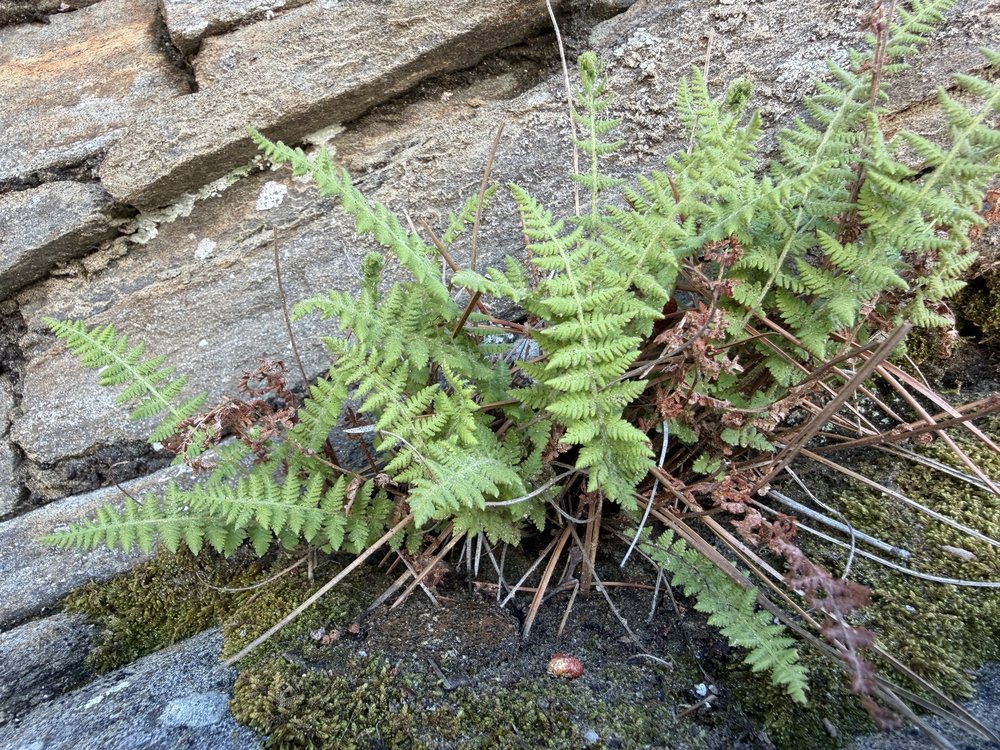
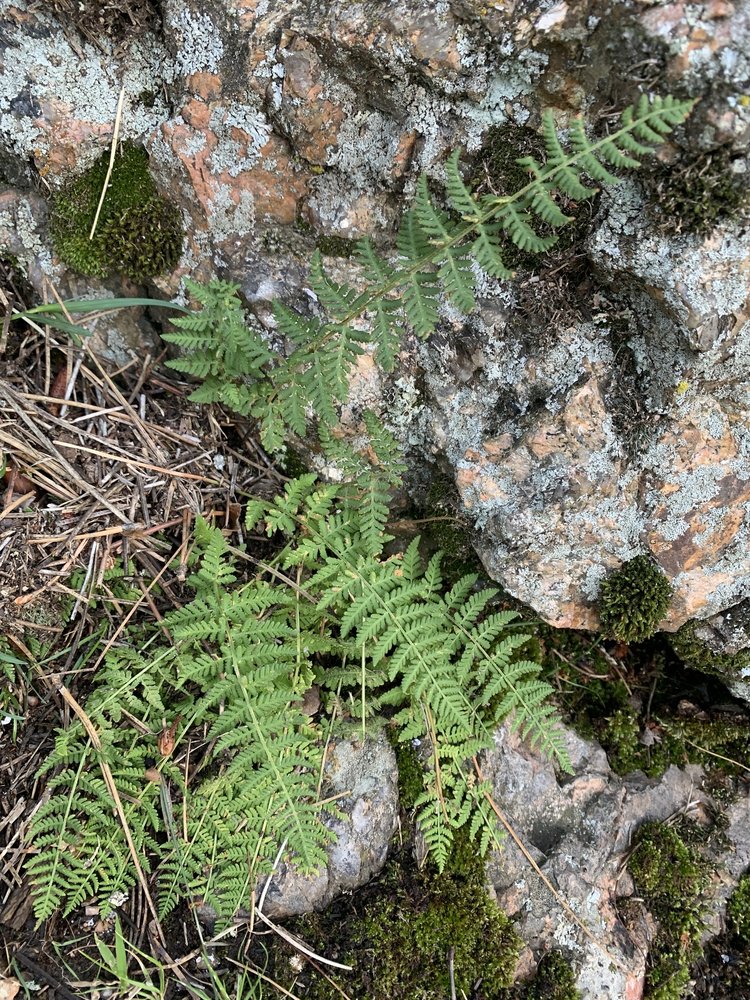
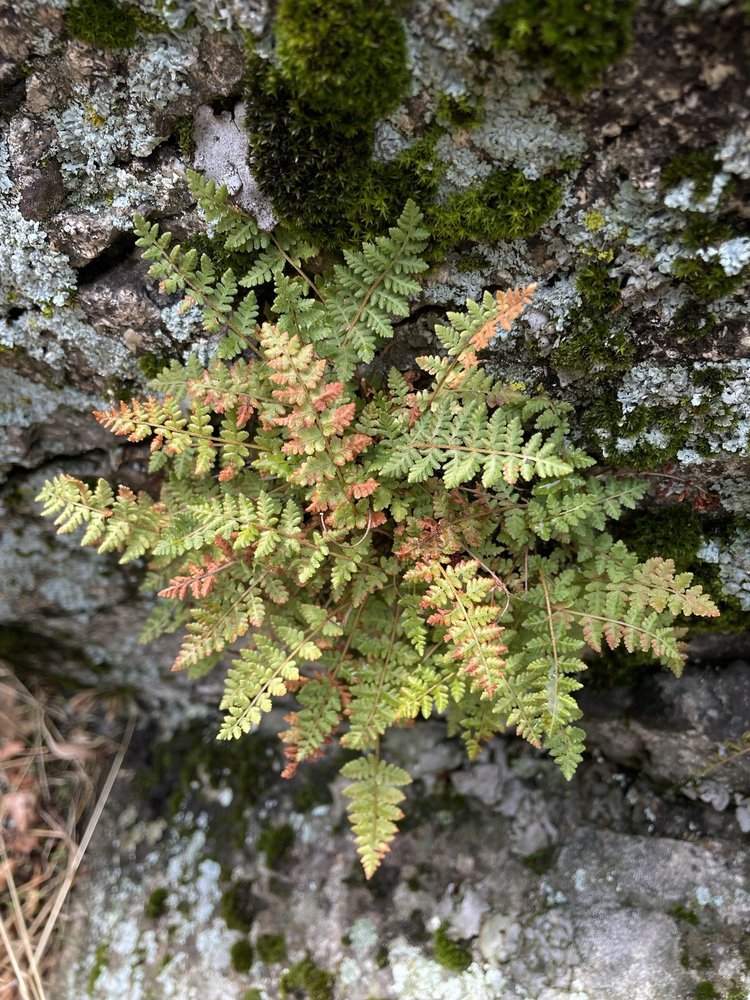
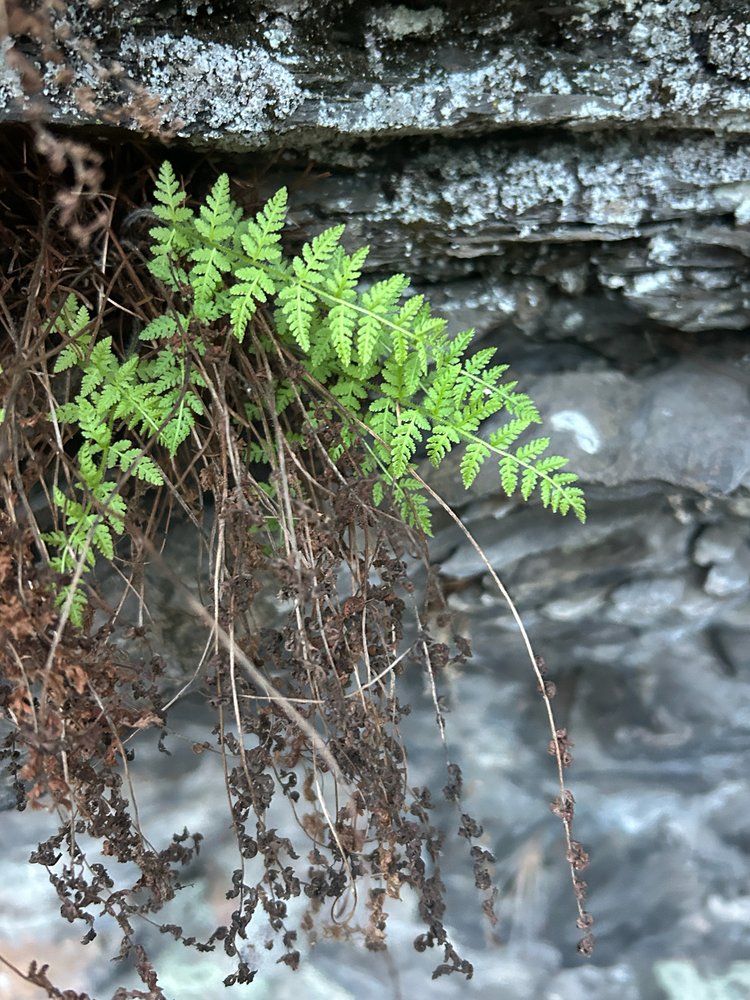
Rocky Mountain Woodsia (Woodsia scopulina) is a small native fern that grows in tufts from cracks in granite and limestone, with lance-shaped fronds 9–35 cm (4–14 in) long that are twice divided, finely hairy and glandular, on brittle stalks that are reddish brown to dark purple at the base. It has no flowers; spores ripen on the undersides of the fronds from summer into fall. In the Black Hills it grows on granite outcrops and cliffs, and the National Park Service lists it at Wind Cave, Mount Rushmore and Devils Tower.
Free photos from other sources
| Family | Dryopteridaceae · Wood fern |
|---|---|
| Status | Native perennial fern |
| Blooms | No flowers; spores ripen on the undersides of the fronds from summer into fall |
| Height | 9–35 cm (4–14 in) |
| Where | Cracks, ledges and bases of cliffs and rock outcrops, granite and limestone, in sun or part shade |
| Also called | Mountain Cliff Fern, Rocky Mountain Cliff Fern |
| Synonym | Woodsia obtusa var. lyallii, Woodsia oregana var. lyallii |
Roots, seeds & germination
Root: A short, compact rhizome (an underground stem) that grows upright or at an angle and keeps the old leaf-stalk bases of past years, so the base of a clump is a brush of brown stubs. Plants form loose to tight clumps.
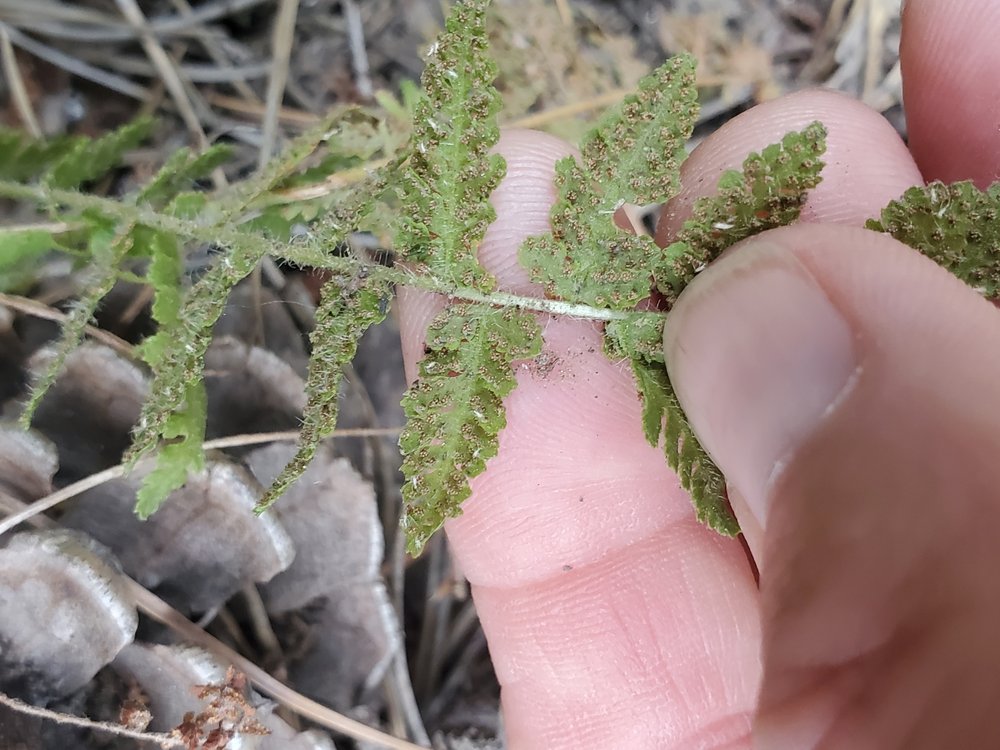
Seed: None. Ferns reproduce by spores, which form in round clusters (sori) in a single row between the midrib and the edge on the underside of each frond lobe, each cluster sitting in a cup split into narrow, thread-like segments. The clusters begin developing in early to midsummer, and fertile and sterile fronds look alike.
How do you identify Rocky Mountain Woodsia?
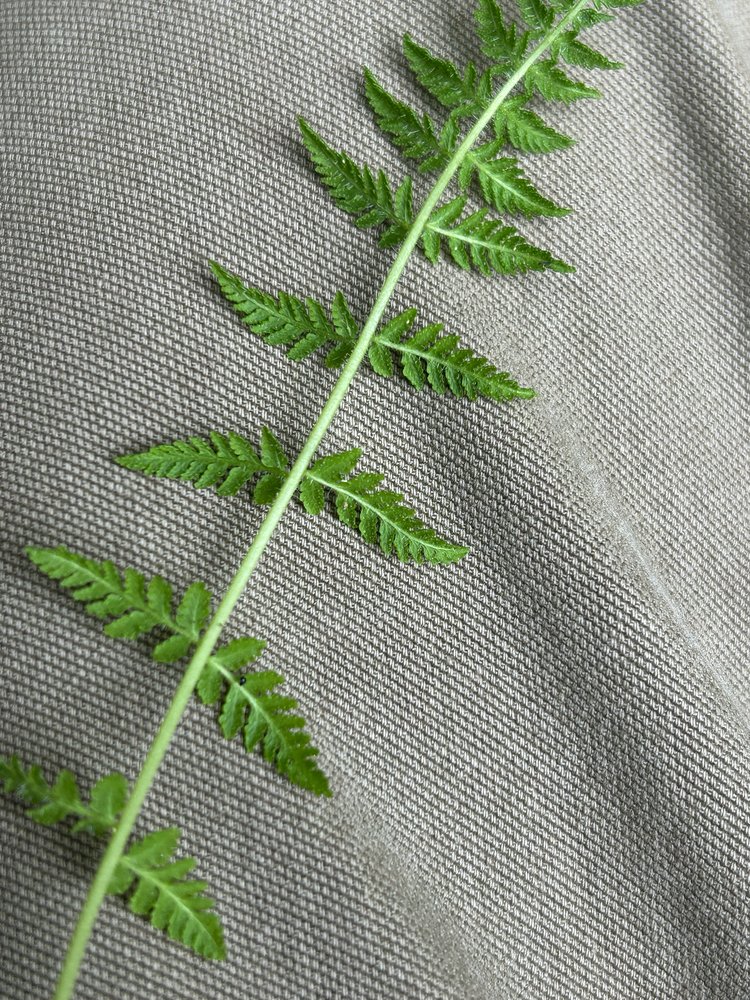
Look for a tuft of fronds growing straight out of a rock crack, with a brush of old brown leaf-stalk bases of different lengths at its foot. Each frond is lance-shaped, 9–35 cm (4–14 in) long and 1–8 cm (½–3 in) wide, divided twice at the base into 6 to 15 pairs of pinnae (leaflets), the largest with 5 to 14 pairs of blunt, toothed lobes. Both surfaces carry a mix of short gland-tipped hairs and longer flattened hairs that gather along the midribs, and the stalk is reddish brown to dark purple at the base and snaps easily. The faint veins end near the edge in a tiny pore (hydathode), best seen from above but often hard to find. The spore clusters (sori) are round and sit in one row between the midrib and the edge on the underside, each ringed by a cup cut into narrow, thread-like segments. Brittle bladder fern (Cystopteris fragilis) also grows on rock, and its genus is often confused with Woodsia, but it has no gland-tipped hairs, no pore at the vein tips, a single flap over each spore cluster instead of a cup of segments, and a stalk that is green to straw-colored above a dark base. Oregon woodsia (Woodsia oregana) lacks the longer flattened hairs along the midribs, its stalk bends rather than snapping, and its sori are ringed by short, hair-like segments.
When does it bloom?
No flowers; spores ripen on the undersides of the fronds from summer into fall.
Where does it grow?
Cracks, ledges and the bases of cliffs and rock outcrops, on granite, limestone, schist and sandstone, in pine and spruce forest from about 1,200 to 2,200 m (4,000 to 7,200 ft), up to the highest summit in the Hills. Herbarium specimens from 1892 to 2016 come from Pennington, Custer, Lawrence and Fall River counties in South Dakota and from Crook County, Wyoming, including the top of Devils Tower. The National Park Service lists it as present at Wind Cave, Mount Rushmore and Devils Tower. Across its range it grows on cliffs and rocky slopes of many kinds of rock.
Other ferns in this guide
Sources: Flora of North America vol. 2: Woodsia scopulina (M. D. Windham), eFloras; Flora of North America vol. 2: Woodsia scopulina subsp. laurentiana (the subspecies FNA lists for South Dakota), eFloras; Flora of North America vol. 2: genus Woodsia, with key (M. D. Windham), eFloras; Flora of North America vol. 2: Cystopteris fragilis, eFloras; Minnesota Wildflowers: Woodsia scopulina (Rocky Mountain Woodsia); USDA PLANTS profile: Woodsia scopulina D.C. Eaton, WOSC; ITIS: Woodsia scopulina (TSN 17747) and its subspecies; NPSpecies checklist, Wind Cave National Park vascular plants; NPSpecies checklist, Mount Rushmore National Memorial vascular plants; NPSpecies checklist, Devils Tower National Monument vascular plants; GBIF occurrence search: Woodsia scopulina, South Dakota herbarium specimens; GBIF occurrence search: Woodsia scopulina, Wyoming herbarium specimens.