Smooth Brome Bromus inermis
Also called Smooth bromegrass, Awnless brome, Hungarian brome, Austrian brome, Russian brome, Bromegrass
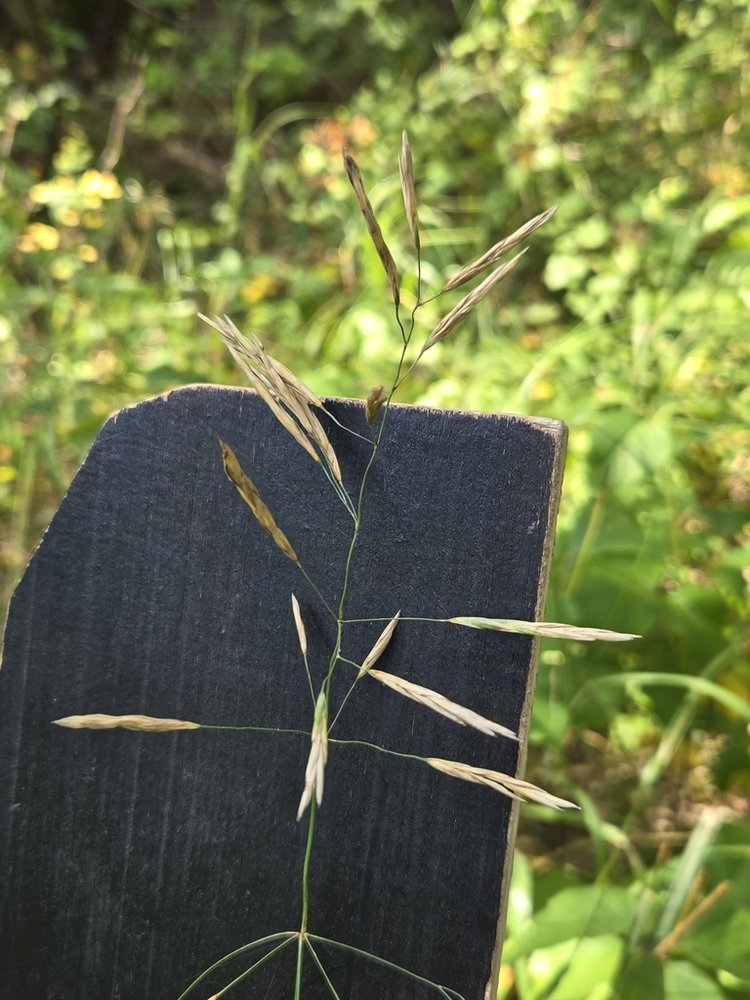
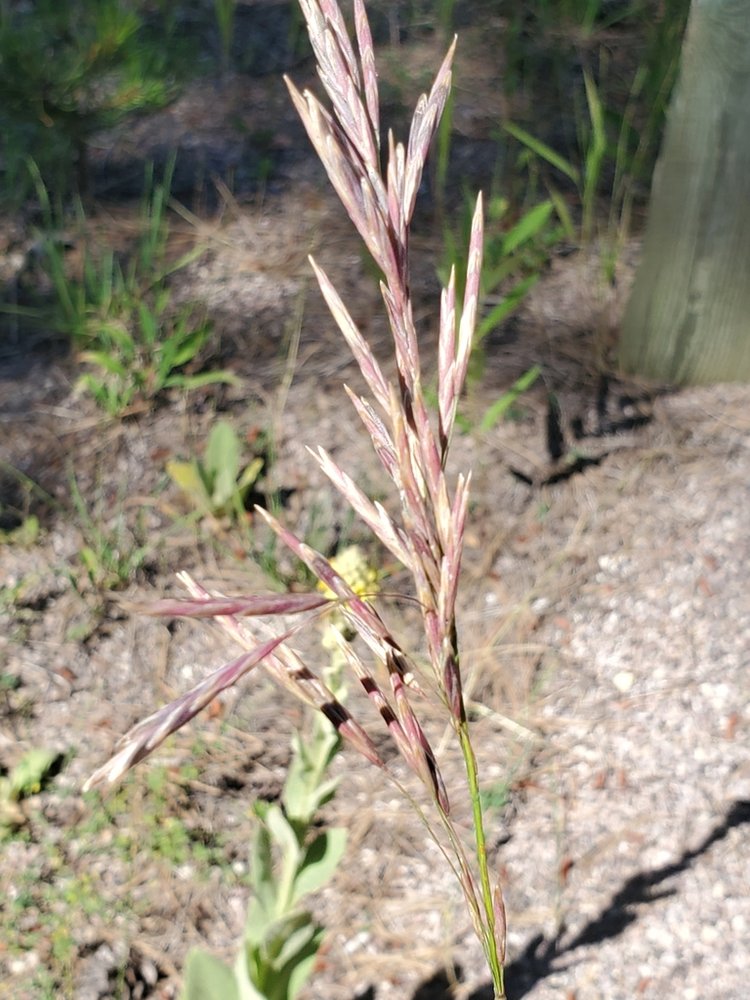
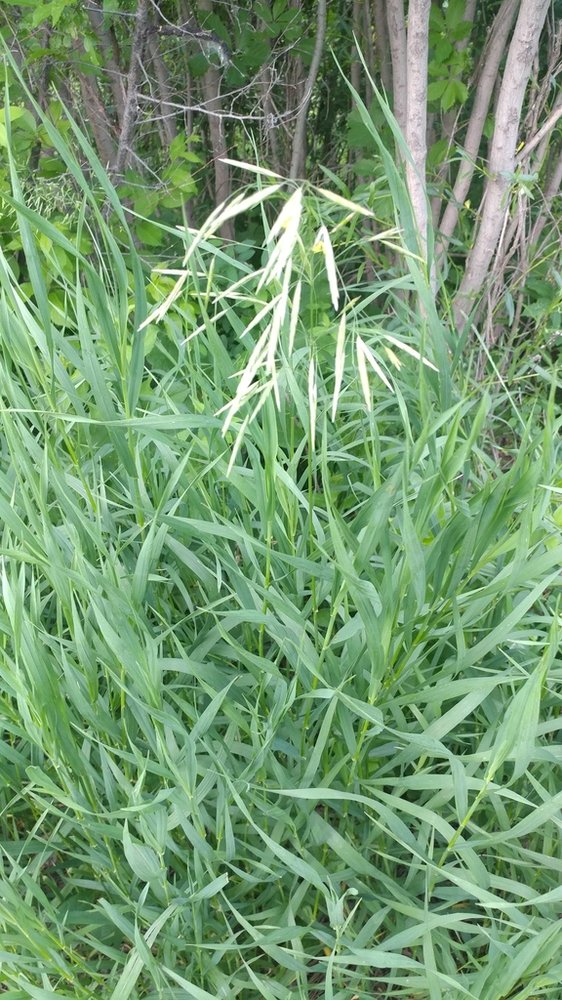
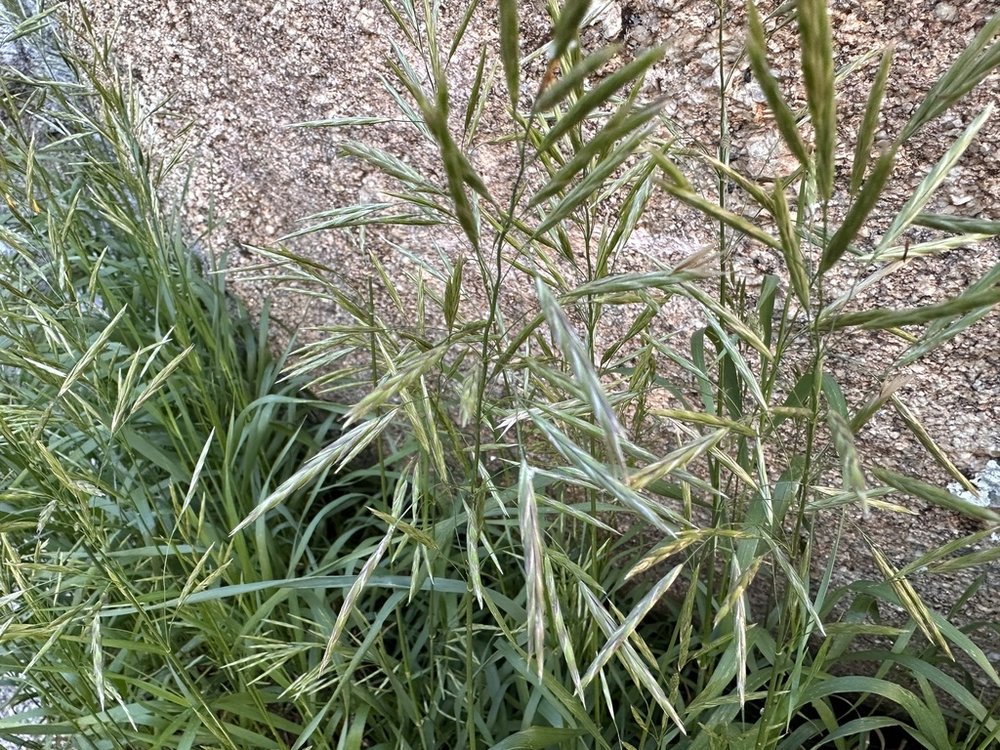
Smooth Brome (Bromus inermis) is a hay and pasture grass from Europe: a sod-forming perennial 40–130 cm (16–51 in) tall with broad, smooth leaves that often carry a W-shaped crimp partway up the blade, and an open seed head of slender, awnless spikelets that ripens purplish brown in July. It flowers in June and July and has been grown in the United States since the 1880s. In South Dakota it grows along roads and ditches and in fields and meadows and invades native grassland, and in the Black Hills it is favored for pasture and hay plantings and also grows in the forest undergrowth.
Free photos from other sources
| Family | Poaceae · Grass |
|---|---|
| Status | Introduced perennial grass |
| Blooms | June and July; the seed heads ripen purplish brown from July |
| Height | 40–130 cm (16–51 in) |
| Where | Roadsides, ditches, hayfields, pastures, meadows and the edges of woods; invades native grassland |
| Also called | Smooth bromegrass, Awnless brome, Hungarian brome, Austrian brome, Russian brome, Bromegrass |
| Note | A native subspecies, Pumpelly's brome (Bromus inermis subsp. pumpellianus), also grows in the Black Hills. The National Park Service lists it, as Bromus pumpellianus, at Jewel Cave and Devils Tower, and Black Elk and Flying By record it as a native bromegrass. The Montana Field Guide says Smooth Brome's awnless florets set it apart from the native plant. |
Roots, seeds & germination
Root: A heavy sod of creeping rhizomes (underground stems) and a large fibrous root system. The USDA fact sheet says it roots to 1.2 m (4 ft) in deep, well-drained soil. The Fire Effects Information System reports a meadow study in which most of the root mass was in the top 8 cm (3 in), and roots elsewhere as long as 2.9 m (9.4 ft).
Seed: The seed is flat, smooth and usually awnless, about 8 mm (1/3 in) long, with a tuft of white hairs at the tip, and there are about 136,000 seeds per pound (300,000 per kilogram). Seed ripens from early to late summer, and the florets drop one by one, leaving the glumes on the stalk. The seed keeps for a long time: the Fire Effects Information System cites viability of 22 months to more than 14 years, and 19-year-old seed stored in a shed still gave 20 percent germination.
Germination: Slow. The USDA fact sheet recommends spring sowing in the northern states, drilled 1.3–2 cm (1/2–3/4 in) deep into a firm seedbed. The Fire Effects Information System says the seed needs a cold, moist treatment (stratification) to germinate. Fresh treated seed germinated 83 to more than 95 percent in the laboratory, best at 20–30 °C (68–86 °F), but seed can also sprout at lower temperatures, even under snow, and light helps but is not required.
How do you identify Smooth Brome?
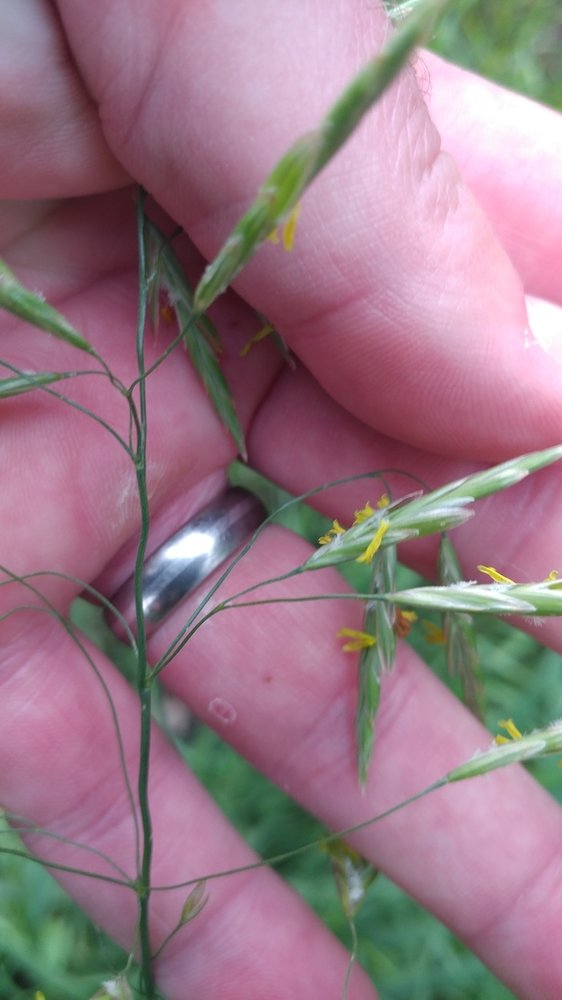
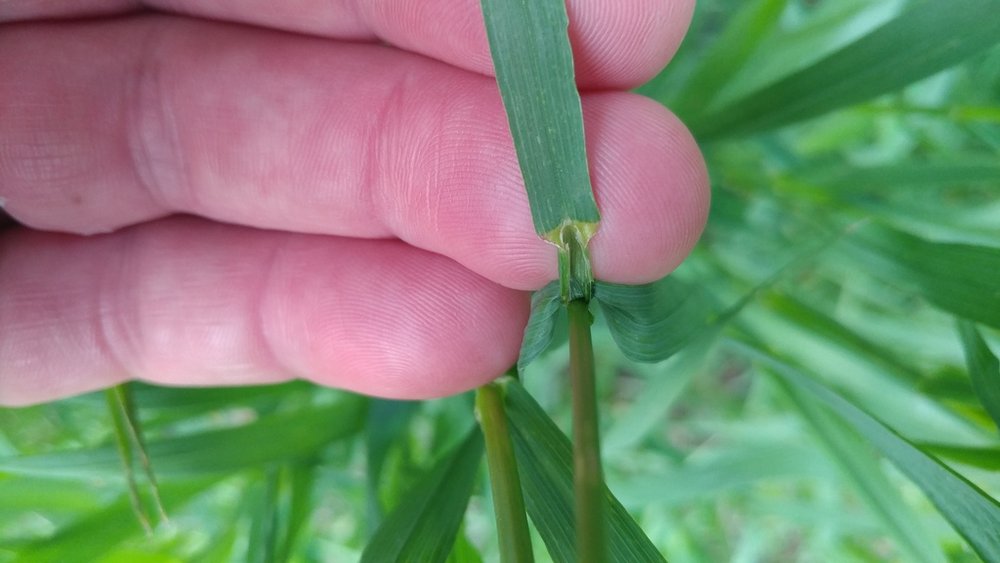
Start with the seed head: an erect, open cluster 10–20 cm (4–8 in) long with slender branches, the lowest in a whorl, each carrying narrow, slightly flattened spikelets 1.5–3 cm (about 1 in) long made of 6 to 13 florets. The florets are awnless or have only a tiny bristle under 3 mm, while most other bromes have awned florets. The Montana Field Guide says the awnless florets set it apart from the native subspecies, Pumpelly's brome, and its stiff, ascending seed-head branches from similar native bromes. The heads are green at flowering and ripen purplish brown. Then check a leaf: the blades are flat, smooth and often shiny, 10–35 cm (4–14 in) long and 5–15 mm (1/4–1/2 in) wide, and many carry a crimp or wrinkle shaped like a W or M partway up the blade, about halfway up in Minnesota's and Montana's descriptions and two thirds of the way up in SDSU's. SDSU Extension calls it a key mark and Kansas Wildflowers says it readily sets this grass apart, though Johnson and Larson note that other bromes and reed canarygrass share it. The leaf sheath is closed into a tube, open only near the top, and the ligule (the flap where blade meets stem) is a short, jagged membrane up to 3 mm long with no fringe of hairs. The stems are hairless, and the plant spreads by creeping rhizomes (underground stems) into dense, leafy colonies rather than clumps.
When does it bloom?
June and July; the seed heads ripen purplish brown from July.
Where does it grow?
Roadsides, ditches, hayfields, pastures, meadows and the edges of woods, from the foothills into the forest. Johnson and Larson say it is found statewide in planted fields, roadsides and waste areas, often invading native grassland, and that in the Black Hills it is one of the grasses favored for pasture and hay plantings; SDSU Extension calls it a frequent invader of native grassland that outcompetes native plants, and the Fire Effects Information System says it is a common invader of disturbed Great Plains prairie. The 1987 Forest Service habitat-type study of the Black Hills National Forest recorded it in the undergrowth of several forest types, from ponderosa pine and snowberry stands to white spruce, and the 1986 Jewel Cave vegetation survey lists it. The National Park Service lists it at Wind Cave National Park, Jewel Cave National Monument, Mount Rushmore National Memorial and Devils Tower National Monument. Herbarium specimens come from Lawrence (1908 to 2025), Pennington, Custer, Meade and Fall River counties in South Dakota and Crook and Weston counties in Wyoming, including Custer State Park and the Bear Lodge Mountains, at about 950–2,110 m (3,100–6,900 ft). Their labels describe streetsides and alleys, roadsides and ditches, open meadows, streamsides, a moist meadow with willow thickets, hazelnut thickets in birch woods, and ponderosa pine and aspen woods. iNaturalist has about 175 research-grade records of it in and around the Black Hills, more than any other grass.
Other grasses in this guide
Compare all 11 grasses side by side
Big Bluestem
Andropogon gerardii
Blue Grama
Bouteloua gracilis
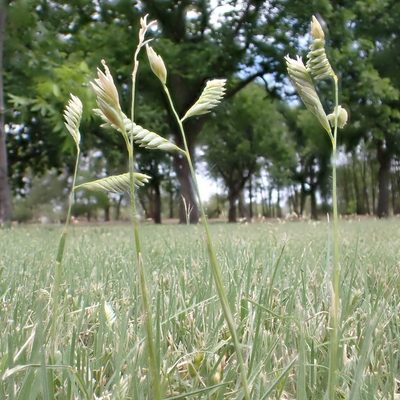
Buffalo Grass
Bouteloua dactyloides
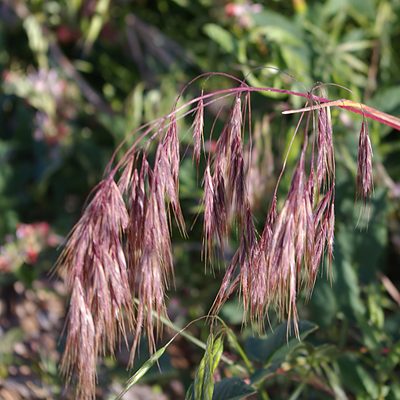
Cheatgrass
Bromus tectorum
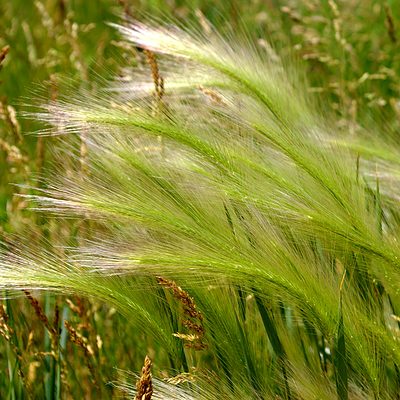
Foxtail Barley
Hordeum jubatum
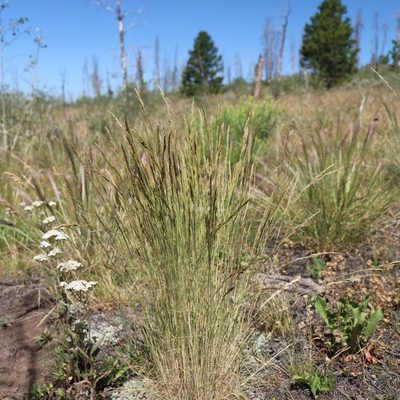
Idaho Fescue
Festuca idahoensis
Little Bluestem
Schizachyrium scoparium
Needle-and-thread
Hesperostipa comata
Prairie Junegrass
Koeleria macrantha
Timothy
Phleum pratense
Sources: USDA PLANTS Database: Bromus inermis (BRIN2), plant profile service; USDA NRCS Plant Fact Sheet: Smooth brome, Bromus inermis (Bush, Rose Lake Plant Materials Center); USDA Forest Service Fire Effects Information System: Bromus inermis (Howard 1996); SDSU Extension P-00231: Cool-Season Grasses of South Dakota (Ehlert and Bachler 2022); Johnson and Larson 1999, Grassland Plants of South Dakota and the Northern Great Plains (SDSU bulletin 566), Open PRAIRIE; Kansas Wildflowers and Grasses: Bromus inermis (Smooth brome); Minnesota Wildflowers: Bromus inermis (Smooth Brome); Montana Field Guide: Smooth Brome, Bromus inermis; Hoffman and Alexander 1987, Forest Vegetation of the Black Hills National Forest: A Habitat Type Classification (USDA Forest Service RM-276); Marriott and Hartman 1986, A Survey of the Vegetation of Jewel Cave National Monument; NPSpecies checklist, Wind Cave National Park vascular plants; NPSpecies checklist, Jewel Cave National Monument vascular plants; NPSpecies checklist, Mount Rushmore National Memorial vascular plants; NPSpecies checklist, Devils Tower National Monument vascular plants; GBIF occurrence search: Bromus inermis, South Dakota and Wyoming herbarium specimens; iNaturalist: research-grade Bromus inermis records in the Black Hills; Black Elk and Flying By 1998, Culturally Important Plants of the Lakota (entry 57, Pumpelly's bromegrass, the native subspecies), filed with the South Dakota PUC.