Cheatgrass Bromus tectorum
Also called Downy Brome, Downy Chess, Bronco Grass, Military Grass
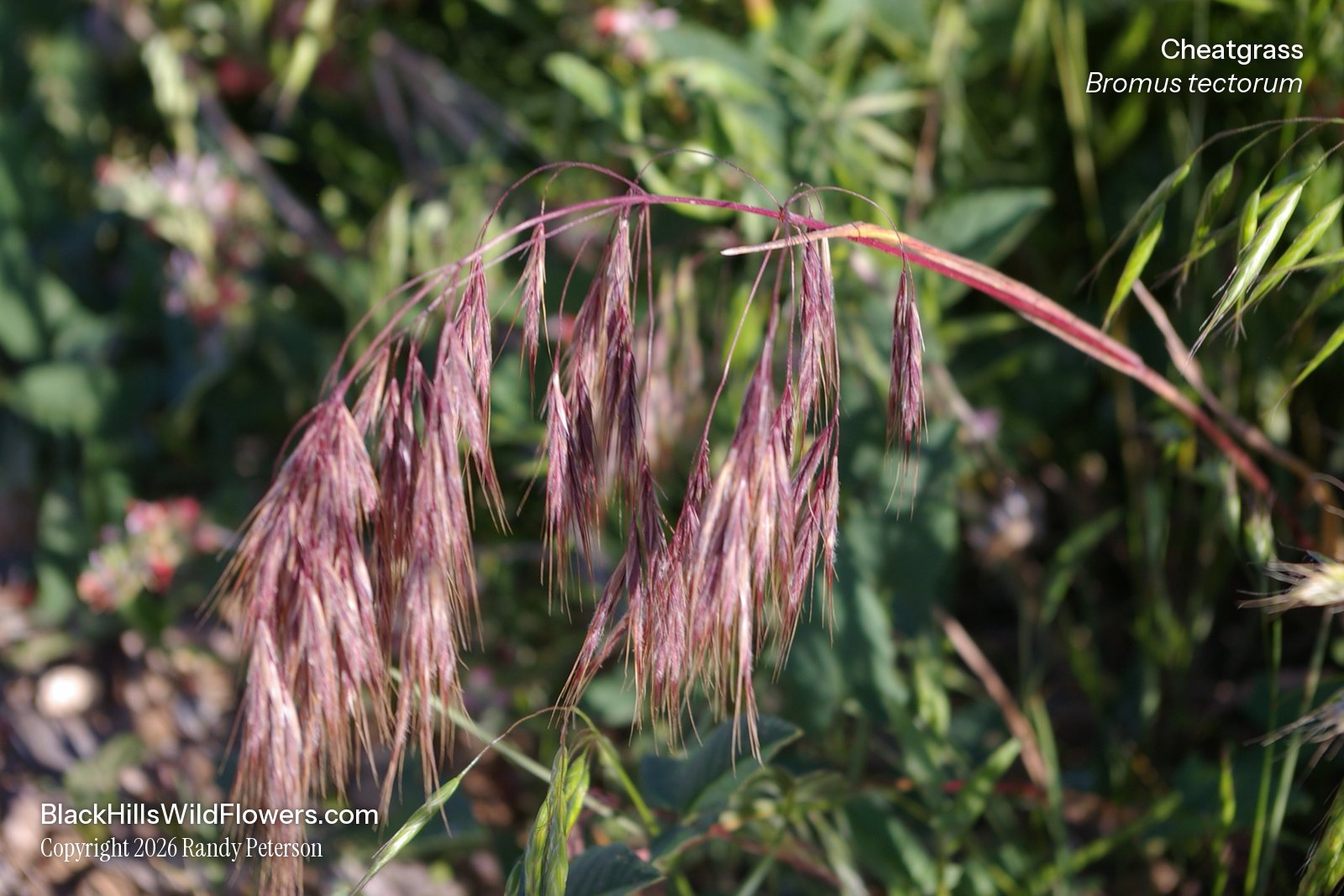
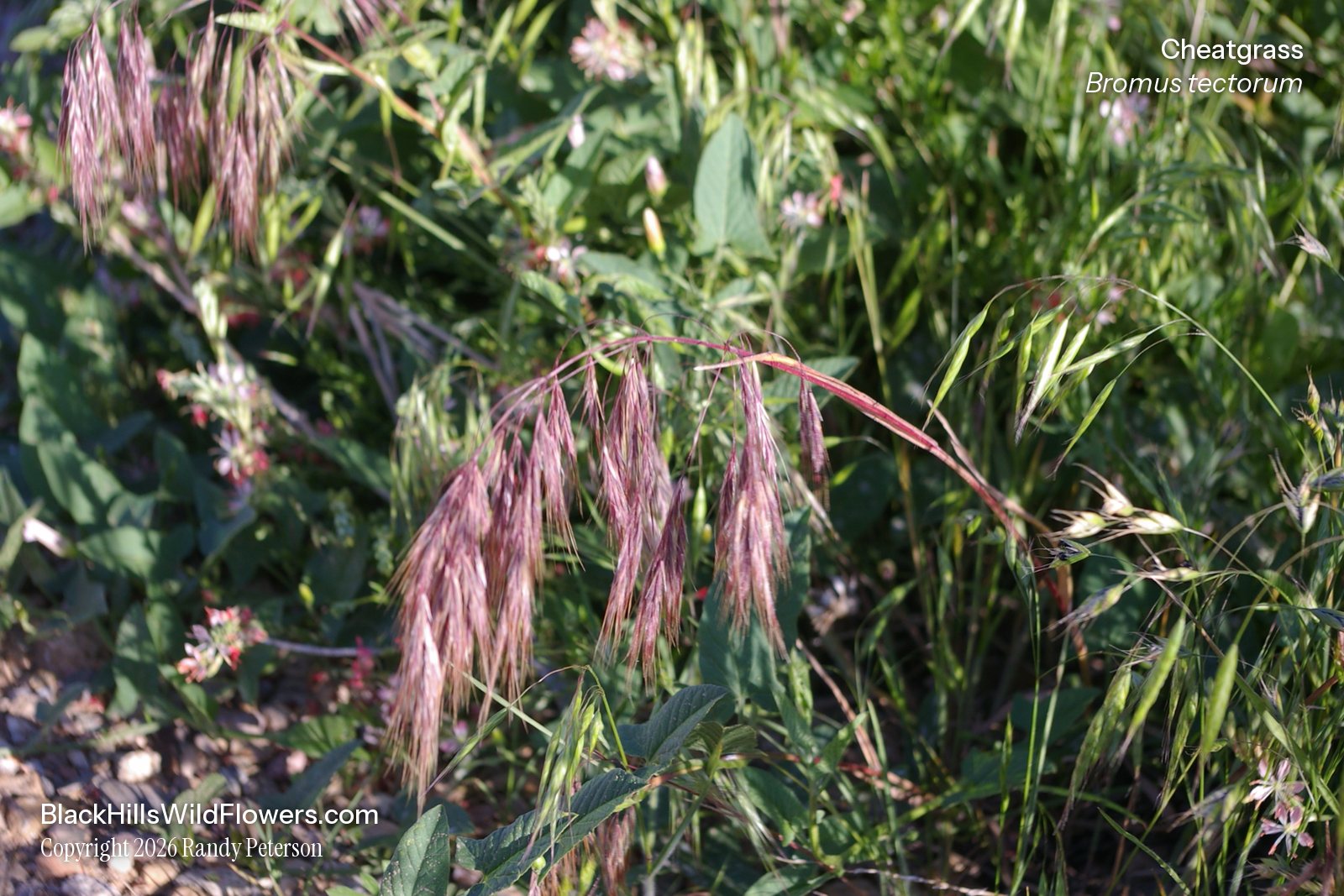
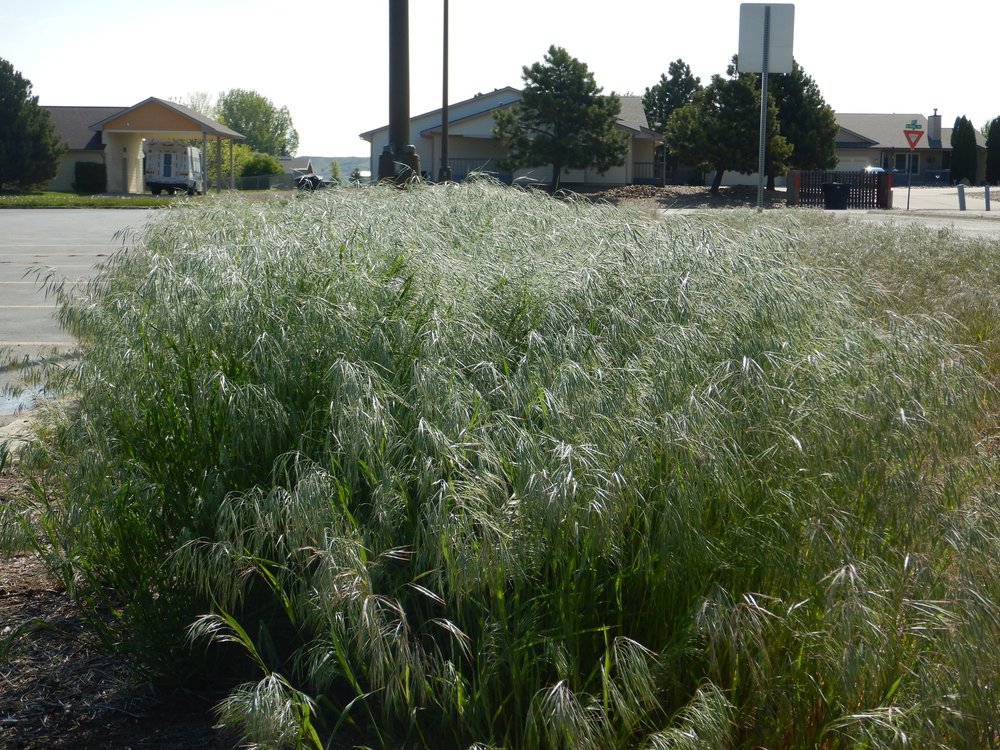
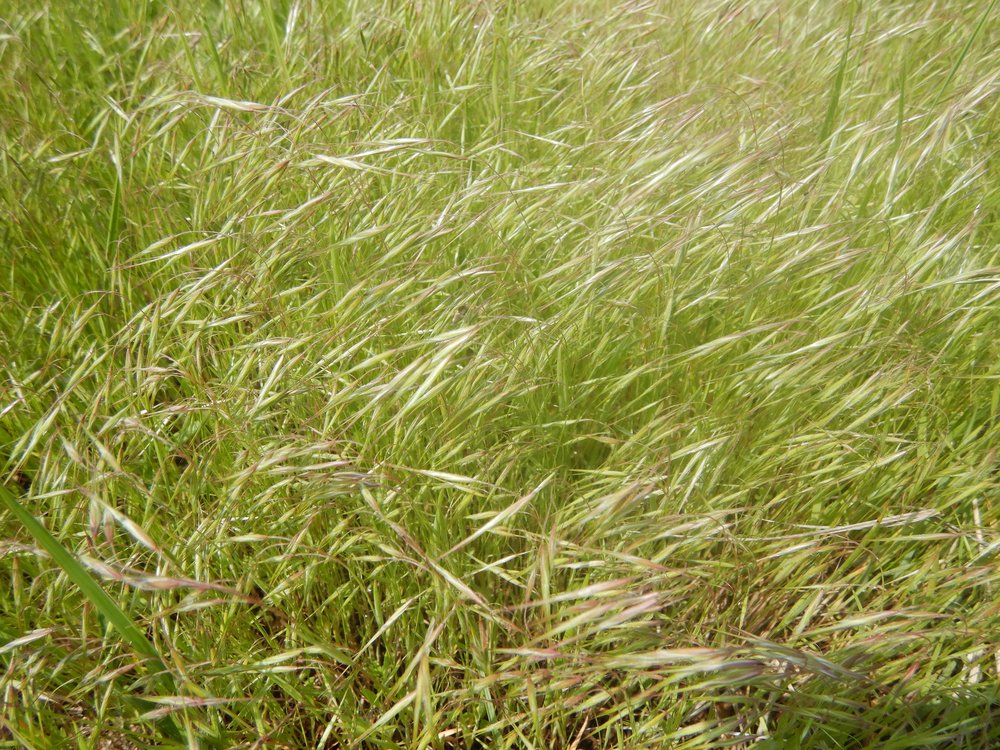
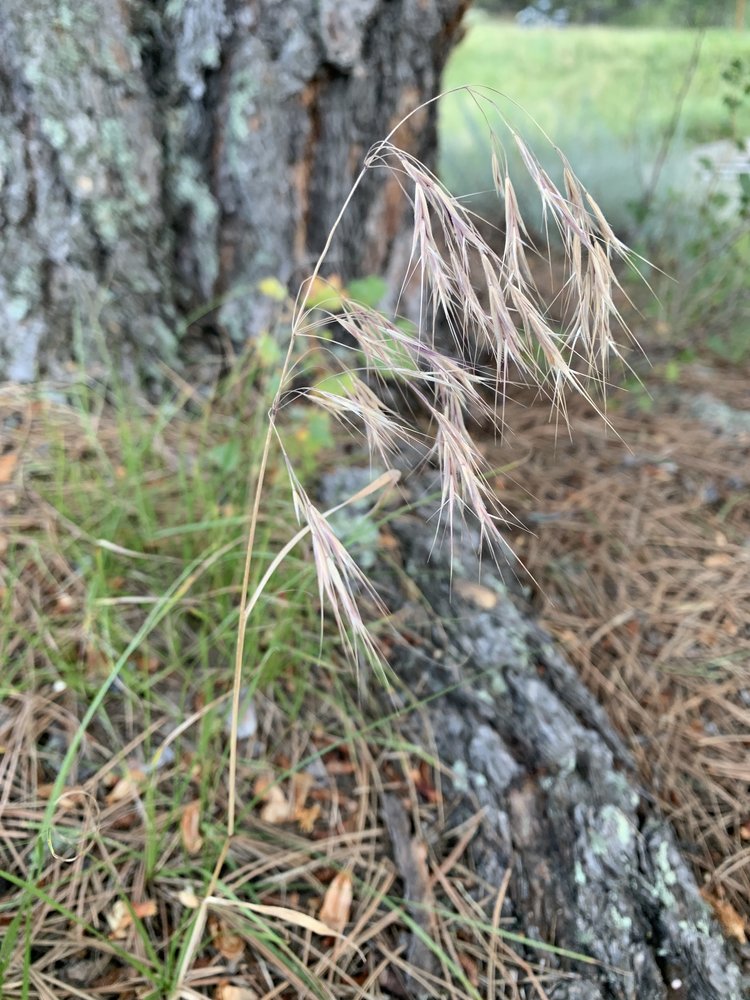
Cheatgrass (Bromus tectorum) is an introduced annual grass from Europe that greens up early, flowers from May into July, and dies and turns straw-colored soon after its seed ripens, its soft, drooping seed heads turning purple on the way. The long awns on its seeds stick in clothing and fur, and the dry stands burn readily. In the Black Hills it grows on roadsides, in pastures and in open pine woods, and the National Park Service lists it at Wind Cave, Jewel Cave, Mount Rushmore and Devils Tower. Photographed in the Black Hills.
Free photos from other sources
| Family | Poaceae · Grass |
|---|---|
| Status | Introduced annual grass |
| Blooms | Flowers from May into July; the heads turn purple, then straw-colored, as the seed ripens in June and July |
| Height | 10–60 cm (4–24 in) |
| Where | Roadsides, overgrazed range, pastures, fields, waste ground and dry, open pine understory |
| Also called | Downy Brome, Downy Chess, Bronco Grass, Military Grass |
| Synonym | Anisantha tectorum, Bromus tectorum var. glabratus, Bromus tectorum var. hirsutus, Bromus tectorum var. nudus |
| Listed | County-declared weed in Weston County, Wyoming (University of Wyoming CAPS county list). Not on South Dakota's state or locally noxious lists, and not on Wyoming's state designated list |
| Toxicity | The sharp, barbed florets work into the eyes, mouths and noses of grazing animals, and the florets can carry ergot, a fungus toxic to livestock. |
Roots, seeds & germination
Root: A finely divided, fibrous root system with about 7 main roots. Most roots are in the top 30 cm (12 in) of soil, though they can reach 87–150 cm (34–60 in). The roots keep growing through winter at soil temperatures as low as 3 °C (37 °F), so by spring the plant has used up the shallow soil moisture before native perennial grasses start growing. The plants don't root at the nodes.
Seed: Reproduction is by seed only. A plant in a dense stand may make about 25 seeds, an open-grown plant about 400, and a single plant with plenty of moisture and sun 5,000 or more. The seed is viable as soon as the head has barely begun to turn purple, and the head shatters within about a week of ripening. Most seed drops near the parent, but the barbed florets catch in clothing, fur and feathers, and hay and vehicles carry them long distances. Nearly all of it sprouts as soon as conditions allow, though some viable seed carries over in the litter and soil to the next year.
Germination: Usually a winter annual: the seed germinates in early fall when there is enough moisture, the seedlings overwinter, and growth resumes in spring. Seed can sprout at temperatures just above freezing, and temperatures above 30 °C (86 °F) hold germination back. Seed that sprouts in spring instead gives fewer, smaller plants with less seed. In Nebraska, seedlings come up best from less than 2.5 cm (1 in) of soil, though some have emerged from 10 cm (4 in).
How do you identify Cheatgrass?
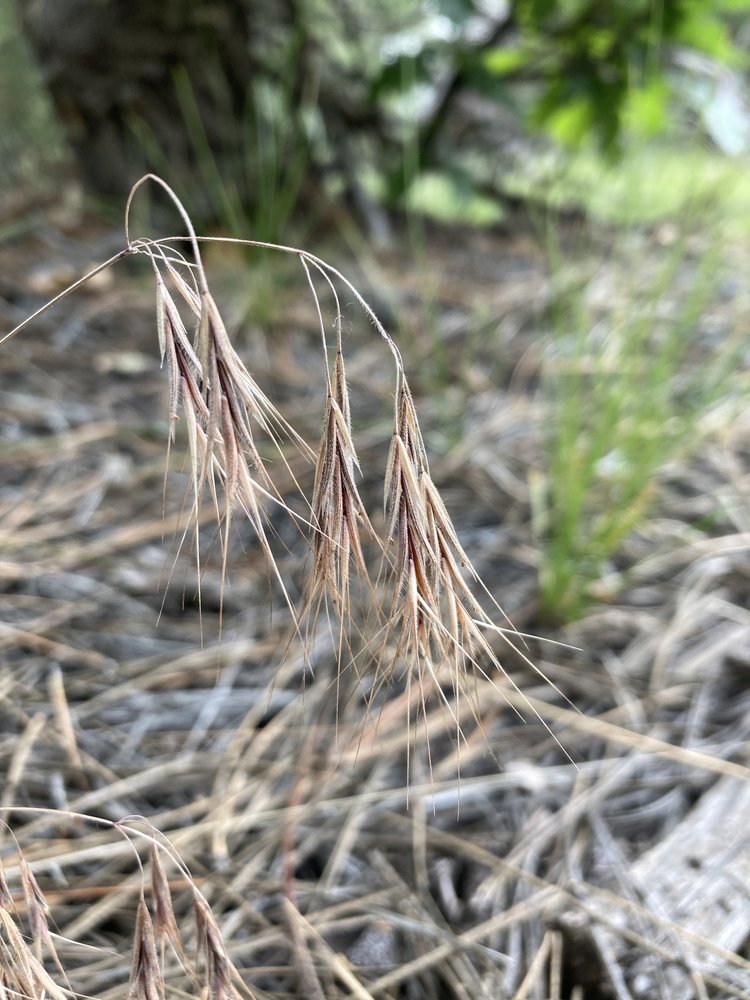
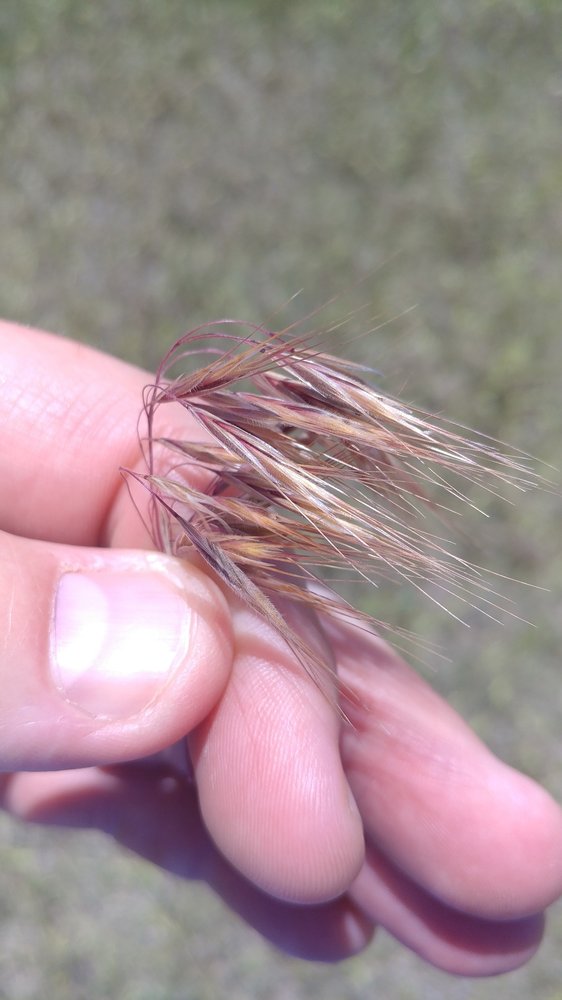
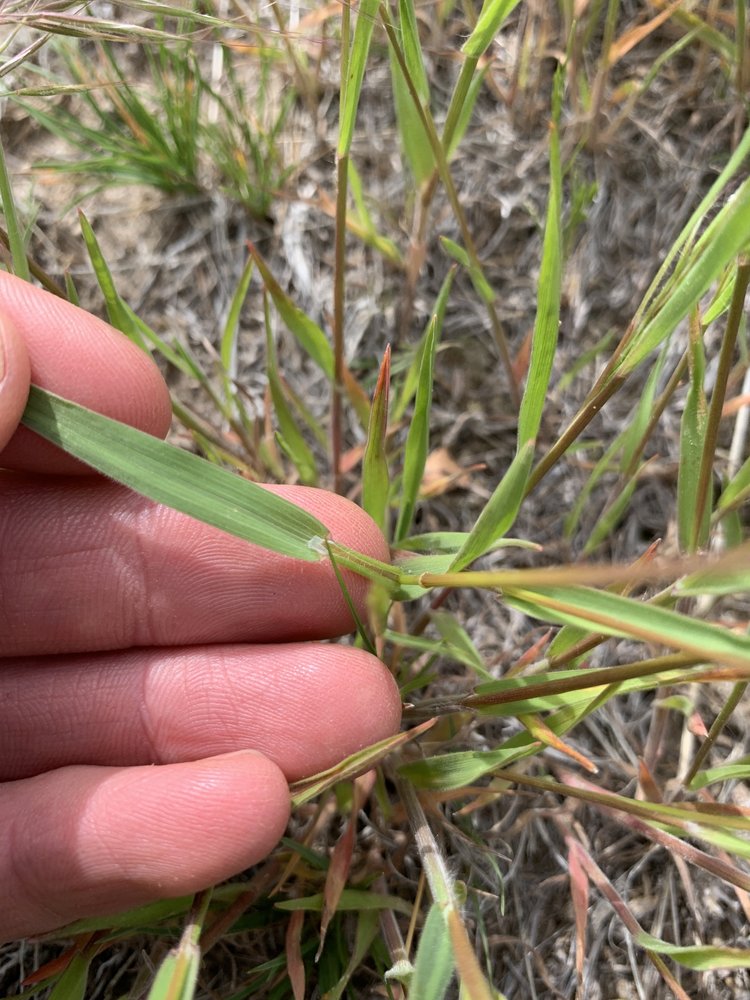
Start with the seed head: a soft, open panicle 5–20 cm (2–8 in) long that droops to one side, each spikelet holding 3 to 8 florets with nearly straight awns about 1–2 cm (½–¾ in) long. It is green at first, turns dull red-purple as the seed ripens, and cures to straw color long before the native grasses mature. The flat, narrow leaf blades and the sheaths are covered in short, soft hairs (the reason for the name downy brome), the ligule is a thin, jagged flap, and there are no ear-like lobes at the collar. The slender stems grow alone or in small tufts 10–60 cm (4–24 in) tall and are finely hairy just below the head. The first purple color is taken as a warning that hazardous fire conditions will follow within about two weeks, and dry stands stay highly flammable from late spring into fall. Japanese brome, another weedy annual brome, has awns under 10 mm, mostly hairless glumes and lemmas, and 7 to 15 florets per spikelet. Smooth brome is a perennial that spreads by rhizomes and is mostly hairless, while most other bromes have hairy sheaths and nodes; its lemmas are awnless or short-awned, and its panicle stands erect at flowering and only nods later.
When does it bloom?
Flowers from May into July; the heads turn purple, then straw-colored, as the seed ripens in June and July.
Where does it grow?
Disturbed, dry ground: roadsides and road cuts, overgrazed rangeland, pastures, hay fields, waste places and the dry, open understory of ponderosa pine forest, from about 940 to 1,670 m (3,100 to 5,500 ft) on labels from Black Hills counties. The National Park Service lists it as present at Wind Cave, Jewel Cave, Mount Rushmore and Devils Tower, the 1986 plant survey of Jewel Cave records it, and herbarium specimens from 1910 to 2025 come from Lawrence, Pennington, Custer, Meade and Fall River counties in South Dakota and Crook and Weston counties in Wyoming. It probably reached North America several times, in ship ballast, contaminated crop seed and packing straw, and by the early 1900s it was in much of its present range.
Other grasses in this guide
Compare all 11 grasses side by side
Big Bluestem
Andropogon gerardii
Blue Grama
Bouteloua gracilis
Buffalo Grass
Bouteloua dactyloides
Foxtail Barley
Hordeum jubatum
Idaho Fescue
Festuca idahoensis
Little Bluestem
Schizachyrium scoparium
Needle-and-thread
Hesperostipa comata
Prairie Junegrass
Koeleria macrantha
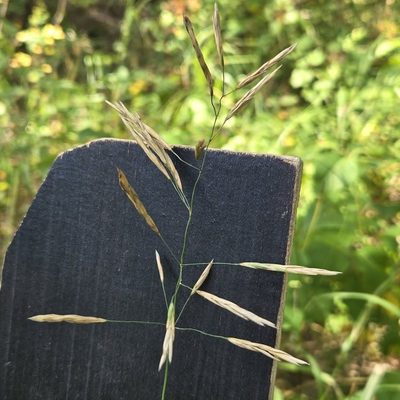
Smooth Brome
Bromus inermis
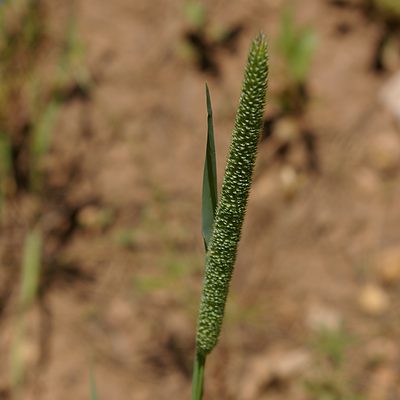
Timothy
Phleum pratense
Sources: USDA PLANTS profile: Bromus tectorum L., BRTE; USDA NRCS Plant Guide: Cheatgrass, Bromus tectorum (Skinner and others); USDA Forest Service Fire Effects Information System: Bromus tectorum (Zouhar 2003); Montana Field Guide: Cheatgrass, Bromus tectorum (Montana Natural Heritage Program); Minnesota Wildflowers: Bromus tectorum (Cheatgrass); Minnesota Wildflowers: Bromus inermis (Smooth Brome); Kansas Wildflowers and Grasses: Downy brome, Bromus tectorum (Haddock); University of Nebraska–Lincoln Extension NebGuide G422: Downy Brome Control (Klein, Lyon and Wilson 2008); University of Wyoming CAPS: Bromus tectorum, Cheatgrass (Downy Brome), county declared weed list; Wyoming Weed and Pest Council: Identify Noxious Weeds (state designated list); South Dakota DANR: State Noxious Weed and Pest List; South Dakota DANR: Locally Noxious Weed and Pest List (updated 2024); NPSpecies checklist, Wind Cave National Park vascular plants; NPSpecies checklist, Jewel Cave National Monument vascular plants; NPSpecies checklist, Mount Rushmore National Memorial vascular plants; NPSpecies checklist, Devils Tower National Monument vascular plants; Marriott and Hartman 1986, A Survey of the Vegetation of Jewel Cave National Monument; GBIF occurrence search: Bromus tectorum, South Dakota herbarium specimens; GBIF occurrence search: Bromus tectorum, Wyoming herbarium specimens; ITIS: synonyms of Bromus tectorum L. (TSN 40524).