Field Horsetail Equisetum arvense
Also called Common Horsetail, Bottlebrush, Pinetop, Jointed Rush, Horse Pipes, Mare's Tail, Snake Grass, waŋyéča swúla (Lakota), pȟeží swúla (Lakota)
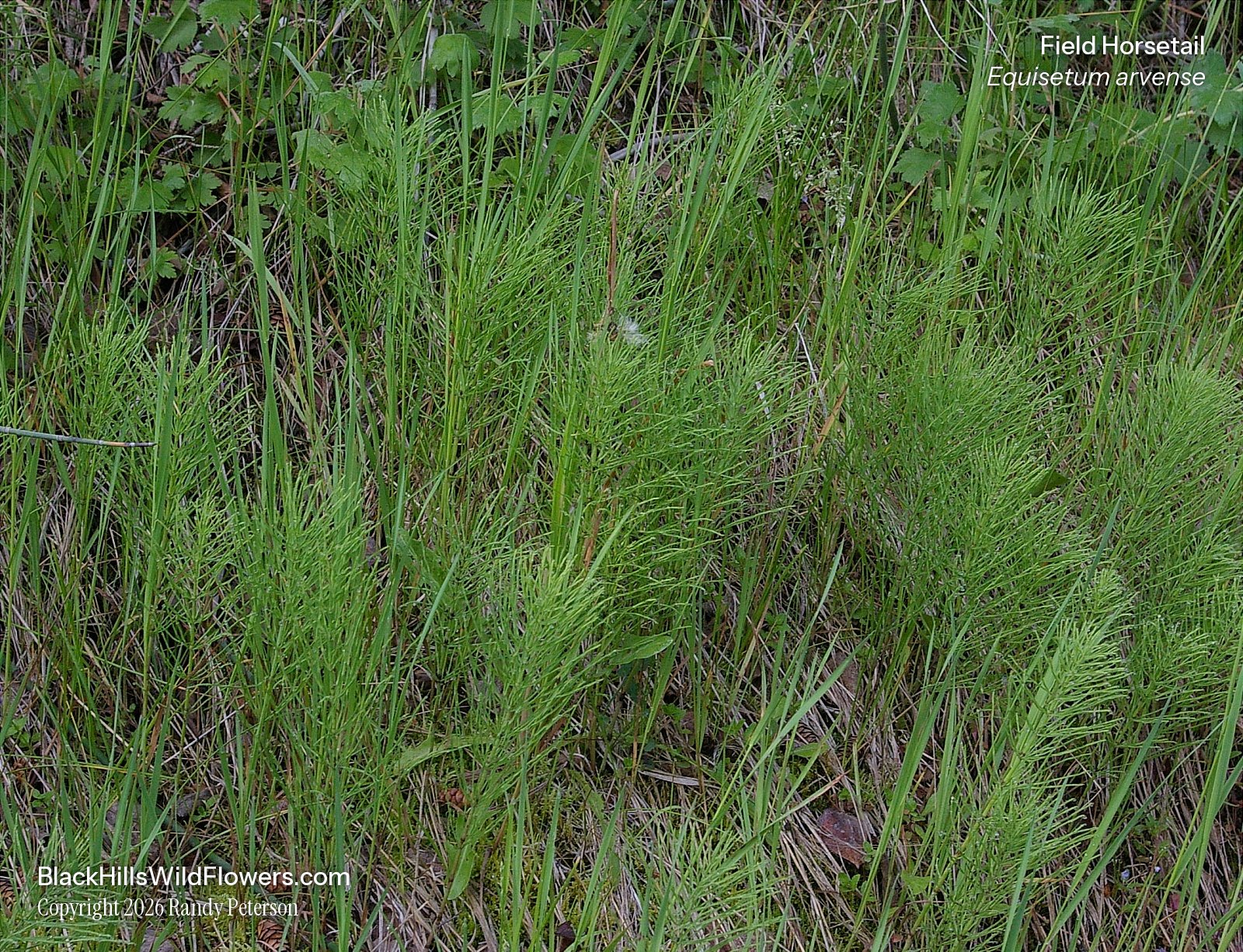
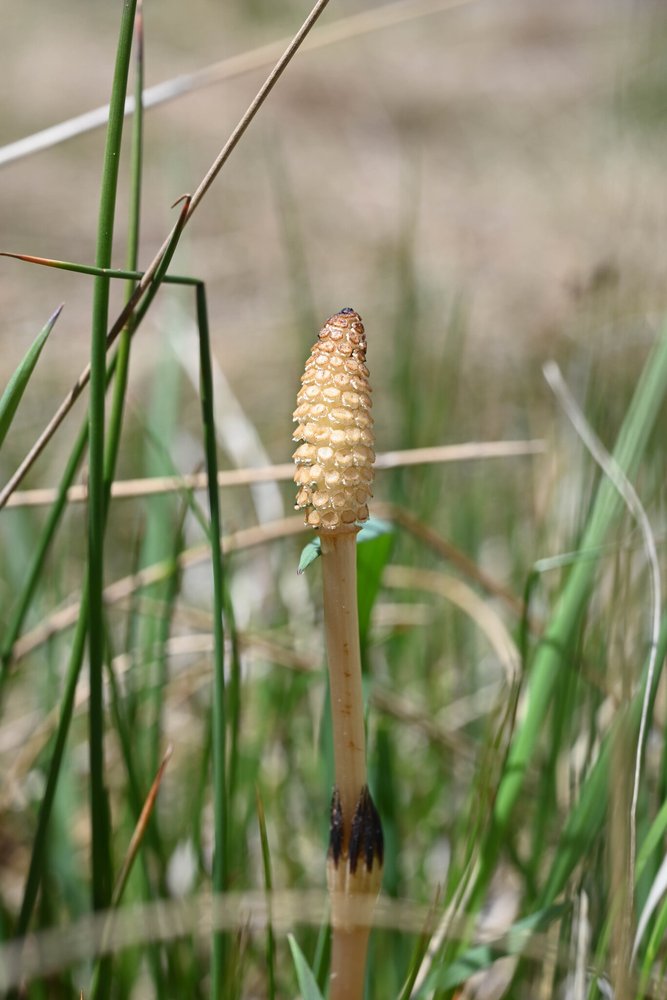
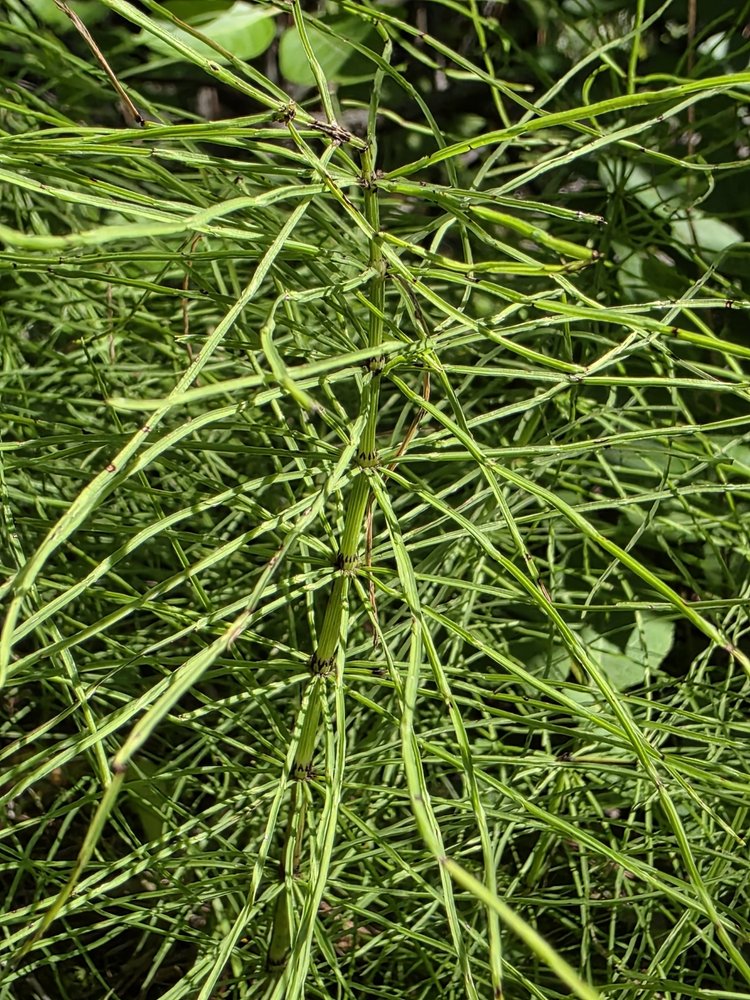
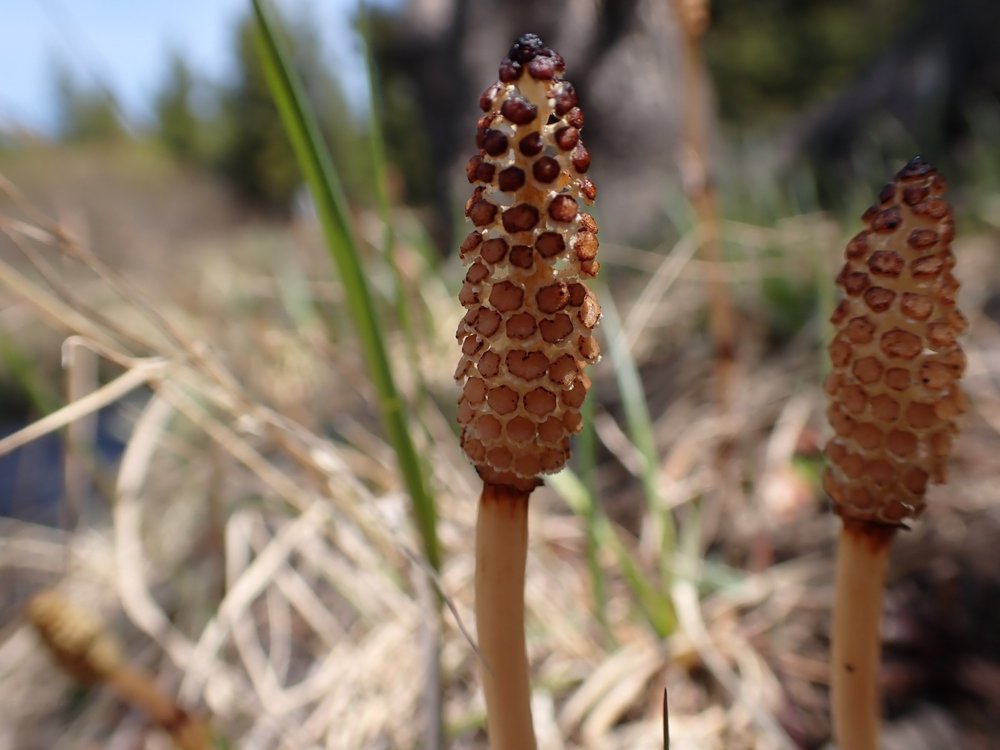
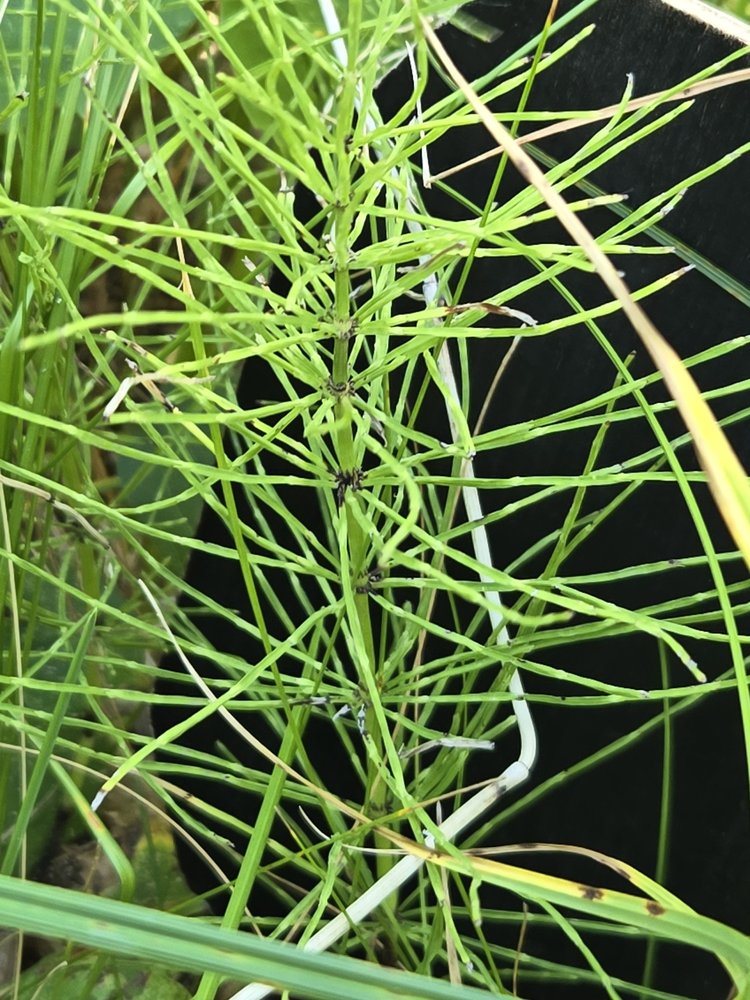
Field Horsetail (Equisetum arvense) is a native perennial with two kinds of stems: in early spring a brown, leafless stem 5–30 cm (2–12 in) tall comes up carrying a blunt spore cone and dies once the spores are shed, and then green, hollow, jointed stems 5–60 cm (2–24 in) tall follow, ringed at every joint by a whorl of slender branches like a small bottlebrush. It has no flowers or seeds. In the Black Hills it grows along creeks, in wet meadows, spruce bottoms and ditches, and the National Park Service lists it at Wind Cave, Mount Rushmore and Devils Tower. Photographed in the Black Hills.
Free photos from other sources
| Family | Equisetaceae · Horsetail |
|---|---|
| Status | Native perennial |
| Blooms | No flowers; brown cone-bearing stems in early spring, then green branched stems from May until hard frost |
| Height | 5–60 cm (2–24 in) |
| Where | Creek banks and floodplains, wet meadows and fens, spruce and birch bottoms, springy slopes, ditches and roadsides |
| Also called | Common Horsetail, Bottlebrush, Pinetop, Jointed Rush, Horse Pipes, Mare's Tail, Snake Grass, waŋyéča swúla (Lakota), pȟeží swúla (Lakota) |
| Synonym | Equisetum arvense var. boreale, Equisetum arvense var. alpestre, Equisetum arvense var. riparium, Equisetum calderi |
| Toxicity | Poisonous to horses when it makes up more than about a fifth of their hay, causing scours, paralysis and death; it contains thiaminase and alkaloids. |
| Traditional use | Black Elk and Flying By (1998) record that the Lakota sometimes ate the plant when it was very young, and that a decoction (a boiled extract) of it, which is quite astringent, was used to stop bleeding. Gilmore (1919) recorded that the Omaha, Ponca and Pawnee used horsetail (he names no species) for polishing, as sandpaper is used today. Moerman's database records that the Blackfoot took an infusion of the fertile stems as a diuretic (Hellson 1974) and that the Cheyenne gave an infusion of the leaves and stems to horses with a hard cough (Grinnell 1972). |
Traditional use: first drafted by Google AI, then checked against the sources on this page.
Roots, seeds & germination
Root: Branched, creeping rhizomes (underground stems) that look like the aerial stems but are solid rather than hollow, with storage tubers. They reach 1 m (40 in) deep or more, in layered horizontal systems about 30 cm (12 in) apart, with half the rhizome weight in the top 25 cm (10 in). Even a 3 cm (1 in) piece of broken rhizome will sprout, and the rhizomes survive even very hot fires.
Seed: None. The brown spring stems carry a blunt cone 1–3.5 cm (½–1½ in) long made of whorls of shield-shaped scales with spore cases underneath. The spores are thin-walled and short-lived, with ribbon-like bands that coil and uncoil as the humidity changes, tangling spores together and working them into the soil; wind and water carry them.
Germination: Spores sprout quickly in moist conditions into tiny plants a few cell layers thick, usually male or female, which need water for the swimming sperm to reach the egg; the new horsetail then grows out of that tiny plant in place. The right conditions are rare, so most spread is by the rhizomes.
How do you identify Field Horsetail?
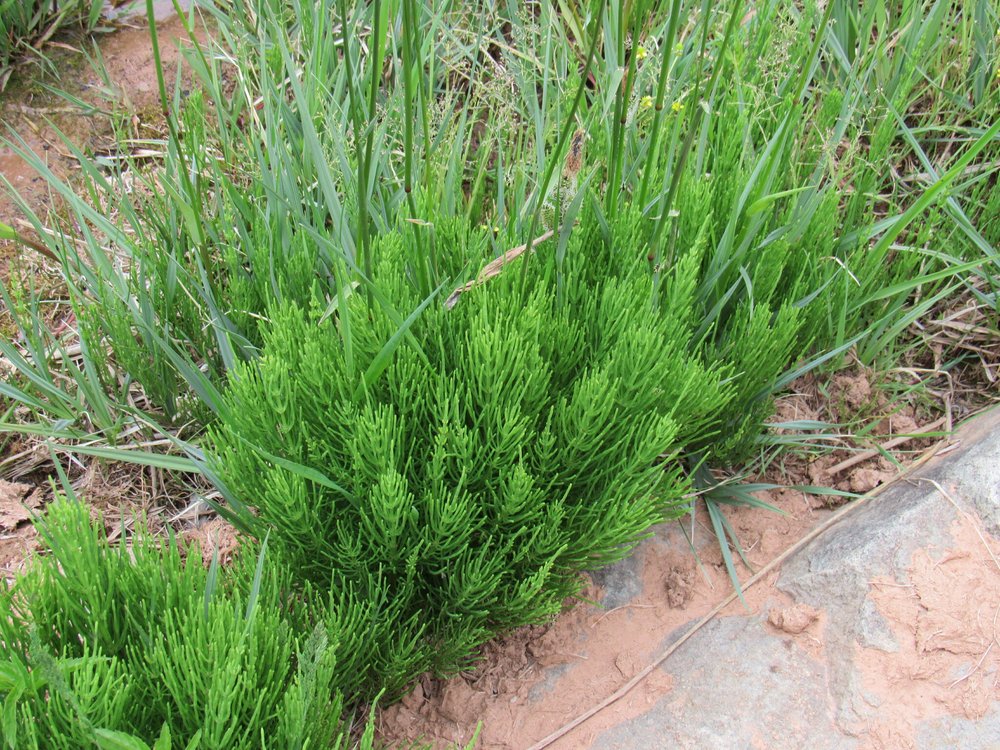
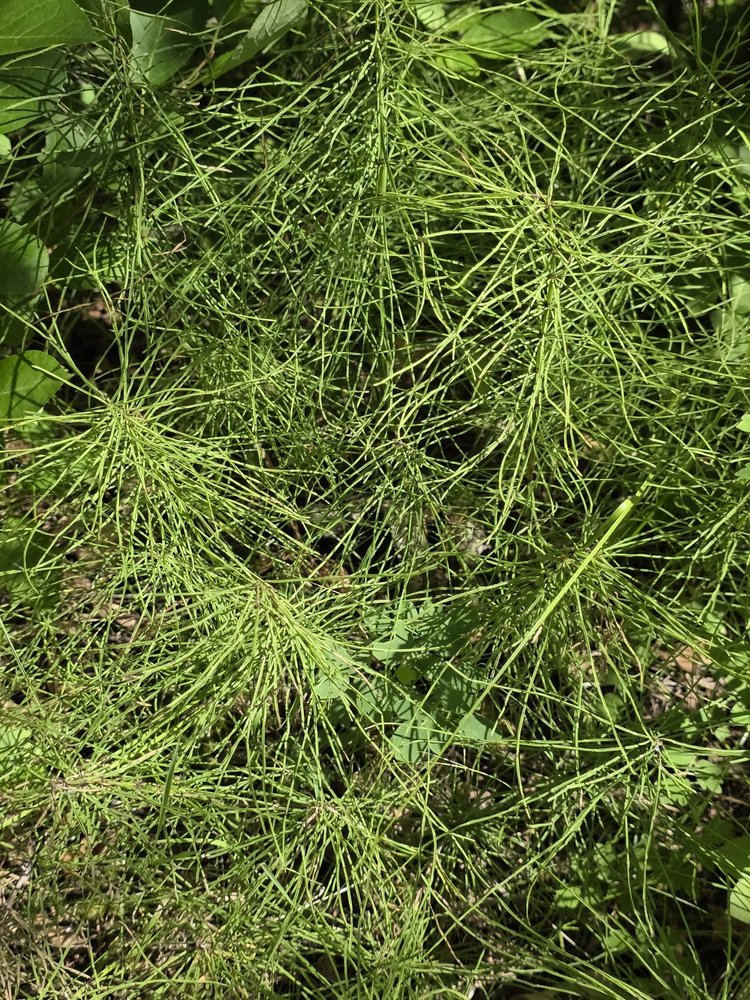
Look for the two stem types. In early spring a brown or flesh-colored, unbranched, fleshy stem 5–30 cm (2–12 in) tall carries a blunt cone 1–3.5 cm (½–1½ in) long at its tip, made of whorls of shield-shaped scales; it dies once the spores are shed. From May on, green, hollow, jointed stems 5–60 cm (2–24 in) tall take over, with a sheath at each joint whose 4 to 14 narrow dark teeth are often joined in twos or threes, and a whorl of solid, three- or four-angled branches rising from each joint; the first segment of each branch is longer than the stem sheath beside it, and the stems feel rough from silica. In moist shade the branches grow long and spreading; in dry sun the plant may lie nearly flat or look like a small shrub, with many stems from the base. Scouring rush, which the National Park Service lists at Wind Cave and Mount Rushmore, belongs to the other half of the genus: its stems are unbranched, last more than a year, carry a dark band on each sheath, and end in a pointed cone that ripens in summer, while field horsetail's green stems are branched and last a year or less, and its cones come only on the brown spring stems. Meadow horsetail's lowest branches have a first segment shorter than the stem sheath and spread or droop, and marsh horsetail has 5 or 6 teeth on each branch sheath instead of 3 or 4.
When does it bloom?
No flowers; brown cone-bearing stems in early spring, then green branched stems from May until hard frost.
Where does it grow?
Moist ground: creek banks and floodplains, wet meadows and fens, spruce and birch bottoms, mossy, springy slopes, lake shores, ditches and roadsides, from about 1,130 to 1,980 m (3,700 to 6,500 ft), and sometimes dry, sandy roadsides. Herbarium specimens from 1892 to 2014 come from Lawrence, Pennington, Custer and Fall River counties in South Dakota, including Custer State Park, and from Crook County, Wyoming, including the Bear Lodge Mountains. The National Park Service lists it as present at Wind Cave, Mount Rushmore and Devils Tower, and across its range it grows on roadsides, riverbanks, fields, marshes and pastures from sea level to 3,200 m.
Other horsetails in this guide
Sources: Flora of North America vol. 2: Equisetum arvense (R. L. Hauke), eFloras; Flora of North America vol. 2: genus Equisetum, with key (R. L. Hauke), eFloras; Flora of North America vol. 2: Equisetum hyemale subsp. affine (scouring rush), eFloras; USDA Forest Service Fire Effects Information System: Equisetum arvense (Sullivan 1993); SDSU Open PRAIRIE: Equisetaceae: Equisetum arvense (R. Neil Reese), entry 300; Minnesota Wildflowers: Equisetum arvense (Field Horsetail); USDA PLANTS profile: Equisetum arvense L., EQAR; Culturally Important Plants of the Lakota (Black Elk and Flying By 1998), filed with the South Dakota PUC, entry 114 Equisetum arvense; NPSpecies checklist, Wind Cave National Park vascular plants; NPSpecies checklist, Mount Rushmore National Memorial vascular plants; NPSpecies checklist, Devils Tower National Monument vascular plants; GBIF occurrence search: Equisetum arvense, South Dakota herbarium specimens; GBIF occurrence search: Equisetum arvense, Wyoming herbarium specimens; Gilmore 1919, Uses of Plants by the Indians of the Missouri River Region; Moerman, Native American Ethnobotany database: Equisetum arvense.