Grasses of the Black Hills
All 11 grasses in this guide, side by side, A to Z. Compare the photos, bloom time, height and where each grows, then open the one that fits for more photos and the full ID notes. Each plant's page lists its sources.
| Plant | Blooms | Height | Where | How to tell it apart |
|---|---|---|---|---|
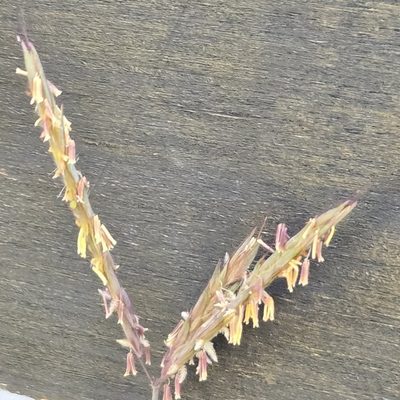 Big BluestemAndropogon gerardii | July into September; the dead stalks stand through winter | 1–2 m (3–7 ft) | Grassland, meadows, draws, floodplains and openings in pine and oak woods; also sandy slopes and roadsides | The seed head settles it: at the top of a tall, stout stalk, 2 to 6 (usually 3) finger-like spikes 5–10 cm (2–4 in) long spread from one point like a turkey's foot, purplish to yellowish brown. Each spike carries spikelets in pairs, one stalkless and fertile with a twisted, bent awn 1–2 cm (½–¾ in) long, the other on a short hairy stalk. Below the seed head the stem is round, solid and hairless, often bluish to purple under a waxy coating, with purplish joints. The leaves are flat, 6–13 mm (1/4–1/2 in) wide and up to 60 cm (2 ft) long, rough on top and usually with long white hairs near the base of the blade where it meets the sheath; the sheaths are slightly flattened and usually hairy, and the ligule (the flap at the base of the blade) is a short fringed membrane 1–2.5 mm long. Clumps grow from short, scaly rhizomes (underground stems), and the dead stalks stay standing through winter. Little Bluestem is the lookalike on this site: it is shorter, each of its stems ends in a single fuzzy spike, and Johnson and Larson and SDSU Extension both point out that its lower stems and sheaths are flatter and hairless. Sand Bluestem, a close relative of sandy ground, has dense yellow hairs on its seed heads and straw-colored stems. |
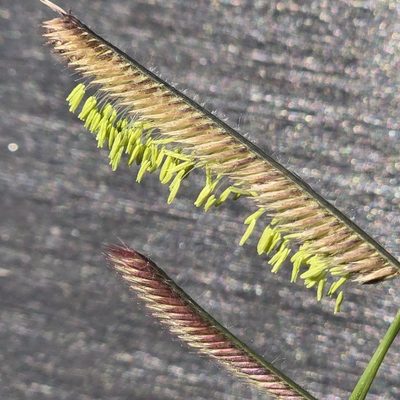 Blue GramaBouteloua gracilis | June into August; the dry seed heads curl into eyebrows and stand into winter | 15–50 cm (6–20 in) | Dry prairie and foothill grassland, open ground under ponderosa pine, rocky and sandy slopes | The seed head is the mark: usually 2 (sometimes 1 to 3) short spikes 1.5–5 cm (up to 2 in) long set at a sharp angle near the top of a thin stalk, each packed with 40 to 90 spikelets in two rows along one side, so it looks like a comb or an eyebrow. The spikes are bluish purple when young, then straw-colored, and they curl back as they dry and stay on the plant into winter. The spike does not end in a bare point: the stalk stops at the last spikelet. The leaves are mostly at the base, narrow (about 2 mm wide), 2.5–15 cm (1–6 in) long, gray-green, and they curl as they cure; the blades are nearly hairless, with few or no hairs along the edges, the ligule (the flap where blade meets stem) is a fringe of tiny hairs, and the plant grows as a dense tuft that spreads into an open sod. The lookalike on this site is Buffalo Grass, which often grows with it: SDSU Extension and Johnson and Larson say Buffalo Grass has hairy leaf blades and edges and spreads by runners along the ground (stolons), while Blue Grama's blades are nearly hairless and it very rarely makes runners; the male Buffalo Grass flower looks like a miniature Blue Grama seed head. Hairy Grama, on dry sandy ground, has stiff hairs on the leaf edges and its spike stalk sticks out past the last spikelet like a needle. |
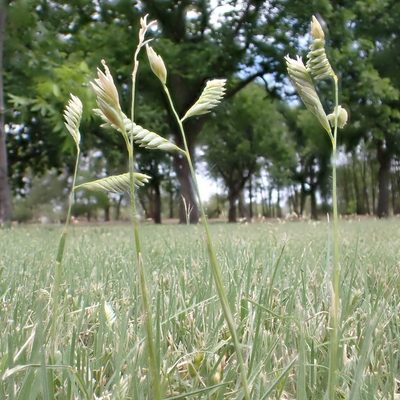 Buffalo GrassBouteloua dactyloides | April into June | 3–20 cm (1–8 in) | Mixed-grass and shortgrass prairies on dry, open sites | Look for a low mat, 3–20 cm tall, joined by runners, with narrow leaves up to about 2 mm wide. Male plants hold short, flag-like branches on slender, upright stems. Female plants have burr-like clusters that sit low, nearly hidden among the leaves. |
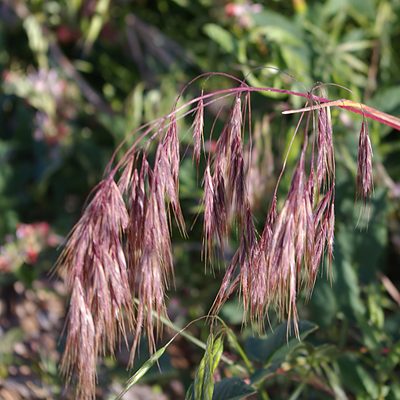 CheatgrassBromus tectorum | Flowers from May into July; the heads turn purple, then straw-colored, as the seed ripens in June and July | 10–60 cm (4–24 in) | Roadsides, overgrazed range, pastures, fields, waste ground and dry, open pine understory | Start with the seed head: a soft, open panicle 5–20 cm (2–8 in) long that droops to one side, each spikelet holding 3 to 8 florets with nearly straight awns about 1–2 cm (½–¾ in) long. It is green at first, turns dull red-purple as the seed ripens, and cures to straw color long before the native grasses mature. The flat, narrow leaf blades and the sheaths are covered in short, soft hairs (the reason for the name downy brome), the ligule is a thin, jagged flap, and there are no ear-like lobes at the collar. The slender stems grow alone or in small tufts 10–60 cm (4–24 in) tall and are finely hairy just below the head. The first purple color is taken as a warning that hazardous fire conditions will follow within about two weeks, and dry stands stay highly flammable from late spring into fall. Japanese brome, another weedy annual brome, has awns under 10 mm, mostly hairless glumes and lemmas, and 7 to 15 florets per spikelet. Smooth brome is a perennial that spreads by rhizomes and is mostly hairless, while most other bromes have hairy sheaths and nodes; its lemmas are awnless or short-awned, and its panicle stands erect at flowering and only nods later. |
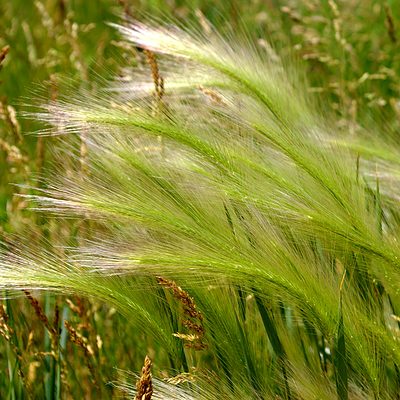 Foxtail BarleyHordeum jubatum | June into August | 20–80 cm (8–30 in) | Roadsides, ditches, pastures and waste ground, often in salty soil | Look for a single dense, nodding spike 2–4 inches long at the stem tip, with long, rough awns up to 3½ inches long that spread as it matures and give the dry head a bottle-brush look. Stems are smooth and grow in loose to dense clumps. |
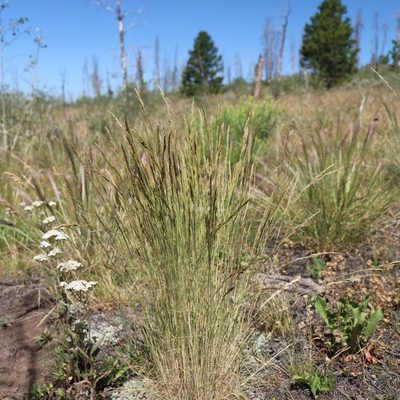 Idaho FescueFestuca idahoensis | June into July; Black Hills herbarium specimens are in flower and seed from late June to mid-July | 25–100 cm (10–40 in) | Grassland on slopes, ridges and summits, and ponderosa pine forest with openings | Start with the seed head: a narrow, loosely open cluster 7–15 cm (3–6 in) long with one or two branches at each joint, which spread a little as the seed ripens. Each spikelet (the small scaly unit along the branches) is 8–14 mm long and holds 4 to 7 flowers, and each flower scale ends in a straight awn (a bristle) 2–6 mm long, usually more than half as long as the scale itself. Then look at the tuft: the leaves are mostly basal, very fine, firm and rolled inward to about 1 mm wide, often with a blue-green or gray-blue cast, and the tuft is dense, 15–25 cm (6–10 in) high and usually more than half the height of the stems, which are smooth and carry few leaves. At the collar, where the blade meets the sheath, the ligule (a small membrane on the inner side) is well under 2 mm, cut straight across and fringed with hairs, and the ear-like lobes some grasses have there are small or missing. The plant has no rhizomes (underground runners), so it grows as a tight bunch. |
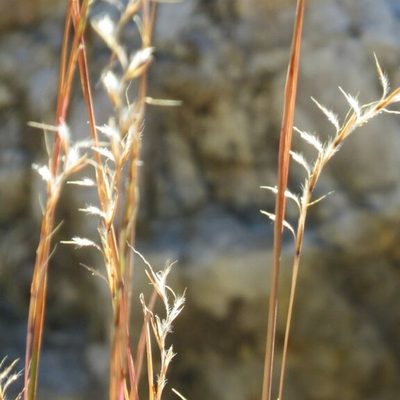 Little BluestemSchizachyrium scoparium | Flowers in August and September; the fluffy white seed tufts follow, and the reddish stalks stand through winter | 30–100 cm (12–40 in) | Dry, open ground: open ponderosa pine on south-facing slopes, grassy ridgetops, dry hills and prairie, sandy and shallow soils | Start with the seed head: each stem and branch ends in a single narrow spike 2.5–7.5 cm (1–3 in) long, and as the seed ripens, fine white hairs on the spikelet stalks spread out, so the spike looks fuzzy and feathery and often arches. Each fertile spikelet carries a bent, twisted awn (a bristle) 9–16 mm (about half an inch) long. Then look at the base of the plant: the lower stems and leaf sheaths are flattened, hairless and waxy, bluish green to purplish, and the leaves are folded lengthwise, up to 25 cm (10 in) long and under 6 mm (1/4 in) wide, crowded low on the plant. The ligule (the small flap where the leaf blade meets the stem) is a fringed membrane up to 2.5 mm long. On dry ground plants grow as distinct clumps 10–25 cm (4–10 in) across. In fall the whole clump turns red to bronze, and SDSU Extension notes that a hillside that looks red is usually full of it. Big Bluestem, the other bluestem on this site, is taller, its seed head is split into 3 to 6 fingers, and SDSU Extension and Johnson and Larson note that its leaf sheaths are only slightly flattened and usually hairy, while Little Bluestem's are flatter and hairless. |
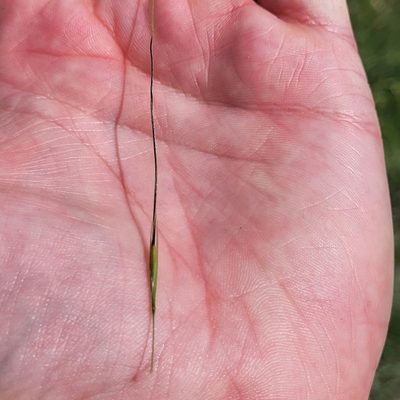 Needle-and-threadHesperostipa comata | Flowers in June; the long twisted awns show in June and July, and the seeds drop in July | 30–100 cm (12–40 in) | Dry prairie, foothill grassland and open ponderosa pine on sandy, gravelly and silty ground | Look at the seed head in June: a narrow, loose cluster whose lower part stays wrapped in the top leaf sheath, with each spikelet holding one seed tipped by an awn (a long bristle) 10–20 cm (4–8 in) long that is tightly twisted near its base and loosely coiled or kinked toward the end, so it looks like a needle trailing a thread. The seed itself is narrow, about 8 mm (5/16 in) long, with a sharp, hairy point at the base; when it falls, the awn twists and untwists with changes in humidity and screws the seed into the ground, and the awns curl as they dry. The leaves are dull green, 20–30 cm (8–12 in) long and narrow, flat or rolled, rough on the upper side, with the tips often dying back, and the plant grows as a dense tuft. Without a seed head, look at the ligule, the pale membrane at the base of the leaf blade, which the USDA plant guide calls an identifying mark: it is tall, 3–6 mm, and split or frayed unevenly, which SDSU Extension describes as the slot you would thread a needle through. Porcupine Grass is the close relative that Johnson and Larson and SDSU Extension compare with it. Porcupine Grass can be taller, its seed heads stand fully out of the sheath and lean under the weight of the heavy spikelets, and its glumes (the papery scales of the spikelet) are 3–4 cm (1¼–1⅝ in) long, against 1.3–2.2 cm (½–⅞ in) on Needle-and-thread. Its seeds taper gradually into longer awns, where Needle-and-thread's have a shoulder at the base of the awn, and its ligule is cut evenly rather than split. |
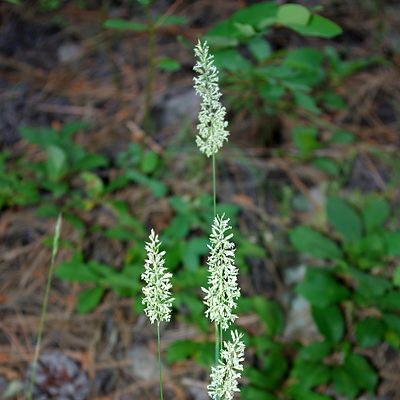 Prairie JunegrassKoeleria macrantha | May into July; the seed ripens in July and August | 15–60 cm (6–24 in) | Dry prairie, open rocky and grassy slopes, rock outcrops and open ponderosa pine woods | Start with the seed head: one narrow, tightly packed head 2.5–17 cm (1–7 in) long on each stem, pale green to purplish and shiny, that looks like a spike. At flowering its short branches spread a little and long yellow anthers hang from the sides; as it ripens it closes up again into a slender, light tan spike. The spikelets are 5–6 mm long, usually with 2 florets and almost never with awns (bristles), their glumes are sharp and shiny, and the stem just below the head is finely hairy. Then check the leaf collar, where the blade leaves the stem: the ligule, the small pale flap there, is very short, 2 mm or less, with a ragged top, and the sheath is open and usually covered in short hairs. The narrow leaves, 1–4 mm wide, flat or rolled, sit mostly in a small tuft at the base. The USDA plant guide says it is often mistaken for Muttongrass (Poa fendleriana), and tells them apart by Junegrass's hairy seed head and smaller spikelets. Minnesota Wildflowers separates it from the wedgegrasses (Sphenopholis), which grow taller in moister ground and have smooth glumes that fall with the rest of the spikelet, while on Junegrass the glumes stay on the stem. |
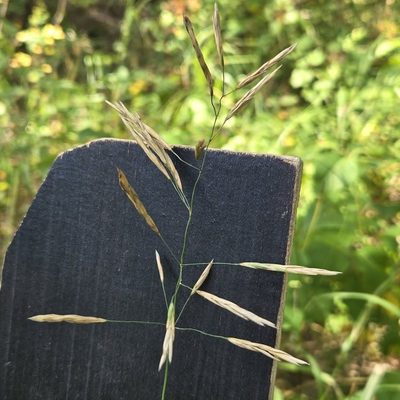 Smooth BromeBromus inermis | June and July; the seed heads ripen purplish brown from July | 40–130 cm (16–51 in) | Roadsides, ditches, hayfields, pastures, meadows and the edges of woods; invades native grassland | Start with the seed head: an erect, open cluster 10–20 cm (4–8 in) long with slender branches, the lowest in a whorl, each carrying narrow, slightly flattened spikelets 1.5–3 cm (about 1 in) long made of 6 to 13 florets. The florets are awnless or have only a tiny bristle under 3 mm, while most other bromes have awned florets. The Montana Field Guide says the awnless florets set it apart from the native subspecies, Pumpelly's brome, and its stiff, ascending seed-head branches from similar native bromes. The heads are green at flowering and ripen purplish brown. Then check a leaf: the blades are flat, smooth and often shiny, 10–35 cm (4–14 in) long and 5–15 mm (1/4–1/2 in) wide, and many carry a crimp or wrinkle shaped like a W or M partway up the blade, about halfway up in Minnesota's and Montana's descriptions and two thirds of the way up in SDSU's. SDSU Extension calls it a key mark and Kansas Wildflowers says it readily sets this grass apart, though Johnson and Larson note that other bromes and reed canarygrass share it. The leaf sheath is closed into a tube, open only near the top, and the ligule (the flap where blade meets stem) is a short, jagged membrane up to 3 mm long with no fringe of hairs. The stems are hairless, and the plant spreads by creeping rhizomes (underground stems) into dense, leafy colonies rather than clumps. |
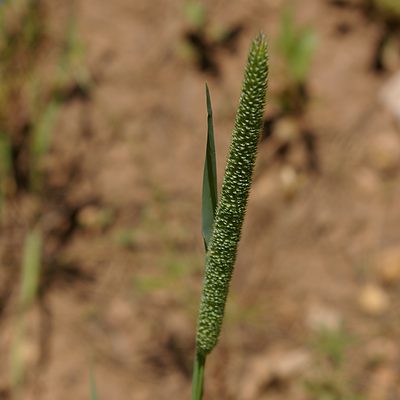 TimothyPhleum pratense | June into August; the seed drops in August | 30–100 cm (12–40 in) | Meadows, roadsides, ditches and streambanks, aspen groves and open pine woods | Start with the seed head: a single slender, dense cylinder 5–15 cm (2–6 in) long and only about 6 mm (¼ in) thick at the top of each stem, green and evenly bristly. Each tiny spikelet holds one flower, and its two equal husks (glumes) have long hairs along the keel and end in a short, stiff point, which gives the head its bristly feel; the floret inside has no awn. In flower, anthers hang all over the head. Then check the leaf collar: the ligule is a white, ragged flap 2–5 mm long, and the sheath is open, smooth and hairless. The leaves are flat and hairless, up to about 8 mm (1/3 in) wide, and the base of each stem swells into a small bulb, a mark the USDA plant guide uses to identify young plants. The USDA guide separates it from Alpine Timothy, which has much shorter seed heads and is a shorter plant, and from Meadow Foxtail and Creeping Foxtail, whose short, twisted awns make the head look fuzzy; ripe Creeping Foxtail heads turn dark to nearly black, while ripe Timothy heads are tan to buff. |
Other look-alike groups: 38 groups
- Anemones (4)
- Asters (4)
- Beardtongues (5)
- Buttercups (3)
- Cacti (4)
- Cinquefoils (7)
- Clovers (6)
- Coneflowers (4)
- Currants and gooseberries (5)
- Daisies (5)
- Dandelions (3)
- Docks and buckwheats (4)
- Evening primroses (4)
- Ferns (4)
- Gentians (4)
- Groundsels and ragworts (3)
- Lilies (5)
- Mayflowers and false Solomon's seals (3)
- Milkvetches and locoweeds (12)
- Milkweeds (6)
- Mints (8)
- Mustards (11)
- Orchids (8)
- Paintbrushes (3)
- Pines (3)
- Raspberries and thimbleberries (3)
- Sagebrushes and sageworts (3)
- Sedges (3)
- Speedwells and kittentails (3)
- Sunflowers (4)
- Thistles (6)
- Vervains (3)
- Vetches (4)
- Violets (7)
- Wild lettuces (3)
- Wild onions (3)
- Wild plums and cherries (3)
- Willows (3)