Vervains of the Black Hills
All 3 vervains in this guide, side by side, A to Z. Compare the photos, bloom time, height and where each grows, then open the one that fits for more photos and the full ID notes. Each plant's page lists its sources.
| Plant | Color | Blooms | Height | Where | How to tell it apart |
|---|---|---|---|---|---|
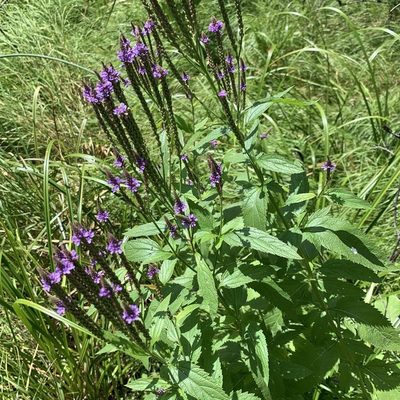 Blue VervainVerbena hastata | Blue, Purple | June into September, in the Hills mostly July and August | 50–250 cm (20–98 in) | Wet ground in full sun: creek banks, lake shores, marshes, wet meadows, ditches and springs | Look for many thin, stiff, pencil-like spikes 5–15 cm (2–6 in) long branching from the top of the plant like a candelabra, each with a ring of open flowers that moves up the spike, with fruit forming below it. The flowers are tiny, about 6 mm (¼ in) across, blue to violet, rarely pink or white, with 5 lobes on a short tube. The stem is square, green to reddish, rough-hairy and usually branched above, and the leaves are opposite, on short stalks, lance-shaped and coarsely toothed, 4–18 cm (1½–7 in) long, rough on top and hairy beneath, some with two lobes at the base. It can be mistaken for Hoary Vervain, which has larger flowers and stalkless, broadly egg-shaped leaves, is densely hairy and prefers drier ground; Blue Vervain's leaves have short but distinct stalks, and it grows in wet places. |
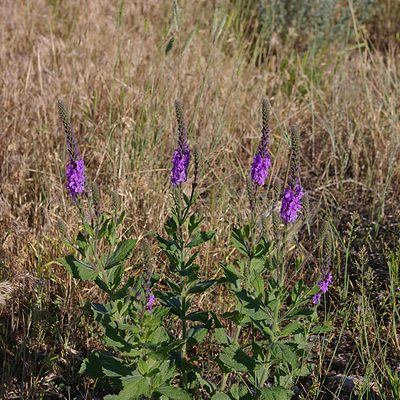 Hoary VervainVerbena stricta | Purple | June into September, peaking in July and August | 20–120 cm (8–47 in) | Dry, open prairie, pastures, roadsides, meadows and other disturbed ground | Look for stiff, narrow, pencil-like spikes up to about 30 cm (12 in) long with small purple to blue-violet flowers, about 8–9 mm (⅓ in) across, that open from the bottom of the spike up, so buds sit above the open flowers and fruit forms below. The leaves are opposite, stalkless or nearly so, oval to almost round, coarsely toothed and densely hairy, with prominent veins underneath and a wrinkled upper side. Blue Vervain grows in wet places and has smaller flowers and narrow, lance-shaped, short-stalked leaves. Bracted Vervain is a low, sprawling mat with tiny flowers set among narrow, leaf-like bracts. |
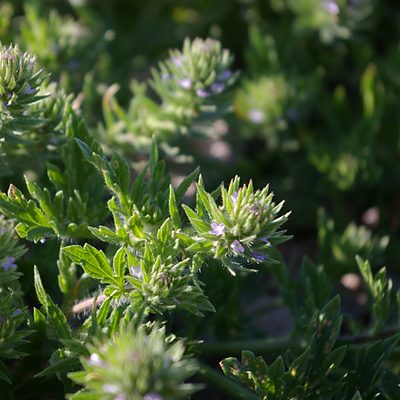 Prostrate VervainVerbena bracteata | Purple, Green & Brown | June into September | Stems 10–64 cm (4–25 in) long, lying flat | Roadsides, pastures, lawns and other dry, disturbed ground, gravelly or rocky soil and open pine woods | Look for a low, round mat of hairy, roughly square stems spreading from a taproot. The opposite leaves are 1–7 cm (½–2¾ in) long, and the lower ones are cut into 3 lobes: a large, toothed, wedge-based middle lobe and 2 much smaller, narrow side lobes; the upper leaves are a little smaller and have no side lobes. Each stem ends in a thick spike, 2.5–20 cm (1–8 in) long, crowded with narrow, white-hairy bracts (leafy scales) 8–15 mm (⅓–⅗ in) long, 2 to 3 times the length of the flower's calyx. The flowers are only about 3 mm (⅛ in) across, light blue to lavender with a whitish throat and 5 rounded lobes, and most of each flower hides among the bracts. Illinois Wildflowers notes that the flat habit and the thick, bract-filled spikes set it apart from other vervains, which mostly stand upright. |
Other look-alike groups: 38 groups
- Anemones (4)
- Asters (4)
- Beardtongues (5)
- Buttercups (3)
- Cacti (4)
- Cinquefoils (7)
- Clovers (6)
- Coneflowers (4)
- Currants and gooseberries (5)
- Daisies (5)
- Dandelions (3)
- Docks and buckwheats (4)
- Evening primroses (4)
- Ferns (4)
- Gentians (4)
- Grasses (11)
- Groundsels and ragworts (3)
- Lilies (5)
- Mayflowers and false Solomon's seals (3)
- Milkvetches and locoweeds (12)
- Milkweeds (6)
- Mints (8)
- Mustards (11)
- Orchids (8)
- Paintbrushes (3)
- Pines (3)
- Raspberries and thimbleberries (3)
- Sagebrushes and sageworts (3)
- Sedges (3)
- Speedwells and kittentails (3)
- Sunflowers (4)
- Thistles (6)
- Vetches (4)
- Violets (7)
- Wild lettuces (3)
- Wild onions (3)
- Wild plums and cherries (3)
- Willows (3)